
Northview High Observes Black History Month (Photos)
February 23, 2012

Northview High School marked Black History Month Wednesday with a program “Black Light: Embracing Diversity & Celebrating Contributions.”
 Guest speaker Eugene Franklin, founder and CEO of the Florida Black Chamber of Commerce, stressed the importance of education to the students, along with cultural understanding.
For a photo gallery from the event, click here.
Born into segregation, Franklin (pictured left) said he had no hope of becoming anything in life that would make a difference, despite his dream to do something important like the great men of modern history.
But the draft and the U.S. Navy changed Franklin’s outlook on life and he learned to appreciate diverse cultures. “It was the greatest thing that ever happened to me,” he said. “I gained a new vision of how the world works.”
“I knew then that one day America would live up to its creed that all people are created equal.”
“We need to learn to appreciate our differences and base our judgments on culture,” he said, “and not look at race.”
“History is being made today by each and every one of you,” Franklin told the Northview students. “Do everything you can to make a difference in someone else’s life.”
Also during the program, Cultural Diversity essay award winners were announced:
- 9th grade: Samantha Sharpless, first place;Tony Puente, honorable mention
- 10th grade: Talana Heathcock, first place; Katelynne Calloway, honorable mention
- 12th grade: Jamila Codrington, first place
For a photo gallery from the event, click here.
Pictured top: Briana Harris performs during a Black History Month program Wednesday at Northview High School. Pictured inset: Guest speaker Eugene Franklin. Pictured below: Students perform during the event. NorthEscambia.com photos, click to enlarge.

Ernest Ward Celebrates FFA Week With Breakfast (Photos)
February 23, 2012
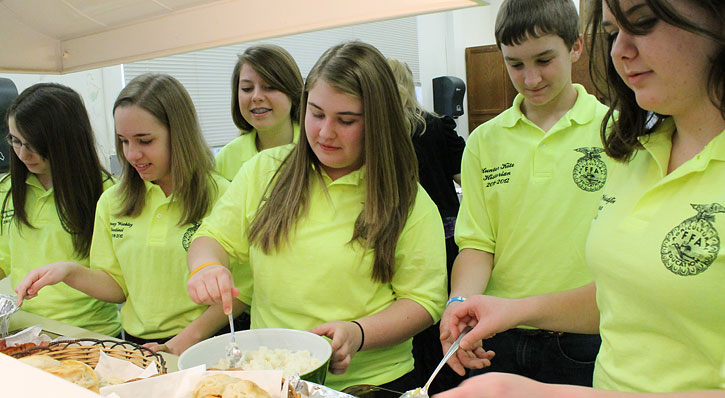
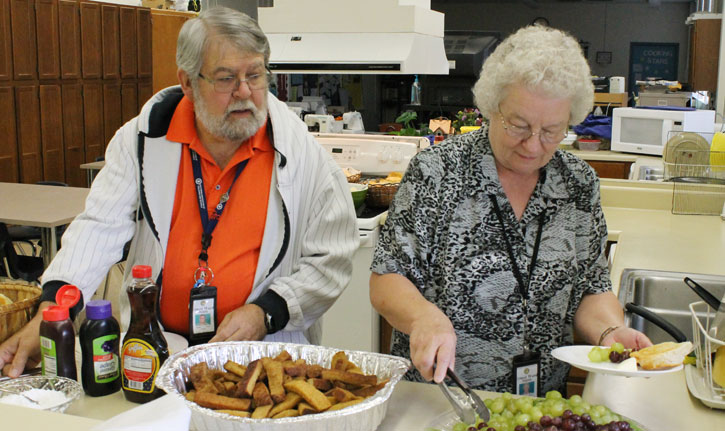
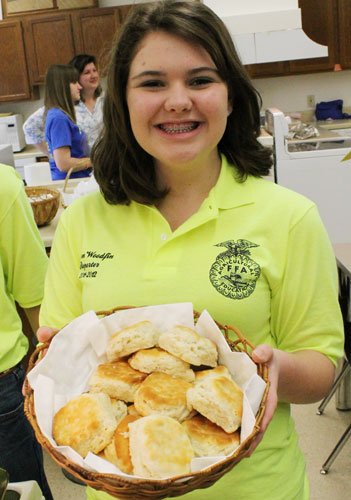 FFA students at Ernest Ward Middle School did their part to celebrate National FFA Week with a Wednesday morning breakfast for faculty and staff.
Students cooked a breakfast of eggs, grits, biscuits, bacon, sausage and more for the EWMS faculty and staff.
Pictured: FFA students at Ernest Ward Middle School provide breakfast for the school’s faculty and staff Wednesday morning. NorthEscambia.com photos, click to enlarge.
Laura Jackson Is Jim Allen’s Teacher Of Year; 5 County Finalists Named
February 23, 2012

Laura Jackson was named the Jim Allen Elementary School Teacher of the Year. Jackson, who teaches the fifth grade at Jim Allen, was also chosen as one of the Top 10 teachers in Escambia County.
Teachers of the year are chosen by the faculty and staff at each school in the county. The Escambia County Teacher of the Year will be announced at the annual Golden Apple Awards Dinner tonight in Pensacola.
The five finalists for Escambia County Teacher of the Year are: Fran Cook, Helen Caro Elementary; Marjorie Stradley, West Florida High School; Jeffrey Pribble, Escambia High School;
Terri Perniam N.B. Cook Elementary School; and Catherine Rudd, Scenic Heights Elementary.
Two Women Charged In 2011 Home Invasion
February 23, 2012
 Two Escambia County women are charged in a home invasion that took place in December 2011.
Investigators say Verna Rosa Malia Sealey, 36, and Leandra Yvette Austin, 25, were armed with a shotgun with they forced their way into home near Ensley on the night of December 7. They reportedly ordered the resident to the floor, asking “Where is the money?”.
When the victim denied having any money, Austin allegedly struck him several times with the shotgun. The suspects searched through the home and fled with the victim’s cordless phone. The victim received minor injuries and declined medical attention.
Investigators received a tip that Sealey and Austin were responsible for the home invasion. During the investigation, it was learned that both Austin and Sealey were currently in jail on robbery charges for robbing a Circle K within the city limits. The Pensacola Police Department was able to apprehend them shortly after that robbery.
Investigators said that Sealey and Austin still had the phone that was taken during the home invasion at the time of the Circle K robbery.
Both women were charged with home invasion robbery and aggravated assault with a deadly weapon. They are currently being held in the Escambia County Jail. With additional charges of robbery, intimidation and drug possession, Sealey’s bond is set at $387,700. Austin, who is also charged with robbery, burglary and larceny, is being held without bond due to a probation violation.
Poarch Creeks Receive $1.85 Million Housing Grant
February 23, 2012
The Poarch Band of Creek Indians have been awarded a $1.85 million Indian Housing Block Grant.
The $1,859,361 grant from U.S. Department of Housing and Urban Development is intended to primarily benefit low-income families living on Indian reservations or in other communities. The award to the Poarch Band of Creek Indians was part of $108 million in additional Indian Housing Block Grant (IHBG) allocations to 68 tribes in 19 states announced Tuesday.
“These funds are making a real difference in tribal communities each and every day,” said HUD Secretary Shaun Donovan. “Projects include affordable housing, infrastructure upgrades, community centers and safety programs that every community needs to thrive. These efforts are part of a broader commitment to ensure Native American communities can build their economies in response to their needs and as they see fit.”
Eligible activities for the funds include housing development, assistance to housing developed under the Indian Housing Program, housing services to eligible families and individuals, crime prevention and safety, and model activities that provide creative approaches to solving affordable housing problems.
JV Aggies Fall To West Florida
February 23, 2012
The junior varsity Tate Aggies lost to West Florida High’s Jaguars in Wednesday night baseball action, 7-2.
With the loss, the JV Aggies are 3-1 on the season.
The JV Aggies will be in action again Thursday evening at 4:30 at Washington High School. Varsity action will follow at 7 p.m.
Florida House Unanimously Passes Ban On Synthetic Drugs
February 23, 2012
The House on Wednesday unanimously passed legislation that bans new forms of synthetic drugs that cropped up after lawmakers banned other substances last year.
 The bill was needed, said sponsor Rep. Clay Ingram, R-Pensacola, because as soon as lawmakers ban one substance, chemists alter the chemical make-up of designer drugs to make it not technically illegal.
“These dangerous synthetic drugs pose a serious threat to Floridians,” Representative Ingram said. “Last year the legislature made great strides in the effort to stamp out these chemicals. It is my sincere belief that this bill will complete that objective and punish those who peddle these toxins in our communities.”
The bill adds dozens of chemical variations of synthetic cannabinoids and psychoactive bath salts to the list of Schedule I controlled substances. The bill now goes to the Senate.
“The House of Representatives demonstrated strong leadership by unanimously passing a bill that will protect Floridians from dangerous synthetic drugs,” Attorney General Pam Bondi said. “We will not allow these creative chemists to skirt state law and pose serious harm to our residents.”
Sen. Greg Evers, R-Baker, the sponsor of the Senate companion bill, said, “I commend Representative Ingram for all his hard work on getting this good bill passed, and I am honored to be the Senate sponsor for this much needed legislation. Its passage today brings us one step closer to the protection of our children and young adults from these synthetic drugs.”
Sneak Peek: Century’s New Website Coming Soon
February 23, 2012

A website for the Town of Century will soon be live. Town officials have been given a draft preview of the design that will be finalized, with their approval, in the coming weeks.
Late last year, the town purchased a $11,450 package from Ideawörks in Pensacola that included $4,200 for a “basic website design”, $1,750 for a content management system (CMS) to allow town employees to update the site, and $5,500 for a five-year comprehensive marketing strategy to include “grant identification, development, PR plan, five-year marketing plan and budget”. The marketing plan will be finalized after the website is completed.
The images above and below are from the website preview presented to the town this week. The preview is meant to show the basic layout of the site, with photos and wording to be updated before it goes live on the web.
Pictured: A layout preview of Century’s upcoming website as provided by Ideawörks for NorthEscambia.com, click to enlarge.

Grenade Found In Busy Intersection
February 22, 2012
What appeared to be a rusty grenade was found Wednesday morning lying in a busy Atmore intersection, tying up traffic for about an hour as officials decided their next move.
The grenade was found in the intersection of Highway 31 and Trammell Street, prompting Atmore Police to direct traffic around the area. After consultation with members of Atmore’s National Guard unit, officials determined the object was likely just a practice grenade.
A bomb squad was notified. After a phone consultation with experts, authorities decided it was just a harmless dummy grenade. Atmore Police Chief Jason Dean then picked up the dummy grenade from the intersection, placed it in a box and transported it away.
Officials are still working to determine just how the dummy grenade ended up in the intersection.
Northview Celebrates National FFA Week
February 22, 2012

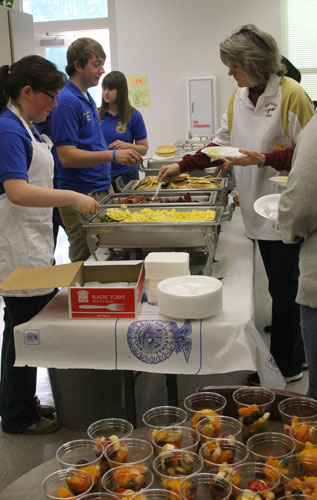 FFA members at Northview High School are celebrating National FFA Week with a variety of events.
Tuesday, the FFA officers and members prepared a homestyle breakfast for teachers, staff and invited guests that support the FFA program. On Monday, students prepared refreshments for bus drivers.
For a photo gallery from the event, click here.
FFA week activites include:
Monday: Bus Driver Refreshment/ FFA T-Shirts
FFA members prepared refreshments for all bus drivers to give to them in the morning as they arrived at school.
Tuesday: Teacher Breakfast
All teachers, staff and invited guests were invited to eat a home cooked breakfast before school started that was prepared by FFA officers and members.
Wednesday: Ag Olympics
All agricultural classes will participate the Ag Olympics program with several events. Members are invited to have a coke float in the Agriculture department during the student’s lunch.
Thursday: Minute To Win It/Ag Style
There will be a workshop put on by the FFA officers/Minute To Win It Ag style.
Friday: Dirty Truck Contest
There will be a Dirty Truck Contest on Friday, along with a game of Don’t Forget the Lyrics in Ag classes.
Saturday: Ruritan Auction
FFA members will assist with the Walnut Hill Ruritan Farm Equipment Auction Saturday as a community service project.
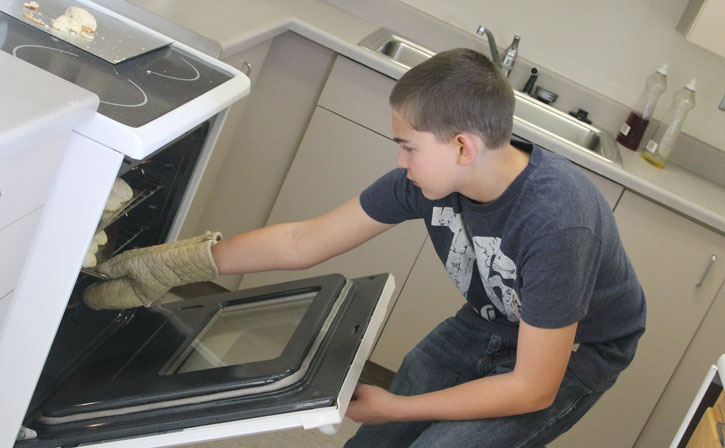
Pictured: FFA members served breakfast Tuesday morning at Northview High School. NorthEscambia.com photos, click to enlarge.