

Ernest Ward Holds Valentine’s Dance, Names Court (With Photo Gallery)
February 11, 2012

Ernest Ward Middle School held its annual Valentine’s Dance Friday night, naming a queen and her court based upon student votes.
Eighth grader Jessica Barrows was named queen, and Gavin Grant was named king. From the seventh grade, McKensie Colvin was named maiden, and Dustin Bethea was named knight. Sixth grade maiden was Raegen Harrell and sixth grade knight was Micheal “MJ” Jones.
For a photo gallery with the complete court, click here.
Pictured top: (L-R) Ernest Ward Middle School Valentine’s Dance sixth grade Maiden Raegen Harrell and Knight Micheal “MJ” Jones, King Gavin Grant, Queen Jessica Barrows, and eighth grade Knight Dustin Bethea and Maiden McKensie Colvin. Pictured below: King Gavin Grant and Queen Jessica Barrows NorthEscambia.com photos, click to enlarge.

Weekend Gardening: Tackle Existing Weeds And Build A Lawn Defense
February 11, 2012
 Just look around and you will probably notice a lot of green lawns. But, its early February, shouldn’t the lawns be brown?
Winter weeds are creating a field of green in many local lawns. Vetch, chickweed, annual bluegrass, henbit and clovers are growing rampantly in many lawns. Unless you do something about these weeds now, your weed problem will only get worse. February is the time to take the offensive against lawn weeds.
Grow a Healthy Lawn
The first and best method of weed control begins with proper management practices that encourage a dense, thriving turf. Healthy turf shades the soil so sunlight can’t reach weed seeds that are ready to germinate. A thick turf also minimizes the physical space available for weeds to become established. Proper mowing, fertilizing and watering will promote a healthy, dense grass.
 Control Existing Weeds
Control existing winter weeds by either hand-pulling or treating with post-emergence herbicides. Be sure to choose herbicides that will control the weeds you have and will be safe to use on the type of lawn grass you grow. It’s best to spot treat the weeds, if possible. Since most people have temporarily stored their lawn mowers, the winter weeds have ample leaf area to absorb the herbicide for effective control.
For help choosing the right product, contact your local Extension Office. They may ask for samples of the weeds to ensure that you have identified them properly.
Prevent Future Weeds
Now is also the time to apply pre-emergence herbicides to prevent annual summer weeds, such as crabgrass, spurges, etc., from infesting the lawn through the spring and summer.
Pre-emergence herbicides must be applied prior to weed seed germination. Applications should be between February 15 and March 5 or when day temperatures reach 65° to 70°F for four to five consecutive days. This generally coincides with the blooming of azaleas and dogwoods.
Pre-emergence herbicides work by creating a chemical barrier in the soil/thatch layer. Therefore, uniform coverage is necessary for optimum control. Large gaps in the herbicide-treated zone can result in weeds popping up.
Pre-emergence herbicides are generally effective in controlling weeds from six to twelve weeks following application. Most will begin to degrade when exposed to the environment. Therefore, to obtain season-long control, an additional application should follow six to nine weeks after the initial one.
 Some pre-emergence herbicides to look for include dithiopyr (Sta-Green Crab-Ex or Vigoro Crabgrass & Weed Preventer) or pendimethalin (Lesco PRE-M or Scotts Halts).
With any pesticide, you should always READ THE LABEL carefully and completely before applying. The herbicide label will provide a list of where it can safely be applied and the weed species the active ingredient will control and at what rate.
What about Fertilizer?
It is still too early to apply a nitrogen-containing fertilizer on our mostly dormant lawns in Northwest Florida. Adding nitrogen now fertilizes your existing weeds. It may also stimulate the grass which makes it more susceptible to winter kill when/if we get our next cold snap. In general, it’s best to apply your herbicides separately from fertilizers.
Wait until April to fertilize your lawn or until you’ve mowed twice because of grass growth. In the meantime, get a soil test done so that you will have a better idea of the type of fertilizer to use.
Theresa Friday is the Residential Horticulture Extension Agent for Santa Rosa County.
Three Arrested After Narcotics Unit Executes Search Warrant
February 10, 2012


Three Century residents — a mother and her two sons — were arrested Thursday night after the Escambia County Sheriff’s Office Narcotics Unit served a drug-related search warrant in Century.
The search warrant was executed about 7:30 p.m. at a mobile home in the 100 block of West Highway 4 near the Century Care Center nursing home. Investigators reported finding powdered cocaine, crack cocaine and marijuana inside the mobile home.
Karen Louise Quinley, 43, was charged with possession of cocaine, possession of drug paraphernalia and destruction of evidence. She was booked into the Escambia County Jail with bond set at $26,000. Cortez Rasheen Davison, 18, was charged with cocaine possession and possession of drug paraphernalia. His bond was set at $10,500. Nakeetric Devonte Davison, 19, was charged with possession of marijuana and possession of drug paraphernalia. His bond was set at $15,500. All three remained behind bars early Friday morning.
 Thursday night was not the first time the Sheriff’s Office Narcotics Unit has targeted alleged drug activity at the trailer. No one was home as officers executed a search warrant at the same mobile home in June 2010, finding a stem of marijuana in a bedroom, crack cocaine on the kitchen table, a razor blade with cocaine residue, a marijuana cigarette and digital scales during their search, according to a Sheriff’s Office report.
Quinley was arrested on multiple charges following the 2010 search, but charges against her were later dropped due to insufficient evidence since she was not at home at the time of the raid.
Pictured above: Thursday night, the Escambia County Sheriff’s Office Narcotics Unit executed a drug-related search warrant at a mobile home in the 100 block of West Highway 4 in Century. NorthEscambia.com photos, click to enlarge.
Highway 29 Sign No Longer Calling Gov. Scott ‘Bad’ Name
February 10, 2012


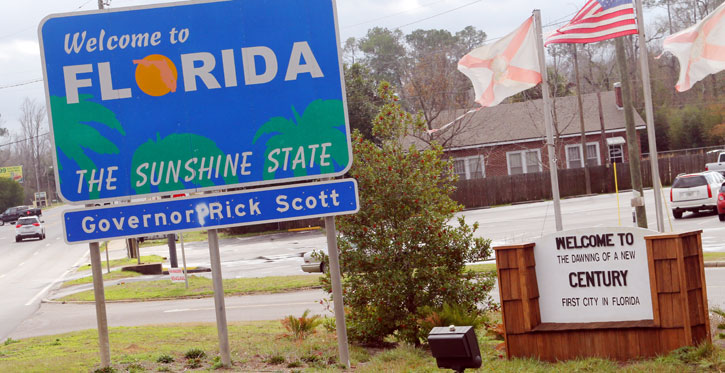
The “Welcome to Florida” sign on Highway 29 has been cleaned up — no longer declaring Florida’s governor to be a “prick”.
In mid-December, a little spray paint from a vandal transformed the official greeting to “Governor PRick Scott”. Despite numerous calls reporting the graffiti to the Florida Department of Transportation, the graffiti remained for over a month and a half.
But shortly after NorthEscambia.com published photos of the sign, the graffiti was removed, and the faded and tattered American and Florida flags nearby were also replaced with new flags.
Pictured top: New flags and a “corrected” Governor Rick Scott Welcome to Florida greeting at the Alabama state line in Century. Pictured inset and below: The sign had referred to Gov. Rick Scott as a “PRick Scott” for over a month and a half prior to these photos being published. NorthEscambia.com photos, click to enlarge.
Cool Pics: In The Moonlight
February 10, 2012

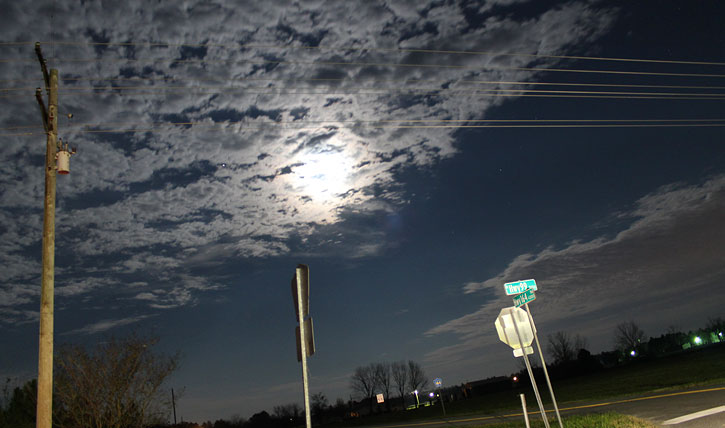
A bright moon lit the skies over North Escambia Thursday night as thin, high clouds streamed by overhead on a cool north wind.
Pictured above is the Walnut Hill water tower next to Ernest Ward Middle School, and pictured below is the intersection of North Highway 99 and Highway 164 near Oak Grove. Both long-exposure photos were taken about 9:30 p.m.
NorthEscambia.com photos, click to enlarge.
County To Give Property To Shooting Range, Allow Longer Hours
February 10, 2012
The Escambia County Commission has voted to give the Escambia River Muzzle Loaders the 30 acres where they operate and allow the group to extend their shooting hours.
The county decided Thursday morning at a Committee of the Whole meeting to give the land to the non-profit ERML group to release the county of any liability associated with the shooting range and avoid an environmental cleanup.
Neighbors of the range on Rocky Branch Road have spoken out in opposition to the range and its practices for years. They claim ERML committed to spend $250,000 to improve the range’s safety and reduce noise. But neighbors said the upgrades have never happened. Neighbors have also claimed that the Muzzle Loaders want to purchase additional property to expand the range — and shoot in the direction of neighboring homes.
Changes approved in spirit by the commission Thursday include:
- The range will be open extended hours from 8 a.m. until 8 p.m. during the April 1 to September 30 period. Previous hours were 8 a.m. until 6:30 p.m.
- A safety officer must be present whenever the shooting range is being used.
- The range will remain closed on Mondays, unless it is a national holiday.
Commissioner Kevin White voted against any changes to the agreement with the Muzzle Loaders, saying that he wanted to keep the agreement the county made in 2009.
The Escambia County Commission must give final approval to the changes at a regular meeting.
The Escambia River Muzzle Loaders is located on Rocky Branch Road, north of Quinette Road near the Escambia River.
Atmore Names Citizen Of The Year, Lifetime Achievement Award Winner
February 10, 2012
About 300 people attended the Atmore Area Chamber of Commerce’s 66th Annual Meeting Thursday night.
Richard Maxwell of Maxwell Construction was named the chamber’s Citizen of the Year for his numerous contributions to the community.
The chamber’s Lifetime Achievement Award was presented posthumously to Mary Joyner Grissett. She was a devoted educator, community leader, and volunteer with a passion for education. After 25 years of teaching with the Escambia County School System, she retired and then taught English and literature for two years at Escambia Academy. Grissett, who passed away in 2011, was a founder of the Academic All-Star Program and named Atmore Citizen of the Year in 1991.
Guest speaker for the event was Alabama Crimson Tide star Siran Stacey. In 2007, Stacy and his family were involved in a traffic accident that claimed the lives of six people — including his wife and four children. Stacy now shares his story and ministers across the nation.
AT&T Grant Funds ‘Harvest For The Hungry’ At Tate High School
February 10, 2012
Thanks to an AT&T “STEM at Work” grant, 350 students at J.M. Tate High School will have the opportunity to learn how what they are studying in the classroom will be used in various occupations.
AT&T Florida provided $120,000 to challenge Florida’s district-wide local education foundations to create STEM workplace experiences throughout the State through a grant to the Consortium of Florida Education Foundations (CFEF). The project’s aim is to provide students with hands-on experiential learning opportunities outside the classroom that are directly linked to their coursework in science, technology, engineering and/or math.
Escambia County Public Schools Foundation has partnered with Tate High School for its project “Harvest for the Hungry.” In addition to the $2,000 provided by AT&T and CFEF, the J.M. Tate FFA Alumni Foundation is providing $2,000 in matching funds.
“Through the AT&T ‘STEM’ at Work’ grant, basic scientific, technology and mathematics skills will be applied to basic agriculture principles. This gives students real-life, hands-on experience. In the next 50 years, we will need more industry leaders than ever before, and agriscience education is providing the next generation of leaders with real-world experience,” said Austin Courson, Agriscience Program assistant and liaison for Tate FFA Alumni Foundation.
“As a student, this will give us hands-on learning that will allow us to advance our knowledge of the industry of agriculture,” says Tate student Megan Gibbs. “At the same time, this will allow us to provide basic needs to community members through our ‘Harvest for the Hungry’ project.”
Students will develop a clear understanding of the principles of soil science and plant nutrition using proper equipment and technology, learn the importance of water quality by taking water samples, and collaborate with a local irrigation supplier and the Natural Resources Conservation Service in evaluating proper irrigation systems designed for water conservation. Students will design and install an irrigation system and grow a vegetable garden; food produced during the project will be sent to a local food bank. The project began in January 2012 and will continue through May 2012.
“We are pleased with this partnership because Florida’s K-12 education foundations are well positioned to be the link between schools and local businesses that can make these critical connections for students,” said Marshall Criser, III, AT&T Florida President. “By concentrating on Science, Technology, Engineering and Math curriculum, this program will provide real life experiences that can help increase the number of Florida’s students graduating high school college- and career-ready.”
Food World Grocery Stores Sold
February 10, 2012

Food World and Bruno’s stores in Florida and Alabama are being sold.
Birmingham-based Southern Family Markets is selling its 57 stores in four states to Belle Foods LLC under an agreement announced Thursday.
Belle Foods LLC, based in Birmingham, was formed by 30-year industry veteran William “Bill” White specifically to purchase the Southern Family Market stores — including the Food World stores in Atmore and Pensacola. White is joined in the venture by his son Jeff.
“We are very excited about this acquisition and look forward with great anticipation to growing this business, being strong partners in the communities we will serve and bringing back the family-owned roots which have always made these stores so special,” White said in a released statement Thursday.
Terms of the deal, which is expected to close in the next couple of months, were not disclosed.
For now, company officials said there were no plans to close any of the stores. Future changes that will be made at the stores, if any, have not been disclosed.
Pictured: The Southern Family Market in Atmore became a Food World Store in May 2010. In this photo, workers make final adjustments to the store sign on opening day. NorthEscambia.com file photo, click to enlarge.
Northview FFA To Present ‘The Springs’ In Concert At Blue Jacket Jamboree
February 10, 2012

The Northview FFA Alumni will present the annual Blue Jacket Jamboree on Saturday, February 18 featuring the CGMA Country Group of the Year “The Springs”.
The Springs have shared the stage with country greats like Alan Jackson, Craig Moran, Toby Keith and Reba McIntire with their high energy brand of Country/Southern Rock.
Nominated along with Steel Magnolia, Sugarland, and Lady Antebellum for the New Music Awards “Country Group of the Year”, The Springs are seen by some as the “next big thing” in country music. The all-male group has also had two Christian country number one songs.
Tickets are $20 per person which includes a pulled pork sandwich meal. The event takes place beginning at 5 p.m. rain or shine on Saturday, February 18 in the Northview High School Auditorium. The event will also include an auction.
Tickets are available now at Smith Tractor Company in Jay and Atmore, Century Pharmacy and Scott’s Pharmacy in Molino. For more information, visit BlueJacketJamboree.com.
The Blue Jacket Jamboree is sponsored in part by NorthEscambia.com, Cat Country, 98.7 and Your Country 102.7 WXBM.
The Northview FFA Alumini uses proceeds from the event for scholarships for eligible seniors and transportation for FFA members to state and national conventions.
Coming up soon on NorthEscambia.com — we’ll introduce you to The Springs and we’ll have tickets to giveaway.