

Pcola Police: 91 Car Burglaries Since May 1; Suspects Arrested
May 23, 2013
There have been 91 car burglaries in the City of Pensacola since May 1, according to Pensacola Police, a three people have been arrested for a few of the burglaries. Most of the vehicles were unlocked.
Treniqua Hollinger, 19, Maurissa Atkins, 20, and Maurice Atkins, 19, were charged with nine vehicle burglaries, one residential burglary and possession of burglary tools. The trio was arrested Wednesday morning and Pensacola Police say there were caught in the act of breaking into a vehicle.
Police are also looking for Tonjas Cornielus Dixon, 20, and Lucas Jenkins, 21, on multiple counts of vehicle burglary, vehicle theft, grand theft, petit theft and credit card fraud.
Pensacola Police Chief Chip W. Simmons said one of the easiest ways to prevent vehicle burglaries is to simply lock vehicle doors.
Anyone knowing the whereabouts of Dixon or Jenkins is asked to call Pensacola Police at (850) 435-1900 or Crime Stoppers at (850) 433-STOP.
Atmore Rotary Scholarship Fund Raiser ‘Old Time Fiddler’s Convention’ Canceled
May 23, 2013

The Atmore Rotary Club announced Wednesday that the annual Old Time Fiddler’s Convention — a primary fund raiser for the group’s Academic All Stars Program — will not be held in 2013. This year would have been the 33rd annual event.
Organizers said the Academic All-Stars program will continue and will not be impacted by the decision.
The Rotary Club decided to not hold the event this year in order to explore ways to update and improve this event with the goal of increasing event attendance numbers, organizers said.
 “This long running event is held close to our hearts as Rotarians, but as with all things, it is good business practice to review event processes and effectiveness, said Atmore Rotary Club President Jennifer Chism. “We want to be proactive and ensure this event can continue to be successful both in terms of exposure and profitability.”
The Old Time Fiddler’s Convention was a primary fund raiser for the Atmore Rotary Club’s Academic All Star Program, which rewards academically successful high school students with recognition of their scholastic achievements through scholarship awards. This year the Rotary Club awarded scholarships to 130 students from Atmore Christian School, Escambia Academy, Escambia County High School and Northview High School.
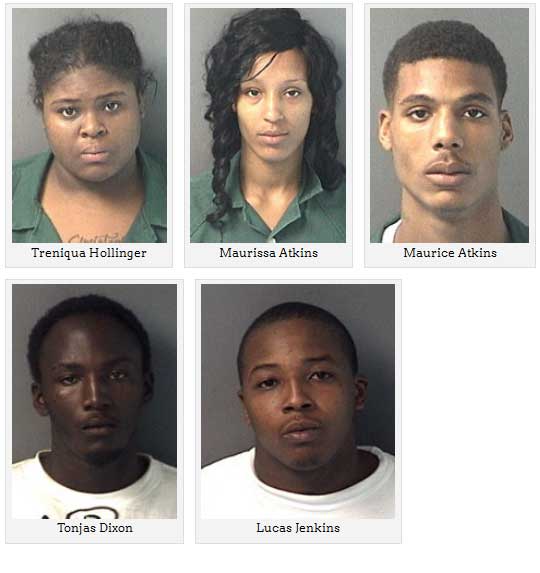
Pictured top: 2013 Academic All Star scholarship winners from four area high schools at a May 9 program. Pictured inset: Atmore Rotary Club President Jennifer Chism. Pictured below: Randolph B. Luttrell, Sr.Scholarship Winner La’Derious Ty’Shon Franklin of Northview High School. NorthEscambia.com file photos, click to enlarge.
Molino Man Gets 15 Years For Driving Into Ex-Girlfriend’s Home
May 22, 2013
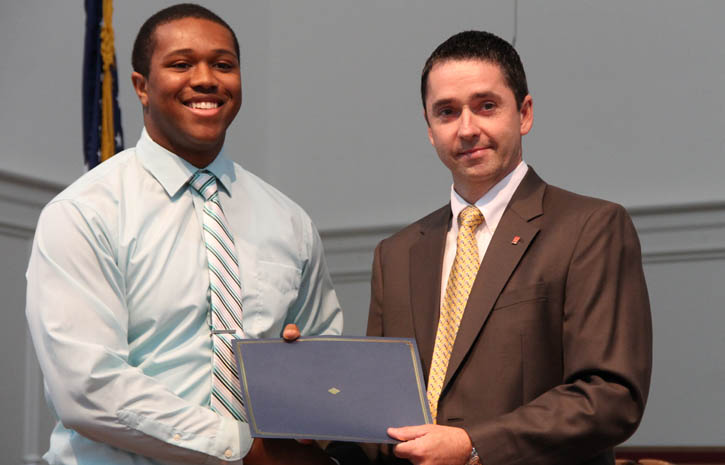
A Molino man that was shot multiple times after driving his vehicle into a house in Cantonment last summer is headed to prison.
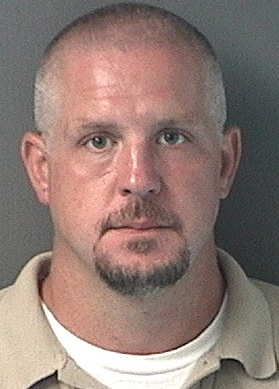 John Alex Godwin, age 35 of Molino Road, was found guilty of burglary and two counts of aggravated assault with a deadly weapon. He was sentenced by Judge Terry Terrell to 15 years in state prison as a habitual offender, to be followed by five years probation.
During the predawn hours of July 13, 2012, the Escambia County Sheriff’s Office said Godwin crashed his car into the home of 25-year old Heather McKamey of Cantonment. The car literally pushed in the front door, door frame and surrounding bricks.
Godwin was then shot by 25-year old Andrew Lundy of Cantonment. Lundy was not charged. Godwin suffered multiple gunshot woulds and was airlifted to Sacred Heart Hospital in Pensacola.
According to the Sheriff’s Office, Godwin was McKamey’s ex-boyfriend. She had unsuccessfully tried to get a restraining order against him in Escambia County back in June 2012 after a domestic violence incident between the pair in Mississippi.
According to a Gulfport Police Department incident report, Godwin was dating McKamey when he allegedly assaulted her on I-10 in Mississippi at the 33 mile marker by grabbing her hair and throwing her to the ground. She suffered minor lacerations to her hand during the incident, according to the report.
Northview Thanks Poarch Creek Indians, Students Win Bikes
May 22, 2013
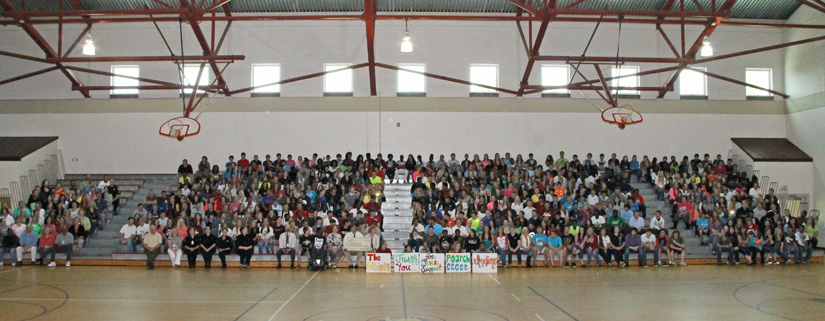
Northview High School took a moment to stop and say “thanks” Tuesday to the Poarch Band of Creek Indians for their ongoing support of the school, and employees from Century Correctional Institution gave away a few bicycles just to add to the excitement of the event.
 During this school year, notable contributions from the Poarch Creeks to Northview, including items in a $56,594.66 grant, were use of their buses, minor sports uniforms and equipment, laptops, projection mounts, contributions to different groups for expenses to attend the Class 1A State Championship football game in Orlando, and two “workhorse” copiers. Visitors to the school will see the PBCI logo affixed to the copiers and technology items.
“On behalf of the entire Northview Chiefs’ family, I would like to thank the Poarch Band of Creek Indians who have been overwhelmingly supportive,” NHS Principal Gayle Weaver said Tuesday. “All of us are most appreciative. Their contributions and support enabled the students to have an enhanced quality education.”
During Tuesday’s Poarch Creek appreciation event at Northview, five students received new bicycles courtesy of Century Correctional Institution. The winning students were chosen from those nominated as “most improved” in particular areas, including behavior, grades, attendance and class participation.
Winners were seniors Zach Bradley and Demontra Mitchell, junior Matt Cayson, sophomore Jessica Brewton and freshman David Godwin.
Pictured top and inset: Northview students and faculty showed their appreciation to the Poarch Creek Indians on Tuesday. Pictured below: Bicycles were award to Jessica Brewton, David Godwin, Matt Cayson, Zach Bradley, Demontra Mitchell. Pictured bottom (courtesy photo): The bicycles for “most improved” students were donated by Century Correctional Institution employees and delivered by Lt. Matthew Jackson, Sgt. Dale Henderson and Warden John Whitehurst. NorthEscambia.com photos, click to enlarge.


Century To Hold Special Meeting About ‘Personnel Problem’
May 22, 2013
The Town of Century will hold a special meeting to review a “personnel problem”, according to public notice released Tuesday.
The notice does not specify the nature of the employment issue.
The meeting will be held Thursday, May 23 at 3 p.m. in the council chambers at the Century Town Hall, 7995 North Century Boulevard.
On The Hill: Molino Teen Serves As House Page
May 22, 2013
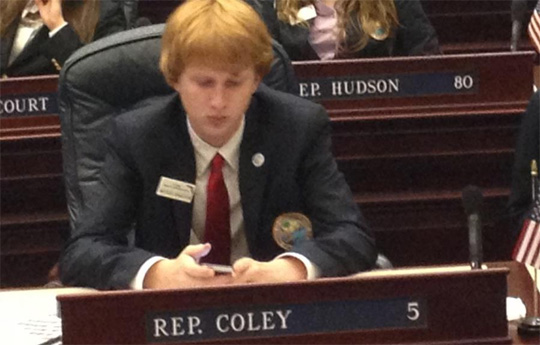
A young man from Molino recently spent a week serving as a page in the Florida House of Representatives. Mitchell Singleton, an eighth grader at Ernest Ward Middle School, served as a page for Rep. Clay Ingram.
 “My experience working as a page for the Florida House of Representatives gave me a perspective of government that most people don’t get to see. I was able to be in the chamber and work with the representatives first hand,” Mitchell said.
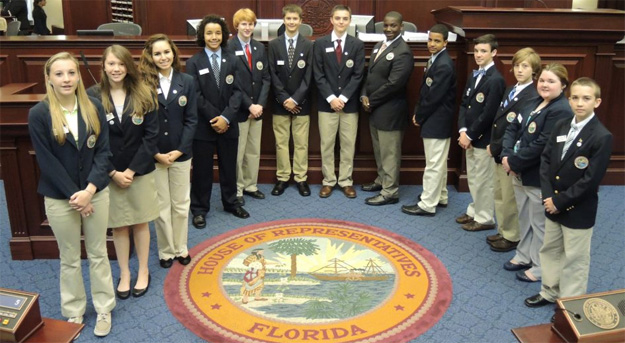
Pages and messengers are students who work one week at the Capitol during the 60-day Regular Session. Each of Florida’s 120 representatives may sponsor one page (ages 12-14) and one messenger (ages 15-18).
Being selected to serve is considered an honor and privilege. Pages and messengers assist the representatives and their staff during the Capitol’s busiest time of year while observing state government in action.
The page and messenger program is a long-standing tradition in the Florida House, with journals making mention of them as far back as 1865. Singleton and each page and messenger will have their name appear in the official Journal of the House as an official record of their time spent serving in state government.
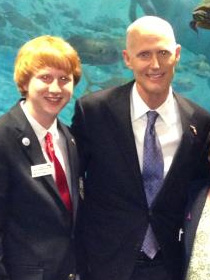
Pictured top: Mitchell Singleton, serving as page in the Florida House of Representatives, in the desk of Speaker pro tempore Marti Coley during a mock session. Pictured inset: Singleton with Gov. Rick Scott. Pictured below: Singleton (just left of center) with his House page group. Submitted photos for NorthEscambia.com, click to enlarge.
ESCO SWAT Competes
May 22, 2013

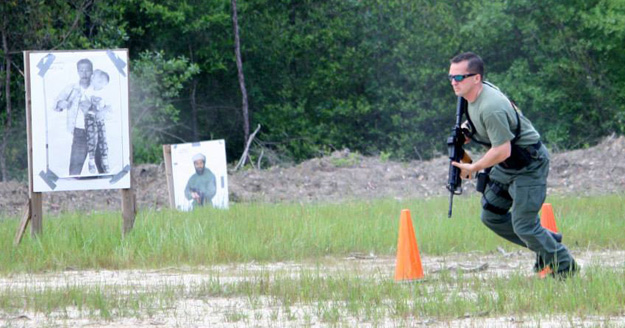
The Escambia County Sheriff’s Office recently competed in the Deputy Tony Forgione Memorial SWAT Competition at Northwest Florida State College.
 The competition included team pistol and rifle shooting, hostage rescue, combat running, and building entries. ECSO teams placed second and third overall in the competition.
The event honors former Okaloosa County Sheriff’s deputy and Special Response Team member Tony Forgione who was shot and killed July 22, 2008.
Other agencies competing included the Okaloosa County Sheriff’s Office , Walton County Sheriff’s Office, Santa Rosa County Sheriff’s Office, Bay County Sheriff’s Office, Fort Walton Beach Police Department, Crestview Police Department, and Eglin Air Force Base Special Response Team
Pictured: The Escambia County Sheriff’s Office in SWAT competition at Northwest Florida State College. Courtesy photos for NorthEscambia.com, click to enlarge.
Scott Signs Elections Bill
May 22, 2013
.Gov. Rick Scott’s office confirmed Tuesday that he quietly signed a bill Monday aimed at cleaning up the voting problems that plagued parts of the state during the November elections.
Scott apparently signed the legislation (HB 7013) before heading to Chile for a trade mission. But the governor’s office didn’t announce the signing until Tuesday afternoon.
“There were inefficiencies in the 2012 general election — and our system needed to be corrected,” Scott said in a statement issued by his office. “I asked the Legislature to enhance our system of elections and they met the challenge. This law will add more early voting locations, add more early voting days and shorten the length of our ballot.”
 Elections reform vaulted to the top of legislative priorities after the November problems, which included some Florida voters not casting ballots until after television networks had projected President Barack Obama the winner nationwide. It also took days before Obama was declared the winner in Florida.
The bill would allow up to 14 days for early voting, though local supervisors could remain at the current eight days, and allows for more flexibility with early voting sites. It would limit the length of some ballot summaries for constitutional amendments.
And it would dissolve a committee that sets the date of the presidential primary and instead require that vote be held on the first Tuesday that complies with party rules. Both Republican and Democratic delegations to national conventions lost members over the last several years as Florida vied for earlier primary dates.
Democrats had consistently pushed for more far-reaching changes, arguing that the bill was essentially a series of tweaks and didn’t fix all the problems that they blamed on a 2011 law that restricted early voting and included a slew of other changes to Florida elections.
But most good-government groups applauded this year’s bill for the changes it made, and it nonetheless passed the House twice with all Democrats supporting it.
“Sometimes it felt like climbing a mountain with concrete boots, but with the governor’s signature on this election reform package, Florida has achieved what many of us thought at one time might be impossible: a huge improvement to our democratic process and a giant step forward for Florida voters,” said Deirdre Macnab, president of the League of Women Voters of Florida.
Except for a provision making sure the state’s gift ban for committees of continuous existence doesn’t lapse, which kicks in immediately, the bill takes effect Jan. 1.
by Brandon Larrabee, The News Service of Florida
Hadley, Baggett Awarded Gandy Memorial Scholarships
May 22, 2013
The Gandy Memorial Scholarship, established by the Gandy Family at Poplar Dell Baptist Church in Byrneville, recently honored two local seniors with $500 scholarships. Both students were selected based on their involvement in church and community activities and grade point averages. The Gandy Memorial Scholarship was established several years ago in memory of J.L. Gandy, Louise Gandy, Solon Gandy and Elmira Gandy Crapps who were longtime and active members of Poplar Dell.
 Haley Hadley, a graduating a senior at Flomaton High School, is the daughter of Eric and Teresa Gohagen. She has been a member of various clubs, including Future Business Leaders of America, BETA and FFA. She has been a member of the Flomaton High School marching band for six years and has also participated in Chamber Ensemble Band and Jazz Band for three years. She has been a part of District Honor Band, All State Honor Band and SEUS Honor Band. After graduation, she plans to attend the University of South Alabama where she will study pharmacy.
Northview senior, Corry Baggett, is the son of Garry and Vicki Baggett of Bratt. Corry is involved in FFA, Rho Kappa Historical Society and Fellowship of Christian Athletes. He was a starting linebacker for the Northview Chiefs Class 1 A State Football Champions, a former regional weightlifting qualifier, Pensacola Sports Association’s Scholar Athlete for weightlifting, a MIRA Award recipient for woodworking, a Boys State representative, and is a dual enrollment student with Pensacola State College and Tallahassee Community College. Corry plans on attending Pensacola State College this fall and then transferring to the University of West Florida or Troy State, where he will complete his business degree.
Submitted photo for NorthEscambia.com, click to enlarge.
Northview Baseball Tryouts Friday
May 22, 2013
Northview Chiefs baseball will hold tryouts for the summer team on Friday at 6 p.m. at the school’s baseball field. Tryouts are for all incoming ninth graders and rising 10th, 11th and 12th graders. For more information, call the school at (850) 327-6681.