

Ernest Ward Names May Students Of The Month
June 3, 2013

Ernest Ward Middle School has named Students of the Month for May. They are (L-R) Lari McCann, seventh grade; Austin Smith, sixth grade; and Kayleigh Linam, eighth grade. Submitted photo for NorthEscambia.com, click to enlarge.
Seed To Plate: Learn More About Your Home Garden
June 3, 2013

The Escambia County Extension Service will host “Seed to Plate – Healthy and Productive Home Gardents” on Thursday, June 6.
The program is for those that have a home garden but want to learn how to get more out of it. Participants will learn the basics of safe garden production and tips for home food preservation. Appropriate shoes for a garden tour should be worn.
The program will take place at the Escambia County Extension office on Stephani Road at 6 p.m. Cost is $5. Register by calling Fran Lainhart at (850) 475-5230 or emailing lainhaf@ufl.edu.
Gaetz: Nobody Knows Who Tally Politicians Are
June 3, 2013
Planning to continue touring Florida with the House speaker, Senate President Don Gaetz, R-Niceville, said that most Florida residents have a disconnect with state government.
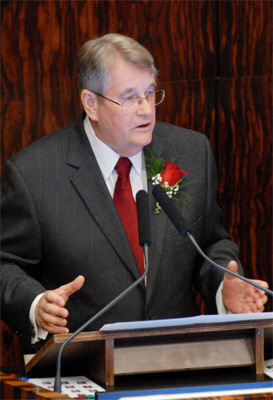 “The first thing that Tallahassee politicians probably need to reflect upon is that nobody knows who they are, nobody knows why they think they are so important,” Gaetz (pictured) said during an interview on The Florida Channel’s “Florida Face to Face” show.
“Only in Tallahassee, inside the echo chamber here where people talk to each other and think they’re hearing the voice of God, are politicians that important. When you’re in a classroom, when you’re in a children’s advocacy center, when you’re in a National Guard armory, then you find out who’s really important.”
Gaetz and Speaker Will Weatherford, R-Wesley Chapel, spent two days last week making appearances in Brooksville, Tampa, Orlando, Lakeland and Lake Wales to discuss the recent legislative session. Gaetz said he and Weatherford plan to go to every region of the state during the summer.
“It’s just two guys who get along with each other pretty well, spending time trying to find out how people are reacting to what the Legislature has done and where we need to do better,” Gaetz said.
by The News Service of Florida
Despite $3,000 Reward, No Arrests In 2011 Cow Strangulation Case
June 3, 2013
Just over two years later, there have been no arrests in what was called a surprising case of animal cruelty — the dragging and strangulation death of a pregnant cow in Enon on Memorial Day 2011 — despite reward money totaling $3,000.
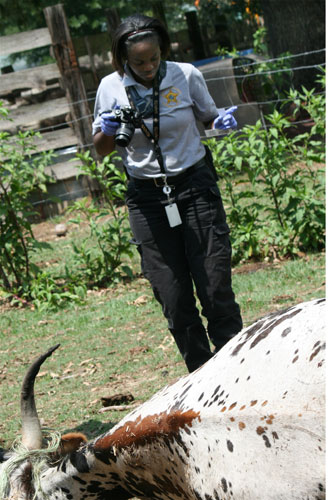 The owner of the pet Jersey cow found the animal dead in a pasture just behind his house on Highway 97A as he checked on his animals. Thin twine — often called grass string – had been tied several times around the cow’s neck and had apparently strangled the animal as it was dragged through the pasture. The cow was found on its side, with its head upside down and its horns pushed several inches into the dirt.
Authorities suspect the death could have resulted from a prank gone wrong since school was about to end and the cow’s owner was a school bus driver.
“Viciously killing a pregnant cow for an apparent prank is an inexcusably cruel crime and anyone who would do that can be capable of hurting people, too,” said Jennifer Hobgood, Florida state director for The Humane Society of the United States. “We hope our reward helps bring justice in this horrible case.”
The Humane Society of the United States is offering a reward of up to $2,500 for information leading to the identification, arrest and conviction of the person or persons responsible for the cow’s death. The Junior Humane Society is now offering an additional $500 reward.
Anyone with information about the case is asked to call the Escambia County Sheriff’s Office at (850) 436-9620.
Pictured: An Escambia County Sheriff’s Office crime scene investigator photographs a pregnant cow that was apparently strangled to death in Enon on Memorial Day 2011. NorthEscambia.com exclusive photo, click to enlarge.
Bratt Elementary Releases Fourth Nine Weeks Honor Roll
June 3, 2013
The following students were named to the fourth nine weeks honor roll at Bratt Elementary School:
All A’s
- Abbie Buford
- Aiden Broadhead
- Alexis Evans
- Allyson Jones
- Amber Gilman
- Angel Schoonover
- Anna Adams
- Anna King
- April Johnson
- Ashlan Harigel
- Ashton Cloud
- Aubrey Stuckey
- Autumn Williams
- Ava Gurganus
- Bailey Van Pelt
- Bailie Merchant
- Bentley Van Pelt
- Berklee Hall
- Braeden McGhee
- Brody Black
- Bryce Hall
- Caitlyn Gibson
- Carsyn Dortch
- Cassie Davis
- Cassie Mullins
- Colby Morris
- Conner Byrne
- Connor Wolfe
- Dallon Rackard
- David Gilley
- Emilee Cabral
- Emma Gilmore
- Erich Amerson
- Gage Eicher
- Gage Lambert
- Hannah Hughes
- Hunter Johnson
- J.P. Gilman
- Jaquez Moorer
- John Bashore
- Kadence Calvert
- Kara Hawkins
- Karlee Criswell
- Kayla Campbell
- Keaton Brown
- Kendall Wise
- Kenna Redmond
- Kennedy Long
- Lane Wilson
- Leah Berry
- Leah Hetrick
- Libby Pugh
- Luke Bridges
- Madison Peterson
- Maggie Amerson
- Maggie Godwin
- Mary Paige Nassar
- Mayson Edwards
- McKenna Simmons
- Mia Starns
- Olivia Boatwright
- Rabekah Abbott
- Raegan Abbott
- Ryan Dove
- Sarah Bailey
- Sarah Branch
- Sarah Long
- Sarah Margaret Hetrick
- Savannah Doremus
- Savannah Spence
- Scotty Elliott
- Shelby Cotita
- Shelby Godwin
- Sophie Cotita
- Summer Waters
- Tucker Hall
- Zane Gurganus
- Zykuria Fountain
All A’s and B’s
- A’laysha Huff
- Abigail Nelson
- Adam Peterson
- Addison Albritton
- Addison White
- Adrianne Shanks
- Ahmad Elliott
- Allie Brantley
- Alyssa Stabler
- Anija Mcneir
- Anna Lee
- Ansleigh Maholovich
- Anyis Cabral
- Arquavian Smith
- Ashton Watts
- Audrey Odom
- Ben Wilson
- Blaize Parrish
- Breyden Freeman
- Bryuana Bivins
- Caden Peterson
- Cadynce Chason
- Cameron Cloud
- Carter Sigafoose
- Cassidy Boutwell
- Cassidy White
- Clay Wilson
- Cody Edwards
- Cody Thomas
- Colton Dockens
- Cordarrius Thomas
- Daelyn Fine
- Dennis Pittman
- Destiney Bradley
- Devon Spencer
- Elijah Amerson
- Franki Daw
- Gabe Henderson
- Gracie Godwin
- Houston Lowry
- Irmani Dixon
- Jackson Edwards
- Jacob Conley
- Jacob Findley
- Jacob Hughes
- Jaimee Taylor
- Jakob Gibson
- Jamyla Feagin
- Jarvis Skanes
- Jason Fayard
- Jaxon Singleton
- Jaylon North
- Ji’keir Hudson
- John Michael Ward
- Jonathan Gibbs
- Jonathan Windham
- Joseph Parker
- Joshlynn Helton
- Joshua Zisa
- Juliana Bryan
- Kaden Dove
- Kailey Fisher
- Kaleigh Macks
- Kaylee Sawyer
- Keazia Washington
- Kinzie Rackard
- Kohle Harigel
- Kyle Blanton
- Landon Chavers
- Lexi Broadhead
- Macie Buford
- Madelin Sheedy
- Madelyn Berry
- Makayla Garrett
- Malachi Bolen
- Martina Howard
- Matthew Pruitt
- Megan McGhee
- Michael Merchant
- Michael Sanders
- Miyhanna Davidson
- Neionni Findley
- Page Ross
- Paige Gibbs
- Paris Burt
- Paris Findley
- Raleigh Gibson
- Raycer Watson
- Reid McCall
- Riley Balckwell
- Rosa Carter
- Ryleigh Barnes
- Savannah Roley
- Shane Hardin
- Shelby Rice
- Sheyenne Dillon
- Summer Harrell
- Tahna Wesley
- Tanner Boone
- Tatum Hasting
- Taviana Parker
- Teriana Redmond
- Tobias Madison
- Tony Hall
- Travis Nelson
- Trent Knighten
- Tyler Cloud
- Tyteanna Dubose
- Ty Wise
- Vivyan Smith
- Wyatt Dillon
- Wyatt Windham
Wahoos Erupt For Record 11-4 Win Over Montgomery
June 3, 2013
The Pensacola Blue Wahoos erupted on offense for a team record 11 runs in an 11-4 win over the Montgomery Biscuits on Sunday night at Riverwalk Stadium in Montgomery, Ala.
 Pensacola claimed the initial lead in the second inning on a solo home run by Travis Mattair, his sixth of the season. Brodie Greene doubled home David Vidal later in the inning before Devin Lohman scored on a Danny Vicioso single. The Blue Wahoos added to their lead with a pair of runs in the third on an RBI double from Lohman and a wild pitch.
The Biscuits plated a pair of runs in the third against Wahoo starter Chad Rogers and added another in the fourth on a solo home run by Keith Castillo, who ended up finishing the night a triple shy of the cycle. Rogers left the game early with an undisclosed injury in the fourth inning with one out. He was charged with three runs on three hits in the no-decision.
Already leading 5-3, the Wahoos exploded for six runs in the seventh to put the game out of reach. Pensacola sent 10 batters to the plate in the inning and tallied six hits. Ryan LaMarre, David Vidal and Devin Lohman all had RBI hits in the inning before Danny Vicioso capped it with a two-run homer to left, his first of the season.
Shaun Ellis, Brian Pearl and Chris Manno combined to finish the final 5.2 innings. The only run the trio allowed was a mop-up unearned run in the ninth. Ellis (1-1) earned the win after working 2.2 scoreless innings. He allowed two hits and struck out one. Biscuits starter Jake Floethe (0-1) took the loss in his Double-A debut. He was charged with the first five runs on five hits over four innings.
Vicioso led the way offensively with a 3-for-5 game and three RBI. Vidal, Lohman and Greene each added two-hit games to spark the offense.
Pensacola looks to continue the momentum in the second game of the five-game set on Monday. The Wahoos will turn to LHP Ryan Dennick (2-5, 2.57) against Montgomery RHP Jacob Thompson (4-5, 5.47). First pitch is set for 7:05 p.m. from Riverwalk Stadium.
story by Kevin Burke
Missing 2-Year Old Escambia County Boy Found Dead
June 2, 2013
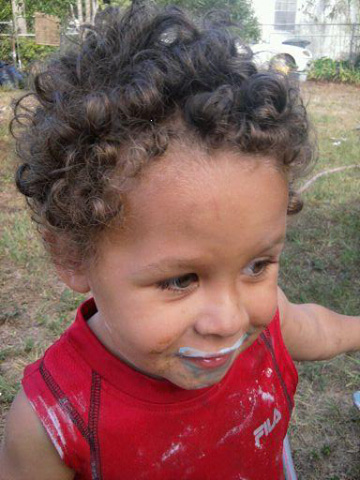
Authorities have located a missing 2-year old missing in the Warrington area since 2:30 p.m. Sunday.
Hezekiah Brooks was found unresponsive in the backseat floorboard of a car “after an exhaustive search” of his Hermey Avenue neighborhood, according to the Escambia County Sheriff’s Office.
First aid was rendered by responding officers and EMS, but all attempts at resuscitation failed. The cause of death is undetermined at this time pending an investigation by the Medical Examiner’s Office.
Sunday’s four hour search involved multiple agencies, including the Escambia County Sheriff’s Office, Escambia County Search and Rescue, the Coast Guard and numerous others. Sheriff David Morgan expressed his gratitude to all that assisted in the search.
Northview High School Class Of 2013 Graduates (With Photo Gallery)
June 2, 2013

Just over 100 members of the Northview High School Class of 2013 graduated Saturday.
Valedictorian Jazzlyn Franklin urged the graduates to look toward the future, as did Salutatorian Winston Riley.
 “Jesus Christ is my Lord and Savior, and I could not stand here today without giving him some time and attention,” Franklin told the hundreds in attendance before leading them in prayer that ended with a standing ovation.
“I’d really like to encourage you to put God first, and if He’s first, He will lead you in the right direction,” she told her classmates.
For a Facebook photo gallery of the graduates and the ceremony, click here.
School Superintendent Malcolm Thomas praised the Class of 2013 for their numerous academic and athletic accomplishments, including the school’s only state football championship.
“This is a class that truly works hard and plays hard,” Thomas said. “But remember, you can’t reach new heights sitting on your bottoms.”
“I can usually stand here and say a class has been good or a class has been great. I can’t honestly stand here and say that about this class,” Principal Gayle Weaver said in her closing remarks. “This class has been awesome.”
A complete list of graduates is below the bottom photo, scroll down.
Pictured top: Valedictorian Jazzlyn Franklin delivers her address to the Northview High School Class of 2012 Saturday afternoon at the school. Pictured inset: Members of the Class Ensemble perform the class song “Best Is Yet To Come”. Pictured below: The Northview Class of 2013 celebrates. NorthEscambia.com photos, click to enlarge.

Summa Cum Luade (4.0 and above)
- Jazzlyn Shanece Franklin – Valedictorian
- Winston Joseph Riley – Salutatorian
- Justin Lance Halteman
- La’Derious Ty’Shon Franklin
- Hannah Elizabeth Fiellin
- Ashley Nicole Mooney
- Zachary Sean Johnson
- Georgia Anna Goetter
- Julia Renee Thorpe
- Jessica Marie Baldwin
- Tyler Dewayne Roley
- Timothy Wayne Rackard, III
- Melanie Elaine Heard
Magna Cum Laude (3.85 and above)
- Jody Michaela Paramore
- Ashton Brooke Gibbs
Cum Laude (3.5 and above)
- Jessica Lea Warner
- Maranda Danielle Moye
- Alison Danielle Bardin
- John Nicholas Helmken, V
- Dustin Todd Parker
- Courtney Elizabeth Lambert
- Jonathan Austin Moretz
- Corry Edward Baggett
- Skyler Ashton Macks
- Johnny Ray Robbins
- Ashley Louise Gunter
- Stephanie Diane Roach
Other Graduating Members, Class of 2013
- Justice Cole Agerton
- Aaron Devin Armstrong
- Lamikeal Deuntrez Banks
- Autumn Cheyenne Bobo
- Zachary Ryan Bradley
- David Bradley Burkett
- Shane Scott Bushaw
- Codie Lee Calloway
- Harley Lynn Caraway
- Dylan Patrick Cartwright
- Laura Ashlynn Clemmons
- Zachary Andrew Cole
- Mason Paul Coleman
- Jordan Lee Coon
- Devon Leon Cottrell
- Dillian Chaise Crutchfield
- Ashley Renea Cunningham
- Jaquan Henry Dale
- Eddmin Theola Davis
- Tyaisha Monique Davison
- Lauren Vanessa Deloach
- Ashtin Montana Dixon
- Misty Suzanne Doran
- James Austin Dorriety
- Ashley Lynn Duncan
- Nysha’ Shaunqaya Dunn
- Robert Dane Eiland
- Arkelle Kaprio Elliott
- Tierra Unique Floyd
- La’Jerieka Yasarian Freeman
- Cheyenne Nichole Godwin
- Billy Wesley Graham, Jr.
- Alisha Ke’Andrya Grice
- Kahlil Jerrell Grice
- Kristin Nicole Guinto
- Kaitlyn Brooke Gunn
- Blaze Thomas Harkness
- Briana Rolonda Harris
- Harold Eugene Harrison, III
- Ashley Nicole Hicks
- Ariel Kaye Holland
- Cordell Anton Jackson
- Alanna Irene Johnson
- Marcus Trey Johnson
- Samantha Diana Johnson
- Ashley Cheyenne Joiner
- Shaquanna Mikel Jones
- Kelby Elton Killam
- Brandon James King
- Kristin Renea Knight
- Te’Andreia Mercedes Knight
- Indigo Zen Knoble-Rodriguez
- La’Mikal De Vonte Kyles
- Ryan Donald Lambert
- Shelby Mae Lewis
- Shane Garrett Lytton
- Christiful Todd Madison, Jr.
- Leigha Kate Maher
- Jessica Nicole Mahon
- Joshua Blake McCall
- John Armicle McGary, Jr.
- Trevelle Omar McWilliams
- Demontra Johnta Mitchell
- Issac Shelton Moorer
- Ashley Danyale Morris
- Shelley Brooke Mothershed
- Stetson Klein Nash
- Morgan Leann Payne
- Travis James Pittman
- Hunter Hall Poston
- Sandy Michelle Rainwater
- Aaron Paul Rausch
- Kassey Shantele Redmond
- Morgan Taylor Roberson
- Kyle Everette Roberts
- Neiko Anthony Robinson
- Merena Lane Roley
- Clarrisa Paige Ross
- Jordan Annabelle Satterwhite
- Chad Maverick Smith
- Johnnie Marie Smith
- Morgan Deann Smith
- Deidre Lynne Steele
- Lindra Lashay Street
- Talia La’Drell Syria
- Justin James Thompson
- Kevin Dewey Vaughan
- Logan Glenn Weber
- Dy’Shun Markell White
Man Hit By Train Near Graffiti Bridge
June 2, 2013
A man was injured Saturday night when he was clipped by a train while trying to get out of its way.
The incident happened about 8 p.m. near the 17th Avenue trestle, commonly known as “graffiti bridge”.
Pensacola Police Lt. Mike McVicker said the man, whose name is not yet being released — was riding his bike westbound over the bridge when he was confronted by the train that was eastbound. McVicker said the man was successful in beating the train across the bridge, but he was hit by the side of the train.
The man was taken to a local hospital for treatment. His condition was not available.
Bratt Elementary Presents Grades 3-4 Academic Awards
June 2, 2013
Bratt Elementary School has presented the following academic awards to students in grades 3-4:
Honor Roll A’s & B’s
- Tanner Boone
- Anyis Cabral
- Kayla Campbell
- Cadynce Chason
- Ashton Cloud
- Tyler Cloud
- Cassandra Davis
- Franki Daw
- Ahmad Elloitt
- Jacob Findley
- Breyden Freeman
- Makayla Garrett
- Gracie Godwin
- Shelby Godwin
- Kara Hawkins
- Anna Lee
- Reid McCall
- Angel Merchant
- Michael Merchant
- Abigail Nelson
- Travis Nelson
- Jaylon North
- Audrey Odom
- Taviana Parker
- Dallon Rackard
- Kenna Redmond
- Shelby Rice
- Paige Ross
- Adrianne Shanks
- Summer Waters
- Addison White
- Autumn Williams
- Lane Wilson
- Ty Wise
Academic Achievement Award
- Anna Adams
- Maggie Amerson
- John Bashore
- Conner Byrne
- Shelby Cotita
- Sophie Cotita
- Savanna Doremus
- Amber Gilman
- Zane Gurganus
- Sarah Margaret Hetrick
- Hannah Hughes
- April Johnson
- Mary Paige Nassar
- Madison Peterson
- Libby Pugh
- Mia Starns
Progress Award
- Madelyn Berry
- Destiney Bradley
- A.J. Broadhead
- Dakota Bryan
- Cadynce Chason
- Andrianna Cooper
- Miyhanna Davidson
- Tyler Davis
- Jacob Daw
- Paris Findley
- Shelby Godwin
- Kaleigh Macks
- Cheyenne Philyaw
- Cordarrius Thomas
- Alyssa Ward
- Mekhi White
Outstanding Citizenship Award
- Anna Faith Adams
- John Bashore
- Miyhanna Davidson
- Zane Gurganus
- Shelby Rice Hannah Hughes
- Mary Paige Nassar
- Maggie Amerson Taviana Parker
Outstanding Attendance
- John Bashore
- Bryuana Bivins
- Tanner Boone
- Kayla Campbell
- Cadynce Chason
- Ashton Cloud
- Tyler Cloud
- Jacob Conley
- Sarius Davis
- Andrew Denton
- Shane Hardin
- A.J. Hasty
- Hannah Hughes
- April Johnson
- Zaria Madison
- Dallon Rackard
- Taliyah Rivera
- Rachael Sanders
- Courtney Shramek
- Savannah Stokes
- Cody Thomas
- Jonathan Windham
Perfect Attendance
- Anna Faith Adams
P.E. Award
- John Bashore
- Tereasia Burt
- Allen Cofield
- Miyhanna Davidson
- Franki Daw
- Shane Hardin
- Libby Pugh
- Madelin Sheedy
Music Award
- Anna Adams
- Madelyn Berry
- Bryanna Bivins
- Ki-Jana Carter
- Cassie Davis
- Sarius Davis
- Gracie Godwin
- Jaylon North
Art Award
- Cadynce Chason
- Shelby Cotita
- Sophie Cotita
- Reid McCall
- Joshua Merchant
- Abigail Nelson
- Mary Grace Rice
- Peggy Sunday
Art Show
- Kayla Campbell
- Allen Cofield
- Donavon Davis
- Savannah Doremus
- A.J. Hasty
- April Johnson
- Reid McCall
- Adrianne Shanks
- Summer Waters
- Addison White
- Ty Wise