

Wahoos Stun Barons With 5-Run 8th Inning
August 25, 2013
Down by four runs headed to the last of the eighth inning, the Penascola Blue Wahoos erupted for an improbable five-run comeback to knock off the Birmingham Barons 5-4 in front of the 28th sellout crowd of the year at Pensacola Bayfront Stadium. The win proved to be crucial as the Wahoos gained a game on first place Jacksonville, who was no-hit on Saturday. Pensacola now sits three games out of first with eight games to go.
 The Wahoos offense scattered seven hits in the first seven frames before finally breaking through against reliever Kevin Vance (L, 2-6) in the eighth inning. Ryan LaMarre started things off with a triple to right-center and scored two batters later on a single from Yorman Rodriguez. Mike Costanzo followed with an RBI double to make it 4-2 before Vance hit Tucker Barnhart and was pulled from the game.
Jarrett Casey entered for Birmingham and fired four straight balls to Travis Mattair to force in a run before walking Devin Lohman to tie the game at four. Corey Wimberly became the first out of the inning, but it was a productive run as his sacrifice fly to left scored Barnhart to give Pensacola their first lead of the game at 5-4.
Trevor Bell (S, 17) came on in the ninth for Pensacola and mowed down the Barons in order to pick up his franchise record 17th save of the year, moving the Wahoos to within three games of first place.
The epic comeback made a winner of Chris Manno (W, 4-3) who struck out two in a scoreless eighth inning. Daniel Renken got the start for Pensacola and posted a quality start, allowing three runs on eight hits in six innings.
Birmingham jumped out to a 2-0 lead on Renken in the third inning on a Trayce Thompson RBI infield single while another run scored on a throwing error by Lohman. In the sixth, Keenyn Walker drove home David Herbek with a single to make it 3-0 before Brandon Jacobs added a fourth run in the seventh on another infield single.
Barons starter Scott Carroll kept the Wahoos at bay through his five innings, allowing just five hits to go along with four strikeouts and a walk.
Winners of seven of their last eight, Pensacola will look to continue its playoff push on Sunday at 4 p.m. Jon Moscot (2-1, 4.95) gets the ball for the Wahoos against the Barons’ Chris Beck (0-2, 5.54)
Photos: NHS Mini-Cheerleaders, Band, Dance Team And More
August 25, 2013


For a photo gallery with the Northview NJROTC, cheerleaders, band and dance team from Friday night, click here.
For a special gallery featuring the Northview mini-cheerleaders, click here.
For a game summary and action photos, click here.
NorthEscambia.com photos, click to enlarge.


Farm Family Of The Year Has Long History In Agricultural
August 25, 2013

The Keith Campbell family of Chumuckla was recognized as Santa Rosa County’s “Outstanding Farm Family of the Year” during the 47th Annual Santa Rosa County Farm Tour.
Keith and his wife Robynn, along with daughters Brittney, Ashleigh and son-in-law Adam Bondurant, accepted the award from County Commissioners Don Salter and Jim Melvin. Sheilah Bowman, Florida District Director for Congressman Jeff Miller, also presented the family with a Congressional Record proclamation honoring them for their accomplishments.
The Campbell’s have a rich agricultural heritage. Keith Campbell is a sixth generation farmer on his father’s side and a fourth generation farmer on his mother’s side of the family. The Campbell family of farmers emigrated from Scotland to South Carolina and finally settled in the Chumuckla area in the early 1800’s.
After two years of college, Keith began farming with his grandfather, W.T. Stewart, on five hundred acres in 1983. He eventually took over complete operation of the farm which has grown to more than 1,300 acres today. The family’s major crops are cotton, peanuts, and wheat. They also raise beef cattle with a herd of around 60 cows and calves. In addition, the past few years they have maintained an apiary for honey production and crop pollination.
Family members and neighbors help sustain the farm. Robynn is a homemaker supporting the family with her full-time efforts. Ashleigh’s husband Adam, a senior at UWF, works part-time on the farm and nephew Dale Campbell helps out after school. A key component of Keith’s approach to farming involves sharing work with neighboring farmers with whom he performs custom planting and harvesting to pool equipment and labor.
Keith is a progressive farmer who always looks for better ways to improve the efficiency of his operation. He says one of the biggest changes he has seen in farming was the introduction of herbicide resistant crops in the late 90’s. This allowed him to implement conservation tillage with benefits of reduced tillage, soil erosion, fuel, machinery, labor costs, and the overall amount of herbicides used.
Keith has also been an early adopter of precision agriculture technologies such as variable-rate lime and fertilizer application, field mapping, and GPS equipment guidance for field operations.
Laura Ann Wiggins Graduates From Rhodes College
August 25, 2013
Laura Ann Wiggins of Walnut Hill graduated cum laude with a Bachelor of Arts in Anthropology and Sociology and a double minor in Archaeology and French at Rhodes College in Memphis, TN.
 While at Rhodes, Wiggins received three funded fellowships to volunteer with the non-profit Urban Farms Memphis to increase local, fresh produce consumption in below-poverty neighborhoods; to excavate Mayan household archaeological sites in Chiapas, Mexico; and to complete a comparative ethnographic study of identity through food choice within Memphis, TN and Dakar, Senegal.
She was a member of Omicron Delta Kappa National Leadership Honor Society and Kappa Delta Sorority, serving as both Ritual Chair and Recruitment Philanthropy Chair.
She also served as Chair of the Rhodes Event Management Committee, advocating alcohol awareness at campus events through responsible event planning.
Beginning this fall, she will teach English at the bilingual school Ecole Actuelle Bilingue in Dakar, Senegal.
Wiggins is a 2009 graduate of the International Baccalaureate program at Pensacola High School. She is the daughter of Glen and Jean Wiggins of Walnut Hill.
Birth: Myles Levi Sellers
August 25, 2013

Ray and Leslie (Respress) Sellers of Atmore are proud to announce the birth of their son, Myles Levi Sellers. Myles was born July 22, 2013, at 7:49 a.m., at Mobile Infirmary. He weighed 8-pounds 13-ounces and was 21½ inches.
Grandparents are Benny and Bobbie Respress and Joyce Sellers of Atmore. Great grandparents are Alvis and Bernice Respress of Atmore and Robert and Jo Grigsby of Trussville, AL. Myles was welcomed home by his big brother, three-year old Jackson, and his big sister, Queenie, a 10-year old Boston Terrier.
Summit To Map State Education Direction
August 25, 2013
With Florida’s public-school system facing major questions, Gov. Rick Scott on Thursday announced plans for a summit this week that will bring together political, business and education leaders.
The summit, which will last from Monday afternoon to Wednesday afternoon in Clearwater, comes after the resignation of former Education Commissioner Tony Bennett and as debates swirl about the state’s school-grading system and a move to “Common Core” standards.
“Florida’s education accountability system has become a national model, but we are at a critical point in our history,” Scott said in a news release announcing the summit. “Our students need and deserve a quality education that emphasizes critical thinking and analysis. Our teachers and schools need our support as we continue to compete nationally and globally in preparing students for success in college, career and in life.”
Scott asked interim Education Commissioner Pam Stewart to focus the summit on four broad issues — state standards, student assessments, school grades and teacher evaluations. Those issues have repeatedly drawn controversy during the past 15 years, as Republican governors and lawmakers have sought to overhaul the education system.
Bennett resigned Aug. 1 because of questions about whether he took part in changing a school grade to benefit a political supporter during a previous job heading the Indiana education system.
Even before Bennett resigned, however, the Florida system was grappling with tough issues. Among other things, the state Board of Education in July voted 4-3 to approve a plan that shielded schools from steep drops in their grades — a move that led some critics to raise doubts about the validity of the closely watched school-grading system.
About three dozen people, representing a broad cross-section of groups, have been invited to participate. As examples, the list includes school superintendents from Miami-Dade, St. Johns and Bay counties and representatives of the Florida PTA, the Florida School Boards Association and the Florida Association of School Administrators.
Other invitees range from Florida Chamber of Commerce President Mark Wilson to officials from the Florida Education Association teachers union.
Senate President Don Gaetz, R-Niceville, and House Speaker Will Weatherford, R-Wesley Chapel, have invited six Republican lawmakers and two Democrats to take part. They are Sen. John Thrasher, R-St. Augustine; Sen. John Legg, R-Lutz; Sen. Bill Galvano, R-Bradenton; Sen. Bill Montford, D-Tallahassee; Rep. Marlene O’Toole, R-Lady Lake; Rep. Erik Fresen, R-Miami; Rep. Janet Adkins, R-Fernandina Beach; and Rep. Reggie Fullwood, D-Jacksonville.
The summit will be held at the EpiCenter Collaborative Labs at St. Petersburg College in Clearwater.
by The News Service of Florida
Prison Time For Man That Robbed Bank, Got Change For Taxi Driver
August 24, 2013
A man that used a cab as his getaway vehicle — and stopped along the way to get change to pay the driver – is headed to prison for robbing a Nine Mile Road bank.
 Terry Dewayne Gideon, previously convicted of robbery without a weapon by an Escambia County jury, was sentenced by Judge Scott Duncan to 20 years in state prison as a habitual felony offender, 15 years of which will be served as a prison releasee offender.
The charges stem from the October 2, 2012, robbery of the Bank of America on Nine Mile Road. Gideon took a Yellow Cab to multiple banks before robbing the Bank of America. Gideon approached the teller just before closing and handed her a note that demanded cash. He left the bank with more than a $1,000, according to prosecutors.
Bank employees were able to identify the cab number and relayed that information to law enforcement. The Escambia County Sheriff’s Office located Gideon a short time later and arrested him. Multiple people were able to identify Gideon and his thumb print was identified on the demand note.
During the investigation, deputies learned that Gideon had gone into a nearby Applebee’s restaurant to get change from the stolen money to pay the taxi driver.
PNJ Cuts 10 Jobs; Both Publisher And Editor Retire
August 24, 2013
The Pensacola News Journal announced Friday that President and Publisher Kevin T. Doyle and Executive Editor Richard A. Schneider are “retiring”, and the newspaper has cut 10 other positions.
Positions eliminated included those of Managing Editor Ginny Graybriel, a 35-year plus veteran of the paper, and columnist Shannon Nickinson.
Layoffs across the country at Gannett owned newspapers, including the PNJ, have totaled over 200 jobs, according to an industry website.
Marketing Director Becca Boles will move into the interim editor’s position, and Kim Thomas will move from managing editor for digital to interim editor.
1A Champ Chiefs Compete Tough Against 5A Bay In Tied Preseason Game (With Gallery)
August 24, 2013

The Northview Chiefs walked away from a preseason classic game Friday night with a tie on the scoreboard against Panama City Bay, but it might as well have been a win for the defending Class 1A state champions.
“I like the way we competed tonight,” Northview coach Sid Wheatley said about how the Chiefs handled the much larger 5A Bay Tornadoes. “”As a confidence standpoint, I know they’ve got to feel good coming out of here, at least score-wise, and the way we did compete. It has to instill some confidence.”
 The first half of the game in Bratt was a varsity on varsity scrimmage that ended in a 0-0 tie. Despite the score, the varsity teams showed a depth that impress Wheatley, especially on the defensive side of the ball.
“I love the way the defense competed. They bent at times, but they didn’t break. They played hard,” he said. “”Offensively, we’ve got to go to work on our mistakes. We were able to make plays at times, but the thing was it was third and 28.”
But overall, Wheatley saw the great potential within his Chiefs.
“Those guys, they are going to be OK,” he said. “Physically, I think we have a chance to be pretty good up front. It’s just a maturation process. They are going to be better Tuesday, and better the following Tuesday. But they’ve got to kind of grow into that role. And mentally, that’s a big part of it right now.”
For a photo gallery, click here.
For cheerleaders, mini-cheerleaders, band, dance team and NJROTC photos, click here.
The second half of the game was scheduled to be junior varsity and reserves only. But 5A Bay rolled on with varsity starters against much younger, smaller and less experienced JV and reserve Chiefs.
 “They competed; they played tough,” Wheatley said of his JV and reserves, stacked up against a much larger Bay that continued to play starters in the second half. “They just got after them.”
Northview freshman quarterback Luke Ward, moving up from an almost perfect season last year at Ernest Ward Middle, led a late Chiefs drive to tie the game. At third and goal, he found junior Hunter Sherouse for a two-yard touchdown with 37.3 seconds on the clock. With the score tied 6-6, the extra point kick by the Chiefs was no good.
Then the Chiefs were able to set up a 30-yard field goal as time expired, but the kick was far wide to the left as the clock rolled to zeros.
“It was a little drama there at the end,” Wheatley said with a laugh.
Next week, the Chiefs will look at Friday night’s film, looking for the areas that need improvement. “We have inexperienced guys; hopefully we are going to be able to look at the film and correct those mistakes,” he said.
The Chiefs will host Bozeman next Friday night at 7:00 in Bratt.
For a photo gallery, click here.
For cheerleaders, mini-cheerleaders, band, dance team and NJROTC photos, click here.
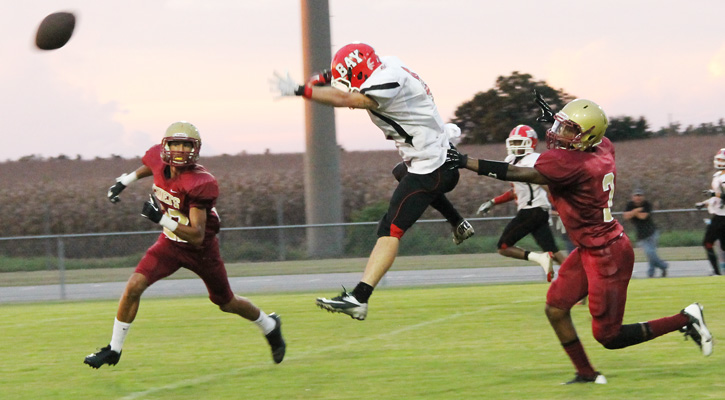
Pictured top: Northview senior Neino Robinson breaks away from a host of Panama City Bay defenders Friday night in Bratt. Pictured top inset: Northview quarterback Daulton Tullis gains yardage for the Chiefs. Pictured bottom inset: Northview coach Sid Wheatly watches his Chiefs under the Friday night lights. Pictured below: A Bay Tornado pass was too long, almost resulting in a Chiefs interception. NorthEscambia.com photos, click to enlarge.
Teen Found Dead After Jogging
August 24, 2013
A Pensacola teen collapsed and died while jogging Thursday night.
Nicholas Cooke, 16 was found in the intersection of Osceola Boulevard and Whaley Avenue around 8 p.m. Several people stopped and attempted CPR after he was found in the street. He was transported to an area hospital where he was pronounced deceased just before 9 p.m.
Police said there was no indication of foul play, with preliminary autopsy results showing Cooke’s death may have been related to a medical condition.
Cooke did not have any identification with him when he was found; he was identified after his mother contacted police and reported him missing.