
Northview Senior Wright Wins Pensacola Heritage Foundation Scholarship
April 28, 2014
 Northview High School senior Victoria Wright has been awarded a $1,000 scholarship by the Pensacola Heritage Foundation, Inc. Her essay on Pensacola’s local heritage was judged he best submitted by a group of Pensacola Heritage Foundation members.
Wright has been accepted to The United States Air Force Academy. Her winning essay is reprinted below.
The History of Pensacola
Victoria Wright
“If you don’t know where you’ve come from, you don’t know where you are.” -James Burke
Pensacola is commonly referred to as “The City of Five Flags;” however, it hasn’t always had this name. In the early 1500s Pensacola Bay was known as Polonza or Ochuse, to Ponce De Léon, Pánfilo de Narváez, Hernado de Soto and the other early explorers of the New World. People have been enjoying the white sandy beaches, and crystal clear blue waters of Pensacola, since Don Tristán de Luna y Areallno and more than 1,500 people from Vera Cruz, Mexico settled here on August 15, 1559.
The first citizens of Pensacola didn’t last long because of a hurricane on September 19, just a month and four days after they arrived. This hurricane brought death to hundreds, and destroyed most of the Spanish fleet, which were still holding the supplies needed to establish a colony. The majority of surviving settlers decided to relocate, leaving only 50 behind in Pensacola. This last group, which was a military detachment, decided to sail home to Mexico in 1561. It was then concluded that the northwest part of Florida was too dangerous to settle.
135 years later on February 2, 1686, Juan Enriques Barroto led an expedition that entered the Pensacola Bay. That expedition set way for Admiral Andres de Pez’s expedition of the bay in April of 1693. A little over a year later, the King of Spain gave them his permission to settle Pensacola. This settlement would fare a little better than the first, but not by much. In 1702 the newly Spanish settlers suffered what is now believed to be a yellow fever epidemic. Five years after this tragedy, with urging from the British, the Creek Indians attacked and burned down the Spanish Pensacola. After recapturing the city in 1719, the Spanish would lose it again, but this time to the French.
The French sailed from Mobile on May 13, 1719 in attempts to capture the town. Three days later under the command of Brothers Jean Baptiste Le Moyne and Sieur de Bienville, the French fired on Fort San Carlos and captured the town. France and Spain made peace with one another in 1720, but two short years later, the French burned Pensacola and the Spanish secured the return of Pensacola to Spain. The Spanish flag would fly over Pensacola for 22 years before a different country’s emblem would replace it.
In 1763 the signing of a treaty would transfer the control of Florida to the British. In August of that year, Augustine Prevost would arrive in Pensacola to accept the transfer and take command of the city. From the start of the Revolutionary War in 1775, until the British lost in 1783, the city of Pensacola and state of Florida as a whole, remained faithful to England. In the middle of that war however, Spain declared war on England in June of 1779. This would threaten the peace in the Florida and change the flag flown over the city of Pensacola.
Bernardo de Galvez from Spain sailed from New Orleans in 1781 to capture Pensacola. Galvez laid siege to one of the British’s forts, Fort George, just north of the city of Pensacola. On May 8, 1781, the day after the siege, General John Campbell and the British surrendered Pensacola to Galvez. After this, the British left their fort in Pensacola and ended their history here in the city. When the Revolutionary War was coming to an end in 1783, England gave Florida to Spain in exchange for the Bahamas and Gibraltar.
After the war of 1812, Spain and the United States signed the Adams-Onis Treaty, on February 22, 1819. This treaty would give the United States the state of Florida and set the boundary between the US and New Spain. It would be two years later on July 17, 1821, when Florida would officially became a part of the United States after a flag-exchanging ceremony in Pensacola. The flag of the United States of America would fly overhead until Florida seceded from the Union on January 10, 1861 as a part of the Civil War. The Confederate flag would find a home in the state of Florida and the city of Pensacola until Florida was readmitted to the Union in 1868. Since then, the flag of the United States of America has flown overhead and has been the last flag to fly atop the City of Five Flags.
Northview To Present ‘Shrek The Musical’ Friday And Saturday
April 28, 2014

The Northview High School Music Department will present “Shrek The Musical” Friday and Saturday nights. Performance time is 7:00 both evenings in the Northview theatre. Tickets are $8 in advance and are available in the school office.
Former NBA Coach Addresses Bratt Youth Group
April 28, 2014
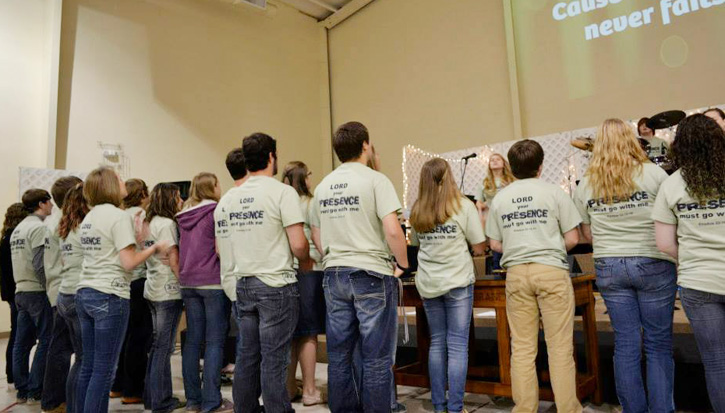
Former NBA, college and high school basketball coach Roger Dutremble of Global Sports Outreach brought his message to the DNow youth group Sunday at the First Baptist Church of Bratt. The special DNow session was led by church’s College and Career class.
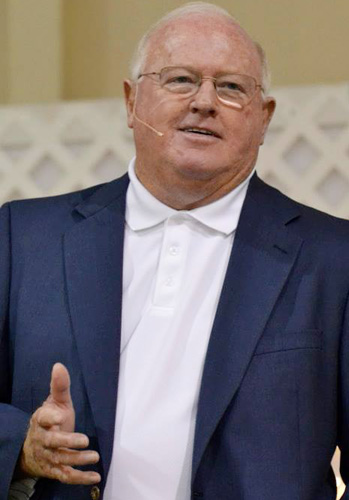 Dutremble is a a retired coach and member of the International Basketball Hall of Fame. He career includes coaching at every level from high school to the NBA, and into international arenas, with a lifetime coaching record of 687-117 and seven national championships. He was selected “Coach of the Year” six times, and served as national team head coach to Belgium, Scotland, and Jordan. He was an assistant coach for the Los Angeles Lakers, serving under Paul Westhead and Pat Riley, from 1979-83 and helping the team to three NBA championships with players like Magic Johnson and Kareem Abdul-Jabbar.
Dutremble hosts a free basketball camp for children and youth each summer at the First Baptist Church of Bratt.
Photos by Marcella Wilson for NorthEscambia.com, click to enlarge.
Jim Allen Students Learn About The Lifecycle Of Butterflies
April 28, 2014


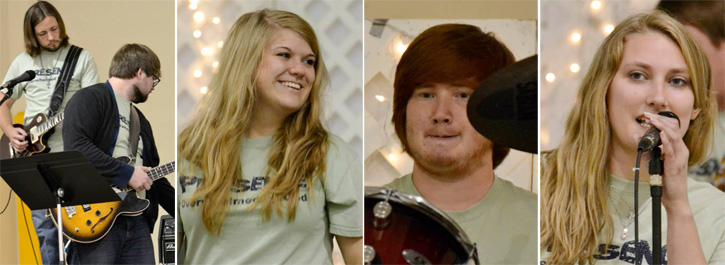
In partnership with the International Paper Foundation, the students at Jim Allen Elementary School received a classroom kit with Painted Lady butterfly caterpillars. The students watched and learned about the life cycle of the butterfly.
Mrs. Rhoda Greenwell, teacher at Jim Allen for more than 40 years, reads Charlie the Caterpillar to the students before releasing the beautiful butterflies.
Submitted photos for NorthEscambia.com, click to enlarge.


Florida Budget All But Done After Late Night Deals
April 28, 2014
Lawmakers were on the verge of a final budget deal Sunday night after agreeing on virtually all of the outstanding spending items —putting them in striking distance of finishing the legislative session on time.
Negotiators led by Senate Appropriations Chairman Joe Negron, R-Stuart, and House Appropriations Chairman Seth McKeel, R-Lakeland, essentially locked down most of the final budget, which is expected to settle in around $75 billion.
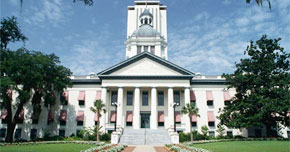 Funding for public education would increase by about 2.6 percent a student, depending on final calculations. The state would work to protect and restore the Everglades ecosystem through projects in the Indian River Lagoon and in the Lake Okeechobee area.
“I feel like it’s a really strong budget and we can be proud,” Negron said.
A handful of issues still remain. Lawmakers have not agreed to spending plans for education construction funding or a list of water projects tied to some of the larger line items. And they were still working to hammer out deals on the fine print of the budget, as well as legislation meant to bring the state’s laws into line with policy changes approved in the budget.
But after two days of what appeared to be faltering negotiations — Negron and McKeel did not meet as expected on Saturday, and met just once on Sunday before the late session at which the agreements were announced — the deals were a sign that lawmakers could finish the budget and have it on lawmakers’ desks by Tuesday.
The legislative session is scheduled to end Friday, and lawmakers are required to wait 72 hours before voting on the completed budget. That means the budget must be finished Tuesday or the session would be sent into overtime.
The final deal on education boosted to $500,000 the price tag for a study into whether the joint College of Engineering operated by Florida A&M University and Florida State University should be broken up. The Senate’s $3 million proposal to set up an independent school for FSU was shelved.
“We got a more accurate number in the interim,” McKeel said in explaining the increase in the study, which was initially slated to cost $150,000.
Now, the Florida Board of Governors will decide whether to break up the college after the study. The panel, which oversees the state’s 12 universities, would have to make a decision on whether to split the school by March 1, 2015.
The board would study three options for engineering programs at FSU and FAMU, including keeping the joint college; setting up “an independent College of Engineering at one or each of the universities;” and offering “differentiated engineering programs” at FSU and FAMU.
Earlier Sunday, Negron said the new proposal was in line with comments about a potential split of the engineering school made by House Speaker Will Weatherford, R-Wesley Chapel, late last week.
“The speaker had advocated for involving the Board of Governors in that decision, so I think where we are moves us in that direction,” Negron said.
Giving FSU its own engineering school — which the university says will help it move up in the ranks of elite public universities — has been a priority of influential Senate Rules Chairman John Thrasher, R-St. Augustine. Thrasher is an alumnus of FSU and is seen as one of the contenders to become the university’s next president.
Thrasher told The News Service of Florida on Sunday that he was satisfied with the study.
“I think the money that we had in the budget obviously got the conversation started,” he said.
The proposal to separate the two colleges sparked an uproar at FAMU. Leaders and alumni recalled the closing of the university’s college of law in the 1960s, at the same time a similar school was opened at FSU. Florida A&M regained its law school under a bill pushed through the Legislature in 2000.
Rep. Alan Williams, a Tallahassee Democrat and strong supporter of FAMU, said the proposal addressed concerns that the issue was being rushed through the Legislature.
“If there’s one silver lining, it is that it now goes to the BOG to have them make a more rational decision based on the information that, hopefully, this report will provide,” Williams said. “We’re pleased with the direction that it’s going in right now, and I believe that all groups involved will be, hopefully, pleased with at least the outcome that we’ve had thus far.”
The House gave Negron what he wanted on funding for projects related to the Everglades, the Indian River Lagoon and the Lake Okeechobee area. Lawmakers agreed to almost $96 million that was included in the Senate budget but not the House plan.
Polluted runoff from Lake Okeechobee into nearby waterways has been a major issue during the past year on the state’s Treasure Coast, which includes Negron’s hometown of Stuart.
And lawmakers settled on $2 million in public transportation improvements related to the Skyrise Miami project, a 1,000-foot-high business and amusement feature that would dominate Miami’s skyline. The Senate had balked at $10 million for the project in a line item the chamber said was too vague.
by Brandon Larrabee, The News Service of Florida
Wahoos Beat Braves 2-0
April 28, 2014

The Pensacola Blue Wahoos evened the series at two games and defeated the Mississippi Braves 2-0 in front of a lively sellout crowd at Pensacola Bayfront Stadium. The game featured impressive starting pitching from Jon Moscot of the Wahoos (10-14) and Williams Perez of the Braves (9-15).
 RHP Jon Moscot had the longest outing of the season for a Wahoo pitcher; Moscot pitched 8.0 innings of three-hit ball. Moscot lowered his ERA to 2.08 thanks to his great day on the mound. RHP James Walczak came on in relief of Moscot and earned his first save of the season with a perfect one-two-three ninth inning.
Both pitchers were on their game and hits were hard to come by on Sunday afternoon. Juan Silverio led off the fifth inning with an infield single and later came home to score. With two outs, Moscot grounded to third baseman Kyle Kubitza who had trouble getting the ball out of his glove allowing the Wahoos pitcher to reach. Moscot’s hustle down the line beat out the throw at first that allowed Silverio to score.
Steve Selsky added an insurance run for the Wahoos when he singled in recently added Beau Amaral from second with two outs in the bottom of the eighth inning.
Mississippi’s RHP Williams Perez was tough on Wahoo hitters and allowed just three hits through 7.0 innings of work. Perez continued his early season dominance and he still hasn’t allowed more than two earned runs in a start this season.
The series finale is Monday night at 6:30 p.m. at Pensacola Bayfront Stadium. RHP Michael Lorenzen (2-1, 1.52) will make the start for the Wahoos while Mississippi will send J.R. Graham (0-1, 1.17 ERA) to the mound. Graham is the third best prospect in the Braves organization and Lorenzen is rated as the sixth best prospect in the Reds’ system.
by Tommy Thrall
Pictured: The Pensacola Blue Wahoos beat the Mississippi Braves 2-0 Sunday. Photos by Michael Spooneybarger/ Pensacola Blue Wahoos for NOrthEscambia.com, click to enlarge.

Florida Man Killed In Atmore Traffic Crash
April 27, 2014
A Florida man was killed in a single vehicle crash Saturday night in Atmore.
 Ronnie Dale Powell, 38, of Marianna, FL, was pronounced deceased on the scene of the of the 10:02 p.m. crash on Highway 31 near the Atmore Country Club. Alabama State Troopers said his 2003 GMC pickup left the roadway and overturned. Powell was not wearing a seat belt and was ejected, according to troopers.
Powell was a native of Atmore.
The accident shut down Highway 31 from Atmore to James Road in Nokomis for several hours.
The Alabama State Troopers are continuing their investigation.
Molino Power Outage Causes Problems For Wedding, But All Ends Happily Ever After
April 27, 2014

When Nikki Burkett and Jason Jones planned their lakeside wedding in Molino for Saturday, they had no idea a five-hour power outage would hamper their plans.
The wedding was set to begin at 3 p.m. at the Gizmo Angus Farm lodge on Gibson Road, just off Highway 97. The bridesmaids arrived at 11 a.m. to find the power was out — the driver of a truck had lost control on Highway 97 and crashed through a power pole, cutting power to over 415 Gulf Power customers.
 A quick phone call, and the bridesmaids found a friend on Highway 95A in Molino that had power.
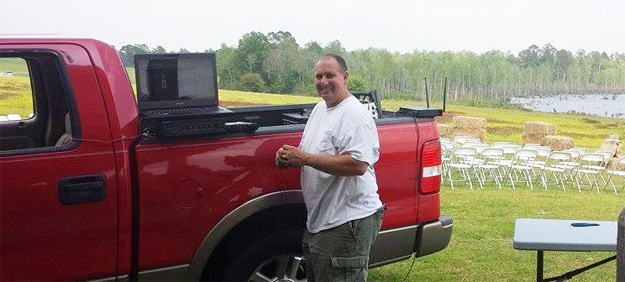
“We loaded up the bride and all beauty supplies and proceeded to move Operation Glamour to another location,’ said bridesmaid Mary Land. The wedding start time was pushed back an hour to 4 p.m., and the DJ, Tom Swartz, set up a mobile sound booth in the back of his truck running off axillary power.
But weddings are all about happy endings. Just after 3 p.m., the power was restored, and the wedding went on in picture perfect splendor for the new Mr. and Mrs. Jones.
Nikki Burkett of Cantonment is the daughter of Ms. Mickey Burkett. She graduated in 2000 from Tate High School. Jason Jones is from Tennessee. They met last year through a mutual friend and were engaged last Easter. Nikki is the procedure supervisor for Gulf Coast Pain Institute, and Jason is an Escambia County Corrections Officer and a volunteer firefighter for the Beulah Station of Escambia Fire Rescue. He has a 9-year old son named Camden.
Pictured top: The power outage delayed wedding of Nikki Burkett and Jason Jones Saturday in Molino. Pictured inset: The bridesmaids moved “Operation Glamour” to another area of Molino with power. Pictured below: The DJ, Tom Swartz, set up a mobile sound booth in the back of his truck running off axillary power. Submitted photos for NorthEscambia.com, click to enlarge.
EREC Celebrates 75 Years At Annual Meeting
April 27, 2014
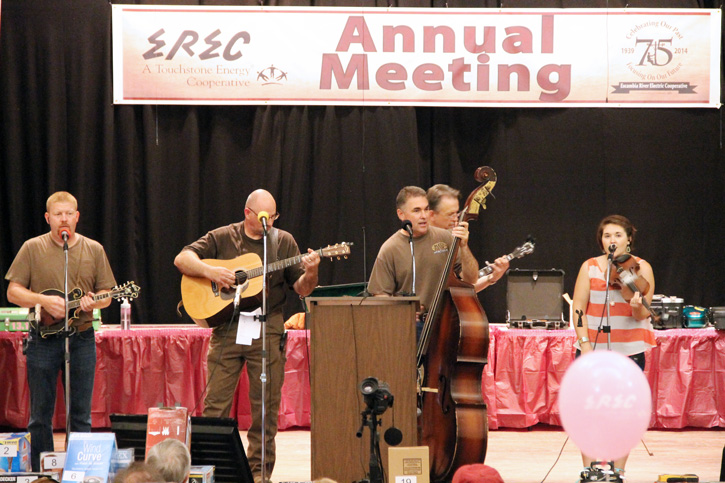
Escambia River Electric Cooperative members held their 75th Annual Meeting Saturday at Northview High School.
 In 1937, the first meeting was held to organize Escambia River Electric Cooperative, Inc. at the Oak Grove Community House. By lamplight, several prominent community leaders laid out the blueprints for the formation and operation of EREC.
After Congress passed the Rural Electrification Act of 1936, which made loans available for the establishment of rural electric cooperatives, widespread rural electrification began. The
formation of cooperatives in other parts of the country stimulated the interest of local leaders such as C. R. Walker, E. H. Lundy, J. L. Robbins and County Agent J. G. Hudson. They
continued to move forward with their plans even though they were often met with opposition and skepticism.
On March 10, 1939, Escambia River Electric Cooperative, Inc. was born when the incorporators met at the American National Bank building in Pensacola to pass the bylaws, which would
establish the cooperative and make their dream a reality. The cooperative’s first month of operation brought them 88 members. Since that time, the cooperative has grown to serve
approximately 10,000 members in Escambia and Santa Rosa counties with over 1,800 miles of energized line.
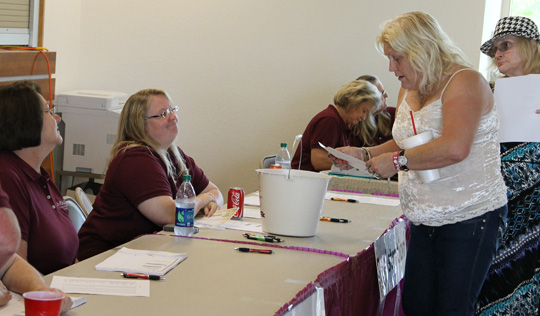
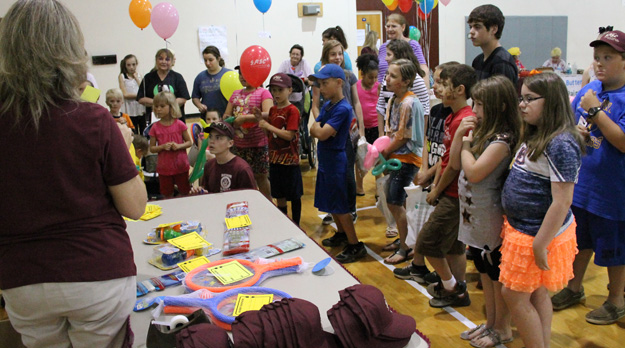
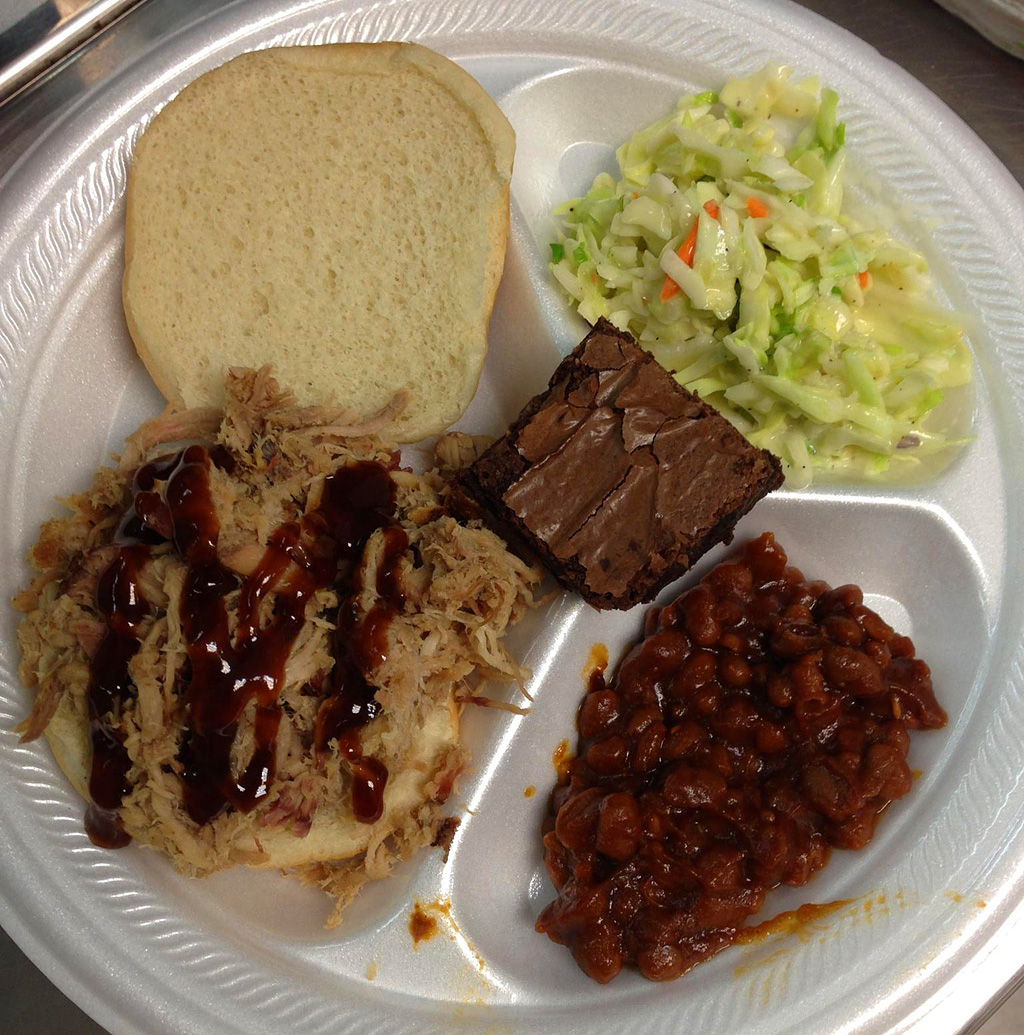
Pictured top: The group Highway Home performs just before the start of the Escambia River Electric Cooperative 75th Annual Meeting Saturday afternoon at Northview High School. Pictured inset: EREC members register to vote for trustees. Pictured below top: Hundreds of EREC members attended the event. Pictured below middle: Children of EREC members win prizes. Pictured bottom: The Northview High School FFA offered BBQ lunch plates to attendees. NorthEscambia.com photos, click to enlarge.

Over 400 Customers Lose Power When Truck Hits Pole On Hwy 97; Driver Cited
April 27, 2014
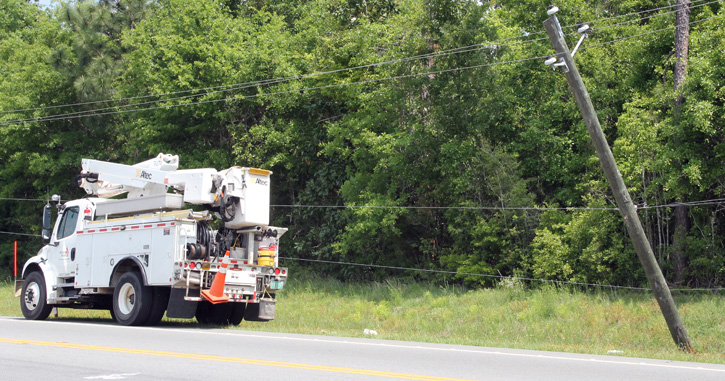
Over 400 Gulf Power customers in the Molino and Dogwood Park areas lost power this morning when the driver of a truck hit a power pole on Highway 97.
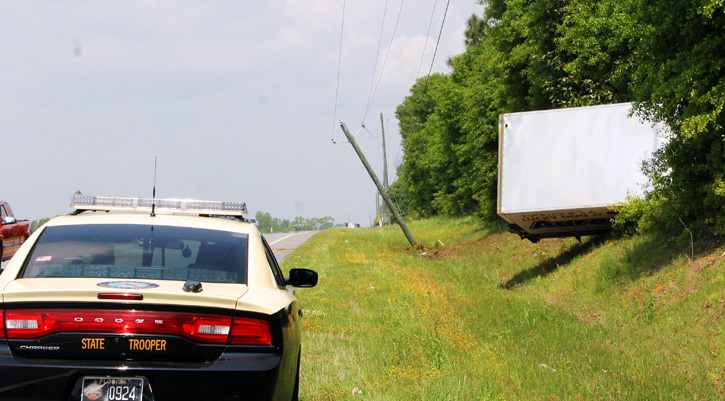
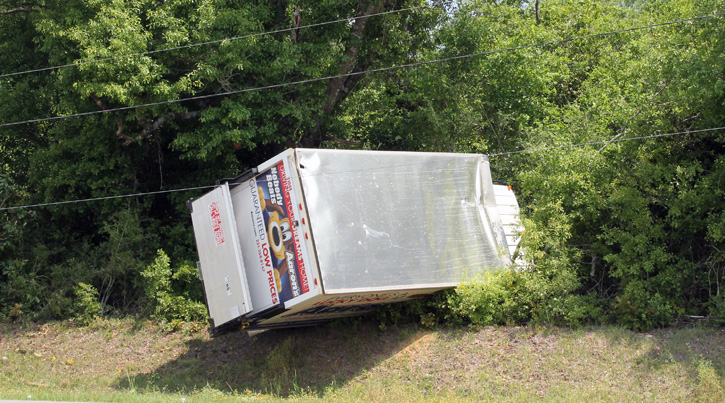 The accident happened about 10:50 a.m. on Highway 97 just north of Highway 29. The Florida Highway Patrol said 21-year old Vidal Robinson of Atmore was driving the 2013 Isuzu box truck south on Highway 97 when he drifted across the oncoming lane and onto the shoulder where he struck a utility poles.
After hitting the pole, the truck rotated counterclockwise and slid about 70 feet before overturning. Robinson refused medical treatment.
The accident was by the Florida Highway Patrol. The FHP said Robinson was cited for careless driving. The Molino Station of Escambia Fire Rescue, Escambia County EMS and the Escambia County Sheriff’s Office also responded to the accident.
Gulf Power restored power by about 3:15 p.m.
NorthEscambia.com photos, click to enlarge.