

Family Fishing Rodeo This Weekend To Support The ‘Backpack Project’
August 29, 2014
The Escambia County School District’s Maintenance Department is hosting the “Backpack Project” fishing competition this weekend. Last year’s event raised enough money to provide nutritious food that was able to be sent home weekly to 150 students at three different schools.
Charles Peterson, director of Maintenance and Custodian Services, said, “All research indicates that adequate nutrition in children can be linked to improved learning skills and memory work. Inadequate nutrition can contribute to lower test scores and poor concentration.”
“Anglers will have the opportunity to win cash prizes in 17 different sponsored categories,” he added. There will be two groups of fishermen: an Open Division for anglers 10 and older, and a Junior Division for those under ten years of age.
A Captain’s meeting will be held Friday at 6:30 p.m. at the Grand Lagoon Yacht Club. The fishing fun and competition begins Saturday at 12:01 a.m. and ends Sunday at 4:00 p.m. Weigh-in times are scheduled as follows: Saturday 2:00 p.m. to 5:00 p.m. and Sunday from 2:00 p.m. until 4:00 p.m. The awards ceremony will start at 5:00 p.m. on Sunday.
In addition, a fish fry will be held on Sunday from 3:30 to 5:00 p.m. The cost will be $5.00 for adults and $1.00 for children under 10. T-shirts will be sold for $15.
For additional information, contact Rodeo Chairman Scott Stillman at (850)595-0135, or sstillman@escambia.k12.fl.us.
Wahoos Get Comback 6-5 Win
August 29, 2014
The Pensacola Blue Wahoos (27-39, 58-78) won in thrilling fashion, 6-5, over the Birmingham Barons (29-36, 58-77) at Regions Field Thursday night. After tying the game with two runs in the ninth, the Wahoos took the lead in the 10th on Bryson Smith’s fourth single of the game. RHP Shane Dyer earned his franchise leading 20th save of the season in the bottom half of the inning.
 The Wahoos shot out to an early lead in the top of the first with a two-out RBI double from Travis Mattair. The Barons tied the score up in the bottom of the second on an RBI double from Joey DeMichele, who scored Jason Coats from second base.
The score remained even until the sixth when Devin Lohman knocked a double deep to left center field. Kyle Waldrop’s groundout moved Lohman to third and he came home to score on Mattair’s fielder’s choice ground ball on the right side.
Pensacola’s lead was short-lived as the Barons scored two runs in the bottom of the sixth. With the bases loaded, DeMichele hit his second double of the game, which scored two Barons. Yorman Rodriguez and Brodie Greene would combine to throw out the runner, Jason Coats, at home as he attempted to score from first. Birmingham’s manager Julio Vinas argued with the umpires and protested the call believing that Wahoos’ catcher Chris Berset was blocking the plate. The rest of the game was played under protest.
The Barons tacked on another run in the bottom of the seventh to take a 4-2 lead over the Wahoos. Waldrop answered for the Blue Wahoos with his seventh home run since the All-Star break to cut the lead to one. Again, the Wahoos could not put together a shut down inning as the Barons re-took a two-run lead in the bottom of the eighth.
Pensacola refused to go down without a fight in the top of the ninth inning. Juan Silverio led off with a double and the next hitter, Bryson Smith, singled him home on a sharp line drive to left field. Smith would eventually come home on a sacrifice fly from Greene to tie the contest at five. It was Birmingham’s 23rd blown save of the season.
In the 10th, Mattair bunted himself on and reached second on the Barons’ third error of the night. Smith, who finished the day 4-for-5 with two RBI, singled him home for the eventual winning run. Smith was one of four Wahoos that ended up with a multi-hit game.
RHP Mikey O’Brien rejoined the team from Triple-A Louisville and made his 11th start of the season with Pensacola. O’Brien pitched well, allowing just three runs over 5.2 innings of work. RHP Radhames Quezada made his Double-A debut for the Blue Wahoos in the seventh inning. Quezada went 1.0 innings and struck out a batter. LHP Fabian Williamson earned his second win of the season going 2.0 innings and allowing 1 R/ER on one hit.
LHP Nelvin Fuentes allowed the winning run in the 10th and took the loss for the Barons.
Pensacola’s series continues with Birmingham on Friday. The second game of the series will begin at 7:05 p.m. at Regions Field. The Blue Wahoos will send RHP Tim Adleman (3-7, 3.00) to the bump on Friday. The Barons have tabbed RHP Mike Recchia (5-4, 3.32) as their starter.
by Tommy Thrall
Two Sentenced For Theft Of Molino Teen’s Kart Racing Gear
August 28, 2014
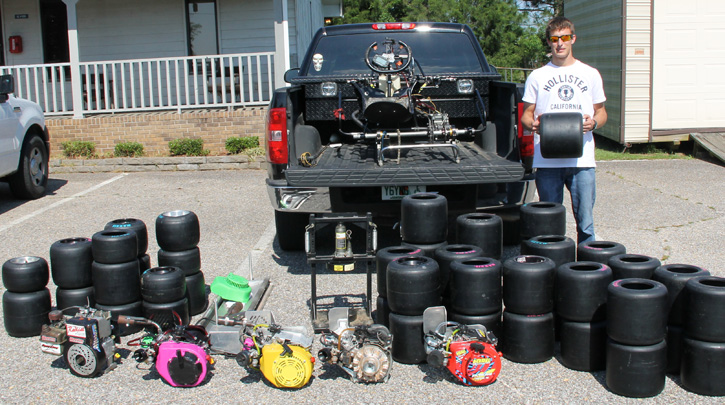
Two people have been sentenced in connection with the May 2013 theft of kart racing gear from a Molino teen.
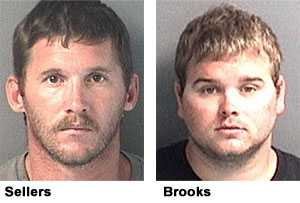 Amos Dewayne Sellers, age 34 of Pensacola and Lake Daniel Brooks, age 23 of Cantonment, were both charged with burglary and grand theft following the incident.
Both men entered pleas of no contest to the charges against them. Judge Michael Allen withheld adjudication in both cases. Each was sentenced to one year community control, three years probation, 250 hours of community service and ordered to pay $1,194 restitution plus $518 in fines and court costs.
The Escambia County Sheriff’s Office says the pair were responsible for the theft of about $16,000 worth of stolen kart racing gear.
In May 2013, Investigator David Preston returned the stolen gear back to the family. Jarrett Parker is a star of sorts in the world of kart racing, winning state titles and racing his way to the top in several national events.
 But the brakes were put on his racing career after the burglary at the family workshop on Gibson Road. A 2012 Elite Triton kart, five motors, cases of MAXXIS tires, tools and other items were taken from the workshop, while other items not related to kart racing like lawn equipment were left behind.
After a story about the thefts appeared on NorthEscambia.com on May 6, 2013, the Sheriff’s Office and family began to receive tips that led to the recovery of the racing equipment.
Some of the stolen items, including three motors, belonged to Jarrett’s then 10-year old teammate in Selma, Ala.
Just days after the stolen equipment was returned, Parker was the Senior Pro Clone Winner at Checkered Flag Speedway in Stateline, MS.
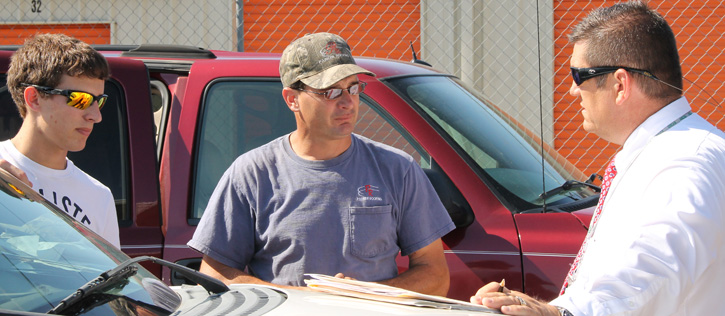
Pictured top: Molino teen Jarrett Parker with about $16,000 worth of stolen kart racing gear returned in May by the Escambia County Sheriff’s Office. Pictured inset: The suspects attempted to change the appearance of motors by painting them. Pictured below: Jarrett Parker and his father Cott discuss the case with Escambia County Sheriff’s Investigator David Preston. NorthEscambia.com photos, click to enlarge.
Workshop To Explore 6-Laning Highway 29 South Of 9½ Mile
August 28, 2014
The Florida Department of Transportation will host a public workshop concerning proposed improvements to Highway 29 from I-10 to Nine and One Half Mile Road. The meeting will be held Tuesday, September 9, from 5:30 to 6:30 p.m. at the Northside Apostolic Church, 213 West Nine and One Half Mile Road, Pensacola.
 The intent of the project is to increase vehicular capacity of the corridor as well as accommodate bicycle and pedestrian traffic. Improvements include widening 2.46 miles of U.S. 29 from four to six lanes, while adding curb and gutter, sidewalks, improving drainage and constructing various safety upgrades along the corridor to meet current standards set by the Americans with Disabilities Act (ADA). Additionally, there will be traffic signal modifications and the construction of storm water drainage treatment facilities, the project is funded for right-of-way acquisition and construction.
Maps, drawings and other information will be on display. There will be no formal presentation. Representatives from FDOT will be available to discuss proposed improvements, answer questions and receive comments.
Escambia, AL, Animal Shelter Now Empty, 200 Animals Gone Days Before Closure
August 28, 2014

The animal shelter in Flomaton is quiet today…almost 200 animals either adopted out or pulled by another rescue group. The Humane Society of Escambia County (Ala.) announced in July that it will no longer operate the shelter as of the end of the August.
 “When we saw ourselves a month ago with no future in the shelter, but with almost 200 poor souls whose future depended on us, we almost went into despair,” the group said in a written statement. “But anything is possible with the help of so many animal lovers out there.”
As for the future of The Humane Society of Escambia County (Ala.), the group plans to form a network of foster homes. They’ve pledged to continue helping animals as they can in Escambia County, Ala. but without a kill shelter.
The humane society decided to close the shelter, saying that they were unable to “humanely operate” on a $120,000 per year budget proposed by the Escambia County (Ala.) Commission.
Citizens Insurance Seeks Rate Cuts For Inland Homeowners
August 28, 2014
Citizens Property Insurance Corp. wants state regulators to reduce base rates for the majority of its policyholders for the first time since a move to artificially lower rates ended in 2009.
About 70 percent of Citizens’ policyholders, mostly inland residential customers, would benefit from the proposed 5.8 percent reduction for multi-peril coverage, according to the state-backed insurer. Meanwhile, the other 30 percent, many in commercial, condominium and coastal properties, could face increases.
 Citizens President and CEO Barry Gilway told the Florida Office of Insurance Regulation on Wednesday that the request comes as efforts have been successful to move more than a half-million policies into the private market the past two years and as rates in prior years have been increased to bring the state-backed insurer more in line with the private market.
Citizens has also been able to bulk up its surplus as Florida is now in its ninth hurricane season without the center of a major storm making contact with the state, he said.
“It’s has been hard getting here,” Gilway said. “But we’re finally at that point where we have good news.”
The Office of Insurance Regulation has until September 4 to rule on the request.
Insurance Commissioner Kevin McCarty wouldn’t speculate on how his office will rule after the “fact finding” session with Citizens officials Wednesday.
Amy Bogner, a spokeswoman for the office, said the decision may not be released publicly until September 5.
The proposed reduction doesn’t automatically mean a drop in costs for all policyholders as individual rates vary county by county, by the locations of properties and by property owners’ different types of coverage.
For example, sinkhole rates will remain flat for most of the state except in Hernando County, where Citizens is requesting a 10 percent increase.
Also, rates for businesses and condominium associations, which comprise about 36,000 of Citizens’ policies, are proposed to increase from 0.2 percent to 10 percent depending upon the type of coverage.
Gilway said more work is need to further trim the number of policies in Citizens.
“I’m not suggesting that the glide path (rate) increases have not been significant in some areas,” Gilway said. “And I’m also not suggesting that we’re there yet, because primarily in the commercial lines arena and the coastal arena, we’ve got a ways to go to get to rate adequacy.”
State lawmakers froze rates from 2007 through 2009 in reaction to a public outcry over spiraling insurance rates, particularly in coastal areas, despite the argument that the freeze would place a burden on the rest of the insurance market.
Citizens quickly became the go-to insurer for many homeowners rather than serving as an insurer of last resort.
Since 2009, rates have steadily increased as lawmakers have sought to draw private insurers to the state.
Citizens had 933,807 policies in place as of July 31, down from 1.5 million two years ago.
UF Report: Florida Consumer Confidence Holds Steady
August 28, 2014
The state’s consumer confidence remains at a post-recession high for the third consecutive month, according to a University of Florida report.
On a scale that ranges from two to 150, confidence among Floridians sits at 82, four points higher than in May, the last time the number changed, according to a release Tuesday from UF’s Survey Research Center in the Bureau of Economic and Business Research.
The numbers, however, don’t reflect mass optimism in the Sunshine State.
The overall index shows an increasing pessimism in households with incomes over $30,000 a year and also recorded a drop among respondents ages 50 to 65 who may be concerned about their personal finances at they look toward retirement, the UF report noted.
“These results suggest the Florida economy is not growing rapidly,” said Chris McCarty, director of the research center. “While it’s good news that the index is not volatile, we would like it to be about 10 points higher given that the recession ended more than five years ago.”
New Fiber Optic Internet Connection Being Installed For Schools
August 28, 2014
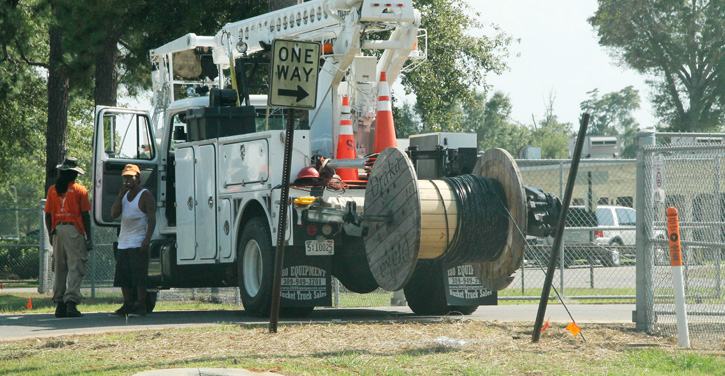
A new fiber optic cable is being installed in the Byrneville, Bratt and Walnut Hill areas. The fiber connection is being installed by a contractor for Southern Light Fiber based in Mobile.
According to Escambia County School Superintendent Malcolm Thomas, the fiber connection will be used to provide improved high speed internet services for Northview High School, Bratt Elementary and Ernest Ward Middle School.
Pictured: A new fiber optic cable is installed outside Bratt Elementary School. NorthEscambia.com photo, click to enlarge.
No Surprises: With Primaries Over, Scott And Crist Look Toward November
August 27, 2014
Republican incumbent Rick Scott and Democrat Charlie Crist are headed for a November battle of the governors after both easily sailed through Tuesday’s primary elections.
The race between Scott and his predecessor Crist is already one of the nation’s most-watched, and expensive, campaign throw-downs. Crist was elected in 2006 as a Republican governor and served a single term before losing a 2010 bid for the U.S. Senate as an independent to Marco Rubio. Crist, who defeated former lawmaker Nan Rich on Tuesday, registered as a Democrat less than two years ago.
“On to November. It’s us against Rick Scott — and for the people of Florida, we’re going to win. Are you in?” Crist posted on Twitter shortly before addressing supporters in Fort Lauderdale Tuesday night. After taking the stage to “Here Comes the Sun,” Crist said he is focused on “giving Florida back to the people of Florida.”
Since entering the governor’s race last November, Crist largely ignored Rich, a former state Senate minority leader. That included refusing to debate Rich, a 72-year-old grandmother from Weston and former national president of the National Council of Jewish Women.
Outraised 20-to-1 by Crist, the little-known Rich traversed the state on a shoestring budget, meeting with Democratic clubs from the Panhandle to the Keys while painting herself as the “true” Democrat in the race.
Crist, meanwhile, travels on private planes and has campaigned almost exclusively against Scott, whose allies have pledged to spend $100 million to keep Crist from returning to the plaza level in the Capitol.
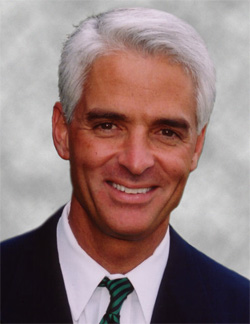 Crist spent much of 2014 reinventing himself as a Democrat. He apologized to gays for his former support of Florida’s law banning same-sex marriages, put into the state Constitution by voters in 2008. Crist also backed away from his previous opposition to instate tuition for undocumented immigrant students, something Scott and the GOP-dominated Legislature approved this spring. Crist, who as education commissioner was a cheerleader for Gov. Jeb Bush’s “A+” education reforms, has also since tempered his positions on school vouchers and high-stakes testing for public school students.
While Crist — the self-dubbed “People’s Governor” — concedes he has evolved on some issues, he insists that he has remained steadfast on issues important to Democrats.
Soon after taking office as governor in 2007, Crist convinced the Florida Cabinet to make it easier for felons to have their rights, including the right to vote, restored. In contrast, one of Scott’s first actions as governor was to push the Cabinet to impose some of the nation’s harshest restrictions on felons seeking to have their rights restored, including a minimum five-year wait period.
Crist, who says he personally opposes abortion, earned high praise from women’s rights advocates when he vetoed a controversial abortion measure that would have required women to undergo ultrasounds prior to getting the procedure. Scott later signed a similar bill into law.
Before leaving office in 2010, Crist became a darling of the teachers’ unions after he vetoed a far-reaching education measure, backed by Bush, which would have made it easier to fire teachers and would have linked educators’ pay to student test scores.
Crist’s efforts at winning over progressives and base voters, who are more likely to show up for primaries in mid-year elections like Tuesday’s, appeared to succeed.
As of 9 p.m. Tuesday, he had captured nearly 75 percent of the vote, including in Rich’s Broward County backyard, the bastion of Democratic voters in Florida.
Crist, 58, began his career in public service after being elected to the Florida Senate in 1992, where he served until 1999. His current quest for governor is Crist’s sixth attempt at statewide office — he ran losing bids for U.S. Senate in 1998 and 2010, and was elected as education commissioner in 2000, attorney general in 2002 and governor in 2006.
Democratic National Committee Chairwoman Debbie Wasserman Schultz, a U.S. congresswoman from Broward County, praised Crist and running-mate Annette Taddeo as working-class champions.
“Charlie and Annette have embraced policies that will help Florida’s middle-class families, a stark contrast to the current governor, Republican Rick Scott, who is beholden to special interests and radical Tea Party ideology,” she said in a statement.
And Florida Democratic Party Chairwoman Allison Tant also praised Crist, saying that Democrats “are ready to work harder than we’ve ever worked” to boost him to victory.
Scott handily defeated two obscure GOP opponents, Yinka Abosede Adeshina and Elizabeth Cuevas-Neunder, on Tuesday. But the Scott team’s primary focus has been on Crist.
“The next few months are about talk versus action. That means Florida will have a choice between a governor who sent our state into a tailspin and a governor who gets results. Charlie Crist failed as governor, lost 830,000 jobs, and tried to run off to Washington — and now he wants his job back. We’ve come a long way in the last few years, but there’s plenty of work left to do. Let’s keep working,” Scott said in a statement after the polls closed Tuesday evening.
by Dara Kim, The News Service of Florida
Century Man Threatens To Kill Deputies, Every Cop That He Sees
August 27, 2014
A Century man is behind bars on a weapons charge after allegedly threatening to kill multiple Escambia County Sheriff’s deputies and every cop that he saw.
 Aaron Tyrone Madison, Jr., 31, was charged with possession of a concealed weapon by a convicted felon and criminal mischief with property damage.
An Escambia County Sheriff’s deputy observed a four wheeler traveling north on Highway 29 carrying a passenger. The driver cut across Highway 29 onto Highway 4A. The deputy caught up with the four wheeler after it stalled in the 4000 block of Highway 4A.
The driver of the four wheeler, identified as Madison, immediately took “an aggressive posture by balling his fists and taking a fighting stance, then started cursing, and threatened to shoot me and every cop he sees,” an arrest report states.
Madison told the deputy that he was upset because “the police were shooting [expletive] in the street,” according to the arrest report. The deputy reported that Madison continued to be aggressive, verbally abusive and continued to threaten to kill him while holding an aggressive stance with his fists balled up. Madison was detained after he pleaded with the deputy to shoot him.
A loaded .22 caliber semi-automatic Ruger pistol was found concealed under the driver’s seat of the four wheeler, with one bullet in the chamber and the weapon ready to fire, according to the report. Madison claimed ownership of the gun, saying “he wanted to shoot some police”.
The passenger on the four wheeler was released and not charged.
While being transported to the jail, Madison slipped his handcuffs to the front and attempted to break the plexiglass partition in the deputy’s vehicle as he yelled for the deputy to stop the vehicle or he would climb up front and kill him. The deputy stopped his vehicle near the Camp O’ The Pines in McDavid where additional deputies arrived and assisted in placing Madison in leg restraints and reposition his handcuffs. Damage to the vehicle was estimated at less than $200.
Madison made several more death threats to each deputy and stated several times that he wanted deputies to shoot him, the arrest report states.
Several corrections officers were needed to removed Madison from the deputy’s vehicle.
The deputy’s in-car video and audio were active during the incident.
Madison remained in the Escambia County Jail with bond set at $15,500.