

Supreme Court Rejects Cellphone Tracking By Police
October 17, 2014
Pointing to privacy rights, the Florida Supreme Court on Thursday said police need to get warrants before using cell-phone information to conduct “real-time” tracking of criminal suspects.
 Justices, in a 5-2 decision, sided with a man who was arrested in 2007 in Broward County after a search of his vehicle uncovered a kilogram brick of cocaine hidden in a spare-tire well. Police tracked the man, Shawn Alvin Tracey, through location information given off when cell-phone calls are made.
In a 46-page majority opinion, Chief Justice Jorge Labarga wrote that using the information without a warrant violated Tracey’s Fourth Amendment constitutional rights, which protect people from unreasonable searches and seizures. Labarga, in ruling that evidence against Tracey should be suppressed, also pointed to the public’s dependence on cell phones.
“We cannot overlook the inexorable and significant fact that, because cell phones are indispensable to so many people and are normally carried on one’s person, cell phone tracking can easily invade the right to privacy in one’s home or other private areas, a matter that the government cannot always anticipate and one which, when it occurs, is clearly a Fourth Amendment violation,” wrote Labarga, who was joined in the majority by justices Barbara Pariente, R. Fred Lewis, Peggy Quince and James E.C. Perry.
The American Civil Liberties Union of Florida issued a statement calling the decision a “big victory for privacy in Florida.”
“The Florida Supreme Court has definitively stated what we have asserted all along: that police can’t track your movements in public using these cell phone tracking tools without first getting a warrant,” ACLU attorney Benjamin Stevenson said in the statement. “Technology is changing all the time, but just because a technology you own is newer than the constitution’s protections doesn’t mean it is exempt from them. Police all over the state should now put an end to warrantless cell phone surveillance once and for all.”
But Justice Charles Canady, in a dissenting opinion, wrote that given the “known realities of how cell phones operate … cell phone users have neither a subjective expectation of privacy nor an objectively reasonable expectation of privacy regarding the cell site information generated by their cell phones.”
“Individuals may very reasonably desire that information they provide to third parties —such as a cell service provider, a bank, or a credit card company — be kept private,” wrote Canady, who was joined in dissent by Justice Ricky Polston. “But a strong desire for privacy is not equivalent to a legitimate expectation of privacy.”
The Tracey case started after police received information that he bought large amounts cocaine, which was transported from Broward County to the state’s West Coast for distribution. In October 2007, police received a court order to use technology that recorded telephone numbers dialed from Tracey’s cell phone and numbers from incoming calls.
More than a month later, officers learned that Tracey would be coming to Broward County to pick up drugs to transport to the Cape Coral area, where he lived, according to Thursday’s ruling. Without getting additional court approval, police used electronically generated cell-phone information to track his movements in real time, ultimately leading to the arrest.
A circuit judge and the 4th District Court of Appeal rejected arguments that evidence in the case should be suppressed, but Labarga wrote that a warrant, based on probable cause, was required for the location information.
“Simply because the cell phone user knows or should know that his cell phone gives off signals that enable the service provider to detect its location for call routing purposes, and which enable cell phone applications to operate for navigation, weather reporting, and other purposes, does not mean that the user is consenting to use of that location information by third parties for any other unrelated purposes,” Labarga wrote. “While a person may voluntarily convey personal information to a business or other entity for personal purposes, such disclosure cannot reasonably be considered to be disclosure for all purposes to third parties not involved in that transaction.”
by Jim Saunders, The News Service of Florida
Victims Identified In Jay Murder Suicide
October 16, 2014
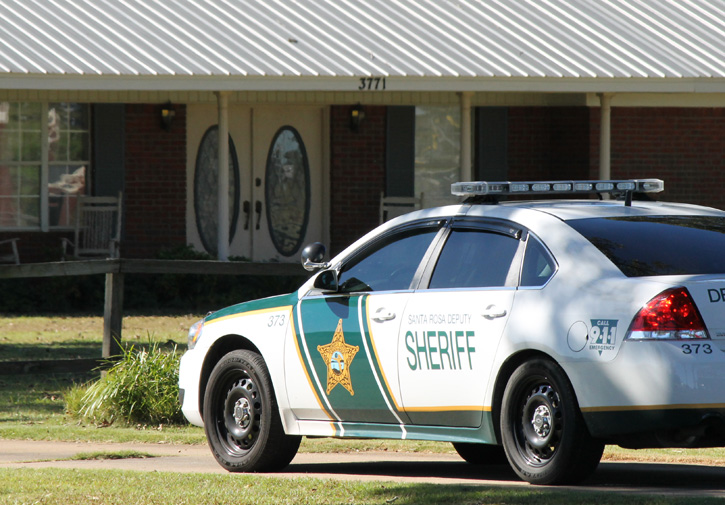
The Santa Rosa County Sheriff’s Office has released the names of two people involved in an apparent-murder suicide near Jay early Thursday morning.
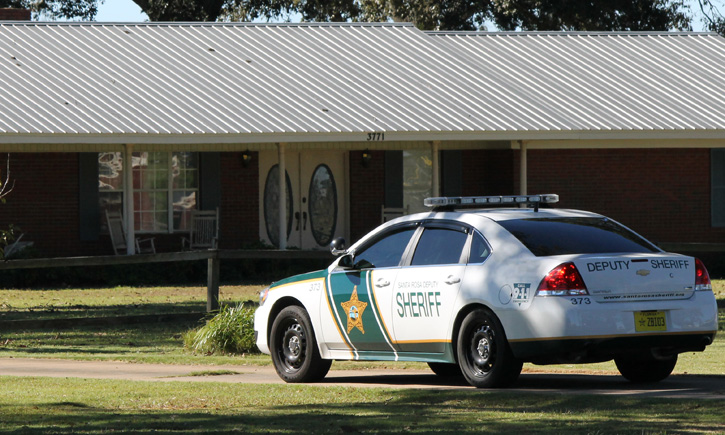
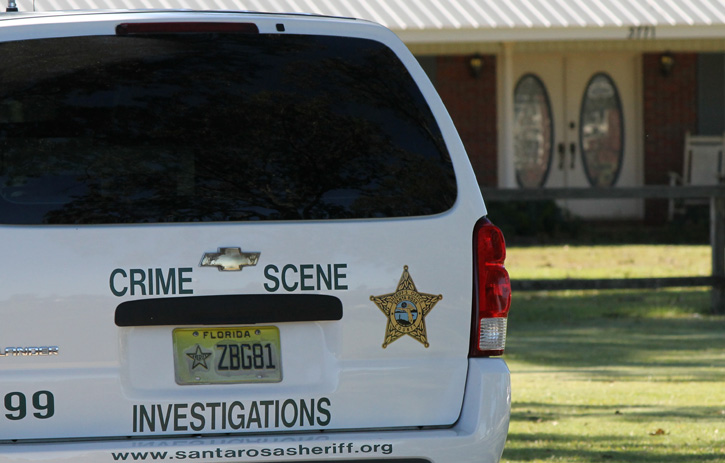 The Sheriff’s Office received a call reporting a shooting at 3771 Nowling Road at 5:56 a.m., and deputies were on scene within three minutes.
Deputies found two deceased individuals – a male and a female – inside the residence. A spokesperson for the Sheriff’s Office said the incident was domestic violence related.
The victims were identified as 41-year old Misty Wright Herring and 43-year old Max Bruce Herring. According to court records, the two were in the process of getting a divorce.
Misty Herring was a pharmacist as the Duramed Pharmacy in Jay, and was formerly the pharmacist at Flomaton Pharmacy.
The shooting appeared to have occurred sometime during the overnight hours. Misty had two children from a previous marriage. Lt. Leeland Butcher said the children were not involved in the shooting and are being cared for by relatives.
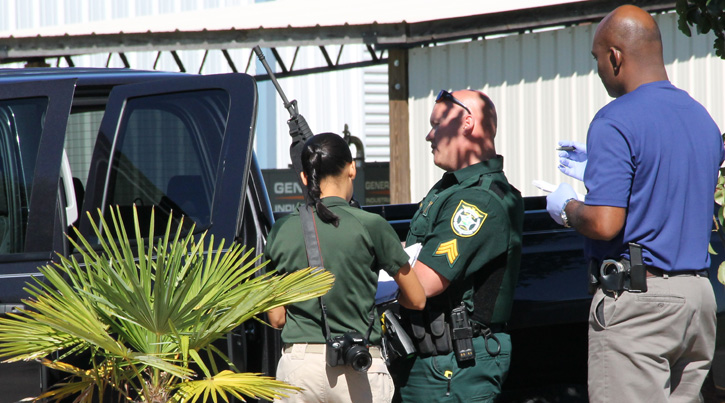
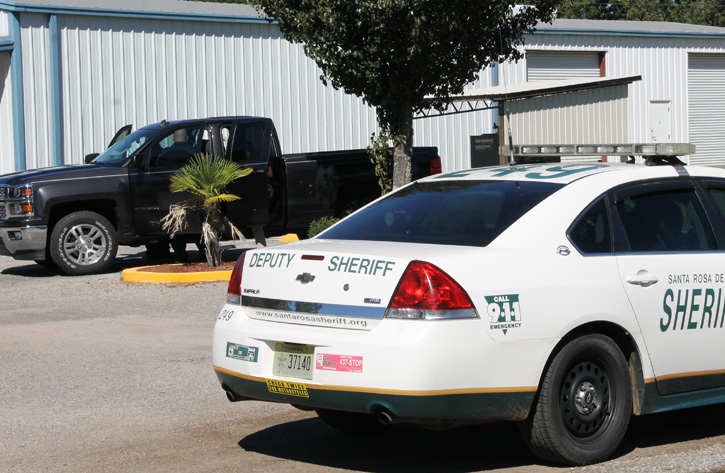
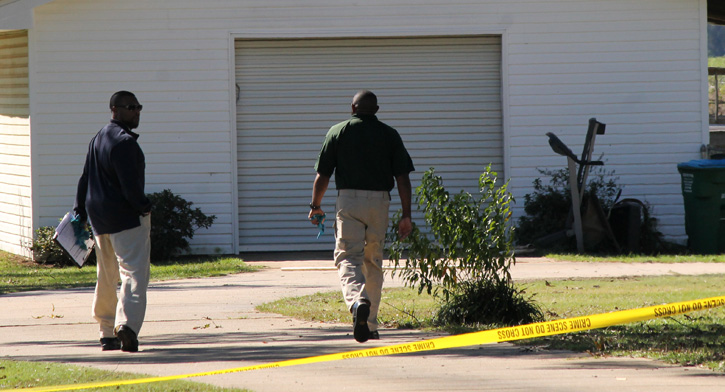
Investigators were also seen combing through a truck in the parking lot of the Moore Creek-Mt Carmel Utilities company, a short distance from the scene. Investigators removed at lease one weapon, a long gun, from the vehicle. The vehicle reportedly belonged to one of the victims.
Nowling Road is just outside the Jay city limits, about a mile south of Jay High School. The Jay schools were placed on a brief lockdown this morning as deputies responded and began their investigation. The lockdown was lifted after is was determined to be a likely murder-suicide with no other suspect.
The incident remains under investigation. Further details will be posted as they become available.
Pictured top and inset: An apparent murder suicide was discovered at this home on Nowling Road in Jay. Pictured first two photos below: Investigators and deputies secure a weapon found in a truck in the parking lot of the nearby Moore Creek-Mt. Carmel Utilities Company. Pictured bottom: More photos from the scene. NorthEscambia.com photos, click to enlarge.
State Selects Century To Participate In Competitive Florida Partnership
October 16, 2014
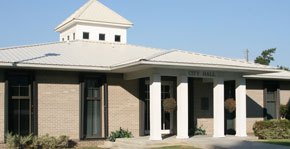
The Town of Century has been selected to participate in the Competitive Florida Partnership, a rural community development initiative.
 The Competitive Florida Partnership focuses on improving local economic development activities, particularly in the rural areas of Florida. The Florida Department of Economic Opportunity will assist Century in working to implement the town’s strategic economic development plan in a way that is tailored to the community’s unique character and vision. One facet of the program will be to create a community asset inventory that will be available to local businesses wishing to expand or potential businesses interested in moving to Century.
The Competitive Florida Program will help Century to market the community’s local assets and to set realistic goals for advancing the town’s economic development vision. The program will help Century develop an innovative economic development strategy that promotes partnerships, community design, and a vibrant local economy.
Asset-based economic development is a bottom-up approach that focuses on developing and promoting existing local resources such as the available workforce, buildings and land, public infrastructure, transportation networks, education, political advocacy and civic organizations, to strengthen the local economy. This approach focuses on leveraging a rural community’s assets and economic advantages into sustainable economic growth and prosperity. DEO will work with Century to identify and market these assets and facilitate promotional opportunities to bring economic development to the community.
Young Wyatt Johnson Loses Fight Against Rare Disease
October 16, 2014

Wyatt Johnson of Century passed away late Wednesday afternoon in Atlanta. He was just two and a half.
Wyatt suffered from a rare liver disease – Langerhans cell histiocytosis – that required chemotherapy and would have eventually required a transplant. He also had an enlarged liver, spleen and heart.
 Last year, Wyatt received national attention due to Shelby Godwin of Bratt. She saw a fundraising flyer with Wyatt’s picture at CVS in Century. She was so emotionally touched by the young man that she wanted to do something to help him, and she set up a roadside orange juice stand to raise money for a young child she had never met. The then 10-year old used her own money to purchase the oranges and supplies for her little business venture and borrowed an old fashioned juicer from a friend of her mom.
Wyatt’s family has an active GoFundMe website that was established to pay about $30,000 in transportation expenses for Wyatt and his family that were incurred to and from Atlanta where he received his specialized medical care. Donations can be made here.
Pictured: Wyatt Johnson in October of last year when a special event was held in his honor at Bratt Elementary School for him to meet Shelby Godwin (bottom photo) for the first time. NorthEscambia.com file photos, click to enlarge.

Two Bodies Found In Mobile Home
October 16, 2014
The bodies of a man and woman were found inside a mobile home in Ensley Wednesday night after neighbors called deputies saying the family had not been seen in days.
 When Escambia County Sheriff’s deputies arrived, they said cars were in the driveway of the residence in the 99 Oaks Mobile Home Park, but no one would answer the door. Deputies forced their way into the home and found the two bodies. There were reportedly no weapons found in the home.
The Sheriff’s Office said a cause of death will be determined by the Medical Examiner’s Office and a determination will be made if there was foul play in the deaths.
Neighbors described the couple as being in their mid-40’s.
Cross Country: Northview, EWMS, Flomaton, Miller
October 16, 2014

About 90 runners took part in a cross country meet with Ernest Ward Middle, Flomaton High, Milton High, Northview High, Catholic High and T.R. Miller High Tuesday at Northview High School in Bratt.
For additional photos, click here.
Results were as follows:
Top Girls Teams
- TR Miller- 30 points
- Pensacola Catholic- 36 Points
- Milton-63 Points
- Northview -141 Points
- Ernest Ward-153 Points
Fastest Girl-Allie Nelson from TR Miller with a time of 20:02
Top Boys Teams
- Pensacola Catholic- 29 points
- Milton High -50 points
- TR Miller -80 points
- Flomaton -126 points
- Northview -165 Points
- Ernest Ward-237 points
Fastest Boy- Grant Kemp from Pensacola Catholic with a time of 18:08
TOP FIVE RUNNERS FROM EACH SCHOOL
Northview Girls
- Moriah McGhan -25:29
- Mary Sullivan -31:53
- Bethany Reynolds -32:18
- Myisha Syria -33:01
- Jessica Barrows-41:28
Northview Boys
- Brandon Korinchak -20:20
- Josh Borelli -20:49
- Heath Sheldt -23:58
- Austin Ates -24:35
- Triston Reaves -28:03
Ernest Ward Girls
- Addison Albritton 28:11
- Haley Black -32:57
- Cailee Wilburn -33:02
- Lexxi Baggett -33:07
- Anna Sullivan 33:09
Ernest Ward Boys
- Brandon Sheldt -25:36
- Bryce Korinchak-28:07
- Shane Hardin -30:12
- Keaton Brown -32:48
- Alexander Floyd -35:04
Flomaton Boys
- Dustin Reaves -20:37
- Duane Hamby -21:00
- Dylan Patterson -22:07
- Dakota Boatwright -23:28
- Hayden Hammond 23:59
TR Miller Girls
- Allie Nelson- 20:02
- Tara Townsend -23:54
- Sarah Byrd -24:17.21
- Madison Lum -24:17.59
- Carmen Knowles -25:02
TR Miller Boys
- Travis Carlson -19:08
- Micah Flores 19:37
- Walker Harris 21:03
- Noah Morris 21:11
- Tuck McDaniel 21:54
Milton Girls
- Isabella Potate-23:36
- Nikki Delagarza-24:57
- Becky Ward -24:58
- Rachel Natioa-25:49
- Aly Bly-26:27
Milton Boys
- Cody Price -18:57
- Alex McDonald -19:03
- Myles Osborne -19:36
- Virgil Holmes -20:35
- Marcus Deloach -20:45
Pensacola Catholic Girls
- Annabelle Doyle-22:52
- Gabby Endacott-24:18
- Olivia Endacott-24:21
- Vivi Lee -24:35
- Angie Gonzalez-24:40
Pensacola Catholic Boys
- Grant Kemp -18:08
- Edward Neyman -18:09
- John Rawley -18:23
- Henry Marcille -19:23
- Logan Kane-19:40
NorthEscambia.com photos, click to enlarge.

Governor’s Race Debate Blown Away By Crist, Scott Dispute Over Fan
October 16, 2014

After tens of millions of dollars worth of television commercials and the slinging of massive amounts of mud, could the Florida gubernatorial election come down to an electric fan?
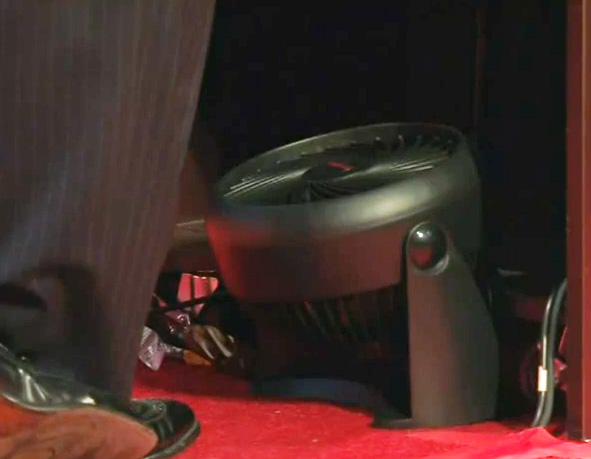
In the latest strange chapter in the always-fascinating politics of Florida, Gov. Rick Scott skipped the first few minutes of a televised debate Wednesday with his Democratic challenger, former Gov. Charlie Crist, because of the presence of an electric fan at Crist’s feet.
Actually, debate organizers were unsure at first whether either of the candidates would be on stage, though Crist strode out as moderator Eliott Rodriguez tried to explain the situation to the audience.
 “Ladies and gentlemen, we have an extremely peculiar situation right now,” Rodriguez said.
Scott eventually came out as well, but the incident brought a whole new meaning to the “spin room,” where surrogates for the two candidates gathered and tried to make sense of a nonsensical turn of events.
The Crist camp’s description of events: They had learned that after an event last week featuring CNN anchor Candy Crowley, the stage at the remodeled venue, Bailey Hall at Broward College, was described as uncomfortably warm. Debate organizers promised to fix the problem — with fans if necessary.
“They said they were going to fix it,” said former state Sen. Dan Gelber, who signed the debate agreement on Crist’s behalf. “And they said … if they don’t, they’ll have something available.”
The Crist campaign quickly produced the copy of the rules they signed, where Gelber had written in “with understanding that the debate hosts will address any temperature issues with a fan if necessary.”
But Scott’s supporters countered that the fan violated the rules of the debate, and Rodriguez said in the opening moments of the debate that a copy of the rules showed to him by the incumbent’s campaign indicated the fan shouldn’t be on the stage.
In fact, Scott’s camp said, it was Crist who threatened to pull the plug on the event if the fan was not plugged in.
“When I got here today for this debate, I was told that Charlie Crist was going to cancel the debate, because unless there was a fan on that stage, he would not come out,” said U.S. Sen. Marco Rubio, R-Fla. “So I think that Governor Scott was waiting to see if Charlie would actually pull that off or not.”
Scott and others said he didn’t immediately take the stage at the beginning of the debate because he wanted to make sure Crist did.
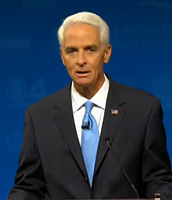 Crist’s nearly ubiquitous fan was already famous, memorialized by a Twitter account and obsessed over by MSNBC host Chris Matthews. Rubio said that “a similar incident” happened in a 2010 Senate debate between himself, former Democratic Congressman Kendrick Meek and Crist, then running as an independent, when Meek complained about the fan.
Both campaigns tried to blow off the issue Wednesday night, but only after scoring a few political points from it.
“What looked bad was this bizarre incident tonight where Charlie Crist insisted on ignoring the rules of a debate, just like he’s ignored the rules time and again when it comes to telling the truth about what he stands for on issue after issue,” Rubio said.
“Charlie Crist can bring his fan, microwave, and toaster to debates — none of that will cover up how sad his record as governor was compared to the success of Rick Scott,” Scott campaign manager Melissa Sellers said in a statement issued after the debate, an apparent effort at damage control. “Crist should buy a fan for the 832,000 Floridians who lost their jobs while he was governor.”
Crist’s campaign said Scott was afraid to address issues.
“I think it’s outrageous that he’s worried about that when he’s not worried about a million Floridians without health insurance, he’s not worried about teachers, he’s not worried about my kid who goes to a public school,” said Annette Taddeo, Crist’s running mate. “That’s what he should be worried about, not about a fan.”
Both candidates addressed the fan flap near the end of the debate, with Crist defending having his cooling system on hand.
“Is there anything wrong with being comfortable?” Crist said. “I don’t think there is.”
Once the debate did begin, the candidates continued the squabbling that started in television commercials and carried through a debate last week at Spanish-language broadcaster Telemundo.
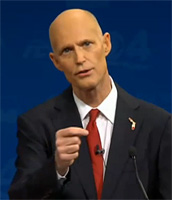 “That’s not true,” Scott said at one point during a discussion of insurance rates.
“Oh, it’s true,” Crist shot back.
Crist once again brought up a years-old deposition in a civil case where Scott invoked his right not to incriminate himself 75 times.
“That is not the kind of leadership that Florida deserves,” Crist said.
In response to a question about gay marriage, Scott noted Crist’s evolving position on the issue — part of a narrative seeking to portray Crist as a habitual flip-flopper.
“We don’t actually know what Charlie believes on this issue, because he’s taken every side of this issue,” Scott said.
But most of the talk on social media and at the debate venue concerned the fan — and whether or not it will make any difference.
“It’s funny, but in terms of pushing people, I doubt it,” said Susan MacManus, a political science professor at the University of South Florida. “But it may make them watch the next one.”
by Brandon Larrabee, The News Service of Florida
Free Hunter Safety Course Offered In Santa Rosa County
October 16, 2014
The Florida Fish and Wildlife Conservation Commission (FWC) is offering a free hunter safety course in Santa Rosa County.
 The class will be heldat Avalon Middle School, 5445 King Arthur’s Way, Milton. Instruction will be from 6-10 p.m. Oct. 21, 23, 28 and 30. The range portion of the class is Nov. 1 from 7-10 a.m.
An adult must accompany children under the age of 16 at all times. Students should bring a pencil and paper with them to take notes.
Anyone born on or after June 1, 1975, must pass an approved hunter safety course and have a hunting license to hunt alone (unsupervised). The FWC course satisfies hunter-safety training requirements for all other states and Canadian provinces.
People interested in attending this course can register online and obtain information about future hunter safety classes at MyFWC.com/HunterSafety or by calling Hunter Safety Coordinator Will Burnett at the FWC’s regional office in Panama City at 850-265-3676.
Molino Bar Wants Noise Ordinance Waived For Veteran’s Event
October 15, 2014
A Molino bar is asking the Escambia County Commission to waive the county’s noise ordinance for an all-day Veteran’s Remembrance Event and Ceremony.
The event is planned for 8 a.m. until midnight on Saturday, November 8 at Louie’s Tavern at 271 Molino Road. The event, according to the establishment’s application, is a “remembrance to celebrate life and remember the fallen”.
If approved the Escambia County Commission at their Thursday meeting, a special event permit will be issued.
Escambia Sample Ballots In The Mail
October 15, 2014
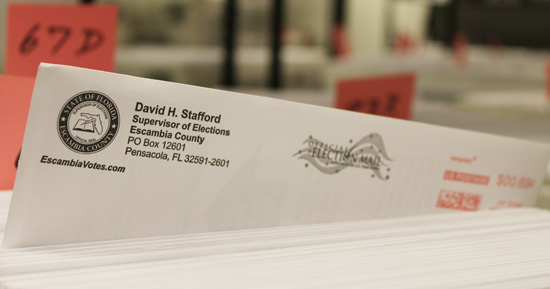 Sample ballots for the November 4 General election are being mailed to Escambia County voters beginning this week. according to Supervisor of Elections David Stafford. The sample ballot includes a ballot image, the voter’s polling location and information on early voting, absentee voting, and voting on Election Day. Sample ballots are also available at EscambiaVotes.com.
Early voting will begin Monday, October 20 and continue through Saturday, November 1.