
Florida Gov’t Weekly Roundup: Signed, Sealed Delivered
August 17, 2014
It might not have been the shortest special session in history — that honor likely goes to an hours-long offshore drilling session that then-Gov. Charlie Crist called in 2010 — but lawmakers who gathered in Tallahassee to address a redistricting mess didn’t stay long.
 In fact, the session ended a little more than 102 hours after the opening gavel. And 48 of those hours were part of the weekend.
With that, Tallahassee returned to its usual summer slumber. Crist swung by, campaigning to get his old job back, as part of a bus tour to tout his plan for education spending. The monthly jobs numbers were released, but largely remained flat, prompting relatively tepid responses from both sides of the aisle despite a looming November election.
BATTLE LINES
By the time the week opened, there wasn’t even that much suspense left about what would happen in the special redistricting session prompted by a court ruling on the old lines. A map released by GOP lawmakers was going to pass, and the only question would be how many Democrats would vote for it.
The answer, it turns out, was relatively few.
The plan (SB 2A) passed on nearly party-line votes in both chambers. The Senate voted 25-12 to approve a new map for seven congressional districts, with Democratic Sens. Audrey Gibson of Jacksonville and Bill Montford of Tallahassee voting with Republicans. In the House, Reps. Mia Jones and Reggie Fullwood, both of Jacksonville, were the only Democrats to support the bill as part of the 71-38 vote in favor of it.
“I certainly hope that litigation time is over and that fair voting time has started,” said Senate President Don Gaetz, R-Niceville.
That was more wishful thinking than anything else.
Prior to the vote, Democrats pounded the map, saying the process wasn’t any better in 2014 than it was in 2012, when the last lines were drawn and when, according to a ruling by Leon County Circuit Judge Terry Lewis, Republican consultants found a way to influence the map-making.
“Such behind-the-scenes collusions violated the constitution as well as the public’s trust. … Nothing really changed in this process this time around which would restore the integrity called into question the first time around,” said Rep. Karen Castor Dentel, D-Maitland.
Lewis ruled the original map unconstitutional last month after voting-rights organizations and some individual voters filed a lawsuit saying the plan didn’t follow the anti-gerrymandering Fair Districts amendments. In his decision, Lewis said lawmakers put too many African-American voters in Congressional District 5, currently represented by Democratic Congresswoman Corrine Brown, in an apparent effort to channel those Democratic-leaning voters away from surrounding districts.
The judge also found fault with an appendage of white voters added to Congressional District 10, now represented by Republican Congressman Dan Webster; Lewis said the voters were placed in Webster’s district to try to help the incumbent hold onto his seat.
The Republican response could more or less be found in a brief the Legislature filed with Lewis on Friday, defending the new plan.
“The Legislature acted promptly and in good faith not only to correct the deficiencies identified by this court but also to enact a plan that dramatically enhances both the visual and numerical compactness of the entire region, while protecting from diminishment the ability of minorities to elect their preferred candidates,” lawyers for the House and Senate wrote.
Meanwhile, Secretary of State Ken Detzner’s office told the court in a separate filing that any special general election to fill the seven seats couldn’t take place until May 26, 2015, if Lewis decided to delay the voting to allow the lines to take effect.
Voting-rights groups that challenged the districts, such as the League of Women Voters of Florida, signaled that Gaetz’s hopes for the litigation to be over wouldn’t be fulfilled.
“We do not agree with the positions taken by the legislative defendants, the secretary of state or the supervisors of elections in their filings today,” attorney Thomas Zehnder said. “We will be filing our response with the court by noon on Monday.”
CRIST: GREEN FOR SCHOOLS, GREEN LIGHT FOR LEAFY SUBSTANCE
Ignoring the primary opponent that he’ll face Aug. 26, Crist embarked on a three-day tour of the state, boarding a yellow school bus in an effort to school Gov. Rick Scott on education funding.
Crist, a former Republican governor who is running as a Democrat, said more of the state’s surplus should be devoted to schools.
“We don’t have a revenue problem, we have a priority problem in Florida,” Crist said during a Tallahassee stop. “The priority needs to be education. It needs to be our hardworking school teachers.”
But Rep. Matt Gaetz, R-Fort Walton Beach, pointed to a decline in school spending during the tail end of Crist’s term and said Scott had revived the economy to allow more funding for education.
“The reason that we’re able to invest more in education is because we finally have an actual leader in the Governor’s Mansion, not somebody that can’t figure out where he lives, can’t figure out what party he wants to be a member of and is generally, I think, someone who’s rudderless,” Gaetz said.
By the end of the week, Crist was talking about something more closely related to after-school specials than school spending: marijuana. He took Scott’s administration to task Friday for using a lottery to select five organizations to grow, manufacture and dispense a now-legal type of marijuana that purportedly does not get users high but can reduce or eliminate life-threatening seizures in children with epilepsy.
“The best way to award any contract is to have a good, open, honest, competitive process,” Crist said when asked about the issue Friday. “I don’t know that a lottery is the right way to go, frankly. It seems to me that people ought to submit their applications. They ought to be reviewed, thoroughly reviewed in a comprehensive fashion, and those that are determined to be the best are the ones that should get the contracts.”
The rule including the lottery provision is far from a done deal, however. After holding two workshops on the rule, health officials will hold another hearing Sept. 5 and could modify the proposal after that.
Lawmakers gave the state’s “Office of Compassionate Use” until Jan. 1 to come up with a regulatory framework for getting into the hands of patients a strain of marijuana that is low in euphoria-inducing tetrahydrocannabinol, or THC, and high in cannabadiol, or CBD.
Meanwhile, former Gov. Jeb Bush, a national Republican star reportedly considering a run for president in 2016, joined Scott on the campaign trail for the first time this season at the Homestead event.
On Thursday, Bush came out against a proposed constitutional amendment that would allow doctors to order “traditional” medical marijuana for critically ill patients. That amendment will appear on the November ballot.
Scott has said he personally opposes Amendment 2, which has been heavily bankrolled by Orlando trial lawyer John Morgan, who also is Crist’s Morgan & Morgan law firm boss.
But Crist on Friday called medical marijuana “the right thing to do,” reiterating his support for the amendment.
“I think it’s compassionate. I think that if a doctor prescribes medical marijuana to somebody who’s truly suffering and in need of help, I think it’s a lot better than prescribing something powerful like oxycontin that’s so harmful,” Crist said.
JOBS NUMBERS FLAT
State unemployment numbers issued Friday didn’t necessarily give Scott a lift in his bid for re-election, but they didn’t hurt him either. Florida’s jobless mark continued its steady run through 2014, holding at 6.2 percent from June to July, the state Department of Economic Opportunity announced.
But the numbers indicate there were about 1,600 fewer people employed in July in Florida than a month earlier.
Scott accentuated the positive Friday, focusing on private-sector job growth.
擢lorida痴 private sector created more than 2,000 jobs for Florida families in July, bringing total private-sector job creation since December 2010 to 620,300,” Scott said in a prepared statement. “Every new job positively impacts a family, and today痴 announcement is more great news for Florida families looking to live the American Dream in the Sunshine State.”
That drew a rebuke from the Florida Democratic Party.
Democratic Party spokesman Max Steele tweeted that Gov. Scott’s “email touts FL gaining 2.1k jobs in July. Only problem? FL lost ~3.7k in the same month, for net of -1.6k.”
The state’s unemployment rate, which stood at 7.3 percent a year ago, has been mostly flat this year, wavering between 6.2 percent and 6.3 percent.
STORY OF THE WEEK: Lawmakers approve a new set of congressional districts, ending a special session that began last week.
QUOTE OF THE WEEK: “I think it’s going to be the biggest yawner, and the only thing really to look for is, what is the margin for Crist? This is not the first, second or third thing on anybody’s mind.”—Screven Watson, a political consultant and former executive director of the Florida Democratic Party, on the primary between Crist and former Senate Minority Leader Nan Rich, a heavy underdog.
by Brandon Larrabee, The News Service of Florida
Wahoos Lose 3-0, Drop Series With Mobile
August 17, 2014
The 140 game Southern League season is down to the last 15 games for the Pensacola Blue Wahoos.
Wahoos Manager Delino DeShields said win or lose he just wants to see the team continue to play hard.
 Saturday night, they had the bases loaded in the seventh inning with no outs and they reached base every inning but couldn’t score, falling to rival Mobile, 3-0, in front of a 5,038-sellout crowd at Pensacola Bayfront Stadium.
“We couldn’t get the big hit tonight,” DeShields said. “But I think we’re playing hard. My biggest concern is not the wins or losses, my concern is the effort. I just want to see them keep playing hard.”
Pensacola’s best opportunity came in the seventh inning when center fielder Yorman Rodriguez had a lead off walk, Brodie Greene hit a bloop single to right field and Kyle Waldrop walked.
That’s when Mobile reliever Seth Simmons came in. All he did was strikeout the next three batters on nine pitches. Pensacola batters are now 6-for-52 against Simmons, or a .115 batting average.
“We were over swinging,” DeShields said. “He didn’t throw a lot of strikes but we got greedy. If we were patient a lot of at bats would have changed.”
Pensacola first baseman Travis Mattair was the first one to go down swinging against Simmons in the seventh. But otherwise had a good series going 7-for-20 (.350) against Mobile’s top pitching with one home run and 6 RBI. He’s raised his season average to .237 after struggling much of the year.
“You just have to keep working hard and stay positive,” Mattair said. “We’re playing good baseball. We just have to keep having fun and stay together as a unit.”
The BayBears showed why their pitching staff has a league leading 3.22 ERA, Saturday. Archie Bradley, who is the No. 1 pitching prospect in all of the minor leagues, according to Baseball America, shut Pensacola out over four innings. He gave up four hits, four walks and struck out three. In his last outing against Pensacola, the Wahoos chased Bradley with seven runs in 2.2 innings.
Mobile moved to 32-21, which is good for first place in the second half and is 74-48 overall. The BayBears are attempting to become just the second team in the Southern League’s 50-year history to win four consecutive halves.
The Pensacola Blue Wahoos start a five-game series against the Miami Marlins Double-A affiliate the Jacksonville Suns at 5:05 p.m. Sunday. RHP Daniel Corcino (10-10, 4.21) takes the mound for the Wahoos and is scheduled to be opposed by the Suns RHP Jose Urena (10-8, 3.64).
The Wahoos return for their last homestand of the season against the Tampa Bay Rays Double-A affiliate the Montgomery Biscuits.
School Bus Routes; Traffic Laws
August 16, 2014
School begins Monday in Escambia County, with over 300 yellow buses back on the road.
To locate your child’s bus stop and pick up/drop off times, click here.
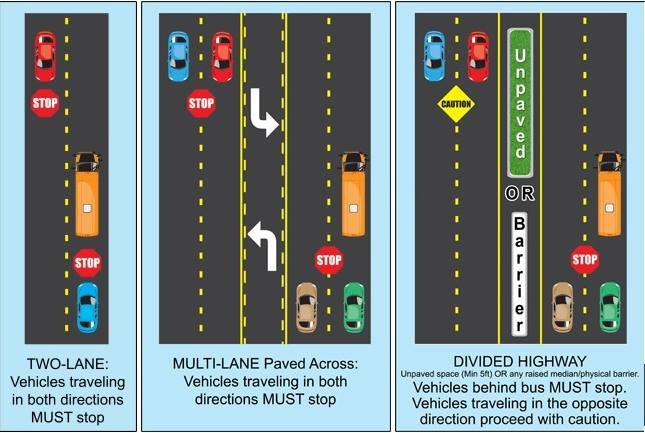
A reminder about Florida traffic laws when you approach a bus:
Burglar Shot In Walnut Hill Sentenced To Prison
August 16, 2014

A burglar shot last summer by a Walnut Hill homeowner was sentenced Friday to 15 years in prison.
 Ricky DeWayne Taylor, now 34, was sentenced by Circuit Judge Michael Allen to 15 years in state prison for burglary of a dwelling with battery; five years for battery on a person age 65 or older; five years for burglary of an unoccupied structure; and five years for grand theft. Taylor pled to the charges on January 21 but then failed to appear for his sentencing on February 20.
Taylor was arrested by the Lafayette Parish Sheriff’s Office in Lousisana on a misdemeanor charge of possession of stolen things and extradited from Louisiana in June. Allen also sentenced Taylor to five years on two counts of failure to appear. Each sentence is concurrent to the 15 years sentence.
On May 17, 2013, Taylor broke into the victim’s home on Rockaway Creek Road and began removing items. The victim unexpectedly returned and caught Taylor and co-defendant Teresa Sunday in the act. Sunday, who was acquainted with the victim, had called him earlier that day to lure him away from the home to meet her at a local pool hall.
The victim held them at gunpoint with a .38 caliber revolver and contacted the Escambia County Sheriff’s Office. As the victim was speaking with dispatchers, Taylor lunged toward him. The homeowner fired a .38 caliber revolver, striking Taylor in the leg and grazing Sunday on the left cheek. Taylor was alert and conscious when he was transferred to LifeFlight to be airlifted to Baptist Hospital in Pensacola. He was charged with burglary, larceny, criminal mischief property damage and battery.
Sunday, age 35 of Century, pleaded guilty to charges of burglary of an unoccupied dwelling and grand theft of a dwelling. In January, she was sentenced by Judge Michael Allen to five years in state prison.
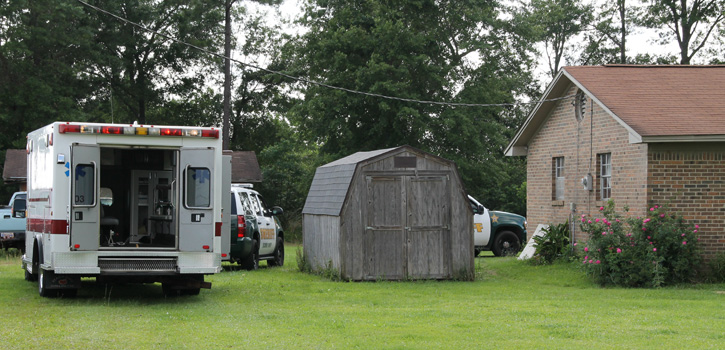
Pictured: The scene on May 17, 2013, at a burglary victim’s home on Rockaway Creek Road in Walnut Hill. NorthEscambia.com file photos, click to enlarge.

Local Unemployment Increases
August 16, 2014
The latest job numbers released Friday show the unemployment level increasing in the North Escambia area.
Escambia County’s unemployment rate jumped from 6.5 percent in June to 6.9 percent in July There were 9,756 people reported unemployed during the period. One year ago, unemployment in Escambia County was 7.5 percent.
 Santa Rosa County unemployment also increased, from 5.9 to 6.3 percent from June to July. Santa Rosa County had a total of 4,788 persons still unemployed. The year-ago unemployment rate in Santa Rosa County was 7.2 percent.
In Escambia County, Alabama, unemployment increased from 8.8 percent in June to 9.4 percent in May. That represented 1,328 people unemployed in the county during the month. A year ago, the unemployment rate was 8.2 percent in the county.
Florida’s jobless mark continued its steady run through 2014, holding at 6.2 percent from June to July, the state Department of Economic Opportunity announced Friday. The state’s unemployment rate, which stood at 7.3 percent a year ago, has been mostly flat this year, wavering between 6.2 percent and 6.3 percent. Besides state government jobs, the biggest June to July gains in Florida were found in the fields of construction, real estate, and entertainment and recreation
Alabama’s seasonally adjusted unemployment rate, at 7.0percent in July, was up from June’s rate of 6.8 percent and was above the year-ago rate of 6.5 percent
The jobless numbers released by Florida and Alabama do not include persons that have given up on finding a job and are no longer reported as unemployed.
The News Service of Florida contributed to this report.
Last Minute Back To School Shopping? Print A Supply List
August 16, 2014

School starts Monday, August 18 in Escambia and Santa Rosa counties. Here are printable school supply lists from each elementary school and middle school in Escambia County, plus the North Escambia area schools in Santa Rosa County and Escambia County, AL.
(High schools typically do not have a general supply list. Students are advised of their supply needs in each class.)
North Escambia Area Schools:
- Bratt Elementary
- Byrneville Elementary
- Central Elementary School
- Chumuckla Elementary
- Ernest Ward Middle
- Jay Elementary
- Jim Allen Elementary
- Lipscomb Elementary
- McArthur Elementary
- Molino Park Elementary
- Pine Meadow Elementary
- Ransom Middle
Complete Escambia County Lists:
ELEMENTARY SCHOOLS
- Bellview Elementary
- Beulah Elementary
- Blue Angels Elementary
- Bratt Elementary
- Brentwood Elementary
- Byrneville Elementary
- Cook Elementary
- Cordova Park Elementary
- Ensley Elementary
- Ferry Pass Elementary
- Global Learning Academy
- Hellen Caro Elementary
- Holm Elementary
- Jim Allen Elementary
- Lincoln Park Elementary
- Lipscomb Elementary
- Longleaf Elementary
- McArthur Elementary
- McMillan Pre-K
- Molino Park Elementary
- Montclair Elementary
- Myrtle Grove Elementary
- Navy Point Elementary
- Oakcrest Elementary
- Pine Meadow Elementary
- Pleasant Grove Elementary
- Scenic Heights Elementary
- Semmes Elementary
- Sherwood Elementary
- Suter Elementary
- Warrington Elementary
- Weis Elementary
- West Pensacola Elementary
MIDDLE SCHOOLS
- Bailey Middle
- Bellview Middle
- Brown Barge Middle
- Ernest Ward Middle
- Ferry Pass Middle
- Ransom Middle
- Warrington Middle
- Woodham Middle
- Workman Middle
ESCAMBIA (AL) SCHOOLS
- AC Moore Elementary
- Escambia County Middle School
- Flomaton Elementary School (not provided)
- Huxford Elementary
- Rachel Patterson Elementary
FWC Law Enforcement Report
August 16, 2014
The Florida FWC Division of Law Enforcement reported the following activity during the week ending August 14.
ESCAMBIA COUNTY
 Officer Cushing was on vessel patrol in Escambia Bay when he observed what appeared to be a shrimp boat pulling two nets. As Officer Cushing maneuvered his vessel closer to the rear of the shrimp boat, he realized that the shrimp boat was actually pulling three nets. Measurements of the nets were taken and it was determined that all three nets were legal, measuring less than 500 square feet in total mesh area. The captain of the vessel was issued a citation for pulling more than two nets.
Officers Hoomes and Manning were working the Bob Sikes Bridge for redfish violations. The officers observed one subject catch and keep three redfish that appeared to be over the legal size limit of 27 inches. The officers stopped the subject and found him in possession of three oversized redfish. The fish measured 35, 33 and 29 inches. The subject was cited for possession of over the daily bag limit of redfish and for possession of oversized redfish. The three redfish were seized as evidence.
This report represents some events the FWC handled over the past week;however, it does not include all actions taken by the Division of Law Enforcement. Information provided by FWC.
Early Voting Begins Underway With New Locations
August 16, 2014
Early voting got underway Saturday, with seven sites available in Escambia County for the August Primary Election.
Early voting is available each day through Saturday, August 23 from 8 a.m. until 5 p.m. at the following locations:
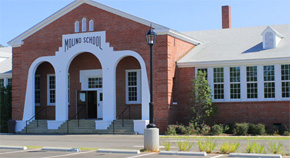
- Molino Community Center, 6450 Highway 95A North
- Escambia County Extension Office, 3740 Stefani Road
- Genealogy Branch Library, 5740 N. 9th Avenue
- Pensacola Interstate Fairgrounds, 6655 W. Mobile Highway
- Southwest Branch Library, 12248 Gulf Beach Highway
- West Florida Public Library, 239 N. Spring Street
- Supervisor of Elections Main Office, 213 Palafox Place, Second Floor
Early voters cast paper ballots through digital scanners and may choose any one of the seven sites – three more than the 2012 Primary Election.
 Another option for voters is to cast an absentee ballot, which can be requested through the online form at EscambiaVotes.com, or by e-mail (absentee@escambiavotes.com), phone (850-595-3900), mail, or fax (850-595-3914). Requests must include the voter’s date of birth and address, and must be received no later than Wednesday, August 20. Voted ballots must be received in the Elections Office no later than 7:00 p.m. on Election Day and may not be returned to a polling location.
Absentee voters may track the status of their ballot at EscambiaVotes.com.
The third option for voters is to cast a ballot at their precinct on Election Day, August 26. Polls will be open from 7:00 a.m. until 7:00 p.m. An AutoMARK ballot marking device will also be available at each polling place and early voting site to assist persons with disabilities.
All eligible voters in Escambia County have been mailed a sample ballot. In addition, voters can verify their registration status, view their sample ballot and find their polling place by visiting EscambiaVotes.com.
Voters are reminded to bring their photo and signature ID with them to the polls, and are encouraged to visit EscambiaVotes.com for complete voting information or contact the Elections Office by phone or e-mail with any questions.
Wahoos Even Series With Mobile
August 16, 2014
The Pensacola Blue Wahoos saved their best game for last in front of Cincinnati Reds Bill Bavasi, who was in town to evaluate the players firsthand.
Bavasi oversees Cincinnati’s scouting, player development and international operations and looked on as the Reds’ Double-A affiliate romped to an 8-3 victory over its archrival Mobile BayBears – the top team in the Southern League.
Bavasi’s assessment? He gives Pensacola, its club, ballpark and fans all high marks.
 “This place is terrific. It’s off the charts,” he said. “This league is full of guys who have great tools and are on their way up. This is a great city and a terrific place to play.”
One of those Wahoos players the Reds have an eye on is its top prospect Robert Stephenson who started Friday’s game. Stephenson earned the win and is now 6-8 on the year. He went five innings, allowing one run on four hits, while striking out five to retake the Southern League lead with 121 on the season.
Stephenson, who left the game after the fifth inning and 88 pitches because his right calf started cramping, said there’s no added pressure when a front office executive like Bavasi pays a visit.
“They have videos and are watching every game any way,” he said. “It didn’t concern me. I just wanted to pitch the way I’m supposed to pitch.”
The hard throwing righty bounced back from his last start when he allowed five runs and nine hits in just 2.1 innings.
“I felt great,” Stephenson said. “I felt my struggles lately have just been mental. I told myself I was going to get everyone out and I was just better than them. It seemed to help me.”
Blue Wahoos Manager Delino DeShields reminded his players of one important lesson.
“They’ve been evaluated all along,” he said. “It comes down to how the guys finished, not how they started. They are all still playing hard. I appreciate the effort they’re giving.”
Stephenson, outfielder Jesse Winker (No. 2), starting pitcher Michael Lorenzen (No. 4) and starting pitcher Ben Lively (No. 6) are all among the Reds top 10 prospects in their organization, according to MLB.com. In addition, starting pitcher Daniel Corcino is ranked No. 12, outfielder Yorman Rodriguez No. 13 and starting pitcher Jon Moscot No. 16.
Bevasi said while Stephenson and Winker get all the kudos as the top two prospects, a lot of other players have a chance to play for the Reds in the coming years. Winker has been on the disabled list since July 24 with a sprained right wrist.
“Robert (Stephenson) has developed well and this is a good place for him to get challenged,” Bevasi said. “We wish Jesse (Winker) wasn’t hurt. We’d like to see him get more at bats. But the guys who are written up are not always the ones who end up playing in the Major Leagues.”
And Blue Wahoos players who have the best chance of joining Cincinnati’s starting lineup? All Bevasi revealed is, “I like them all.”
In Friday’s game, the players most fans liked best were leftfielder Juan Silverio, who clubbed a solo homer in the sixth, and first baseman Travis Mattair, who blasted a three-run home run in the seventh inning that put Pensacola up, 8-1.
GAME NOTES
The finale of the five-game series with Arizona Diamondbacks Double-A affiliate the Mobile BayBears (73-48) gets underway at 6:30 p.m. Saturday. RHP Michael Lorenzen (4-5, 2.98) takes the mound for the Wahoos (53-71) and is scheduled to be opposed by the BayBears RHP Archie Bradley (2-2, 3.77).
by Tommy Thrall
Fire Damages Bratt Home
August 15, 2014
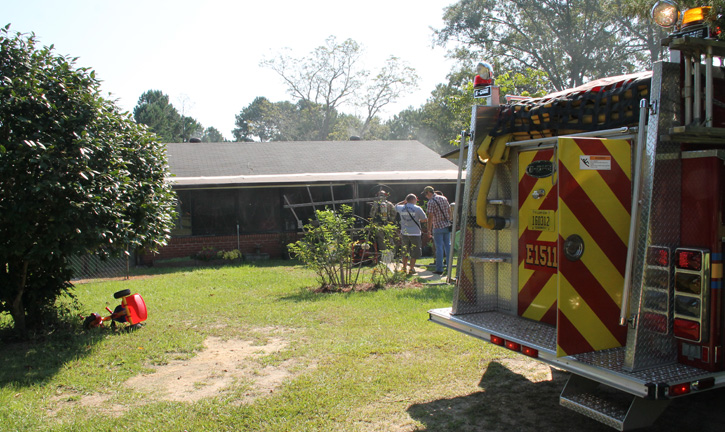
Fire damaged a single story home in Bratt Friday morning.
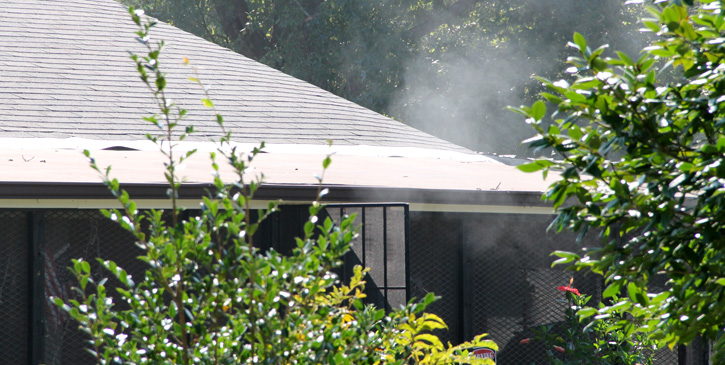
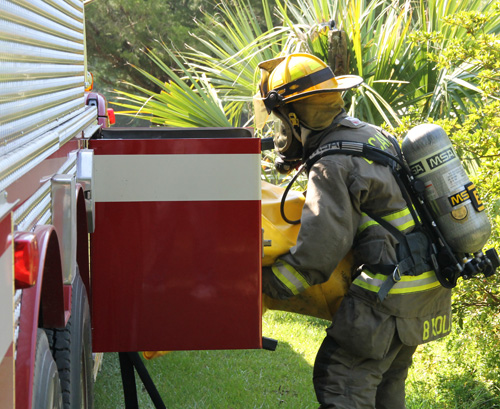 The fire was reported about 9:15 a.m. in the 3800 block of Macks Road, just east of North Highway 99. A resident reported a problem with a propane gas stove and a resulting kitchen fire. The fire was quickly contained.
There was no immediate report of any injuries.
The Walnut Hill, Century and McDavid station of Escambia Fire Rescue, the Atmore Fire Department and Escambia County EMS were dispatched to the fire.
NorthEscambia.com photos, click to enlarge.