

Cantonment Meeting: Learn How To Protect Your Home Against Formosan Termites
April 6, 2015

Rep. Doug Broxson (R-Gulf Breeze) is hosting a free public workshop Tuesday in Cantonment for area residents to learn necessary steps to protect their greatest investment from costly Formosan termite damage.
Annually, Formosan termites cause $1 billion in damage in the United States, and our surrounding areas of Escambia, of Santa Rosa and Okaloosa countis are known hot spots for these aggressive pests. Florida’s temperate climate provides a perfect environment for termites, and immediate signs of structural damage to a home may go undetected for long periods of time. Springtime serves as the breeding season for most species of termites, and Formosan termites will be swarming in May, so it is important for residents to understand what they can do in advance to protect their homes.
The Florida Department of Agriculture and Consumer Services is collaborating with the University of Florida/Institute of Food and Agricultural Science’s Extension Offices in the Panhandle to educate homeowners about Formosan termites. Homeowners can learn methods for controlling this structural pest and protecting their homes by attending one of four educational meetings being held in the month of April. Homeowners are also encouraged to bring their pest control contract to one of these workshops for review.
Specific topics include:
- Formosan termite biology including simple ways to identify them
- Available Formosan termite pest control protection for your home
- Florida law and building code pertaining to termites
- What you can do to recognize and fix the weaknesses in and around your home
- Bring your pest control contract for review by FDACS experts
Registration is encourage, but not required, for meetings that will be held as follows:
Escambia County Meeting
Tuesday, April 7, 6 – 8 p.m. at Escambia County Extension, 3740 Stefani Road, Cantonment. Contact Beth Bolles to register: bbolles@ufl.edu or (850) 475-5230.
South Santa Rosa County Meeting
Thursday, April 9, 6- 8 p.m. at Tiger Point Community Center, 1370 Tiger Park Lane, Gulf Breeze, Contact Johanna Welch to register: Johanna.Welch@FreshFromFlorida.com or (850) 363-5845.
North Santa Rosa County Meeting
Tuesday, April 14, 2015, 6- 8 p.m. at Santa Rosa County Extension, 6263 Dogwood Drive, Milton. Contact Johanna Welch to register: Johanna.Welch@FreshFromFlorida.com or (850) 363-5845.
Photo courtesy UF/IFAS for NorthEscambia.com, click to enlarge.
‘Graffiti Bridge’ Used To Spread Easter Message
April 5, 2015

“Graffiti Bridge” in Pensacola, as seen on Easter Morning. Reader submitted photos for NorthEscambia.com, click to enlarge.

Faithful Celebrate Resurrection At Easter Services
April 5, 2015

Easter morning sunrise services and special church services were held at many locations across the area Sunday morning.
 One of the largest sunrise services in North Escambia was held in Molino as several churches came together for a community Easter morning sunrise service at Aldersgate United Methodist Church, celebrating with music and a message.
Other sunrise services were held in Century, Atmore,Walnut Hill, Flomaton, Gonzalez and Cantonment. And thousands attended a Marcus Pointe Baptist Church Sonrise Service held at the Blue Wahoos Stadium downtown.
The sunrise services celebrated the Resurrection of Jesus Christ, an important event to the faithful. According to the Bible:
Matthew 28:1-20
Resurrection Morning
1 After the Sabbath, as the first day of the week was dawning, Mary Magdalene and the other Mary went to view the tomb. 2 Suddenly there was a violent earthquake, because an angel of the Lord descended from heaven and approached [the tomb]. He rolled back the stone and was sitting on it. 3 His appearance was like lightning, and his robe was as white as snow. 4 The guards were so shaken from fear of him that they became like dead men. 5
But the angel told the women, “Don’t be afraid, because I know you are looking for Jesus who was crucified. 6 He is not here! For He has been resurrected, just as He said. Come and see the place where He lay. 7 Then go quickly and tell His disciples, ‘He has been raised from the dead. In fact, He is going ahead of you to Galilee; you will see Him there.’ Listen, I have told you.”
8 So, departing quickly from the tomb with fear and great joy, they ran to tell His disciples the news. 9 Just then Jesus met them and said, “Good morning!” They came up, took hold of His feet, and worshiped Him. 10 Then Jesus told them, “Do not be afraid. Go and tell My brothers to leave for Galilee, and they will see Me there.”
The Soldiers Are Bribed to Lie
11 As they were on their way, some of the guard came into the city and reported to the chief priests everything that had happened. 12 After the priests had assembled with the elders and agreed on a plan, they gave the soldiers a large sum of money 13 and told them, “Say this, ‘His disciples came during the night and stole Him while we were sleeping.’ 14 If this reaches the governor’s ears, we will deal with him and keep you out of trouble.” 15 So they took the money and did as they were instructed. And this story has been spread among Jewish people to this day.
The Great Commission
16 The 11 disciples traveled to Galilee, to the mountain where Jesus had directed them. 17 When they saw Him, they worshiped, but some doubted. 18 Then Jesus came near and said to them, “All authority has been given to Me in heaven and on earth. 19 Go, therefore, and make disciples of all nations, baptizing them in the name of the Father and of the Son and of the Holy Spirit, 20 teaching them to observe everything I have commanded you. And remember, I am with you always, to the end of the age.”
from the Holman Christian Standard Bible
Pictured top and below: A morning “Sonrise Service” at Pensacola’s Maritime Stadium Sunday. Courtesy photos from Marcus Pointe Baptist Church for NorthEscambia.com, click to enlarge.

Driver Hits Utility Pole In Highway 95A Crash
April 5, 2015

 One person was injured when they slammed their vehicle into a utility pole early Sunday morning near Cottage Hill.
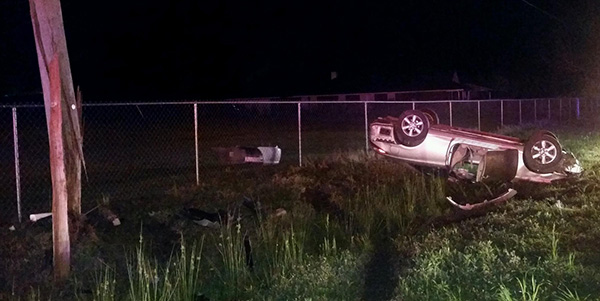
The driver of the passenger car lost on Highway 95A near Williams Ditch Road about 2:30 a.m. and struck a utility pole nearly head-on, nearly snapping the pole in half. The vehicle came to rest upside down in a ditch.
The accident is under investigation by the Florida Highway Patrol. Further details, including the name of the person injured, have not yet been released as they continue their investigation.
NorthEscambia.com photos by Kristi Price, click to enlarge.
One Injured In Cantonment Wreck
April 5, 2015

One person was injured in a single vehicle wreck Saturday night in Cantonment.
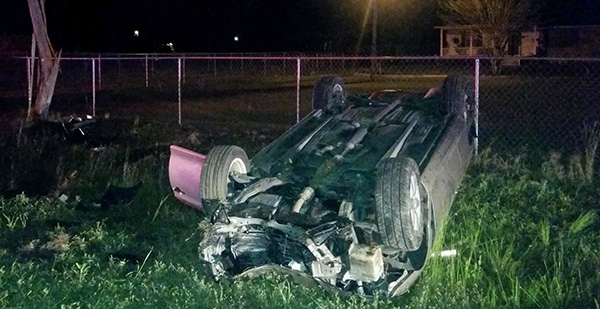
The driver of this car left the roadway and struck a pole on Highway 29 near the Winn Dixie shopping center. The adult male was transported to Sacred Heart Hospital by Escambia County EMS as a trauma alert.
The accident remains under investigation by the Florida Highway Patrol. The driver’s name has not yet been released.
NorthEscambia.com photo by Kristi Price, click to enlarge.
Test Bill On Hold Amid Debate Over High Level Courses
April 5, 2015
Legislation that would overhaul Florida’s testing program for public schools was in suspended animation, as senators weigh whether to exempt some students in high-level classes from statewide standardized tests.
The potential change bubbled up as lawmakers try to put the finishing touches on the highest-profile education legislation of the session. After a lengthy discussion of the bill (HB 7069), the Senate decided to return to the legislation
 Language under consideration by the Senate, some of it adopted, would put on hold the use of student test data for school grades, teacher evaluations and student promotion to fourth grade until the new Florida Standards Assessments can be independently validated. The testing platform used for the assessments has come under attack from lawmakers and the public after a rollout last month that featured log-in problems and a cyber attack.
The Senate would also scrap a law requiring school districts to come up with end-of-course tests in classes where the state doesn’t administer such exams; cap at 5 percent the share of students’ time that can be spent on testing; and reduce from 50 percent to a third the portion of a teacher’s evaluation tied to student performance.
But the chamber got bogged down when Senate Appropriations Chairman Tom Lee, R-Brandon, proposed an amendment that would exempt students who do well on tests in high-level courses — like advanced placement or industry certification exams — or on the ACT or SAT from the corresponding statewide tests.
There seemed to be little disagreement about the policy thrust of Lee’s proposal. According to the overall bill’s sponsor, though, it was unclear whether the amendment might undermine an emerging compromise with the House on the legislation.
“This may be the one straw … that causes us to hit the reset button,” said Senate Education Pre-K-12 Chairman John Legg, R-Lutz. “But if it’s a passion of this body, it will be a passion of mine.”
Lee said he wouldn’t stand in the way of a compromise. But if there wasn’t a done deal, he said the Senate should “send the strongest message to the Department of Education and to our colleagues in the House that we think there’s too damn much testing going on in this state,” particularly with students who are likely to pass the tests with ease.
“We have lost the public-relations war in our communities over testing,” Lee said. “And all the theory and all the concept is great, but the parents aren’t buying it anymore. We’ve spun and talked our way through this as long as we can, and no one’s buying the message anymore.”
Other lawmakers were prepared to go along with the idea regardless of what it might do to negotiations with the House.
“Don’t we owe it to the students, the parents and the teachers of this state to do it right instead of doing it in a hurry?” said Sen. Alan Hays, R-Umatilla. “I beg you, pass this good amendment and challenge, if you need to, our colleagues in the House to not take it. I cannot imagine their good conscience allowing them to reject this amendment.”
Even if the amendment were to pass, though, there could still be divisions about the legislation. A bipartisan group of senators protested an amendment that would allow schools in Florida to start as early as Aug. 10, saying it could hurt tourism and take away summers for young Floridians. That measure was approved on a voice vote.
Some Democrats hammered provisions of the Senate language as inadequate to address parental complaints about the Florida Standards Assessments in particular and over-testing more generally. For example, they questioned why the state didn’t suspend the test while a third-party group conducts the study called for by the legislation.
“This is kind of backwards. What we’re doing is giving kids the test and then deciding afterwards whether or not we’re going validate the test,” said Sen. Jeff Clemens, D-Lake Worth.
by Brandon Larrabee, The News Service of Florida
New Members Inducted Into Tate High National Honor Society
April 5, 2015
The following students were recently inducted into the National Honor Society at Tate High School:
- Kayla Armstead
- Ann Barker
- Samantha Brown
- Megan Gulsby
- Alexa Harmon
- Kayla Johnson
- Jesica Johnston
- Jenna Loomis
- Dawn Looney
- Katherine Luebke
- Julie Menah
- Jessica Merritt
- Paxton Metcalf
- Grace Mills
- Erin Reitz
- Madison Rondeau
- Rebakah Seibert
- Justin Shelton
- Emma Shows
- Heather Sport
- Leah Struble
- Daliss Williams
- Gaylin Workman
Florida Gov’t Weekly Roundup
April 5, 2015
Florida has a reputation for weird news; one need only peruse the @_FloridaMan Twitter account’s timeline or do a web search for “FanGate” to see how the state provides seemingly endless entertainment for the residents of the rest of the nation.
But even for the bouquet of bizarre that is Sunshine State politics, this week was exceptionally strange.
 Federal and state officials no longer simply disagree on what to do about the potential expiration of $2.2 billion in health care funding; they disagree on whether they’re trying to reach agreement. And the strangest story of the week had no humor to it at all, as the Department of Corrections faced reports of a murder plot that included the involvement of members of the Ku Klux Klan.
All the while, cultural scuffles broke out on a range of issues, from abortions to whether — in an only-in-Florida twist — guns and ammunitions should be part of a July 4 sales-tax holiday.
As the legislative session passed the halfway point, there were plenty of remaining questions. But one of them is how much stranger Florida politics can get.
PAYING LIP SERVICE TO NEGOTIATIONS?
From the beginning, discussions about the state budget for the fiscal year that starts July 1 have been clouded by the uncertain prospects of $2.2 billion in funding for the Low Income Pool, or LIP, program. The LIP program, which is currently set to expire June 30, funnels additional money to hospitals and other health providers that serve large numbers of poor and uninsured patients.
As lawmakers worked on their versions of the budget, the state Agency for Health Care Administration negotiated with the federal Centers for Medicare & Medicaid Services to try to strike a deal to allow some presumably revamped version of the program to continue. The federal government plays a major role in funding the program.
The Senate decided to get an in-person update from federal officials this week. Senate Health and Human Services Appropriations Chairman Rene Garcia, R-Hialeah, and Senate President Pro Tempore Garrett Richter, R-Naples, spent Tuesday in Washington meeting with Obama administration officials.
That same day, according to Agency for Health Care Administration Secretary Liz Dudek, the talks took an unexpected hiatus. Federal officials told the state that CMS’s top negotiator would not be available for at least two weeks and the discussions were off in the meantime, Dudek said.
Not so, said CMS, which sounded bewildered by the notion that the talks were off.
“CMS remains in contact with state officials and continues to share information,” said Aaron Albright, a spokesman for the agency, in a statement sent to reporters Thursday. “Senior officials from CMS will continue conversations with state officials about our shared goal of securing access to high quality health care coverage for low income Floridians.”
Dudek issued a statement late Thursday standing by the state’s version of events.
“After months of discussions we found out that negotiators would not be available to continue to further discuss the LIP program. At this time, no date has been set for a future meeting,” she said.
The back-and-forth overshadowed the House and Senate both approving their respective versions of the budgets this week and increased doubts that lawmakers could get their work done before the scheduled May 1 conclusion of the regular session.
UNWELCOME ECHOES OF THE PAST
The Florida Department of Corrections already had plenty of problems without the ghosts of the state’s past haunting efforts to reform the agency. But history is always hard to shake in the South, and a particularly ugly feature of Florida’s past re-emerged Thursday, when two Florida prison guards and a former prison worker who are members of the KKK were arrested for allegedly plotting to kill a black ex-inmate in retaliation for a fight.
Thomas Jordan Driver and David Elliott Moran, who worked at the Reception and Medical Center in Lake Butler, and Charles Thomas Newcomb, an “Exalted Cyclops ” of the group called the “Traditional American Knights of the Ku Klux Klan,” each were charged with conspiracy to commit murder for allegedly planning to kill the former inmate by injecting him with insulin and making it appear as though he had drowned while fishing.
The men allegedly targeted the unidentified former inmate because he had been in a fight with Driver last year, before the prisoner was released.
The arrests were the result of a joint probe by Attorney General Pam Bondi’s Office of Statewide Prosecution and the Federal Bureau of Investigation.
Moran, 47, and Driver, 25, worked at the prison about 25 miles north of Gainesville. Newcomb worked briefly at the same facility for three months but was dismissed in January 2013 for failing a certification exam. Department of Corrections Secretary Julie Jones fired Moran and Driver after their arrests Thursday.
When asked during a conference call with reporters if the arrests indicate that racism “is alive and well in Florida,” Bondi replied in the affirmative.
“Oh, it is. It is. And we will never tolerate, or ever remain silent, over the violence of hate embedded in prejudice in our state or in this country,” she said.
The arrests are the latest troubles for the beleaguered corrections agency, which has been under scrutiny for months amid reports about inmate deaths at the hands of prison guards, widespread corruption and accusations of retaliation against whistleblowers.
Just a day earlier, the Senate overwhelmingly supported a prison-reform package that would include a commission to oversee the department.
The legislation (SB 7020) would make it easier for inmates to file complaints, create new penalties for rogue guards who abuse prisoners and establish the governor-appointed commission to oversee prisons and investigate wrongdoing. The measure, approved by a 36-1 vote, would also allow inmates’ families or lawyers to pay for independent medical evaluations and expand opportunities for old or sick inmates to get out of prison early.
But House Speaker Steve Crisafulli and other GOP House leaders have repeatedly rejected the oversight commission, objecting that the effort would create another “layer of bureaucracy.” Critics of the commission also say that a previous iteration of the oversight panel did not work.
CULTURE WARS
As states like Indiana and Arkansas reeled from battles over proposed “religious liberty” laws decried by critics for alleged anti-gay bias, Florida lawmakers found themselves in cultural skirmishes that were less potent but still divisive.
The closest to the fights in other states was a proposal approved by the House Judiciary Committee that would allow private adoption agencies to refuse to place children with same-sex couples.
The committee passed the measure (HB 7111) by Rep. Jason Brodeur, R-Sanford, providing what it calls “conscience protection” for private agencies whose “religious or moral convictions” do not permit the children in their care to be adopted by gays or lesbians.
“What we are saying in this bill, very narrowly crafted for the handful of private adoption agencies that have a written moral or religious exemption, is that they cannot have that be a basis for damages or for retribution,” Brodeur said.
The bill passed 12-3 on a party-line vote. But opponents warned that if it became law, Florida could suffer the same sort of economic boycott now aimed at Indiana.
“This bill is even worse than Indiana’s,” said Carlos Guillermo Smith of the pro-gay advocacy group Equality Florida. “This threatens Florida’s tourism-based economy.”
Meanwhile, the House Health & Human Services Committee approved a bill (HB 633) that would require women to wait 24 hours before having abortions in Florida. The sponsor, Rep. Jennifer Sullivan, R-Mount Dora, said the plan would “empower” women by giving them more time to reflect before making such momentous decisions.
But Dian Alarcon of Miami told lawmakers that because she’d had no access to a legal abortion, she’d had an illegal procedure — with no medical care.
“By supporting this bill, what you’re doing is making women like me and women in the community go out and seek illegal and unsafe abortions,” Alarcon said. “I think the most important thing we can do for our children is to educate them and to give them the tools to make decisions about their bodies and their lives.”
And the House Finance & Tax Committee chose to keep guns and ammunition in a proposed Independence Day sales-tax holiday on hunting gear that is part of a wide-ranging, $690 million tax-cut package (PCB FTC 15-05).
The panel rejected efforts by Democrats to remove firearms and ammo from the sales-tax holiday for July 4. Rep. Jose Javier Rodriguez, D-Miami, said the proposal sends mixed messages, as law enforcement will be telling people at the same time not to fire guns into the air.
“It’s not an exaggeration to say that it really is a bad policy when we have law enforcement expending resources to address a public safety issue and in our tax code we have the exact opposite incentive and we’re encouraging people to purchase ammunition for the holiday,” Rodriguez said.
Rep. Frank Artiles, R-Miami, said the proposal could help increase tourism by promoting hunting and fishing in the state. In addition to rifles, shotguns, spearguns, crossbows and bows, the July 4 sales-tax event would cover camping tents and fishing gear.
“While I understand my Democratic colleagues don’t like firearms and ammunition, the reality is that fish hooks also kill fish,” Artiles told Rodriguez. “But apparently fish are not important to you.”
STORY OF THE WEEK: With the state and federal government arguing about whether negotiations continue for $2.2 billion in health-care funding, the House and Senate approved their versions of the budget for the fiscal year that begins July 1.
QUOTE OF THE WEEK: “We’re walking hand-in-hand with 800,000 souls to the altar of fringe politics.”—Rep. Evan Jenne, D-Dania Beach, on the House’s refusal to accept a Senate alternative to Medicaid expansion.
by Brandon Larrabee, The News Service of Florida
Camp Fire Kids Enjoy Easter Egg Hunt
April 5, 2015


The Children of the Camp Fire Century Youth Learning Center recently visited their neighbors at the Century Health and Rehabilitation Center for their annual Easter Egg Hunt. The children enjoying hunting for the eggs, while the residents enjoy watching them. Courtesy photos for NorthEscambia.com, click to enlarge.

Area Authorities Searching For Escaped Inmate
April 5, 2015
Area authorities are on the lookout for an escaped Alabama inmate.
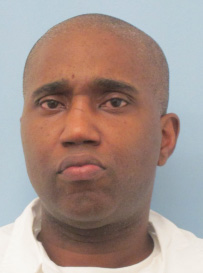 Work release inmate Christopher Michael Wright, 43, left from an assigned job site in Daphne, AL, about 2:15 p.m. Saturday. He is described as black male, 6-foot 2-inches tall, 210 pounds.
He was serviced a 20 year sentence from Mobile County for receiving stolen property and was being held in the Loxley Work Release Center.
Anyone with information on his whereabouts should contact their local law enforcement agency, the Alabama Department of Corrections at (800) 831-8825 or 911.