

DCF Offers Summer Water Safety Tips
July 11, 2015
The Florida Department of Children and Families (DCF) is reminding parents to take extra precautions to keep their children safe.
 “We can’t forget the importance of safety when it comes to our youngest family members,” DCF Deputy Secretary David Fairbanks said. “Drowning remains a leading cause of death for children in our communities. You can never be too careful around water.”
In Florida, 41 children have died so far this year from drowning. Of those who have tragically passed away, 68 percent were under the age of three. These deaths are 100 percent preventable. There should always be a responsible adult present when a child is engaging in water activities.
DCF urges parents and caregivers to keep “Eyes on the Kids” at all times when children have access to water. Lengthy conversations, texting and phone calls create distractions that should be avoided while children are swimming or near water. A responsible adult should be designated as a “Water Watcher” at all times.
Often times a child slips away undetected in family pool when several adults are present. Supervision, pool barriers and emergency preparedness, such as learning CPR, are crucially important.
Elderly Man Dies After Crashing Into House
July 11, 2015
An elderly Escambia County man died Friday evening when he accidentally drove into a house.
 According to the Florida Highway Patrol, 84-year Howland Clark Quinby was parked in a driveway on Sawmill Run, just off Davis Highway, where he picked up his passenger. Quinby then suddenly accelerated forward, crossed the road and struck the front of a house on Waterwheel Turn with his 2006 Toyota Solaris.. Quinby was transported to nearby West Florida Hospital here he later passed away.
The passenger, 69-year old Martha Morris Quinby, was transported to West Florida Hospital with minor injuries.
Oh How We Love Our Blue Angels
July 11, 2015

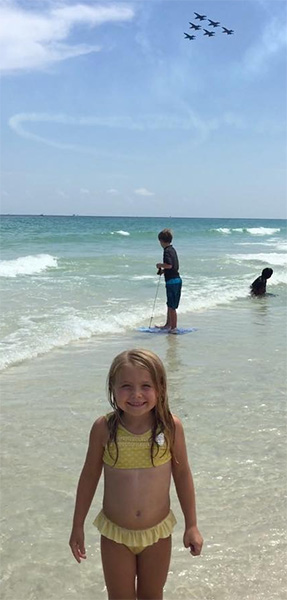
The Blue Angels took to the skies over Pensacola Beach Friday, along with other military and civilian acts, in air show dress rehearsal for Saturday. The official 2015 Blue Angels Pensacola Beach Air Show begins at noon Saturday, with the Blues taking to the skies at 2 p.m.
Have Blue Angels pictures to share? Email news@northescambia.com, visit us at Facebook.com/NorthEscambia, or follow @northescambia on Twitter.
Pictured top: Cousins wave to Fat Albert Friday (Leigh Ann Beck photo). Inset: Kaylie McCall enjoys the Blues Friday afternoon (Kirsten McCall photo). Below: A Blue Angels selfie (#BlueAngels). Submitted photos for NorthEscambia.com, click to enlarge.

Florida Gov’t Weekly Roundup: Spicing Up The Summer
July 11, 2015
Things were just starting to slow down in Tallahassee, returning to the summertime rhythm devoid of crowds of college students and the activities of the Legislature.
But now, lawmakers might be coming back.
 The Florida Supreme Court issued a redistricting ruling Thursday that appears bound to spark another special session, which would mark the third time legislators have met this year. Throw in a court challenge to Senate maps that will begin in late September, and you have the recipe for several more months of talking about a process that was supposed to be done three years ago.
The court was busy Thursday, also issuing decisions on the state’s controversial “stand your ground” self-defense law and how to pay for the state’s legal aid programs. Around the same time, Democratic Congressman Alan Grayson was officially announcing what most already assumed: He’s running for the U.S. Senate seat up for grabs in next year’s elections.
A busy news day to cap off a slow week. There might still be a few more of the latter in the near future, but it looks like there will be plenty of the former as well.
END OF THE LINES
Even before lawmakers wrapped up their June special session to finish crafting the state budget, there was already speculation that a Supreme Court ruling on the state’s congressional lines could upset any plans to wait until January to hold the next session.
Then, it happened. A bitterly divided Florida Supreme Court threw out eight congressional districts under the state’s anti-gerrymandering Fair Districts Amendment, then ordered the Legislature to redraw the lines within the next 100 days.
For those who have watched the court on redistricting — or anything else, really — the 5-2 decision was not much of a surprise. It featured the five more-liberal justices in the majority and a pair of conservative justices in the minority. Justice Barbara Pariente, who has crafted most of the court’s decisions on redistricting since voters put Fair Districts into the Florida Constitution in 2010, wrote the opinion.
What was a little more surprising were the sharp attacks that the two sides of the court hurled at each other, perhaps a sign that years of ruling on the redistricting standards was starting to take a toll.
Justice Charles Canady used his dissent to blast the majority for no less than doing violence to the state’s form of government.
“This decision causes serious damage to our constitutional structure,” Canady, a former lawmaker, wrote in an opinion joined by Justice Ricky Polston. “The proper functioning of the judicial process is deformed and the separation of powers is breached in an unprecedented manner. Since 2012, this court’s decisions concerning the redistricting process have been characterized by a repeated rewriting of the rules.”
Pariente was having none of it. She called Canady’s criticisms “extravagant” and suggested he wanted the court to abdicate its responsibility to make sure that lawmakers follow the law.
“Far from upending the law, then, our legal analysis today adheres to our recent redistricting precedents,” she wrote. “The dissent, to the contrary, continues its refusal to acknowledge the import of the Fair Districts Amendment.”
As for the actual fallout, the court has now issued orders that will require a delicate balancing act by map-drawers. One of the districts thrown out is represented by Democratic Congresswoman Corrine Brown. Brown’s district ambles its way from Jacksonville to Orlando to create an opportunity for black voters to elect a candidate of their choice.
The Supreme Court told lawmakers to draw the district’s lines from east to west — likely from the Jacksonville area to Tallahassee. But the Legislature will also have to avoid violating the Voting Rights Act when it crafts the new lines.
Justices also ordered up new versions of districts 13 and 14 “to avoid crossing Tampa Bay” and an overhaul of vast swaths of South Florida — always one of the more difficult and racially charged areas of the state when it comes to redistricting.
And the redrawing might not stop there. A trial on state Senate districts that lawmakers drew in 2012 is set to be heard by Circuit Judge George Reynolds beginning Sept. 25.
PROVE YOUR GROUND
The same 5-2 majority in the redistricting case also ruled that people who use Florida’s controversial “stand your ground” legal defense have the burden of proving they should be shielded from prosecution
In “stand your ground” cases, which come under a law that in part provides immunity to people who use justifiable force in self-defense, pre-trial evidentiary hearings are held to determine whether defendants qualify for the immunity. The Supreme Court ruling Thursday centered on who should have the burden of proof during those hearings — defendants or prosecutors.
Justices sided with lower courts that have required defendants to prove that they should be protected from prosecution by the self-defense law. The majority opinion, written by Pariente, said immunity in the “stand your ground” law “is not a blanket immunity, but rather, requires the establishment that the use of force was legally justified.”
“We conclude that placing the burden of proof on the defendant to establish entitlement to Stand Your Ground immunity by a preponderance of the evidence at the pretrial evidentiary hearing, rather than on the state to prove beyond a reasonable doubt that the defendant’s use of force was not justified, is consistent with this court’s precedent and gives effect to the legislative intent,” said the majority opinion, which was joined by Chief Justice Jorge Labarga and justices Peggy Quince and James E.C. Perry. Justice R. Fred Lewis concurred in the outcome, though he did not sign on to the majority opinion.
Canady was once again in dissent, writing that the majority ruling “substantially curtails the benefit of the immunity from trial conferred by the Legislature under the Stand Your Ground law.”
“The factual question raised by the assertion of Stand Your Ground immunity in a pretrial evidentiary hearing is the same as the factual question raised by a Stand Your Ground defense presented at trial: whether the evidence establishes beyond a reasonable doubt that the defendant’s conduct was not justified under the governing statutory standard,” Canady wrote.
A 4-3 majority of the court, meanwhile, rejected a proposal that could have led to attorneys paying higher Florida Bar membership fees to help cover the costs of legal services for the poor.
The measure would have allowed the Bar to increase dues by as much as $100 a year, with the increased money going to legal-aid programs. The Bar opposed the proposal, which was spearheaded by former Supreme Court Justice Raoul Cantero and backed by more than 500 lawyers.
The court’s majority wrote that “there is an urgent need to develop new solutions and sustainable sources of funding for legal aid” but said a more-comprehensive approach is needed than the possible increase in Bar dues.
SHADES OF GRAYSON
In one of the least-shocking stories of the week, Grayson announced Thursday that he would run for the Democratic nomination to succeed U.S. Sen. Marco Rubio, R-Fla., who is running for president. Grayson wasted little time targeting his primary opponent, Congressman Patrick Murphy, who has the backing of much of the party’s establishment.
“He’s a Republican,” Grayson told Orlando television station WESH. “He’s really a Republican pretending to be a Democrat.”
But party leaders clearly see Murphy as a better general-election candidate than Grayson. Murphy knocked off high-profile Republican Congressman Allen West in 2012 and cruised to re-election last year in a swing district that includes St. Lucie and Martin counties and part of Palm Beach County.
In response to Grayson’s candidacy, Murphy released a statement Thursday touching on his support for issues that are important with Democratic primary voters.
“I look forward to a clean, honest discussion of the issues in this primary,” Murphy said. “I have built a strong record of working together to get things done, while remaining true to core Democratic principles like protecting Social Security and Medicare, fighting for a woman’s right to choose, and strengthening the middle class.”
STORY OF THE WEEK: The Florida Supreme Court struck down the state’s congressional boundaries, setting the stage for a politically charged fight over new lines.
QUOTE OF THE WEEK: “We seem to attract our fair share of crazies in the Sunshine State, and we want to protect our citizens. That’s why we’re the only state in America that has a 50-year mandatory prison sentence for anyone who rapes a child under the age of 12.”— Rep. Matt Gaetz, R-Fort Walton Beach, during a call to the morning show on SiriusXM Radio channel POTUS.
by Brandon Larrabee, The News Service of Florida
Winker Grand Slam Seals Wahoos Win
July 11, 2015
Left fielder Jesse Winker hit the Pensacola Blue Wahoos first grand slam of the season when he took Montgomery Biscuits starter Jaime Schultz’s fastball deep to left field with one out.
 His fifth homer of the year capped a five-run fifth inning that also included catcher Kyle Skipworth’s solo shot to right field into the Hill-Kelly Hill area to lead off the inning.
Pensacola went on to win its third straight game and hand Montgomery its sixth straight road loss, 6-3, Friday in front of a sellout crowd of 5,038 at Pensacola Bayfront Stadium.
The Blue Wahoos improved to 8-7 (33-50) and remained in a four-way tie for first place in the second half of the Southern League South Division season. The Biscuits dropped to 8-6 (42-40) on the year.
Winker, the Cincinnati Reds No. 3 prospect according to Baseball America, hit his last grand slam two years ago to the day with the Low-A Dayton Dragons.
The newly bearded Winker is hitting .373 (19-51) in 15 games in the second half with a .492 on-base percentage. And Winker has multi-hit games in eight of his last 17 starts.
Winker said he was waiting for Schultz to bring his 90-95 mph heater over the plate, after watching him walk shortstop Zach Vincej.
“I wanted to elevate a fastball,” Winker said. “I didn’t want to get cheated there. I got it up and over the wall. It was really cool.”
Seth Mejias-Brean added a solo blast in the sixth inning over the left field wall just inside the foul pole. It was his fourth homer of the year and gave him a team-leading 32 RBIs on the season.
Pensacola manager Pat Kelly was most impressed with Skipworth’s homer of the three Friday.
“The one that was impressive was Skipworth’s,” Kelly said. “That ball had an over spin, which is basically impossible to do.”
Meanwhile, Barrett Astin earned his first victory in Double-A after two no-decision games since being called up June 25 to Pensacola. The 23-year-old is now 1-0 with a 2.95 ERA, allowing 13 hits, 10 walks and striking out 16 batters in 18.1 innings.
Kelly said Astin has looked good in his three starts.
“That’s what you want is a starter who can give you six innings and then turn it over to the bullpen with a lead,” he said. “Barrett’s done that all three times he’s been out there.”
One other impressive play came defensively from Juan Duran in right field that saved a run. The 6-foot-7 prospect charged a soft liner by Montgomery shortstop Leonardo Reginatto and threw a perfect strike to Skipworth to nail third baseman Patrick Leonard at the plate for the second out of the seventh inning.
Kelly said he coached Duran when he was a 16-year-old “baby giraffe.”
“He could barely stand up,” Kelly joked. “But every year he gets better. He’s got a more controlled swing at the plate and a better throwing arm than you think.”
By the way, Winker said his mom is getting used to his new beard.
Photo courtesy Pensacola Blue Wahoos for NorthEscambia.com, click to enlarge.
No Serious Injuries In Highway 29, Molino Road Crash
July 10, 2015

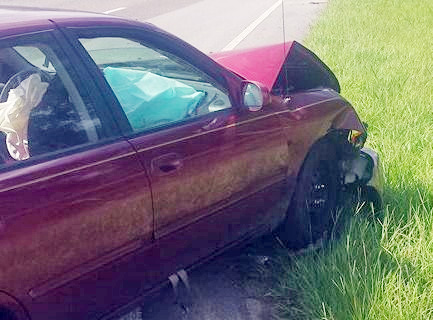
There were no serious injuries in a two vehicle crash at Highway 29 and Molino Road about 10:15 Friday morning. The accident is under investigation by the Florida Highway Patrol. NorthEscambia.com reader submitted photos, click to enlarge.

Century Driver Charged After Traffic Stop With Rolling Meth Labs
July 10, 2015
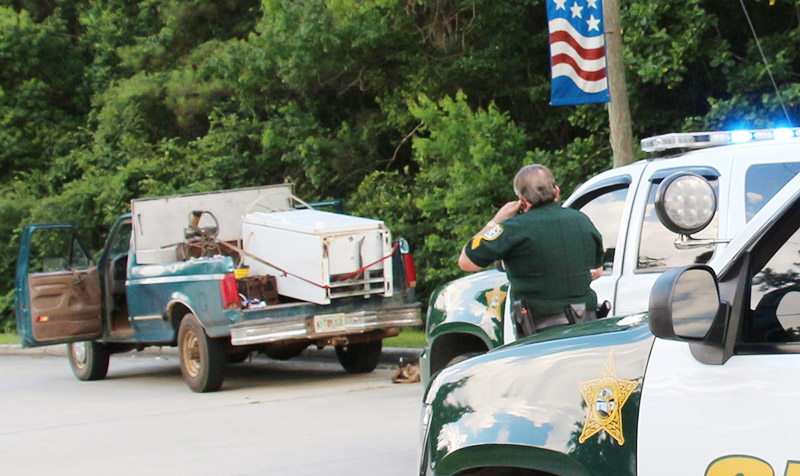
Charges have now been filed against the driver of a pickup stopped by deputies in Century last month with two “one pot” meth labs.
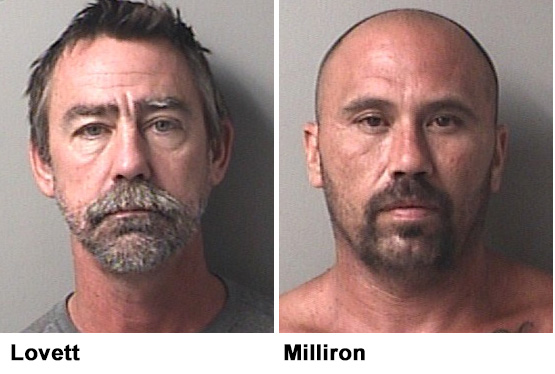 Ansel D. Lovett, age 47 of Century, was booked into the Escambia County Thursday on felony charges of methamphetamine production and trafficking in amphetamine. His bond was set at $200,000.
The incident began when patrol deputies conducted a traffic stop on an older model Ford F250 truck on Front Street at Highway 29 in Century about 3 p.m. on June 18. The traffic stop occurred after a deputy observed a refrigerator and other objects protruding from a pickup truck with no tailgate, and after the deputy observed driver Lovett tossing cigarette butt from the truck’s window.
 According to an Escambia County Sheriff’s Office report, deputies were familiar with Lovett and the passenger, 43-year old William Burr Milliron of Century, as convicted felons that were already under investigation for the possible use and manufacture of methamphetamines.
The deputies discovered two apparent “one pot” meth labs in a bag that was located in bed of the pickup. A .22 caliber revolver was also located. About 30 minutes into the investigation, Milliron ran from the area of the truck as deputies attempted to handcuff him.
Millron reportedly told deputies that he was not going back to prison before fleeing. He lunged at a deputy and was tased before being wrestled to the ground by a deputy that was later airlifted to a Pensacola hospital suffering from breathing difficulties. Milliron continued to wrestle and fight both deputies and was tased a second time. After he was taken into custody, deputies discovered ammunition for the firearm in his pocket, according to an arrest report.
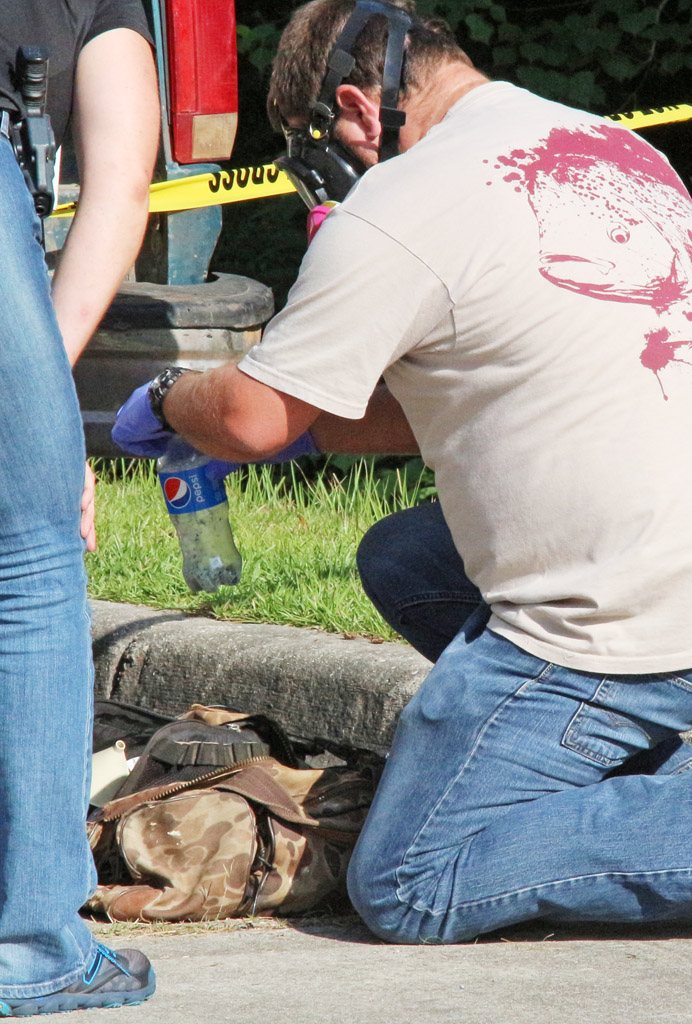
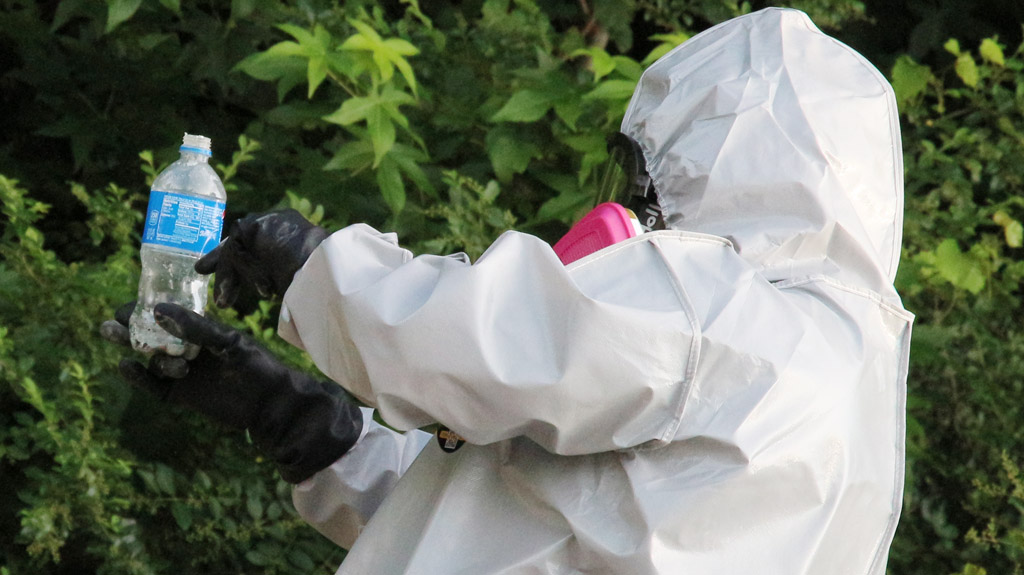
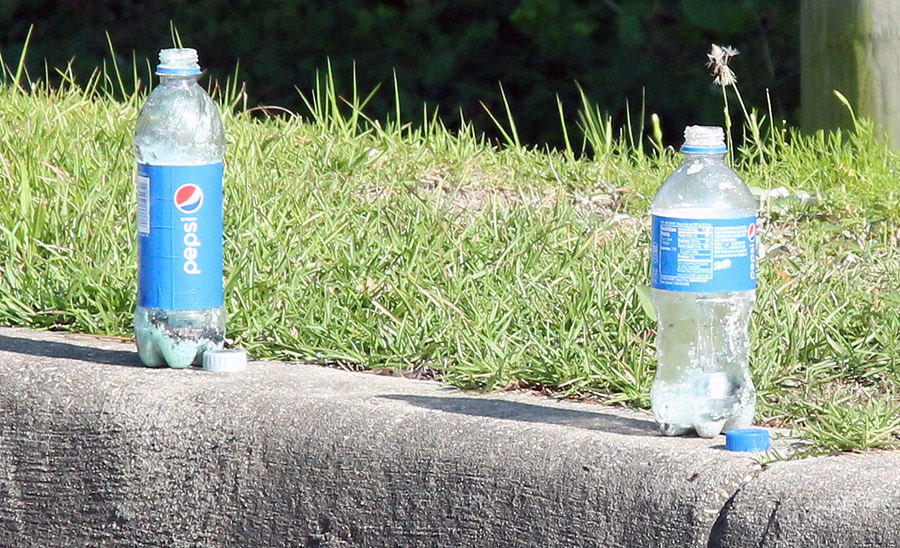
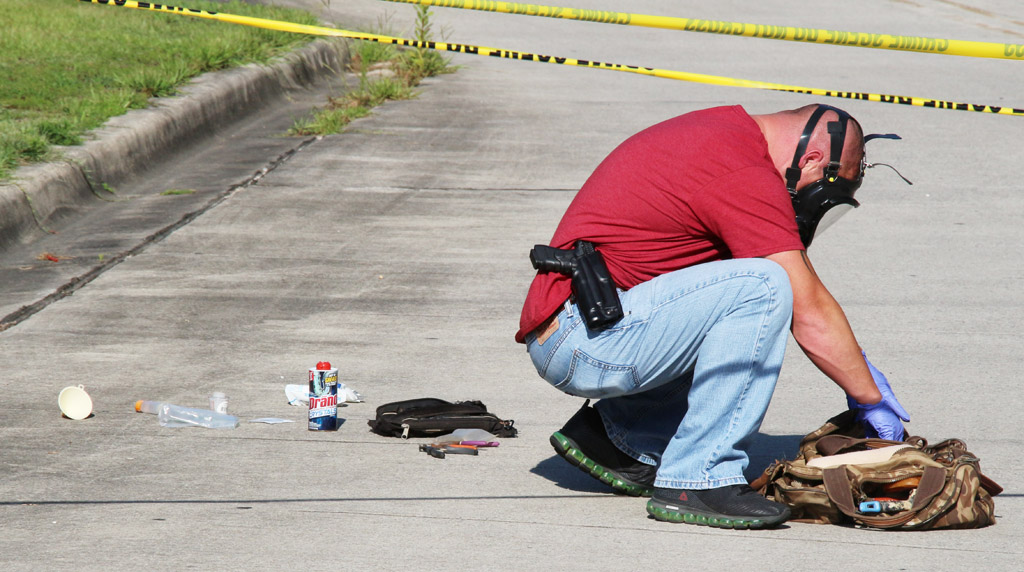
Members of the Escambia County Sheriff’s Office Narcotics responded to the scene. They were observed removing two plastic soft drink bottles containing the suspected meth labs from a camouflage bag. The bag also contained several items known to commonly be used in the manufacture of methamphetamine, including drain cleaner.
The Escambia County Sheriff’s Office Rapid Response Unit responded with a hazardous materials team that neutralized the meth labs in buckets that were then filled with concrete. After being rendered inert, the buckets and concrete are later disposed of at the county landfill.
Milliron was charged with methamphetamine production, possession of drug paraphernalia, possession of a listed chemical, battery on a law enforcement officer, resisting an officer with violence, possession of a weapon by a convicted felon, and possession of a weapon or ammo by a convicted felon.
Milliron remained in the Escambia County early Friday morning with bond set at $395,000. The deputy airlifted to the hospital with breathing difficulties has since recovered.
For a photo gallery, click here. (Editor’s note: In some images, the face of an undercover deputy has been hidden to protect the safety of the officer.)
NorthEscambia.com exclusive photos, click to enlarge.

Two Suspects Arrested For Burglary Of Molino Tax Collector’s Office
July 10, 2015
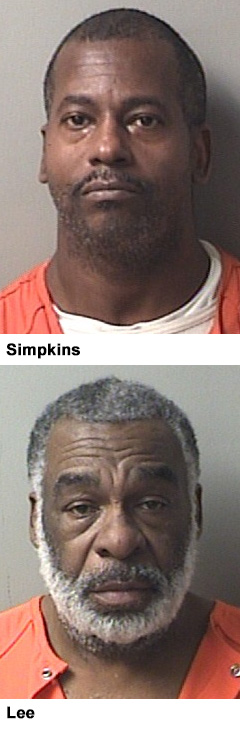
Two additional suspects have been arrested in connection with the October 2014 burglary of the Escambia County Tax Collector’s Office in Molino.
Markett Devon Simpkins, age 43 of Cantonment, and Johnnie Lee, age 55 of Pensacola were charged with burglary and criminal mischief property damage for their alleged roles in the Molino burglary. They were both also charged in connection with the burglary of auto repair shop on Pace Boulevard. Lee was being held in the Escambia County Jail without bond, while Simpkins was being held with bond set at $776,000.
Bruce Lovon Purifoy, 43, and Duriel Vidle Armour, 38, both of Pensacola, were charged back in February with first degree felony burglary and felony criminal mischief with property damage for the October 4, 2014, tax collector burglary in Molino that was caught on surveillance video.
During the break-in, the suspects allegedly attempted to disable the alarm system and used long pry bars to break open the doors of the Tax Collector’s Office in the Molino Community Complex on North Highway 95A. according to an Escambia County Sheriff’s Office arrest report. Both the building and ATM suffered extensive damage.
Scott Orders Additional Prison Reforms
July 10, 2015
Gov. Rick Scott issued an executive order Thursday that furthers prison-reform measures being put in place by Department of Corrections Secretary Julie Jones.
 Scott’s order requires an independent audit of the agency’s operations and creates a partnership between the Department of Corrections, the Department of Juvenile Justice and the Department of Children and Families to establish “best management practices” regarding mental health services.
“This executive order empowers Secretary Jones to improve safety in our correctional facilities, enhance services to reduce recidivism, and address the growing needs of inmates that require additional mental health services,” Scott said in a release tied to the signing. The order follows an executive action taken by Scott in May, after lawmakers failed to agree on prison reforms during the regular legislative session.
The reforms come amid increased scrutiny of Florida’s prisons in the wake of reports of inmate deaths at the hands of abusive prison guards, cover-ups involving inmate deaths and allegations of retaliation against whistleblowers.
Scott’s order in May requires the department to track use-of-force incidents. The May order also requires each prison to keep track of the use of chemical agents as well as the disposal of expired, used or damaged canisters of gas, adds a fourth administrative region to the Department of Corrections, requires regional directors to make at least two surprise visits each quarter to prisons within their areas and requires Jones to establish a policy to protect employees from retaliation for reporting wrongdoing.
by The News Service of Florida
Occupants Run From Ensley Crash; FHP Seeks Info
July 10, 2015
The Florida Highway Patrol is seeing information about a traffic crash in Ensley Thursday in which three people fled on foot.
According to the FHP, a 2005 Ford Expedition was traveling west of Johnson Avenue east of Chisholm Road, near Ensley Elementary School. The driver changed lanes to pass a vehicle, pulling into the path of a 2012 Toyota Camry driven by 19-year old Michelle R. Delacruz of Pensacola.
Three people — two black males and a child about five years old — fled the scene on foot from the Ford Expedition. Troopers said the Expedition belonged to a Lisa Beasley who is deceased.
Anyone with information is asked to call (850) 484-5000 Ext. 335 or Crime Stoppers at (850) 433-STOP.