

ESAR Locates Missing Alzheimer’s Patient In Minutes
October 16, 2015
A missing woman was located by Escambia Search and Rescue is just minutes Thursday night.
 ESAR volunteers assisted the Escambia County Sheriff’s Office in locating the missing 63-year old Alzheimer’s/dementia patient neear Lowe’s on Nile Road in Ensley. She had been missing about 3.5 hours. ESAR arrived, gathered information and formed search teams. One team located the woman within minutes, according to Jim Walters, ESAR public information officer.
The woman was returned to her family in good condition.
ESAR was alerted at 7:23 p.m. and found the woman at 7:39 p.m.
Gulf Power, Other Utilities Continue To Fuel Solar Amendment
October 16, 2015
A political committee pushing one of two competing solar-energy initiatives for the 2016 ballot has quickly amassed nearly $1.5 million, with financial backing from Florida’s major electric utilities.
The committee, “Consumers for Smart Solar,” reached a key threshold Thursday when it submitted enough valid petition signatures to trigger a review by the Florida Supreme Court. To help fuel the effort, it collected $670,000 during September, bringing its overall contributions to $1,468,045.
 The committee, which began raising money in July, has received money from Duke Energy, Florida Power & Light, Tampa Electric and Gulf Power. The utilities collectively accounted for $395,000 of Consumers for Smart Solar’s contributions in September, after pitching in $180,000 in August and $115,000 in July.
The committee’s largest contribution in September, $200,000, came from a Tallahassee-based group known as “Let’s Preserve the American Dream,” which was created as a non-profit social welfare organization.
A Tallahassee-based political-action committee with the same name lists its chairman as Ryan D. Tyson and its treasurer as Robert D. McRae, both officers with the powerful business-lobbying group Associated Industries of Florida. Tyson, in an email, said the Let’s Preserve the American Dream organizations are entirely different, with separate missions and purposes.
Associated Industries later released a statement and noted that, “If and when AIF does take an official position on either of the two proposed constitutional amendments regarding solar in Florida, we will release an official statement.”
The committee is seeking a constitutional amendment that would allow Floridians with solar equipment on their property to sell energy to power companies and “ensure that consumers who do not choose to install solar are not required to subsidize the costs of backup power and electric grid access to those who do.”
As of early Thursday afternoon, the state Division of Elections website reported that the committee — whose leadership includes two former state lawmakers, a Jacksonville tea-party founder and a former chairman of the Florida Public Service Commission — had submitted 68,792 valid signatures.
The state needed to validate 68,314 of the committee’s signatures to trigger a court review of the proposed ballot language..
The committee’s monthly fundraising total surpassed the $446,670 raised by “Floridians for Solar Choice,” which is spearheading the competing solar initiative. It had collected an overall total of $859,002 between December and Sept. 30.
Floridians for Solar Choice, which has most of its money coming from a political arm of the Southern Alliance for Clean Energy, is seeking to pass a constitutional amendment that, in part, would allow businesses to generate and sell up to two megawatts of solar power to customers on the same or neighboring properties.
Stephen Smith, of the Southern Alliance for Clean Energy, said this week that fundraising and signature collections continue, but they are expected to accelerate if the Florida Supreme Court rules that the initiative’s proposed ballot language meets legal requirements to go before voters in November 2016.
The court heard arguments Sept. 1 about the proposed ballot language. If Floridians for Solar Choice gets approval from the Supreme Court, it would need to submit a total of 683,149 valid petition signatures.
As of Thursday morning, it had submitted 182,660 valid signatures to the state Division of Elections. Major electric utilities oppose that ballot proposal.
by Jim Turner, The News Service of Florida
Ernest Ward Eagles End Undefeated Season With Win Over Atmore
October 16, 2015


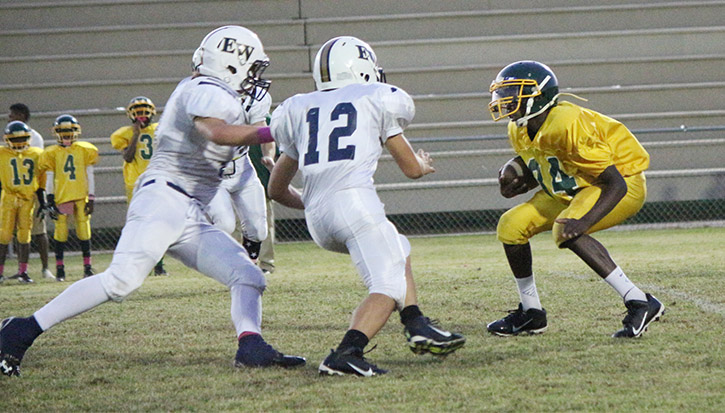
The Ernest Ward Middle School Eagles ended a perfect season with a win over Escambia County Middle School of Atmore.
The Eagles of Ernest Ward beat the Eagles of Escambia County 42-8 in Atmore.
NorthEscambia.com photos, click to enlarge.

Reimagine Flomaton Planning Begins
October 16, 2015
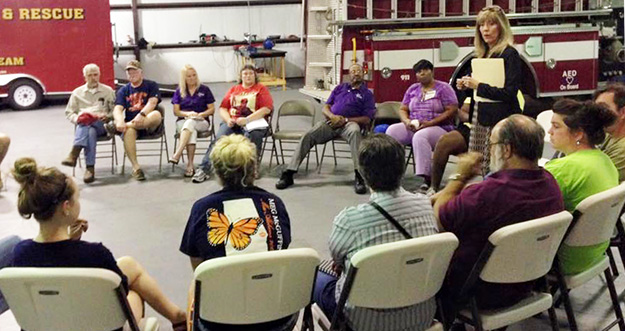
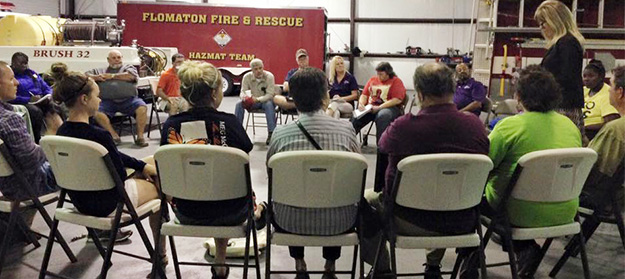
The organizational volunteer meeting for Reimagine Flomaton was held Thursday night at the Flomaton Fire Department.
Reimagine Flomaton will be held Saturday, February 20, 2016. Reimagine has held similar events in Century, Brownsville, Warrrington, Thomaston, GA, Santa Rosa County and Peru. Events have included clothing giveaways, free haircuts, free food, free health checks and displays from community organizations.
The next meeting for the group will be Thursday, November 19 at 6:30 p.m. The meeting location will be announced at a later date on NorthEscambia.com. For more information, contact Linda at (850) 454-5280.
Pictured: Volunteers discuss Reimagine Flomaton Thursday night at the Flomaton Fire Department. Photos for NorthEscambia.com, click to enlarge.
Restore Advisory Committee To Meet Next Week
October 16, 2015
The Escambia County RESTORE Advisory Committee will meet Tuesday, October 20, at 4 p.m. in the County Commission Chambers at 221 Palafox Place to discuss submitted projects and the next step in the process. The public is invited and encouraged to attend.
The County’s RESTORE project submission portal website launched on July 1 and closed on October 2, 2015. More than 120 projects were submitted for entry, with initiatives ranging from bayou restoration to coastal sediment management, a native path boardwalk, workforce development, stormwater projects, habitat restoration, community centers and more.
For more information or general questions about the RESTORE process, upcoming meetings or related topics, visit myescambia.com/restore
West Florida Downs Northview
October 16, 2015


The West Florida Lady Jaguars defeated the Northview Chiefs Thursday night 3-1 in varsity action, and 2-1 in junior varsity play.
West Florida def. Northview varsity 25-, 25-13, 21-25, 26-24.
West Florida def Northview junior varsity 25-9, 25-15.
NorthEscambia.com photos by Gary Amerson, click to enlarge.




Molino Woman Charged With Exploitation Of Elderly Man
October 15, 2015
A Molino woman has been charged with stealing from an elderly man.
 Heather Nicole Gulsby, 27, was charge with felony grand theft, crimes against the elderly and six felony check offenses.
Gulsby was caretaker for a 65-year old man unable to adequately take care of himself, according to an arrest report. Without proper permission, Gulsby allegedly wrote six checks totaling $1,084.72 on the elderly man’s account for her own personal benefit.
According to an Escambia County Sheriff’s Office report, Gulsby wrote checks for her benefit on the victim’s account as follows:
- Three checks for $200 each cashed at a local bank on different dates.
- A $290.37 check to Walmart for merchandise.
- A $144.35 check to Molino Utilities, of which $92.22 was applied to her personal account. The remaining$52.13 was applied to the victim’s account; however, the check was written without his permission, the report states.
- A $50 check cashed at a local bank.
Northview Chiefs Baseball Coach Lister No Longer With The Team
October 15, 2015
Northview High School head baseball coach Martin “Marty” Lister is no longer in charge of the school’s baseball program.
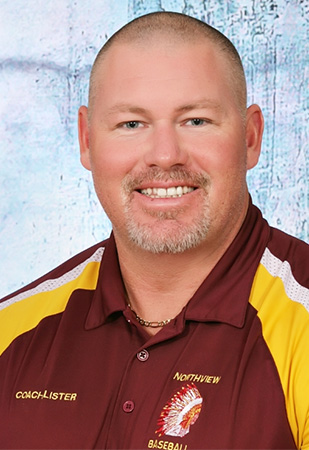 “He has been removed as baseball coach,” Northview Principal Gayle Weaver said Wednesday. She declined to provide any specific reasons for the decision. Lister remains a member of the Northview faculty teaching drafting and construction technology.
Last season, Lister led the Chiefs to their first appearance in the 1A state final four in school history. They lost to Blountstown 7-4 in the Class 1A state semifinal game at Jet Blue Park in Fort Myers.
Lister joined the Chiefs as head baseball coach in October 2012.
He was drafted in the seventh round by the Cincinnati Reds in the 1992 MLB June Amateur Draft from Jefferson Davis Community College in Brewton. He has pitched for the Cincinnati Reds, Houston Astros and Arizona Diamondbacks organizations.
Lister taught at Escambia High School in Pensacola for five years before coming to Northview to teach drafting and construction technology. He coached varsity baseball for four years at Escambia, along with freshmen football, running back coach for varsity football and boys weightlifting. He also was an assistant baseball and pitching coach at Pensacola State College.
Fields Of Faith: Community Worship Service Held
October 15, 2015
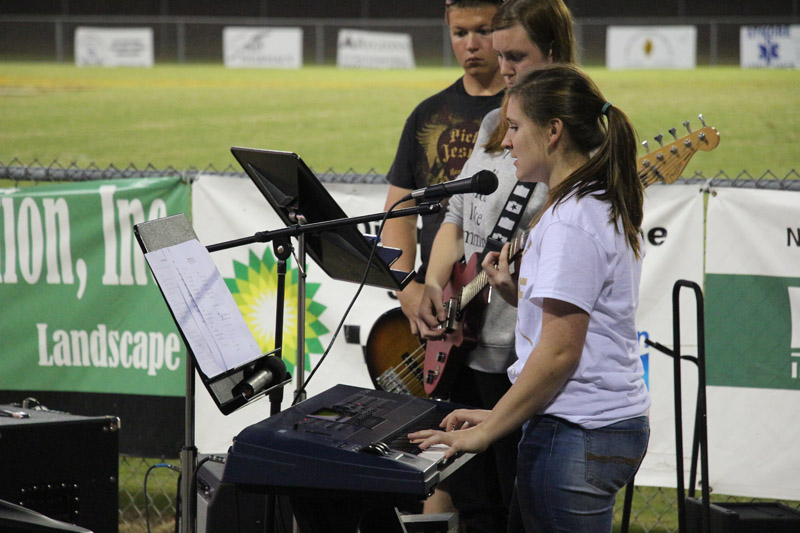
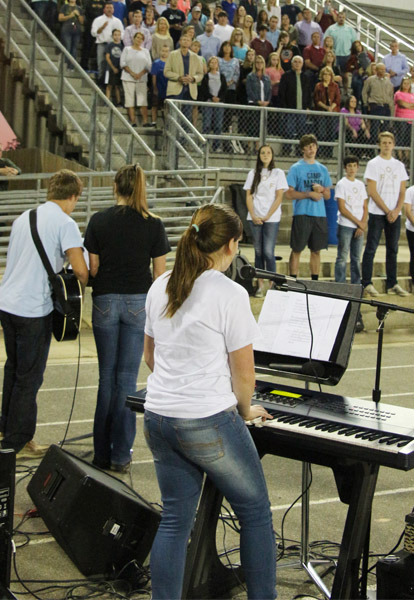
The Northview High School Fellowship of Christian Athletes (FCA) sponsored a student led worship event “Fields of Faith” Wednesday night in the Tommy Weaver Memorial Stadium.
The service included music, student testimonies and a message from guest speaker Jody Levins, a youth leader at Ray’s Chapel Baptist Church in Bogia.
NorthEscambia.com photos, click to enlarge.

U.S. Senate Candidates Take Aim At Washington Dysfunction
October 15, 2015
Facing low name recognition and a largely unshaped race, the five front-runners for Florida’s open U.S. Senate seat introduced themselves to reporters and editors in Tallahassee on Wednesday by arguing that they could actually get things done in a dysfunctional Washington, D.C.
Speaking at an annual Associated Press media gathering at the Florida Capitol, four sitting congressman and the state’s lieutenant governor began distinguishing themselves even as much of the political world’s focus remains on presidential primaries in both parties.
Some of the sharpest contrasts came between Democratic Congressmen Alan Grayson and Patrick Murphy, who are vying for their party’s nomination to the Senate seat being vacated by Republican presidential candidate Marco Rubio.
“I would say the biggest difference between us is style, first and foremost,” said Murphy, who was elected to Congress in 2012 by knocking off Republican firebrand Allen West. “I think Congressman Grayson prides himself on being the bomb-throwing, name-calling, finger-pointing person. … If you ask me, that’s no way to get something done with people.”
But Grayson defended his style of saying “interesting” things and claimed that he has passed more amendments in the House of Representatives than any other member of Congress.
“I don’t try to bore people with the usual drivel. And I’ll plead guilty to that,” he said.
A few minutes later, he proved his point in a soliloquy on the GOP caucus.
“There’s a fundamental problem, which is that Republicanism in the House of Representatives is cannibalizing itself,” he said. “They keep eating each other. Oh, there I go again, saying something interesting.”
Lt. Gov. Carlos Lopez-Cantera hammered home the point that he was the only one of the five without Washington experience.
Lopez-Cantera also distanced himself from right-wing demands that the GOP threaten to shut down the government in order to try to defund Planned Parenthood clinics. He said he would support such a move if it were “not just for a talking point,” but that previous spending showdowns haven’t worked.
“This whole shutdown strategy; I don’t understand it, because it has not accomplished what they have sought to accomplish,” Lopez-Cantera said. “The endgame is still going to be same.”
Republican Congressman David Jolly underscored the fact that he didn’t vote for a congressional committee to investigate Planned Parenthood’s handling of fetal tissue. He noted that three committee were already looking into the matter.
While describing himself as a conservative, Jolly touted a maverick streak that he said came from his desire to get things done rather than dodge issues.
“What is true is that I voted against the intransigence and dishonesty of our own side of the aisle. Look, I am in a space right now in this Senate race where I’m calling it like I see it, with great political risk,” he said.
But Republican Congressman Ron DeSantis demurred when asked about the shutdown strategy, saying he believed Congress should instead get back to the regular budget process instead of a process that causes last-minute showdowns. He noted that because of the procedures, the current Congress has not passed a full package of spending bills.
He also suggested that it was the inability of Congress to at least work for change that was causing some of the discontent among voters.
“I think voters understand, we have a complicated system,” he said. “There are checks and balances. … But if they don’t see the effort, then I think they say, ‘You know what, these guys just say what they want, just to get in there and once they’re there, all they care about is maintaining their positions rather than actually doing things on behalf of the American people.’”
by Brandon Larrabee, The News Service of Florida