
Escambia Man Convicted Of UWF Dorm Attack
May 4, 2016
An Escambia County man has been convicted of attacking a female University of West Florida student..
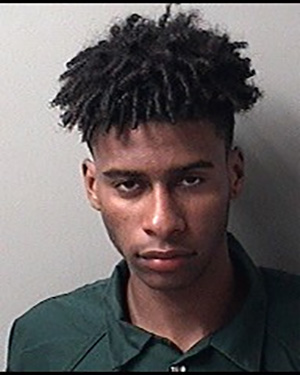 Dylan R. Robinson was convicted on by an Escambia County Jury of two counts of sexual battery. He faces a maximum sentence of life in state prison for each count.
Robinson was charged with attacking the female student in her dorm on the UWF campus in November 2014.
He will be sentenced on June 7.
Northview Track Team Members Place At Regionals; Headed To State
May 4, 2016

Fourteen Northview High School athletes recently competed in the 1A Regional Track Meet in Jacksonville.
 The Chiefs’ Dezmine Moorer (pictured left) placed fourth in the 200 meters with a time of 23.00 to advance to the state meet this week. Also advancing to state are members of the Northview Girls 4×100 team — Myisha Syria, Celeste North, Audriene Odom and Crystal Douglas (pictured top) — who placed third with a time of 51.97.
Other results were as follows:
- Celeste North placed 10th in the 100 hurdles with a time of 18.65
- Kirsten White placed 13th in the 100 hurdles with at time of 19.54
- Audriene Odom placed 7th in the 100 meter dash with a time of 13.46
- Crystal Douglas placed 7th in the 200 meters with a time of 27.18
- Ziara Johnson placed 11th in the 300 hurdles with a time of 56.39
- Myshia Syria placed 12th in the 400 meters with a time of 1:08.30
- Girl’s 4X800 –placed 12 with a time of 12:09.37 – Autumn Albriton, Kirsten White, Moriah Mcgahan, & Savanna Roux
- Moriah McGahan placed 15th in the 800 meters with a time of 2:44.41
- Celeste North placed 12th in the high jump with the height of 4-02
- Dezmine Moorer placed 5th in the 100 meters with a time of 11.49
- Brandon Spencer placed 12th in the 100 meters with a time of 11.66
- Brandon Korinchak placed 10th in the 800 meters with a time of 2:13.92
- Brandon Korinchak placed 9th in the 1600 meters with a time of 4:56.11
- Brandon Spencer placed 6th in the 200 meters with a time of 23.57
- Lawrence Douglas placed 16th in the 400 meters with a time of 59.06
- Boy’s 4×400 –placed 8th with a time of 3:40.75- Brandon Korinchak, Lawrence Douglas, Brandon Spencer, & Ohijie Elliott
Team coaches are:
- Head Girl’s Coach- Natalie Nall
- Assistant Girl’s Coach- Michelle Peebles
- Head Boy’s Coach- Barbara Luker
- Assistant Boy’s Coach – Michael Crumm
The 1A state meet is this Friday and Saturday in Bradenton.

Tate Aggies Beat Milton In Regional Semifinal
May 4, 2016
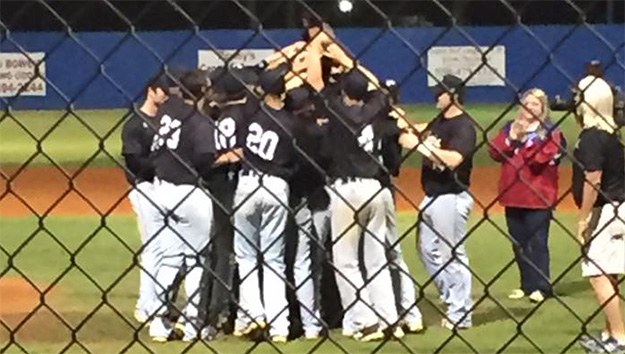
The Tate Aggies came alive to score four in the the fourth inning and held on for a 4-2 win over the Milton Panthers Tuesday night in the Region 1-7A semifinal game.
Madison Lockman pitched the the win for Tate Aggies.. He allowed one run over 4 1/3 innings. Lockman struck out three, walked none and gave up four hits.
Up next for the Aggies is the Region 1-7A championship game against Creekside High School at 7 p.m. Tuesday in St Johns (just south of Jacksonville).
Escambia County To Provide Financial Assistance To Century For Tornado Cleanup
May 3, 2016
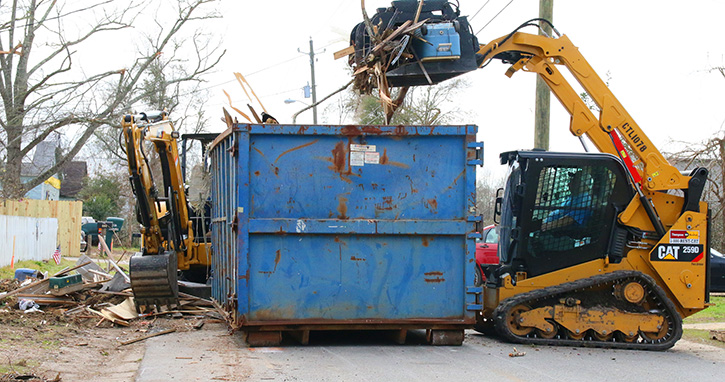
Escambia County Administrator Jack Brown is recommending that the county provide financial assistance to the Town of Century to help cover tornado cleanup expenses.
On February 15, the Town of Century was struck by an EF-3 tornado that had winds estimated to be up to 155 miles per hour that damaged or totally destroyed 109 structures. The Town of Century didn’t have the approximate equipment to clean up the debris caused by the tornado, so they rented the equipment from Thompson Tractor Company, Inc., and hired Republic Services to remove the debris.
Town officials believed that FEMA funding would become available to reimburse them for expenses associated with the cleanup, but FEMA determined that the damage was not severe enough for federal assistance.
At Thursday’s meeting of the Escambia County Commission, Brown will recommend that county pay invoices from Thompson Tractor Company for $10,042.20 and from Republic Services for $24,413.34.
The invoices total $37,455.54. If approved by the county commission, the Escambia County will make payment on Century’s behalf using county operating reserve funds.
Pictured: Tornado debris is loaded into a dumpster on Front Street in Century on March 1. NorthEscambia.com photo, click to enlarge.
FWC Law Enforcement Report
May 3, 2016
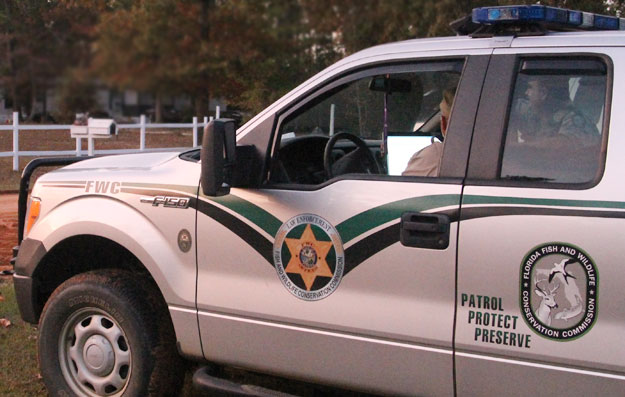
The Florida FWC Division of Law Enforcement reported the following activity during the weekly period ending April 28 in Escambia and Santa Rosa counties.
ESCAMBIA COUNTY
 Officers Land and Cushing patrolled both state and federal waters of the Gulf of Mexico aboard the FinCat, targeting illegal fishing activity. The officers conducted numerous fishing inspections resulting in resource cases for possession of gag grouper during the closed season, possession of undersized triggerfish, possession of undersized amberjack, and possession of red snapper during the closed season. All subjects were issued the appropriate paperwork for these violations.
Officers Land, Roberson, Cushing and USCG Boarding Officer Dziama patrolled both state and federal waters of the Gulf of Mexico, aboard the FinCat, targeting illegal fishing activity. The officers conducted numerous fishing inspections during the day, one of those resulting in several violations. Prior to the officers boarding a recreational fishing vessel to conduct a fisheries inspection, the operator stated that he had some triggerfish and red snapper on board. Additionally, he stated that he knew red snapper was closed, but he didn’t know what to do with the ones he was catching. During the inspection, Officer Land discovered three undersized gray triggerfish in a cooler and a bag of red snapper fillets in the bottom of a bucket of ice with fishing gear piled on top. The owner of this vessel was issued the appropriate citations for these violations.
SANTA ROSA COUNTY
Officer Hutchinson received information about a group of people camping along the Escambia River and fishing illegally. He patrolled the river by vessel and made contact with three of the suspected violators. He conducted a vessel stop and discovered several untagged bush hooks in the vessel. While running the subjects’ information, he discovered that one of them had four outstanding warrants out of Escambia County. He issued two written warnings for the bush hook violations and arrested the subject who had the warrant.
Officers Lewis and Ramos were on forest patrol in Blackwater River State Forest when they observed a group recreating around a campfire. They observed the group cutting live vegetation and littering. The officers heard a truck’s engine revving in a nearby parking area. They observed the group around the campfire leave the area without extinguishing the campfire. The officers ran approximately a half mile toward the truck they heard. When the parking area was in sight, Officer Lewis observed a truck spinning its tires and a “rooster tail” of sand coming up from beneath the vehicle. He approached the truck and found a group a people around it. He observed that the truck was immobile and dug large ruts in the parking lot. Officer Lewis identified the truck’s driver. The driver admitted that he was showing off and intentionally spun his truck’s tires.
Meanwhile, Officer Ramos intercepted the group that was around the campfire as they were heading toward the parking area where the truck was revving its engine. The group around the campfire was with the group with the stuck vehicle. Officer Lewis charged the truck’s owner with destruction of state lands by motor vehicle. Both officers issued multiple citations for forestry violations including not extinguishing the campfire, cutting live vegetation, and littering.
Officer Hutchinson was patrolling in the Blackwater State Forest where he located a subject using a GPS to locate hunting dogs in the field trial area. He made contact with him and after further investigation discovered that he had six hunting dogs with him that were pursuing wildlife. While he was talking to him, he smelled the odor of cannabis and found him in possession of cannabis cigarettes. Officer Hutchinson charged him with hunting with dogs out of season and possession of not more than 20 grams of cannabis.
Over the course of the week, Officers Manning and Allgood conducted resource and boating safety inspections in state and federal waters. They documented several violations including four misdemeanor notices to appear for possession of undersized triggerfish, undersized amberjack, and red snapper out of season. They also documented several other boating safety-related violations.
While conducting resource inspections near the Pensacola Pass, Officers Allgood and Manning noticed several signs of impairment from the operator of one vessel. These signs included a strong smell of an alcoholic beverage on his breath, slurred speech, and glassy red eyes. The operator agreed to perform several field sobriety tasks and performed poorly on them. Officer Allgood placed the operator under arrest and transported him to the Escambia County Jail for boating under the influence (BUI). The operator refused to give a breath sample. This was the operator’s second arrest for BUI.
This report represents some events the FWC handled over the past week; however, it does not include all actions taken by the Division of Law Enforcement. Information provided by FWC.
Sunshine Math Results; Bratt’s Van Pelt Takes First
May 3, 2016
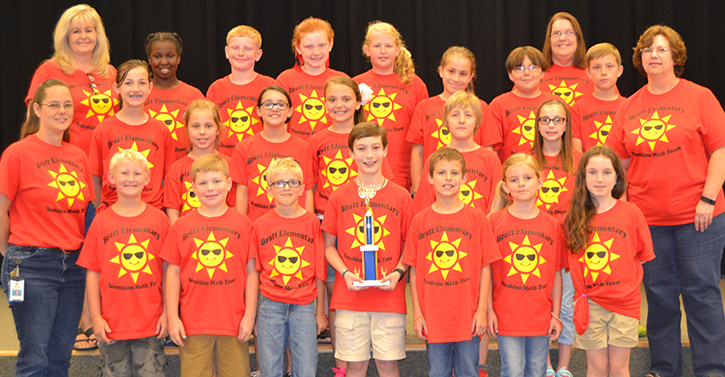
The Escambia County Elementary Sunshine Math Competition was held Saturday at Booker T. Washington High School. Teams of third, fourth and fifth grade students competed as individuals and as teams.
The individual round challenged students to answer 38 math problems in 40 minutes, while the team competitions involved 10 rounds of questions. This year’s event involved 29 elementary schools and over 630 students. Coordinating all of this involved the use of the high school’s auditorium, gymnasium and cafeteria.
The results were:
Individual Competition Winners:
3rd Grade:
1st Place–Beatrice Bunnell McArthur
2nd Place–Alex Young Pine Meadow
3rd Place–Brody Hills Pensacola Beach
4th Grade:
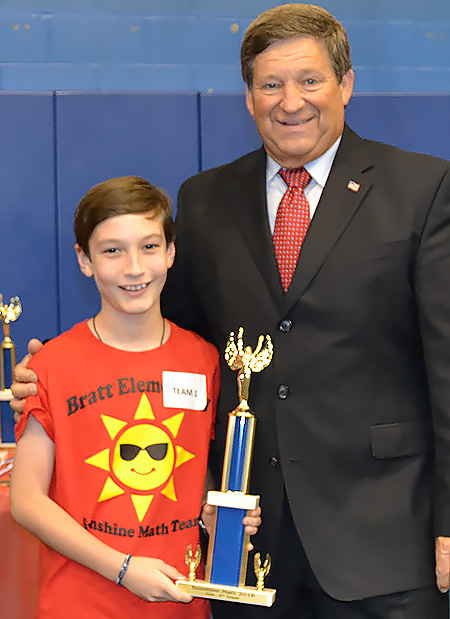
1st Place–Bentley Van Pelt Bratt
2nd Place–Davis Sherman Cordova Park
3rd Place–Logan Weeks Helen Caro
5th Grade:
1st Place–Soloman Burt Brentwood
2nd Place–Roman Bassett A.K. Suter
3rd Place–Drake Salter N.B. Cook
Team Competition Winners:
3rd Grade:
1st Place–Helen Caro Team 1——–Eli Meyer, Hadley Chardon, Connor Mathews, Colin Rhodes
2nd Place–Jim Allen Team 1——–Leslee Brooks, Harlie Davidson, Kyleigh Soto, Desmond Tucker
3rd Place–A.K. Suter Team 1——–Reid Bassett, Olivia Rabby, Carey Vinson, Annabelle Apel
4th Grade:
1st Place–Bellview Team 2———Kara Gilmore, Kailey Vogt, Carlos Herrington, Marissa Balkum
2nd Place–Helen Caro Team 2——Luke Nichols, Rachel Hall, D.J. Gerhardt, Kaiden Foree
3rd Place–Jim Allen Team 1——–Abigail Arnette, Damian Cullen, Grayson Jackson, Audrey Rudd
5th Grade:
1st Place–A.K. Suter Team 2—–Jade Alonzo, Sarah Noeth, Julianna Landers, Madison Brown
2nd Place–A.K. Suter Team 1—-Roman Bassett, Tori Vinson, Alyx Zapatka, Ameila Crawford
3rd Place–Pine Meadow Team 1—-Ian Delay, Max Fina, Audra Davis, Jessica Stabler
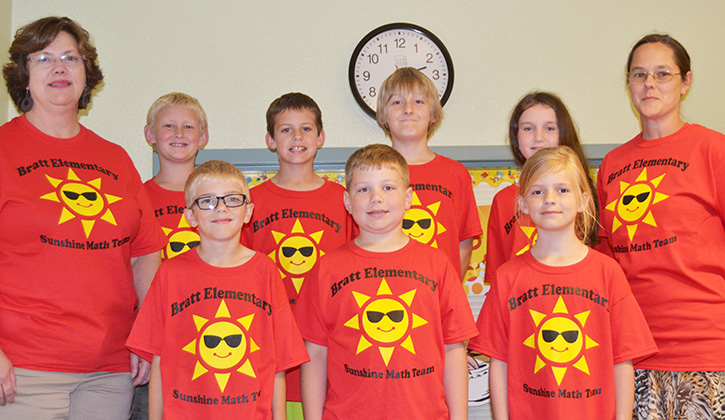
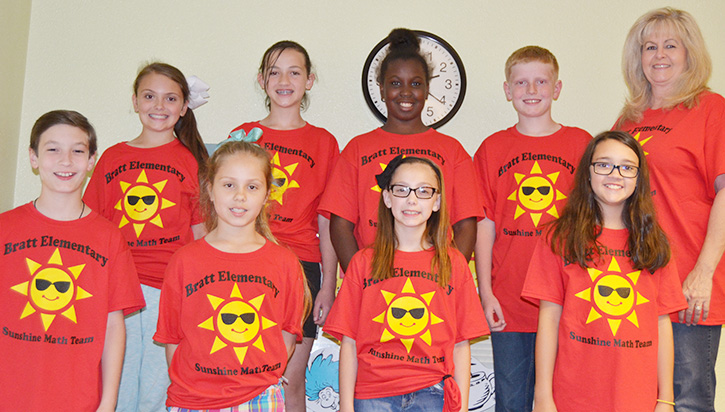
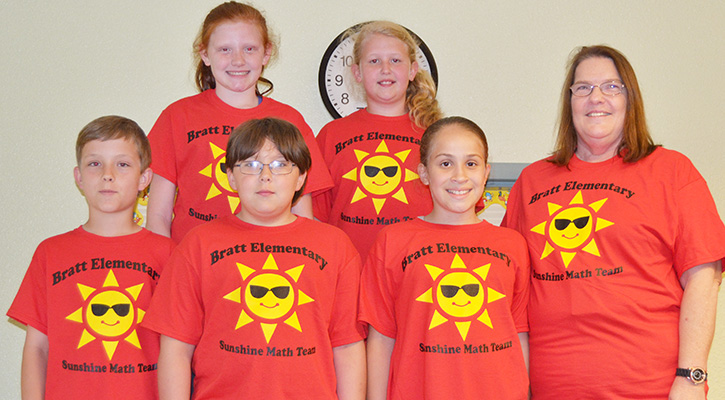
Pictured top: The Bratt Elementary School Sunshine Math Team. Pictured below (top to bottom): The third, fourth and fifth grade Bratt Elementary Sunshine Math teams. Pictured inset: Superintendent Malcolm Thomas with first place fourth grade student Bentley Van Pelt of Bratt Elementary School. Photos for NorthEscambia.com, click to enlarge.
Fallen Law Enforcement Officers Remembered At Capitol
May 3, 2016
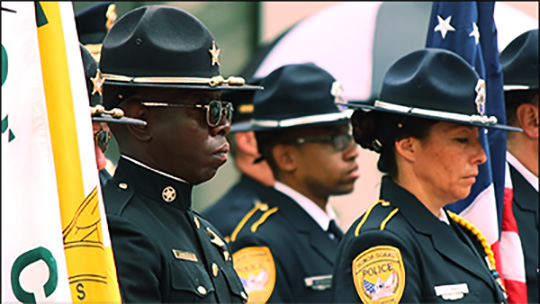
Hundreds of law-enforcement officers from across Florida gathered Monday at the Capitol and honored two colleagues who died in the line of duty in 2015. Family and friends of the late officers took part in the annual Law Enforcement Memorial Service, hosted by the state Fraternal Order of Police.
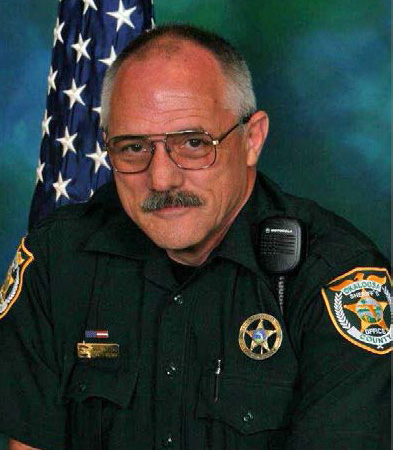 Those who died in 2015 were Ocala police officer Jared Forsyth and Okaloosa County Deputy William Myers (pictured).
Speaking at the ceremony, Okaloosa County Sheriff Larry Ashley said all law-enforcement officers feel the impact when an officer is killed, regardless of where they work.
“We don’t all share the same values and beliefs or the same religion or language even,” Ashley said. “But what is it that unites us? It’s the law, which we all freely and voluntarily agree to and submit ourselves to.”
So far in 2016, one law-enforcement officer has died in the line of duty. Hillsborough County Deputy John Kotfila was killed in March in a head-on collision with a wrong-way driver near Tampa.
by The News Service of Florida
Photo by Joseph Rhodes for NorthEscambia.com, click to enlarge.
Race For Congress: And Then There Were 12
May 3, 2016
There are a now a dozen candidates filed to run for the Congressional seat being vacated by Rep. Jeff Miller.
Robert Edward Black of Shalimar became the ninth Republican to join the race, joining two Democrats and one independent Candidate. The field of candidates, so far, looks like this:
Republicans
Blake, Robert Edward
Bydlak, Rebekah Johansen
Dosev, Cris
Evers, Greg
Frazier, Brian Wayne
Gaetz, Matt
Mills, John
Wichern, Mark
Zumwalt, James
Democrats
Kondrat’yev, Amanda Leigh
Specht, Steven
No Party Affiliation
Schrey, Elizabeth Anne
FCA Presents Extra Inning Awards
May 3, 2016
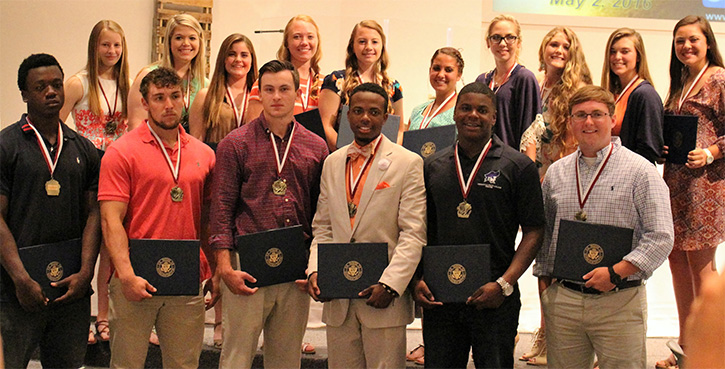
 The Northwest Florida Fellowship of Christian Athletes named their Extra Inning winners from area softball and baseball teams Monday night at the First Baptist Church of Pensacola.
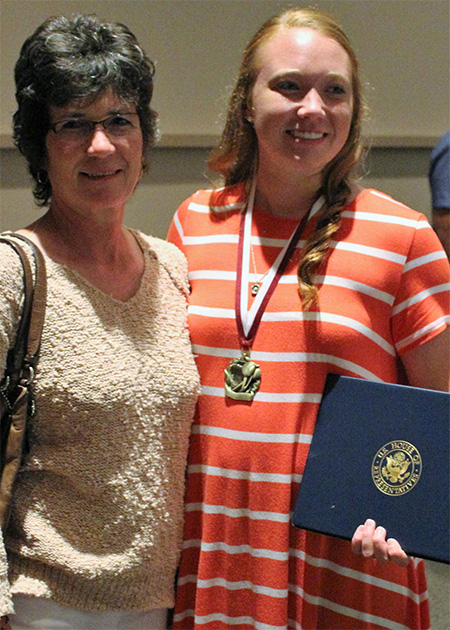
Winners included Northview Softball’s Hanna Ging, Tate Softball’s Ashley Barnett and Tate Baseball’s AJ Gordon.
Winners were:
- Catholic High School Softball- Serena Bruder
- Catholic High School Baseball- Devin Whitehead
- Escambia High School Softball- Makenna Wade
- East Hill Christian School Softball-Alyssa Grizzard
- East Hill Christian School Baseball- John Mobley
- Milton High School Softball- Megan Predmore
- Milton High School Baseball- Kobi Floyd
- Navarre High School Softball- Hanna Stapleton
- Navarre High School Baseball- Tyler Rebber
- Northview High School Softball- Hanna Ging
- Pace High School Softball- Madison Newton
- Pensacola High School Softball- Elydia Eligio
- Pensacola High School Baseball- Damyis Olds
- Pensacola State College- Miles Fore
- Tate High School Softball- Ashley Barnett
- Tate High School Baseball- AJ Gordon, Jr.
- Washington High School Softball- Sara Sewell
- Washington High School Baseball- Nolan Ricketson
- West Florida High School Softball- Ealon Pyle
- West Florida High School Baseball- Hunter Hatcher
Pictured top: Extra Inning award winners. Pictured inset: Barnett and Tate Softball Coach Melinda Wyatt. Photos for NorthEscambia.com, click to enlarge.
Car Seats Credited With Saving Two Babies From Injuries In Wreck
May 3, 2016
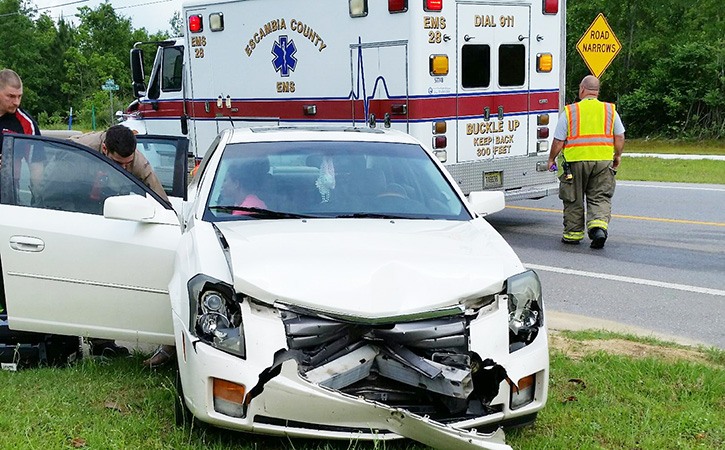
Two babies in two different vehicles escaped injury in a Monday wreck in Cantonment.
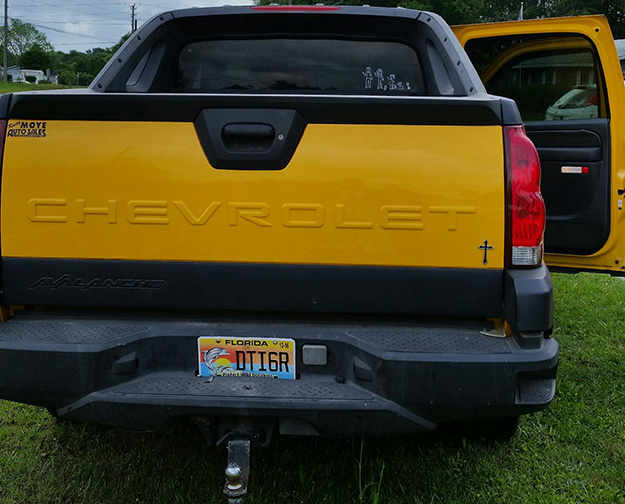
The driver of a car apparently rear-ended a pickup truck on Highway 297A near Kingsfield Road.
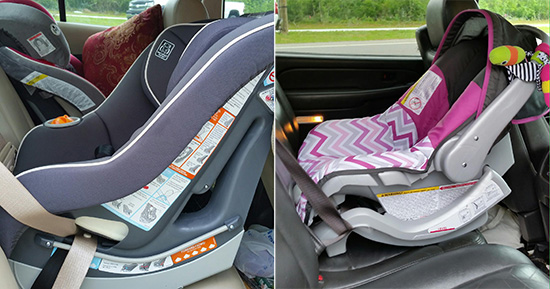
Properly installed car seats were credited with preventing injuries a 2½ month old and a 9 month old involved in the accident.
Further details on the crash have not been released by the Florida Highway Patrol. Escambia County EMS and the Cantonment Station of Escambia Fire Rescue also responded to the crash.
Photos by Kristi Barbour for NorthEscambia.com, click to enlarge.