

Voters Receive New ID Cards
June 27, 2016
Voters in Escambia County were recently mailed a new voter information card from the office of David Stafford, Escambia County Supervisor of Elections.
 Voters are strongly encouraged to review their new cards carefully, particularly their party affiliation and polling location. Voters should contact the elections office immediately with any necessary updates.
The new cards have green text making identification of the most current card simpler. The updated card reflects Escambia County’s State Senate District number change to District 1.
Voter information cards are NOT required when voting; Florida requires approved photo and signature ID when voting in person.
First Baptist Of Bratt Honored For Operation Christmas Child Collections
June 27, 2016
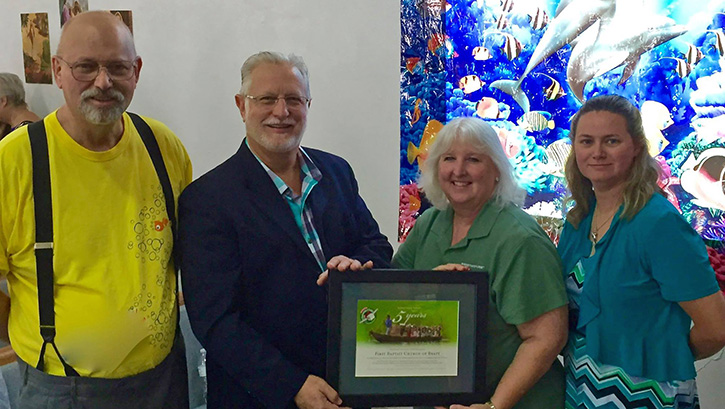
Christmas is still several months away, but Christmas was on the mind of church members Sunday at the First Baptist Church of Bratt.
The church has served for the past five years as a collection point for Operation Christmas Child, which provides simple, gift-filled shoe boxes that bring Christmas joy and evangelistic materials to children in countries across the globe.
Sunday, Bethany Daily, Northwest Florida area coordinator for Operation Christmas Child, gave special recognition to Tim Hawsey and Michelle McKinley at the church. Over 2,300 boxes have been collected by the First Baptist Church of Bratt since 2010.
Submitted photos for NorthEscambia.com, click to enlarge.

Two Molino Residents Injured In Cantonment Crash
June 26, 2016
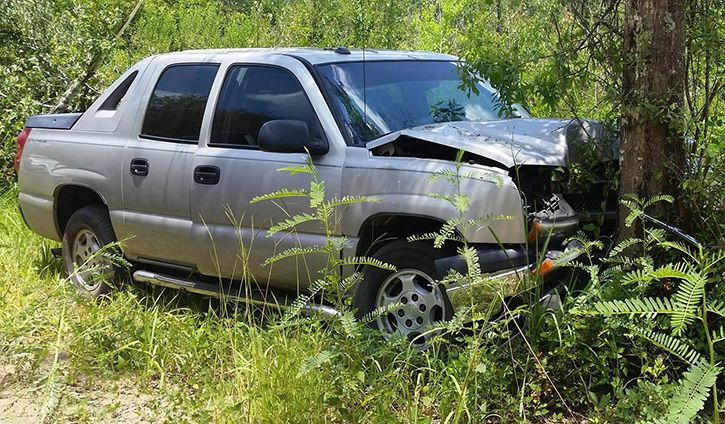
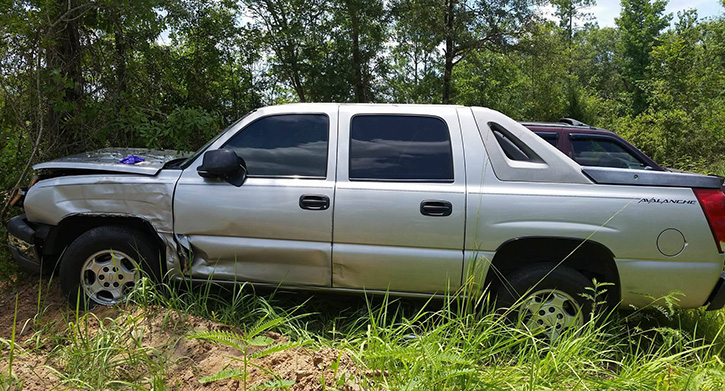
Two people were injured, one seriously, in a single vehicle accident in Cantonment Saturday afternoon.
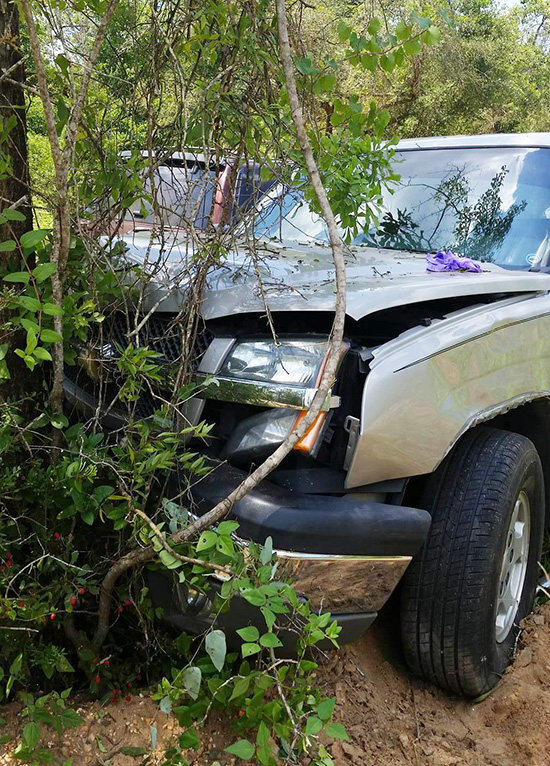 The Florida Highway Patrol said 70-year old John Wall of Molino was southbound on River Annex Road approaching Muscogee Road when he lost control of his 2004 Chevrolet Avalanche, left the roadway and struck a tree.
Wall received minor injuries, while his passenger, 53-year old Laura Montoya of Molino, was seriously injured. Both were transported to Baptist Hospital by Escambia County EMS.
The crash was not alcohol related, and both victims were wearing their seat belts, troopers said.
Any charges against Wall are pending, according to the FHP.
NorthEscambia.com photos by Kristi Barbour, click to enlarge.
Scooter Driver Critical After Beulah Crash
June 26, 2016
The driver of a scooter was critically injured in a wreck Saturday afternoon in Beulah.
 Tommy Mitchell, 50, was westbound on Nine Mile Road near Beulah Road in a 2014 Chevrolet Pickup when he turned into the path of a Yamaha Scooter driver by 51-year old Brian J. Moulyet of Pensacola, according to the Florida Highway Patrol.
Moulyet was airlifted by LifeFlight helicopter to Sacred Heart Hospital in critical condition. Mitchell was not injured.
Mitchell was cited for an improper left turn by the FHP.
FDOT: Weekly Traffic Alerts
June 26, 2016

Drivers will encounter traffic disruptions on the following state roads in Escambia and Santa Rosa counties as crews perform construction and maintenance activities.
Escambia County:
- Interstate 10 (I-10)/U.S. 29 Interchange Improvements – The following traffic impacts will occur Sunday, June 26 through Thursday, June 30 from 8 p.m. to 6 a.m. to allow crews to perform bridge widening work:
- Alternating lane closures on I-10 near U.S. 29 (exits 10A and 10B).
- The U.S. 29 south to I-10 eastbound ramp will be closed. Traffic will be detoured south to make a U-turn at Diamond Dairy Road.
- The U.S. 29 north to I-10 westbound ramp will be closed. Traffic will be detoured north to make a U-turn at Broad Street.
- Drivers are reminded that the speed limit on I-10 near U.S. 29 has been lowered to 50 mph.
Santa Rosa County:
- I-10 Widening – Alternating lane closures, between the Escambia Bay Bridge and S.R. 281 (Avalon Boulevard/Exit 22), Sunday, June 26 through Thursday, June 30 from 8 p.m. to 6 a.m. as crews continue widening work. In addition, alternating lane closures on Avalon Boulevard near the I-10 interchange for bridge work. Drivers are reminded that the speed limit has been lowered to 60 mph. Be alert for construction vehicles entering and exiting the roadway.
- State Road 87 – Construction crews are building the new northbound bridge across the Yellow River in Milton. Although the river will remain open during construction, boaters and kayakers are encouraged to use extra caution when approaching the bridge.
All activities are weather dependent and may be delayed or re-scheduled in the event of inclement weather. Drivers are reminded to use caution, especially at night, when traveling in a work zone and to watch for construction workers and equipment entering and exiting the roadway.
Vehicle Fire Threatens Mobile Home
June 26, 2016
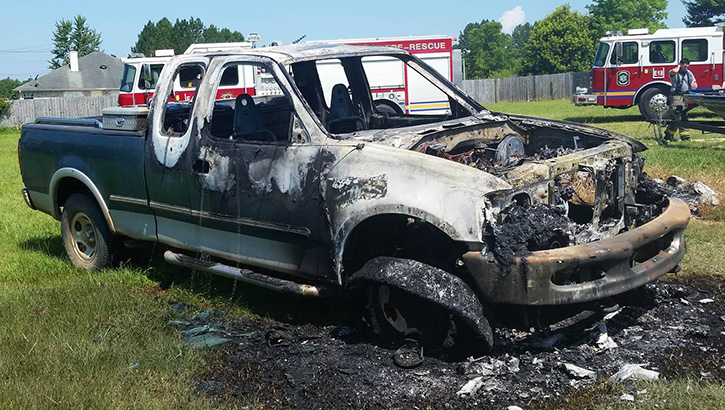
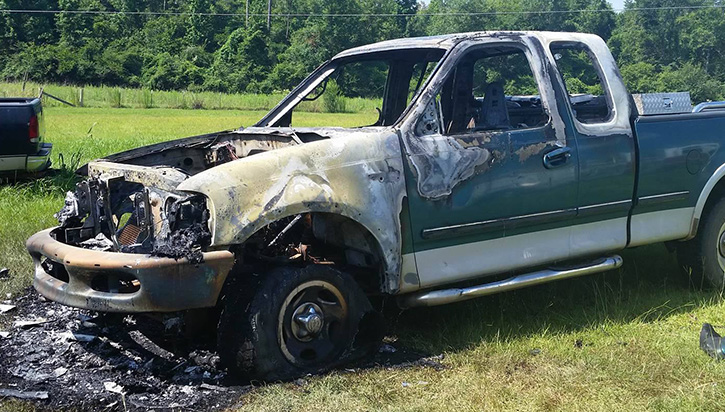
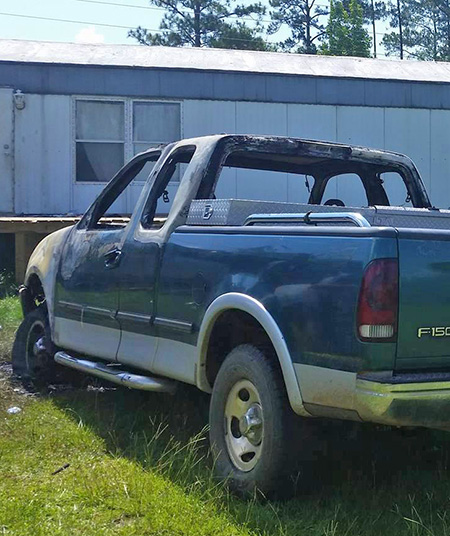 Firefighters were able to keep a vehicle fire from spreading to a nearby mobile home Saturday near Molino.
The fire was reported to be fully involved and threatening a nearby structure on Casey Lane of Highway 95A. The blaze was quickly brought under control by responding firefighters.
NorthEscambia.com photos by Kristi Barbour, click to enlarge.
Chance Of Showers Tonight
June 26, 2016
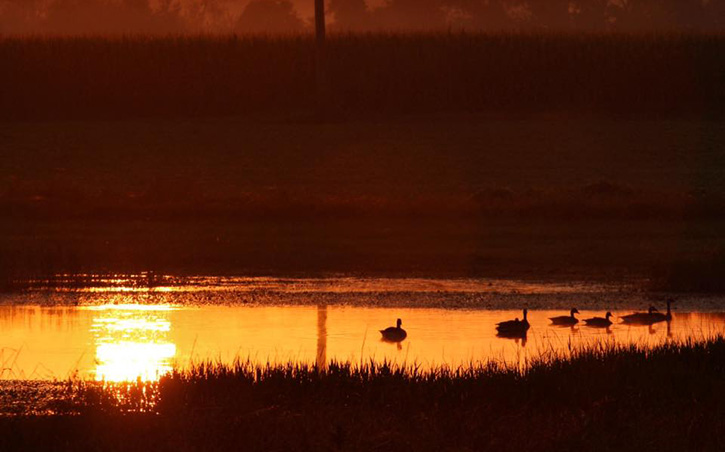
Pictured: Saturday morning’s sunrise is reflected in pool of water in Davisville. Photo by Ditto Gorme for NorthEscambia.com, click to enlarge.
Here is your official North Escambia area forecast:
Tonight: A 30 percent chance of showers and thunderstorms before 1am. Partly cloudy, with a low around 74. Southwest wind around 5 mph becoming calm in the evening.
Monday: A 40 percent chance of showers and thunderstorms after 10am. Partly sunny, with a high near 94. Calm wind becoming south around 5 mph in the afternoon.
Monday Night: A 30 percent chance of showers and thunderstorms. Mostly cloudy, with a low around 74. Southwest wind around 5 mph becoming calm in the evening.
Tuesday: Showers and thunderstorms likely. Mostly cloudy, with a high near 89. Calm wind becoming southwest around 5 mph in the morning. Chance of precipitation is 70%.
Tuesday Night: A 30 percent chance of showers and thunderstorms. Mostly cloudy, with a low around 73. West wind around 5 mph becoming calm in the evening.
Wednesday: Showers and thunderstorms likely. Mostly cloudy, with a high near 87. Calm wind becoming northeast around 5 mph in the afternoon. Chance of precipitation is 60%.
Wednesday Night: A 20 percent chance of showers and thunderstorms. Mostly cloudy, with a low around 70. South wind around 5 mph becoming calm.
Thursday: A 40 percent chance of showers and thunderstorms. Partly sunny, with a high near 90. Calm wind becoming south around 5 mph in the afternoon.
Thursday Night: Partly cloudy, with a low around 73. South wind around 5 mph becoming calm after midnight.
Friday: A 30 percent chance of showers and thunderstorms. Mostly sunny, with a high near 91.
Friday Night: A 20 percent chance of showers and thunderstorms. Partly cloudy, with a low around 74.
Saturday: A 40 percent chance of showers and thunderstorms. Partly sunny, with a high near 90.
Saturday Night: Mostly cloudy, with a low around 75.
Sunday: A 40 percent chance of showers and thunderstorms. Partly sunny, with a high near 92.
Do You Know The Difference Between A Heat Stroke And Heat Exhaustion?
June 26, 2016
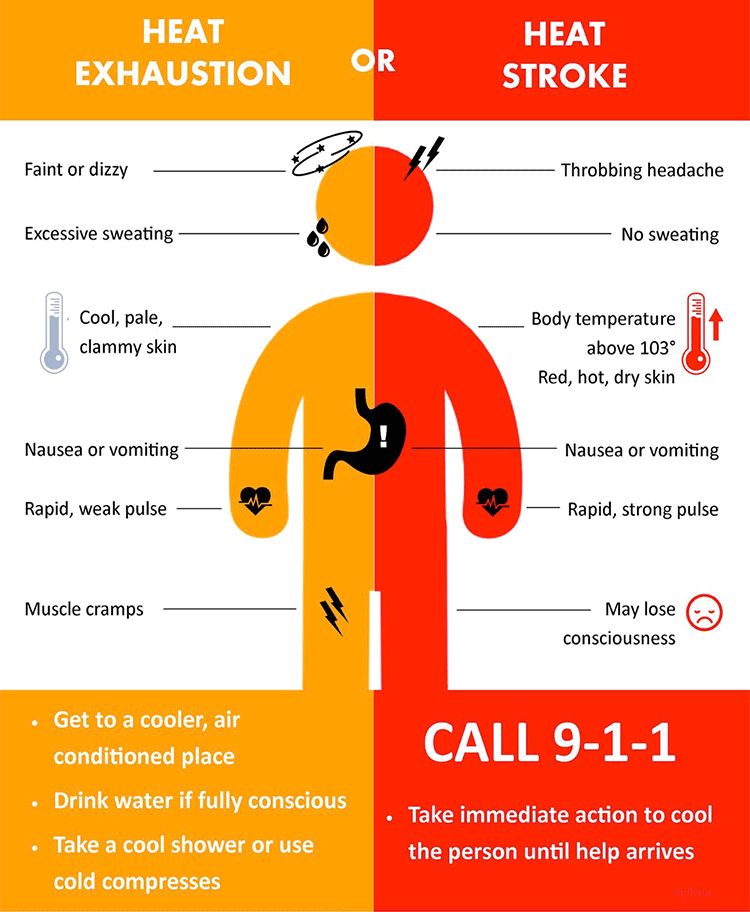
The following graphc from the National Weather Service, explains the difference between a heat stroke and heat exhaustion, and it details how to treat each.
Northview’s Ward Attending Super Combine In Dallas
June 26, 2016
Luke Ward from Northview High School is attending the Blue-Grey National Super Combine this weekend at AT&T Stadium, home of the Dallas Cowboys.
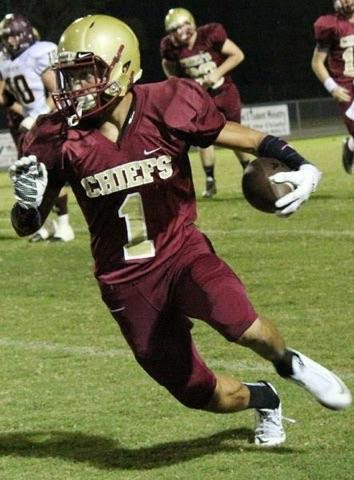 Ward led Northview last year with 407 rushing yards, 331 receiving yards and nine touchdowns.
In April, Ward represented the Alabama region as wide receiver and attended the Blue-Grey Combine held at Cramton Bowl, in Montgomery where he earned the broad jump award with the longest distance at 10’0”. He also had a 4.47 recorded time in the 40, and 4.59 in the shuttle.
“It’s a real honor to be selected to participate in this. I’m excited to visit the AT&T Stadium, and I hope to represent my school well.” Ward said.
If Ward performs well enough in Dallas, he will be in position to be selected to play in one of the Blue-Grey National All-American Bowls played and televised at four NFL locations in January.
Wahoos Top Smokies 6-4
June 26, 2016
Pensacola Blue Wahoos starting pitcher Rookie Davis used both his bat and his right arm to overcome the Tennessee Smokies, 6-4, Saturday at Smokies Park.
He gave the Blue Wahoos the lead, 4-3, in the top of the fourth when he hit a sacrifice to left field that scored Pensacola third baseman Tyler Sparks from third.
 Davis also knocked a solo homer to left field In the third inning that had put his team up, 2-1. The last Pensacola pitcher to hit a home run was Ben Lively on Aug. 19, 2014.
Davis has two hits in 13 at bats this season for Pensacola, and now has three RBIs total.
In the fifth inning, Davis worked out of a jam with runners on second and third and two out by getting Tennessee second baseman Ian Happ out for the first and only time in the game. Davis ended up working 5.1 innings, giving up five hits, three walks and striking out one. He now has a team best 6-1 record with a 2.64 ERA.
Besides Davis, both Pensacola second baseman Alex Blandino and right fielder Sebastian Elizalde also homered. Pensacola went ahead, 5-3, in the top of the seventh when Blandino yanked a solo homer to left field, his fifth of the season.
Elizalde then blasted a solo homer – his third of the year – to right field to start the eighth inning, putting Pensacola ahead, 6-3.
The Blue Wahoos are now second in the Southern League with 48 home runs behind the Montgomery Biscuits with 50.
Happ, who scored three of Tennessee’s four runs, was 3-4 with his first Double-A home run. He hit a two-out, two-run homer in the bottom of the third inning that drove in Smokies third baseman Chesney Young, who had walked.
Happ also crossed the plate in the bottom of the eighth inning on a ground out by Tennessee right fielder Billy McKinney that pulled the Smokies within, 6-4, of Pensacola.
Pensacola’s bullpen came through again. Carlos Gonzalez, Kevin Shackelford and Alejandro Chacin combined to allow one run on one hit and strike out three in 3.2 innings of relief. Chacin nailed down his 13 save this season, which leads the Southern League.
Pensacola tied the score, 1-1, in its next at bat in the top of the second inning when third baseman Taylor Sparks singled in Elizalde, who also singled.
Pensacola first baseman Eric Jagielo knocked a double with one out to left field in the top of the fourth that scored Elizalde that knotted the game, 3-3. Then, Davis drove in his second run of the game on a sacrifice fly that put Pensacola ahead for good, 4-3.
Pensacola, which won the first half title, improved to 2-1 in the Southern League South Division in the second half and is tied for first with the Jacksonville Suns. Overall its record stands at 43-30.