

FWC Law Enforcement Report
July 19, 2016
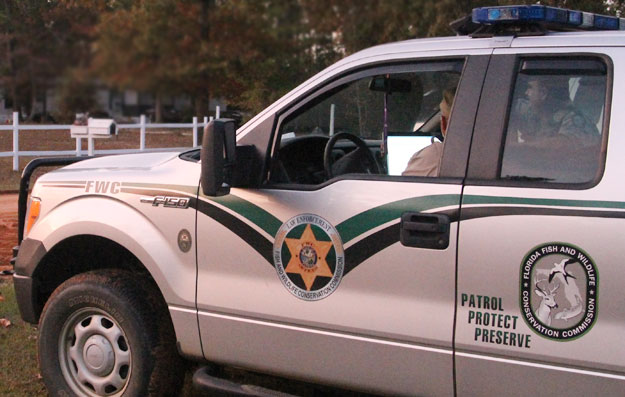
The Florida FWC Division of Law Enforcement reported the following activity during the weekly period ending July 14 in Escambia and Santa Rosa counties.
ESCAMBIA COUNTY
 Officers Manning and Allgood arrested a subject on a warrant for failure to appear in court on a recent fisheries case. Earlier this summer, Officer Allgood arrested the subject for interfering with an FWC officer. The individual threw red snapper out of the boat when Officer Allgood attempted to check his catch. This was the second time the individual was charged with the same violation this year.
Lieutenant Hahr was working enhanced patrol in the Perdido River Wildlife Management Area (WMA) when he observed a truck drive off of the road and enter a muddy area. The driver intentionally spun the vehicle’s tires and created deep ruts in the mud. The driver was charged with damaging state lands with a motor vehicle.
Officers Manning and Allgood patrolled federal waters this week. Together they documented 21 federal violations. Some of the cases included possession of red snapper and triggerfish during closed season, failure to land king mackerel in whole condition, and possession of undersized and over-the-bag limit of vermillion snapper.
SANTA ROSA COUNTY
Officer Lewis was on patrol in the Blackwater River WMA at a primitive campsite when he observed 11 juveniles on a sandbar. He approached the group and could smell cannabis amongst the group. He observed that one of the subjects in the group appeared to have recently smoked cannabis. The subject admitted to smoking cannabis and removed a glass smoking pipe containing cannabis residue and a clear plastic baggy containing cannabis. Officer Lewis cited the juvenile with possession of cannabis not more than 20 grams and possession of drug paraphernalia.
This report represents some events the FWC handled over the past week; however, it does not include all actions taken by the Division of Law Enforcement. Information provided by FWC.
Frustrated Police, Black Leaders Seek Answers After Shootings
July 19, 2016
In the aftermath of fatal attacks on police in Dallas and Baton Rouge, La., black leaders say Florida — which has a long and ugly history of racism — has reached a race-relations crossroads.
Meanwhile, one sheriff says the African-American community needs to “mature” as law enforcement officials seek to keep a lid on the violence that has erupted in other states.
Race relations in Florida, where lynchings of black men were once almost commonplace, have reached a low point as a result of a growing distrust — and outright fear — of law enforcement officers, black leaders told The News Service of Florida in a series of telephone interviews Monday.
The tension is fed by videos documenting black men sitting in their cars or crossing the street — some of them unarmed — being shot dead by police across the country.
“I have not seen the kind of anger and agitation and unrest and paranoia and frustration across the board that I see now,” the Rev. R.B. Holmes, pastor of Tallahassee’s Bethel Missionary Baptist Church said.
Florida sheriffs are reaching out to leaders in the black community while also taking additional measures to beef up protection for their own.
Martin County Sheriff William Snyder, a former state representative who was a Miami-Dade County police officer during race riots that engulfed urban Miami in 1980, said he is exploring the purchase of “tactical rifles” for all of his deputies and holding training sessions with local businesses and schools, if requested.
Snyder met recently with a dozen black leaders, will hold a town hall meeting later in the week in a largely African-American neighborhood and is taking to social media to address concerns, he said.
But he also blamed black activists for contributing to the tension.
“I could be politically correct and say yes, we have to continue the dialogue, which we do, which I’m doing. But the African-American community must mature and deal with the reality that they have too many young black males that are aggressive and hateful and racist themselves who are consistently making the lives of the average deputy or police officer untenable. And that’s a fact,” Snyder said.
Snyder echoed the frustration of other law enforcement officers who feel they’ve been painted with the same brush as a handful of rogue cops caught on camera but who don’t represent the actions of the vast majority of nearly 1 million men and women policing the streets around the nation.
While much of the focus has been on the growing dissatisfaction of people being policed, Snyder’s comments represent what may also be a tipping point for those on the other side of the thin blue line.
“If they continue shoving cameras into our faces and calling us names and agitating and trying to create anarchy in their neighborhoods, they may end up winning the day, but the people are not going to be happy with what they get,” he said.
Many law enforcement officials, including Snyder, are looking to spiritual leaders like Holmes to help keep the situation in Florida from exploding.
“I’ve talked with many spiritual leaders across the country, in the state and city about a need to continue to call for strategic ways to strengthen police and community relations,” Holmes said.
Black pastors are organizing a “Solidarity Sunday” to show support for law enforcement and to “encourage the community to not turn on police officers but to turn to them with a spirit of love, unity and respect,” Holmes said.
But Dale Landry, vice president of the Florida branch of the NAACP, said black leaders are tired of being called upon by white officials to quell possible unrest.
“It starts to get ugly when that’s the only time you’re invited to the party, when they flash the ‘black man’ light,” Landry said, using the Batman superhero phone as an analogy.
Landry said there is “a malignancy of fear spreading among black people” about the police. He speaks about calls from mothers concerned about what might happen to their adult sons — some with sons of their own — when they travel to work or to the store.
“People have no faith anymore,” Landry, a retired law enforcement officer, said. “Right now, no lives matter in police hands.”
Landry is pushing a local referendum to create a citizens’ review board to oversee policing in Leon County and is urging other communities to pass similar initiatives.
Holmes advocates for broad-based advances — including better schools, doing away with predatory lending and making it easier for ex-felons to get jobs — to counter the despair in some urban communities.
“There is a feeling of hopeless, and when a person feels hopeless, they will ambush anyone, police, politicians, parents principals, whatever,” the pastor said.
Florida was ranked number one in police killings of unarmed individuals last year, according to Umi Selah, the mission director for the Dream Defenders, a black rights organization that pre-dates the “Black Lives Matter” movement.
“So if you’re looking for a place where this is to happen, you can, with a reasonable amount of certainty, think that Florida will be amongst those places like something like that occurs and people don’t react in a calm peaceful way to it,” said Selah, whose group coalesced after the death of Trayvon Martin, an unarmed teenager shot by neighborhood watch volunteer George Zimmerman near Orlando in 2012.
While his group does not advocate violence, Selah said the country’s foundation is rooted in violence.
“The chickens are coming home to roost,” he said. “With the amount of video evidence that we have, the amount of information that has been released that was redacted, you see very clearly the level of violence instigated by this country. So there should be no confusion about the fact that now people find the only solution in violence.”
But Pinellas County Sheriff Bob Gualtieri said he does not believe the state is at a tipping point.
“There’s a saying that perception’s reality. Whether people are actually being treated in a certain way is different than whether they are, but if there is a perception on their part, then that’s a problem. That needs to be dealt with,” he said. “Law enforcement needs to do the best job we can, and in some cases a better job, about being transparent and about helping people to understand what we do, how we do it, why we do it.”
Orange County Sheriff Jerry Demings, who serves as the head of the Florida Sheriffs Association, said the Black Lives Matter movement — which some blame for violence against police — is “not going away.”
At the same time, Demings, who is black, said the majority of African Americans support law enforcement in their communities.
He urged both sides to “tone down the rhetoric” and strengthen the relationships between law enforcement and other members of the community, including clergy.
“We’ll get through this time just like we always have,” Demings said. “A respect for honest differences is a healthy sign of process. …When we get to know each other, we can break down some of those stereotypes. I believe the overwhelming majority of people want to resolve the conflicts, if they care about their community.”
by Dara Kam, The News Service of Florida
After News Article, Contractor Mows Century Sidewalks
July 19, 2016
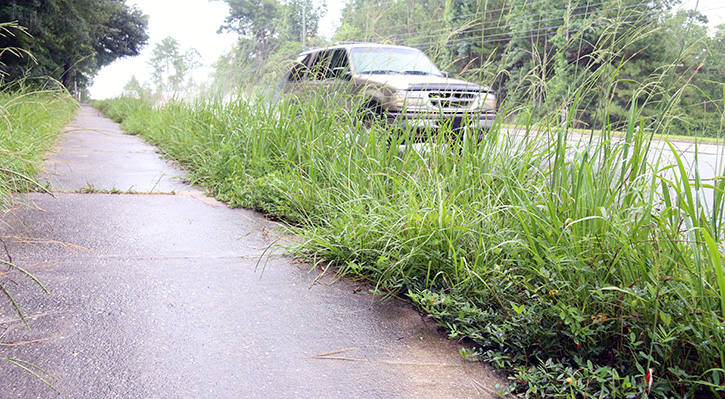
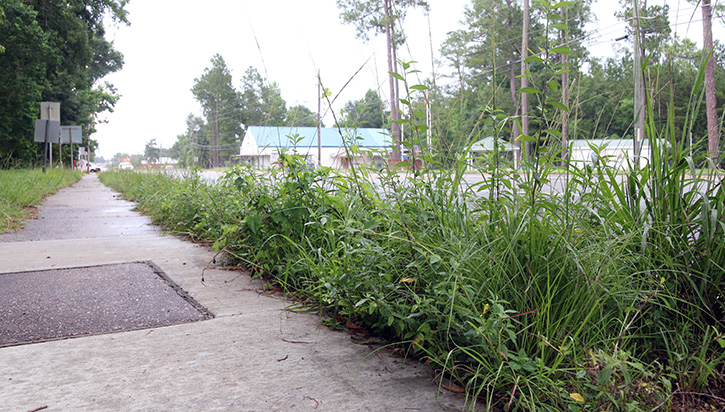
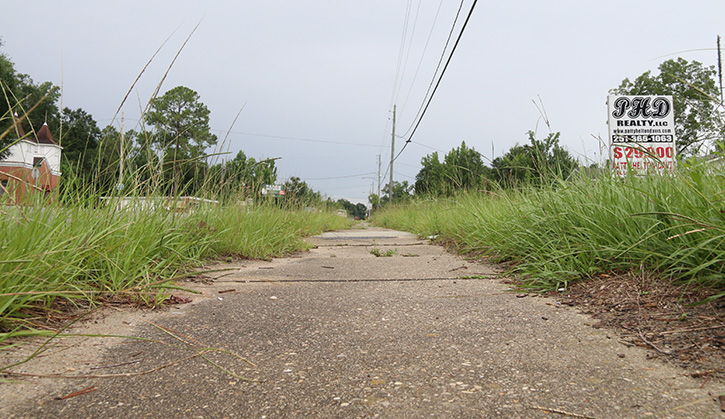
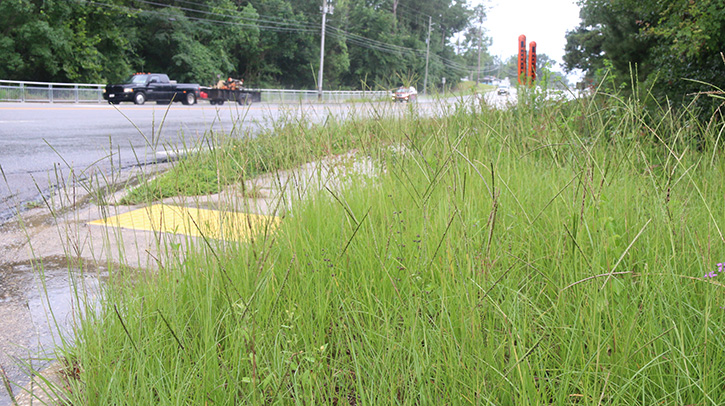
Last Thursday, NorthEscambia.com published an article about weeds along the North Century Boulevard sidewalks in Century reaching several feet high in several places after not being mowed this season. By Friday, an small army of mowers descended on Century, and that mowing continued Monday.
The Florida Department of Transportation contracts with Broadspectrum (formerly known as Transfield Services) to mow along the rights of way of the state highway within the town limits. In most of the town, the right of way has been mowed by individual home or business owners. But in other locations, some weeds were over five-feet high as of last week.
Mayor Freddie McCall reported Monday that Broadspectrum has eight zero turn mowers in Century Friday, with additional mowing on Monday. He said the company will continue to work Tuesday or Wednesday, cleaning sidewalks and trimming tree limbs.
McCall said he is scheduled to meet with a company representative from Tallahassee on Wednesday.
NorthEscambia.com photos, click to enlarge
Trump Adds Flair To GOP Convention’s Dramatic First Day
July 19, 2016

With a dollop of the pizzazz that turned him into one of the most famous businessmen and celebrities in the world, presidential candidate Donald Trump made a dramatic entrance to the Republican National Convention on its first day.
The appearance, which was already a departure from tradition for a presumptive party nominee, took on a surreal air when Trump entered a darkened Cleveland convention hall, silhouetted by a bright backlight, as the audience roared. The podium for his speech rose from the floor as Trump strode across the stage.
 “We’re going to win so big,” Trump told the crowd. “Thank you very much, ladies and gentlemen; we’re going to win so big.”
Trump became known during the primary elections for his stream-of-consciousness addresses, but after that simple statement to the crowd Monday he introduced his wife, Melania, and stepped aside as “We Are the Champions” blared through the hall.
He said about 50 words his entire time on the stage.
It was perhaps the most electric moment on the opening day of the 2016 GOP convention, which follows a topsy-turvy primary race that exposed a deep rift between Republican voters and the party’s establishment.
That Trump even appeared was a sign the outspoken billionaire will continue to run the campaign his way as he turns to a general election race against former Secretary of State Hillary Clinton, who will accept the Democratic Party’s nomination next week in Philadelphia.
Presumptive nominees generally do not appear at the convention on the first day and do not speak at length and in person until the final day, which is capped off with the acceptance speech.
But it was in some ways a fitting end for a day that featured a speech by the star of the reality show “Duck Dynasty” and a floor fight over the party’s rules. The official theme for the first night was “Make America Safe Again,” with a focus on Trump’s pledge to crack down on illegal immigration and wage a more ruthless war on terrorist groups like the self-proclaimed Islamic State.
“What I did for New York, Donald Trump will do for America,” said former New York City Mayor Rudy Giuliani, famous for steering his city through the aftermath of the Sept. 11, 2001, terrorist attacks.
The night also zeroed in on the attack on a diplomatic outpost in Libya while Clinton was secretary of state. Her campaign was quick to respond that Trump would be a hazard to the nation.
“Donald Trump’s ideas on foreign policy aren’t just different — they are dangerously incoherent. … The choice in this election is clear, and we deserve better leadership for our nation — and the world — than Donald Trump,” Florida Democratic Congressman Ted Deutch said in a statement issued by the Clinton campaign.
The focus in Cleveland, though, inevitably kept returning to Trump and his attempts to unite a party trying to win a presidential election for the first time in 12 years.
Trump spoke hours after the floor had erupted into pandemonium following a decision to push through the party’s rules on a voice vote. Some delegates — many of whom had supported candidates other than Trump in state primaries earlier this year — wanted a roll call vote on the rules to try to force consideration of changes to the primary process.
The rules’ critics said they had gained the support of a majority of at least nine state delegations — more than the seven required to request a roll call vote.
When Arkansas Congressman Steve Womack called for a voice vote, opponents of the rules protested loudly. The roar continued after Womack said delegates had approved the rules, and the convention essentially entered suspended animation for about 10 minutes.
Womack eventually took the stage again and carried out another voice vote as opponents chanted “Roll call vote!” After the second vote, Trump supporters began chanting “We want Trump!” in response. Womack then explained that three states had withdrawn their support for a roll call vote — reducing to six the number of delegations that supported the move.
But some opponents of the rules, including U.S. Sen. Mike Lee of Utah, said they had support from as many as 11 states. Speaking on CNN, Lee said the Republican National Committee had created a “toxic environment” with its handling of the rules challenge, including lobbying some delegates to change their positions on a roll call vote.
“Why did they have to do that?” asked Lee, who supported U.S. Sen. Ted Cruz of Texas during the primaries. “Why not just allow for the vote? What are they afraid of?
Opponents of the rules tried to make it clear that the uprising was not necessarily part of the “Never Trump” movement that has opposed the businessman’s blend of populism and nationalism as a betrayal of conservative principles. Ed Buchanan, a Wyoming delegate who supported the effort and chaired Cruz’s campaign in his state, brushed off the idea that the raucous scene indicated the party was split.
“Today what you saw was what makes America great, which is we have a democracy, you can dissent, you can voice your opposition and you saw that today,” Buchanan said. “This isn’t chaos. This is American democracy in action. This is what makes this country great.”
Regardless, the proceedings shattered the idea that Trump and the GOP had completely vanquished opponents and that the Cleveland gathering would be another one of the sedate conventions that have become the rule in recent years. For months during the primary elections, there was widespread speculation that delegates might arrive at the convention without any candidate having won a decisive victory.
Earlier Monday, Republican Party of Florida Chairman Blaise Ingoglia told reporters that he thought the Never Trump movement had already fizzled out.
“I think it was dead before it got here,” he said after a breakfast for the state’s delegation at a hotel in the nearby city of Independence.
Ingoglia, who doubles as a state representative from Spring Hill, also pointed out that many of the Never Trump supporters are lifelong Republicans who would have a lot to lose if the party’s nominee lost.
“All the hard work they’ve been doing for 20, 30, possibly 40 years, could be wiped away in one election if Hillary Clinton was elected president,” he said.
by Brandon Larrabee, The News Service of Florida
Wahoos Fall To Jacksonville
July 19, 2016
The Pensacola Blue Wahoos pulled within one run, 3-2, in the sixth inning but that was as close as they could come to the Jacksonville Suns on Monday at the Baseball Grounds of Jacksonville.
Jacksonville starting pitcher Jake Esch and relievers Tyler Bremer and Sean Donatello combined to shutout Pensacola over the last three innings, allowing one hit and retiring the last seven Blue Wahoos hitters in row.
 Esch improved to 10-6 with a 3.72 ERA, becoming the first pitcher to reach 10 wins in the Southern League. In 6.2 innings of work he allowed seven hits, one walk and two earned runs, while striking out seven.
Despite Monday’s loss, Pensacola won the series, 3-2, but are still below .500 on the road at 23-26. They are 12-13 in the second half, one game back of Jacksonville, which improved to 13-12 to take first place in the Southern League South Division.
Jacksonville scored first when first baseman Chris Curley hit a two-run homer off of Pensacola starter Nick Travieso in the bottom of the second inning to give the Suns a 2-0 lead.
Travieso took the loss and is 4-6 with a 4.16 ERA this season.
In the top of the third inning, Pensacola right fielder Sebastian Elizalde singled to the opposite field on a ground ball to left field drive in shortstop Alex Blandino, who doubled, pulling the Blue Wahoos within, 2-1.
Suns left fielder Austin Dean put Jacksonville up by two runs again, 3-1, on a single on a fly ball to left field that scored pitcher Jake Esch, who led off the fifth inning with a single back up the middle.
Pensacola’s Elizalde doubled to start the sixth inning and crossed home plate on a ground out by third baseman Taylor Sparks to third base to bring the Blue Wahoos, within, 3-2. But that is as close as they would get.
Pensacola was 1-6 with runners in scoring position and left six runners on base.
Leading the Blue Wahoos at the plate were Elizalde, who was 3-4 with a double, run scored and RBI, and Blandino, who was 2-4 with a double and a run scored.
Hundreds Walk To Share Message Of Unity, Love For Police (With Gallery)
July 18, 2016

Hundreds of people from Atmore and North Escambia came together Sunday evening to take part in a “love walk” from the Atmore City Hall to a local park.
The walk was planned to send a message that the local area is close-knit and supportive of people of all races and law enforcement.
“We want to send a message to each other and to the rest of the nation that the senseless violence that has plagued others will not be tolerated in Atmore,” Mayor Jim Staff said. “At a time when other communities are divided, in Atmore we want the nation to know that we stand together.”
“In Atmore, we are determined to stand together as a community,” Staff said. “We have a long tradition of tolerance, respect for each other and respect for our law enforcement officers who every day put their lives on the line for us.”
City officials and local pastors called for a loving — and Godly – attitude among local residents in the wake of violence that has struck Dallas, Baton Rouge and other cities.
For a photo gallery, click here.
Pictured top: People from multiple races came together following a “love walk” to hear a message of unity and pray Sunday evening in Atmore. Picture below: The “love walk” ends at Heritage Park in Atmore. Pictured below: Pastor Ted Bridges of the Walnut Hill Baptist Church shares a Biblical lesson. Pictured bottom: Participants took the take to thank local law enforcement. NorthEscambia.com photos, click to enlarge.


Cantonment Resident Charged In Drug Debt Collection Attempt
July 18, 2016

A second Cantonment man has been arrested in connection with a reported home invasion robbery and the battery of an elderly man while trying to collect a drug debt.
Matthew Paul Pittman, 28, forced his way into a home on Woodbury Circle in Cantonment, holding a 79-year old resident at gunpoint, demanding to know the whereabouts of his adult son, according to an arrest report. He found the son exiting a bathroom, placed a semi-automatic handgun against his head and threatened to kill him if he didn’t pay up. The elderly man escaped through the front door, and the son was able to jump out of a bedroom window.
Outside the home, the son was reportedly grabbed by 39-year old Joseph Diamond Rivers of Cantonment who assaulted him and placed a handgun in his mouth while threatening to kill him, deputies said.
The son told deputies that he owned Rivers $300 for Oxycodone tablets, according to the arrest report.
Pittman was charged with burglary of an occupied dwelling with the use of a firearm, battery on a person 65 years of age or older, two counts of aggravated assault with a deadly weapon and possession of a firearm by a convicted felon. He remained in the Escambia County Jail with bond set at $810,000.
Rivers was arrested a few days after the incident and charged with burglary of an occupied dwelling with the use of a firearm, possession of a firearm by a convicted felon, aggravated assault with a deadly weapon, and battery. He has remained in the Escambia County Jail since March with bond set at $130,000.
Escambia Fire Rescue Comes To Aid Of Cantonment Horse
July 18, 2016

The Cantonment Station of Escambia Fire Rescue came to the aid of a horse that was unable to stand up Sunday at Panhandle Equine Rescue.
 Sky, who just celebrated her 32nd birthday, had fallen and needed assistance from the firemen and PER volunteers. Once out of her stall, they were able to use a large animal lift that was recently purchased with donations.
“She is doing well right now and we are watching her closely. Prayers would be appreciated,” Panhandle Equine Rescue President Diane Lowery said. She also thanked the Escambia Fire Rescue members and the volunteers that assisted.
“They were awesome,” Lowery said.
The only horse rescue in Escambia County, Panhandle Equine Rescue was founded by a small group of concerned citizens with a mission to rescue, rehabilitate and provide adoption services for abused, neglected and abandoned equines. PER is authorized by the court system to investigate equine cruelty in Escambia County.
Photos for NorthEscambia.com, click to enlarge.


Northview Cheerleaders Take Gold At Auburn Camp; Four Headed To London
July 18, 2016

The Northview High School varsity cheerleaders attended UCA Cheer Camp last week at Auburn University, and the squad brought home the gold in several categories.
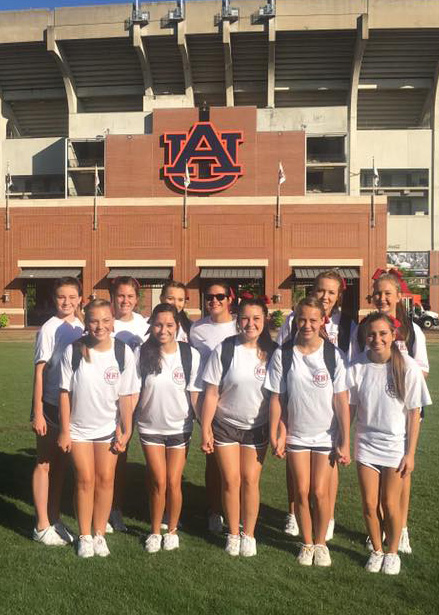 The Northview cheerleaders received first place trophies and gold ribbons in the small division for Xtreme routine, cheer, sideline, home fight song and overall division camp champions.
Additionally, four Northview cheerleaders — Peighton Dortch, Mallory Gibson, Autumn Albritton and Gabrielle Kline — earned All American status and now have the opportunity to cheer in London this fall.
Members of the Northview varsity cheerleaders are: seniors Autumn Albritton, Peighton Dortch, Mallory Gibson and Morgan Myrick; juniors Bailee Hinote and Anna Nelson; and sophomores Shelby Bashore, Gabrielle Kline, Allison Rice, Olivia Seals and Madison Sherouse. Coaches are Genia Bashore and Lauren McCall.
Pictured top and inset: The Northview High School varsity cheerleaders at Auburn University. Pictured below: All-American cheerleaders from Northview (L-R) Autumn Albritton, Peighton Dortch, Gabrielle Kline and Mallory Gibson. Photos for NorthEscambia.com, click to enlarge.

One Serious After Collision With Escambia Deputy
July 18, 2016

One person was seriously injured in a collision involving an Escambia County deputy Sunday night.
About 9:04 p.m., a Ford Taurus driven by 24-year old Jasmine Dodds of Bonifay was traveling north on Pine Forest Road at Blue Angel Parkway when she turned into the path of a marked Escambia County Sheriff’s Office cruiser driven by Deputy M. Keebler, 24. according to the Florida Highway Patrol.
Dodds., who was not wearing a seat belt, was seriously injured and transported to Sacred Heart Hospital. Two adult passengers in her vehicle received minor injuries.
Deputy Keebler received only minor injuries and was not transported to the hospital.
Dodds was cited for an improper left turn in front of approaching traffic by the FHP.
Pictured: An Escambia County deputy was not at fault in this collision Sunday night on Pine Forest Road at Blue Angel Parkway. Images courtesy WEAR 3 for NorthEscambia.com, click to enlarge.

