

Escambia Man Dies In Crash, Possibly While Racing
September 5, 2016
An Escambia County man was killed in a single vehicle crash Sunday night, possibly while racing another vehicle.
 The Florida Highway Patrol said 25-year old Jerrandin Pankey of Pensacola was traveling south on W Street from Truman Avenue in a 1993 Chevrolet Camaro when he lost control, hit a utility pole, a fence and two parked vehicles. He was pronounced deceased on the scene by Escambia County EMS. He was not wearing a seat belt.
A preliminary investigation by the FHP indicated that Pankey may have been racing a gray Ford Focus.
Anyone with information on the crash is asked to contact Corporal Kelley with FHP by meial at ShawnKelley@flhsmv.gov.
Century Changes September Council Meeting Schedule
September 5, 2016
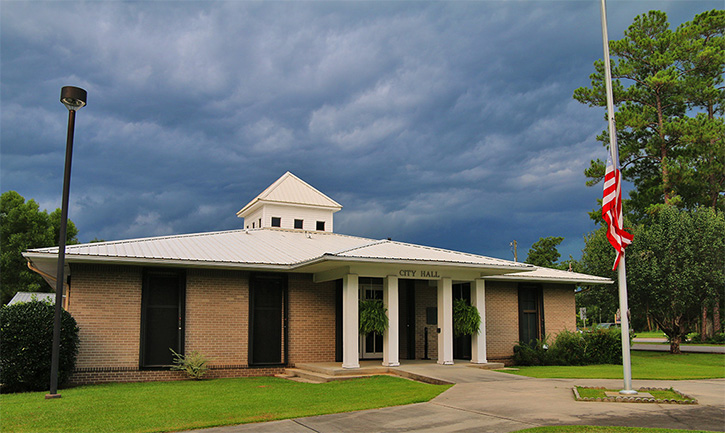
The Century Town Council has changed their meeting scheduled for September to accommodate the Labor Day holiday and budget hearings for the upcoming fiscal year.
The September council meeting schedule will be as follows:
- Monday September 05 — Canceled – Labor Day
- Monday September 12 — 6:50 pm 1st Budget Hearing
- Monday September 12 — 7:00 pm Meeting
- Monday September 19 — 6:50 pm 2nd Budget Hearing
- Monday September 19 — 7:00 pm Meeting
All meetings are open to the public and are held at 7995 North Century Boulevard.
NorthEscambia.com file photo, click to enlarge.
Florida Gov’t Weekly Roundup: A Stormy Week In Florida
September 5, 2016
It wasn’t quite a week of firsts in Florida, but it was a week of “the first time since.”
 For the first time since 2005, a hurricane made landfall in the state — ending a decade of calm for a peninsula that juts out into one of the most active tropical storm areas in the world.
And for the first time since it was created in 1992, someone with a name other than “Corrine Brown” won the state’s 5th Congressional District, as former state Sen. Al Lawson toppled one of Florida’s longest-serving incumbents.
There was a first that seemed inevitable, as the state confirmed the first cases of mosquitoes testing positive for the Zika virus. With the disease already being transmitted locally, it had seemed like just a matter of time until that happened — just like another hurricane in Florida or the end of Brown’s time in Congress.
But like those inevitabilities, no one knew exactly when it would happen until this week rolled around.
THE STORM AFTER THE CALM
Debates over issues like property-insurance reform had taken on a predictable cast at the Legislature over the last several years: warnings that a hurricane had not hit the state in quite some time but that the Sunshine State would experience a large tropical storm soon.
Those predictions came true Friday morning, as Hurricane Hermine — not to be confused with a similarly named character from the Harry Potter books — made landfall near St. Marks around 1:30 a.m.
By late morning Friday, officials were reporting one storm-related fatality, a homeless man in Marion County who was hit by a tree. But more than a quarter of a million people across North and Central Florida had lost power, and downed trees and other hazards made travel difficult.
“Some of the state’s hardest-hit areas were along the coast as you would expect,” Gov. Rick Scott said during a media briefing Friday morning at the state Emergency Operations Center.
“There is a lot of work left to do following the storm,” he said. “We’ll spend the coming days assessing the damage and responding to the needs of our communities and Florida families.”
State offices were closed in 37 counties, and schools were shuttered in 35.
It was Scott’s first hurricane as governor, though he had gotten some practice going through the paces with near-misses and tropical storms. It was also the first hurricane for hundreds of thousands of Floridians who moved to the state over the last decade.
There was a least one more way in which the storm was distinct from the past, as noted by the Miami Herald’s Patricia Mazzei on Twitter: “Florida’s first live-tweeted hurricane.” The platform launched in 2006.
BROWNOUT
In the marquee race of Tuesday’s primary elections, there was no real surprise. U.S. Sen. Marco Rubio was re-nominated by the Republican Party, fending off developer Carlos Beruff and a couple of other candidates in a landslide.
Rubio’s Democratic opponent will be Congressman Patrick Murphy, whose race turned into a rout after his most prominent rival, Congressman Alan Grayson, faced allegations of domestic abuse from an ex-wife. The allegations, which Grayson denies, became public in the closing weeks of the campaign.
But that didn’t mean that Tuesday passed without any major changes. For almost a quarter of a century, Democratic Congresswoman Corrine Brown and her winding district were lightning rods for controversy.
In 1992, three congressional districts were created to give African-American voters a chance to elect candidates of their choice to settle a voting-rights dispute. One of those was the 5th Congressional District, which wound its way from Jacksonville in the north to Orlando in the south.
A voter-approved ban on political gerrymandering changed all that. Brown was forced to run this year in a district that ran from Jacksonville in the east to Gadsden County in the west, cutting through Tallahassee along the way. That brought her a primary challenge from Lawson, whose power base was in the Tallahassee area.
“I’m not going to Washington looking for a job,” said Lawson, who won 47.7 percent of the vote to Brown’s roughly 39 percent. “I’m going to Washington to make a difference.”
Another congressional incumbent facing a stiff challenge, Debbie Wasserman Schultz, hung onto her seat against outsider Tim Canova.
It wouldn’t be election night in Florida without at least some controversy, though, this time in the form of a slip-up that saw Broward County post some voting numbers online nearly half an hour before polls closed at 7 p.m. Under Florida law, releasing election results before the polls close is a third-degree felony.
Secretary of State Ken Detzner said Tuesday evening he had referred the matter to the Broward County state attorney and sheriff. Asked if the Broward elections office could be fined, Detzner said, “It’s a little more serious that that.”
The Broward office blamed the snafu on a vendor, and Detzner said the elections otherwise seemed to go off without a hitch.
THE OLD CRISIS
All the attention to Hermine almost distracted from the issue that had consumed Florida officials for much of the last few weeks: the continuing threat of the mosquito-borne Zika virus, now confirmed to be borne by Florida mosquitoes.
Agriculture Commissioner Adam Putnam and Scott’s office announced that the disease had been detected in three mosquito samples, but stressed that all of them where in a small portion of Miami-Dade County where the virus was already being locally transmitted.
Still, the governor said the state would step up its efforts to swat the virus, and Republican Congressman Vern Buchanan called for a quick vote on funding to fight the disease.
But while Scott tried to project calm, Buchanan took up a different note.
“Congress must put aside partisan differences and come together immediately to protect the public,” Buchanan wrote in a letter to congressional leaders. “The situation in Florida worsens each week, and now looming rainfall from tropical storms threaten to create a fertile breeding ground for the mosquitoes that carry the virus.”
That highlighted the coming together of Florida’s twin problems right now: Scott urged residents to get rid of standing water as quickly as possible once Hermine had passed. After an eventful week, the last thing the state needed was a feedback loop.
STORY OF THE WEEK: Hurricane Hermine became the first hurricane to hit Florida in a decade, killing at least one person and plunging tens of thousands into darkness.
QUOTE OF THE WEEK: “This is life-threatening. We have a hurricane. You can rebuild a home. You can rebuild property. You cannot rebuild a life.” — Gov. Rick Scott, urging Florida residents to be cautious Thursday as Hermine approached.
by Brandon Larrabee, The News Service of Florida
Wahoos Win Over B’ham
September 5, 2016
This time it was Sebastian Elizalde who doubled in three runs with one out in the top of the ninth to deliver a second consecutive victory Sunday for the Pensacola Blue Wahoos in its last at bat against the Birmingham Barons.
This time, Pensacola won, 5-4, over Birmingham at Regions Field, after scoring four runs in the ninth on Saturday to beat the Barons 6-2. The Blue Wahoos have won four of the five games against the Barons with the final game at 12:30 p.m. Monday.
 The Blue Wahoos entered the ninth inning Sunday, trailing 4-2, when pinch-hitter Phillip Ervin singled to third base to start the inning, catcher Joe Hudson hit a single back up the middle. They both moved up to second and third on a sacrifice bunt by center fielder Jeff Gelalich. Then Pensacola second baseman Alex Blandino walked to load the bases with one out.
That’s when Elizalde hit his bases clearing double on a fly ball to center field for the 5-4 lead. Elizalde went 2-5 with one run scored and three RBIs. In four games in the five game series against Birmingham, Elizalde is 10-20 or .500 with four runs scored, a double and six RBIs.
The 24-year-old left-handed hitter has had four-straight multi-hit games and now has 35 multi-hit games on the season to lead Pensacola, plus he leads the team with a .298 batting average.
Pensacola then brought in closer Alejandro Chacin, who was the only Blue Wahoos player named to the post season Southern League All-Star team, then sewed up the victory. Chacin earned his franchise record 30th save, striking out one in one inning of work. On the season, he has 75 strikeouts in 60.2 innings and is 5-2 with a 1.78 ERA.
Sal Romano, the hottest starter for Pensacola in the second half, tossed six innings giving up four runs on five hits and one walk. The Cincinnati Reds No. 17 ranked prospect had four strikeouts giving him 144 this season, which is good for second in the Southern League.
Meanwhile, Pensacola, which won the first half Southern League crown, improved to 39-30 (80-59) for second place during the second half, putting pressure on division leader Mississippi (39-28, 73-63) to beat the Biloxi Shuckers on Sunday.
Pensacola jumped out in front of Birmingham Sunday. Blue Wahoos shortsop Zach Vincej singled to center in the first inning to knock in Elizalde for a 1-0 lead. On the previous play, Pensacola center fielder Jeff Gelalich was thrown out at home when left fielder Brandon Dixon bounced back to Birmingham pitcher James Dykstra, who threw home to catcher Sean O’Connell to catch him.
With the bases loaded in the third inning and no outs, Vincej drove in his second run of the game for Pensacola when he grounded out to first, allowing second baseman Alex Blandino to score to put the Blue Wahoos up, 2-0.
Vincej was 2-5 with two runs batted in Sunday for his 27th multi-hit game of the season. He is also hot in the series against Birmingham, going 9-18 (.500) and two walks and driving in six runs for 47 RBIs this year.
However, Birmingham came back in the fourth inning when right fielder Keenyn Walker doubled, his 16th of the year, and scored when DH Courtney Hawkins hit a ground ball to third base. Barons left fielder Marcus Lemon singled to drive in Hawkins to tie the score, 2-2.
In the sixth inning, Birmingham then went ahead, 4-2, when first baseman Keon Barnum hit a sacrifice fly to left field that scored Barons second baseman Joey DeMichele. Lemon then hit a line drive single to center field to score Hawkins with Birmingham’s fourth run.
Meanwhile, Birmingham starter James Dykstra and reliever Colton Turner combined for five shutout innings. Turner pitched two scoreless innings, allowing no hits, while walking one and striking out three. Pensacola scored all three runs to win the game off of Barons closer Brian Clark.
Area Sees Fewer Business ‘Births’ During Latest Recovery
September 5, 2016
by Allison Tyler Romer
Researchers frequently highlight the role geography plays in our lives, whether that is the likelihood of upward mobility, our overall health or the cost of raising a family.
A recently released study by the Economic Innovation Group emphasizes the changing geographic landscape of new business establishment growth during the nation’s three most recent economic recovery periods.
 The authors used data from the U.S. Census Bureau to analyze business establishment growth in the five years following the last three major recessions (1992-96, 2002-06, and 2010-14). Their findings present alarming trends for communities across the country – including the greater Pensacola community.
Unlike the previous two recovery periods, business establishment growth during the 2010-14 recovery period was much slower nationwide, growing only 2.3 percent over five years. While the most recent recovery period has been characterized by much slower growth rates than the two preceding recovery periods, what is perhaps most striking is how geographically concentrated the recovery has been. Haas Center staff analyzed the data to see how Escambia and Santa Rosa counties compare to counties in other parts of the country.
Historical data shows us Santa Rosa County has fared better than Escambia County during periods of economic recovery, typically experiencing growth rates much higher than both the state and national level. While Santa Rosa continued to outpace both the nation and Escambia during the past recovery period, the county’s rate of growth was noticeably lower than previous recovery periods.
It is possible that population growth rates may explain some of this trend. The population growth of Santa Rosa County was 1.3 percent per year in 2010-14, compared to 3.6 and 2.6 percent per year during 1992-96 and 2002-06, respectively.
The geographic concentration of establishment growth continued to shrink during recent recovery periods. Astonishingly, 50 percent of the nation’s new establishment growth from 2010 to 2014 can be attributed to a total of 20 counties. Disproportionately, these counties only represent 17 percent of the U.S. population. Four of these counties are located in Florida (Miami-Dade, Palm Beach, Broward, and Orange counties), none of which are located in Northwest Florida.
Additionally, the number of counties experiencing a decline in establishments increased.
Approximately 59 percent of counties, representing nearly one-third of the nation’s population, saw a decline in the number of establishments between 2010 and 2014. Comparatively, only 17 percent of counties, representing 14 percent of the U.S. population, saw a decline in establishments between 1992 and 1996.
Furthermore, only 25 percent of counties saw a growth rate of establishments that matched or exceeded the national level. These counties are home to approximately 48 percent of the nation’s population.
Florida as a whole fared better than most states, with approximately 82 percent of its population residing in a county that experienced positive growth equal to or greater than the national rate.
A decline in new startups is one reason for the slow business establishment growth rate during the most recent recovery, according to EIG. A company is distinct from an establishment in that an establishment is the physical location out of which a firm operates. For example, the Drowsy Poet coffee shop would be counted as a company creation in the year it started for Escambia County. Each new store is credited as a new business establishment for the county where it is located.
For the Pensacola area over the most recent recovery period of 2010-14, there was a net loss of 203 firms, meaning there were more firm deaths than births. The previous recovery periods of 1992-96 and 2002-06 saw net increases of 678 and 1,046, respectively.
Because the Pensacola-area business establishment growth rate was positive from 2010-14, despite a net loss of firms, we can conclude that the establishment growth can largely be attributed to the expansion of existing firms.
Allison Tyler Romer serves as economic development coordinator at the Haas Center in Pensacola.
Man In Wheelchair Killed In Escambia County Crash
September 4, 2016
A man in a wheelchair was struck and killed Saturday night in Escambia County.
 According to the Florida Highway Patrol, 32-year old Gerald Desota was eastbound on Fairfield Drive approaching Pace Boulevard in 2012 Chrysler 200 when a man in a wheelchair, identified as 59-year old Steven Carl Travis of Hardy, AR, entered Fairfield directly in his path.
Travis was transported to Baptist Hospital where he later died from the injuries sustained in the crash. Any charges are pending the outcome of a traffic homicide investigation.
Driver Misses Molino Stop Sign, Hits Distant Tree
September 4, 2016
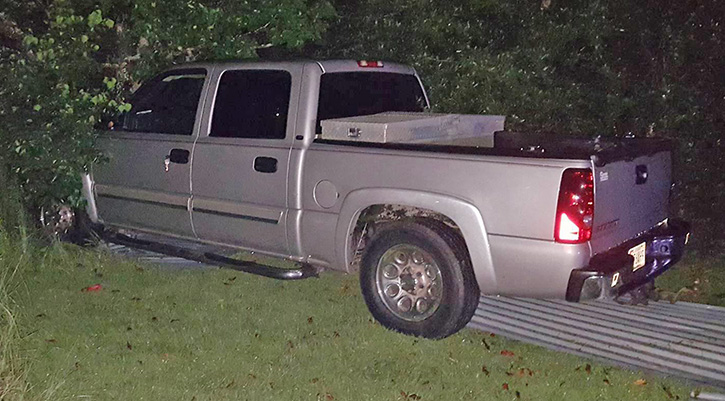
A driver traveled hundreds of feet and hit a treee after missing a stop sign in Molino Saturday.
About 9:50 p.m., the drive of a pickup truck was westbound on Crabbtree Church Road when he failed to stop at the intersection with Sunshine Hill Road. The vehicle crossed Sunshine Hill Road, ran off the roadway and continued about 350 to 400 feet before striking a tree. The driver refused transport to the hospital.
The homeowner said this is not the first time someone has missed that stop sign and traveled past their home into the tree line.
NorthEscambia.com photos by Kristi Barbour, click to enlarge.
UWF Football Rolls To Historic 45-0 Victory In Program Opener
September 4, 2016

The UWF football program got everything it could have asked for on Saturday in its first-ever intercollegiate game – 500 yards of total offense, a defensive shutout that held the opposition to 105 yards and a happy group of close to 200 Argonaut fans, including the university president.
UWF (1-0) got off to a slow start, failing to score on its first three possessions before a pair of 50-plus yard scoring drives to close the half put the Argonauts up for good.
Tim Bellinger scored from a yard out midway through the second quarter before Kaleb Nobles completed a 15-yard pass to Caleb Robinson just before the half ended.
Bellinger rushed 18 times for 101 yards and a pair of touchdowns to lead the UWF ground game, which finished with 288 yards and four scores.
The teams were set to start the second half but were sent back to the locker rooms when a lightning storm hovered over the area, forcing a 2 hour 15 minute delay.
When play resumed, the UWF offense went into overdrive, scoring on the team’s opening four possessions. Bellinger added crossed the goal line from two yards out, Austin Peffers drilled a 25-yard field goal, Daviante Sayles made the highlight play of the game when he hurdled an AMU linebacker at the 3-yard line and Ishmel Morrow caught an 8-yard pass from Nobles.
Chris Schwarz completed the scoring in the fourth quarter with a rushing TD from four yards.
Nobles finished the game with 235 yards passing on 21-of-29 and two TDs. He and fellow signal caller Grey Jackson combined for 236 yards passing and connected with nine different targets.
AMU (0-1) managed just 105 yards of offense and just two net yards rushing.
UWF will face Missouri S&T in its inaugural home game next Saturday. Kickoff at Blue Wahoos Stadium in downtown Pensacola is set for 6:00 p.m. Central time.
Special Commission Meeting To Address OLF-8 In Beulah
September 4, 2016
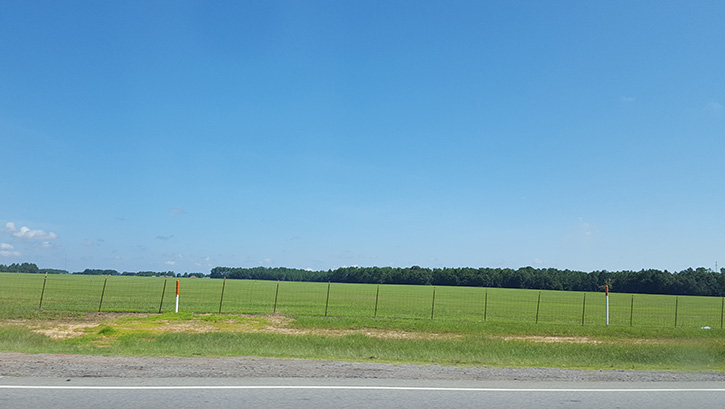
A special Escambia County Board of County Commissioners meeting has been scheduled for Tuesday, Sept. 6 at 5:03 p.m. to discuss issues concerning OLF-8, or Outlying Landing Field 8.
OLF-8 is the Navy’s 640-acre helicopter field on Nine Mile Road in Beulah, adjacent to Navy Federal Credit Union. Escambia County has planned to trade land it owns in Santa Rosa County for OLF-8. Several groups want to see OLF=8 developed into a commerce park. Meanwhile, many residents of Beulah have called for the development of a master plan to manage the develop of the area, including OLF-8.
The special BCC meeting will be held in the Board Chambers, room 100, in the Ernie Lee Magaha Government Building, located at 221 Palafox Place in Pensacola.
NorthEscambia.com photo, click to enlarge.
FDOT: Weekly Traffic Alerts
September 4, 2016
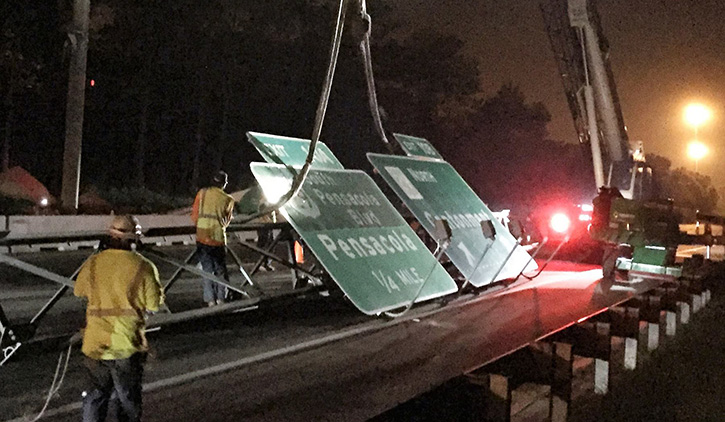
Drivers will encounter traffic disruptions on the following state roads in Escambia and Santa Rosa counties as crews perform construction and maintenance activities. There will be no planned lane closures on the state road system through 12:01 a.m., Tuesday, September 6 due to the Labor Day holiday. All major roads will be open to normal traffic. In emergency situations requiring a lane or road closure, repairs will continue until all safety issues related to the traveling public have been addressed and the lane/roadway is reopened.
Escambia County:
- Interstate 10 (I-10) Widening – Intermittent and alternating lane closures on I-10, between State Road (S.R.) 291 (Davis Highway/Exit 13) and U.S. 90 (Scenic Highway/Exit 17), from 7 p.m. to 6:30 a.m. Tuesday, Sept. 6 through Sunday, Sept. 11 as crews place pavement markers.
- I-10 / U.S. 29 Interchange – The U.S. 29 north to I-10 eastbound ramp will be intermittently closed from 8 p.m. to 6 a.m. Tuesday, Sept. 6 through Thursday, Sept. 8 as crews work on the shoulder of the roadway. Traffic will be detoured north to make a U-turn at Broad Street and access I-10 eastbound. The closures will continue Sunday through Thursday nights through September.
Santa Rosa County:
- I-10 Widening – Alternating lane closures, between the Escambia Bay Bridge and S.R. 281 (Avalon Boulevard/Exit 22), from 8 p.m. to 6 a.m. Tuesday, Sept. 6 through Thursday, Sept. 8 as crews continue widening work. In addition, there will be alternating lane closures on Avalon Boulevard near the I-10 interchange for bridge work.
All activities are weather dependent and may be delayed or re-scheduled in the event of inclement weather. Drivers are reminded to use caution, especially at night, when traveling in a work zone and to watch for construction workers and equipment entering and exiting the roadway.
Pictured: The I-10/U.S. 29 construction team removed overhead interstate signs recently. Removing the signs allows crews to continue widening I-10 westbound near exit 10B. Photo for NorthEscambia.com, click to enlarge.