

Southwest Plane Diverted To Pensacola After ‘Uncontained Engine Failure’
August 28, 2016
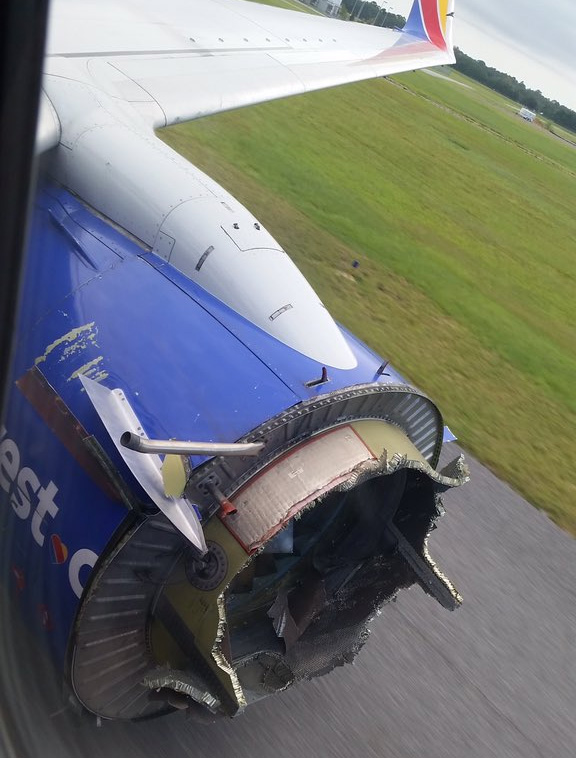
A Southwest Airlines flight from New Orleans to Orlando diverted to Pensacola Saturday morning due to a mechanical issue with one of the plane’s engines.
“Today, the Captain of Flight #3472 from New Orleans to Orlando made the decision to divert to Pensacola due to a mechanical issue with the number one engine. The flight landed safely without incident at Pensacola International Airport at 9:40 a.m. central time,” Southwest said in a statement.
The plane experience an “uncontained engine failure”, according to The National Transportation Safety Board.
There were no injuries to any of the 99 passengers or five crew members, Southwest said. Alternative arrangements were made to get the passengers to Orlando.
The aircraft remained out of service in Pensacola awaiting a damage assessment.
Photos courtesy Stephanie/Twitter and Lexy/Twitter.

Wahoos Beat Jacksonville
August 28, 2016

The Pensacola Blue Wahoos won the first half of the Southern League South Division and now are in the hunt to win the second half, too.
The Blue Wahoos defeated Jacksonville, 5-3, thanks in part to a two-out, two-run homer by Brandon Dixon and pulled within 1.5 games of current frontrunner Mississippi Braves.
Mississippi lost its seventh game in a row and is 33-27 in the South Division and are 67-62 overall. Meanwhile, Pensacola is 32-29 in the second half and are having the club’s best season in its five-year history at 73-58 overall. Pensacola won five in a row starting Aug. 17 and are 12-5 since then.
The Blue Wahoos pulled out another victory Saturday when they scored two runs in the bottom of the eighth inning when Pensacola shortstop Zach Vincej hit a sacrifice fly to left field that allowed both center fielder Jeff Gelalich and left fielder Phillip Ervin to score when Jacksonville left fielder Austin Dean threw the ball to home off the mark. The two runs put the Blue Wahoos ahead, 5-3.
Pensacola closer Alejandro Chacin then entered the game in the ninth and saved his 26th game for the Blue Wahoos record, surpassing Zack Weiss, who had 25 for Pensacola last season.
Pensacola manager Pat Kelly, who was celebrating his 61st birthday, likes the way his team is playing, especially Chacin, who allowed two hits and struck out two in his one inning.
“The players have confidence behind him,” Kelly said. “There was no doubt in anyone’s mind that he was going to finish that one out.”
Pensacola jumped out to a quick 2-0 lead in the bottom of the first inning when Dixon smashed a two-out, two run homer to left field. Dixon, who last hit one out of the park on Aug. 2, now has a team-leading 15 homers and 61 RBIs. He has a seven game hit streak and is batting .469 (15-32) with one homer and seven RBIs.
Dixon, who has 28 hits in August compared to 31 in June and July combined, said he turned things around working with Cincinnati Reds instructor Hall of Fame shortstop Barry Larkin on being more consistent and driving the ball.
“I’m just driving the ball more and trying to make more consistent contact,” said the 24-year-old Dixon, who played for the Arizona Wildcats in college. “You get hot sometimes and sometimes things just don’t go your way.”
Ervin generated a run in the sixth inning. He leadoff with a hit by a pitch, stole second for his 34th steal of the year, move to third on a ground out by Vincej and beat a diving Jacksonville catcher Cam Maron to home plate for a 3-0 lead.
“He had Billy Hamilton in him there,” Kelly said about the Cincinnati Reds base thief. “He got a great break to the plate. It was outstanding.”
After allowing 10 runs in eight innings in his last two starts, Pensacola starter Tyler Mahle returned to his pitching form when he came up with the Blue Wahoos mid-season.
Mahle had retired 12 batters in a row before Jacksonville right fielder Alex Glenn smashed a two-run, line drive home run with no outs to pull within, 3-2, of Pensacola. The 21-year-old Mahle tossed 6.1 innings, gave up two hits, two runs, three walks and struck out seven.
Jacksonville’s Glenn, who is hitting .296 this season, has four homers and 12 RBIs in his last 11 games.
Girl Airlifted To Hospital After Equestrian Center Accident
August 27, 2016
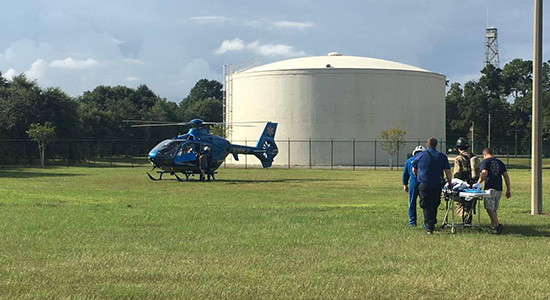
A young girl was airlifted to a Pensacola hospital after an accident Saturday morning at the Escambia County Equestrian Center.
A horse reportedly fell on top of the 7-year old girl. An update on her condition was not available.
The Beulah and Bellview stations of Escambia Fire Rescue and Escambia County EMS responded to the call.
Photos for NorthEscambia.com, click to enlarge.


High School Football Finals
August 27, 2016

Here are final scores from around the area:
Crestview 70, Northview 0
Flomaton 42, Jay 7
Tate 42, Biloxi 22
Pine Forest 33, Pensacola 12
Washington 25, Milton 13
Gulf Breeze 38, Choctaw 29
Pace 35, Fort Walton Beach 7
Navarre 41, Catholic 13
Baker 30, Holmes County 14
West Florida 28, Escambia 27 (Thurs pm)
Escambia County (Atmore) 24, Wilcox Central 16
Opp 30, T.R. Miller 20
Tallassee (AL) 26, W.S. Neal 21
Escambia Academy (off week)
Century Unable To Discuss Attorney For Four Charged With Sunshine Law Violation
August 27, 2016
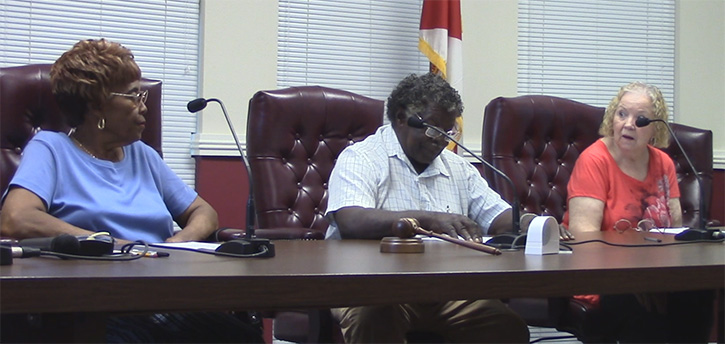
Four members of a Century volunteer task force charged with noncriminal violations of the Florida Government in the Sunshine Law will have to wait until next week to find out of the town will provide them with an attorney.
The Century Town Council was to hold a special called meeting Friday afternoon to discuss retaining an attorney, but the council failed reach a quorum in order to hold the meeting. Council members Gary Riley and Ann Brooks were present, but council members Ben Boutwell, Sandra McMuray-Jackson and Annie Savage were absent. At least three members must be present for the council to take any action.
Alfonzie Cottrell, Helen Mincy, Sylvia Godwin, and Robert Mitchell were charged by the State Attorney’s Office with having a public meeting of the Century Citizens Advisory Task Force that was not properly advertised. On July 26, a meeting was advertised to begin at 4:00 p.m. The meeting was actually held at 2:00 p.m. preventing the public from attending.
This case is set for arraignment on September 7. At that hearing, the four will have a chance to enter a plea or move forward with a trial in front of a judge, most likely in one to three weeks after the arraignment. They face a maximum penalty of a $500 fine, according to State Attorney Bill Eddins.
The Century Town Council was also set to discuss the appointment of a Citizens Advisory Task Force to review two proposed grant applications at Friday’s meeting.
A new special council meeting at been scheduled for next Wednesday at 6 p.m. to discuss the attorney and CATF members.
Pictured top: CATF members Helen Mincy, Robert Mitchell and Sylvia Godwin during a CATF meeting on Thursday, July 28. NorhEscambia.com file photo.
UWF Enrollment Reaches Record Of 13,000 Students
August 27, 2016

The University of West Florida has surpassed 13,000 in enrollment for the first time in the institution’s history, reaching 13,030 students for the Fall 2016 semester, as of today, Aug. 24, 2016.
“We have a lot to be excited about as we start the fall semester, and this news adds to that excitement,” said UWF President Dr. Judith Bense. “I am proud that we’ve reached this milestone, as it shows we are becoming a first-choice university. Enrollment is dropping at many mid-sized public and private universities, but we are growing and thriving. The future is bright at UWF.”
UWF reached 10,000 in enrollment in 2008 and 12,000 in 2012. The growth has been steady in recent years, reaching 12,416 in 2014 and 12,603 in 2015.
“We have added a number of new programs to meet student demand and regional workforce needs,” added Dr. Martha Saunders, executive vice president and provost. “Our cybersecurity, supply chain logistics and online programs have generated a great deal of enthusiasm. Combine that with the finest faculty on the planet, and we have a winning combination for a great academic year.”
Graduate students accounted for the largest growth entering Fall 2016. The total graduate student headcount increased by approximately 20 percent compared to Fall 2015.
Additionally, sophomore undergraduate students increased by approximately 15 percent for Fall 2016. The increase in sophomores is a direct result of the University’s increased focus on student retention.
Escambia Man Killed In Motorcycle Crash
August 27, 2016

A motorcyclist was killed in a traffic crash Friday afternoon on Pine Forest Road.
Austin Rickmers, 23, was pronounced deceased at the scene of the accident on Pine Forest Road near Loblolly Road. According to the Florida Highway Patrol, Rickmers was southbound on Pine Forest Road when 72-year old Judy Courtney of Robertsdale entered the roadway from a driveway entrance in a Ford F-150 pickup and traveled into Rickmers’ path.
Judy Courtney and her 66-year old passenger, Russel Courtney, were transported by ambulance to Sacred Heart Hospital with minor injuries.
Any charges in the crash are pending the outcome of a traffic homicide investigation.
Reader submitted cellphone for NorthEscambia.com, click to enlarge.
Tate Tops Biloxi (With Photo Gallery)
August 27, 2016

The Tate High School Aggies hit the road Friday night for their season opener to hand Biloxi High School a 44-22 loss.
The Aggies were first on the board with 8:12 on the clock in the first, and added another touchdown with 1:07 in the first to end the quarter with a 14-0 advantage. Tate scored again early in the second for comfortable 21-0 lead, but Biloxi scored in the second and again early in the third to make it 21-14.
Tate answered with 9:48 to go in the fourth to make it 28-14; however, the Indians scored again and had two point conversion for a 28-22 score.
The Aggies scored again twice in the fourth quarter for the 44-22 final.
The Tate Aggies (1-0) will be at home in Pete Gindl Stadium next Friday night as they host the West Florida Jaguars.
For more photos from Biloxi, click here.
Photos by Jennifer Repine for NorthEscambia.com, click to enlarge.

Early Voting Ends Today, Over 7,000 Voted Early So Far In Escambia County
August 27, 2016
Today is the final day of early voting in Escambia County, with seven sites available. As of Friday, 7,092 residents — a 12 percent turnout — had voted early in Escambia County.
Early voting is available today at the following locations:
- Molino Community Center, 6450 Highway 95A North, 9 a.m. to 6 p.m.
- Escambia County Extension Office, 3740 Stefani Road, 9 a.m. to 6 p.m.
- Genealogy Branch Library, 5740 N. 9th Avenue, 9 a.m. to 6 p.m.
- Bellview-Saufley, 916 W Michigan Avenue, 9 a.m. to 6 p.m.
- Southwest Branch Library, 12248 Gulf Beach Highway, 9 a.m. to 6 p.m.
- Main Library, 239 N. Spring Street, 9 a.m. to 6 p.m.
- Supervisor of Elections Main Office, 213 Palafox Place, Second Floor, 8 a.m. to 5 p.m.
 Early voters cast paper ballots through digital scanners and may choose any one of the seven sites.
On Election Day, Tuesday, August 30, the polls will be open from 7 a.m. until 7 p.m. Voters must present a valid photo and signature ID and must vote at their home precinct on Election Day. Voters are encouraged to be sure to know where to vote on Election Day by checking their Voter Information Card, sample ballot, the precinct finder at EscambiaVotes.com, or by contacting us by phone or e-mail prior to Election Day. Any voters who need to change their address should contact the elections office prior to Election Day.
Vote-by-mail ballots must be received in the elections office by 7 p.m. on Election Day. The Postal Service recommends voters mail ballots at least one week before the due date. Vote-by-mail participants may track the status of their ballot at EscambiaVotes.com.
Crestview Beats Northview (With Photo Gallery)
August 27, 2016

Playing up multiple classes proved to be difficult for the the 1A Northview Chiefs Friday night as they lost 70-0 on the road to the 6A Crestview Bulldogs.
 Crestview jumped out to a 7-0 lead with 9:54 to go in the first quarter. And they scored again in the first with 7:22 to go, again in the first with 3:53 on the clock and ended the first quarter with a 28-0 lead. And while the first quarter was ugly, it only got uglier from there for the Northview Chiefs.
By halftime, the Chiefs were down 49-0.
Crestview cruised a little slower as the clock ran faster on the Mercy Rule in the second half. In the third Crestview had just two touchdowns and one in the forth for the 70-0 final.
Northview will be looking for a much better outcome next Friday night as the Escambia Academy Cougars head south from Canoe, AL, to take on the Chiefs in Bratt.
For a photo gallery, click here.
NorthEscambia.com photos by Gary Amerson, click to enlarge.