

Impact Of Supreme Court Abortion Ruling On Florida Law Unclear
June 28, 2016
Florida abortion providers are breathing sighs of relief following a U.S. Supreme Court ruling on Monday striking down a Texas law that would have greatly limited access to legal abortion in that state.
The Texas law would have required doctors to have admitting privileges at hospitals within 30 miles of the clinics where they perform abortions and clinics to meet the same standards as walk-in surgical centers.
 By a 5-3 vote, the justices found that neither of the provisions “offers medical benefits sufficient to justify the burdens upon access (to abortion) that each imposes,” and that each constitutes an “undue burden” on access to the procedure, violating the U.S. Constitution.
“This decision is certainly historic,” said Laura Goodhue, executive director of the Florida Alliance of Planned Parenthood Affiliates. “This is the biggest case since Roe v. Wade in terms of its impact on access to a safe and legal procedure.”
But in Florida, supporters of recent laws requiring more stringent standards for abortion providers say the high court ruling should have no impact.
Sen. Kelli Stargel and Rep. Colleen Burton, both Lakeland Republicans, sponsored House Bill 1411, which was signed into law by Gov. Rick Scott in March. On Monday, they said the new Florida law is different from the Texas statute at issue in the Supreme Court case. Scott’s office and legislative leaders are reviewing the ruling.
Among its provisions, the new Florida law requires clinics that perform first-trimester abortions to have patient-transfer agreements with nearby hospitals, or for clinic doctors to have admitting privileges nearby. Stargel noted that the law does not include Texas’ requirement that a doctor have admitting privileges within 30 miles of an abortion clinic.
“We have reasonable proximity, which is what we’ve had in law for a very long time with regards to all other clinics, and we’re doing abortion clinics the same way,” she said.
Although the Florida law takes effect Friday, U.S. District Judge Robert Hinkle on Wednesday will hear a challenge from Planned Parenthood aimed at blocking three parts of the law.
That complaint, in part, targets a section of the law that seeks to prevent state agencies, local governments and Medicaid managed-care plans from contracting with organizations, like Planned Parenthood, that own, operate or are affiliated with clinics that perform elective abortions. The complaint also challenges a provision that would require the state Agency for Health Care Administration to inspect at least 50 percent of abortion-clinic patient records each year. And it challenges a change to the way the state determines trimesters of pregnancy.
Burton, the House sponsor of HB 1411, said the three provisions had nothing to do with the Texas law. And while opponents contend the challenged provisions are medically unnecessary, Burton said she was only concerned with protecting women’s health and safety.
Tallahassee attorney Rick Johnson, local co-counsel in another challenge to a recent abortion statute, agreed that Monday’s ruling was unlikely to alter Florida law for now. He’s involved with a challenge to a 2015 law, requiring a 24-hour wait before women can obtain an abortion. That case is now before the Florida Supreme Court.
Johnson said the U.S. Supreme Court upheld the constitutionality of protecting access to legal abortion threatened by an “undue burden.” But in Florida, he said, stronger protections are in place — those of privacy.
“We had the intermediate appellate court, the 1st (District Court of Appeal), attempt to apply the federal ‘undue burden’ standard and find that under that standard, the 24-hour waiting period was good enough,” Johnson said. “So if (Monday’s ruling) has any impact, that will be the impact — that some of those courts that were incorrectly applying Florida law will now find that even if they apply federal law, some of those ridiculous restrictions won’t pass muster.”
Monday’s ruling drew a wide range of reactions from political candidates and activists. Florida Senate President Andy Gardiner, R-Orlando, was dismayed by those who celebrated the ruling.
“In Florida, we have championed policies and programs that promote life and provide resources for women who choose life for their babies,” Gardiner said in a statement. “Photos of people celebrating today’s ruling should disgust anyone who values the health of women and the life of their unborn children.”
Goodhue said Scott and the Legislature are unlikely to back off their efforts to limit abortion in Florida.
“We’ve seen an increase every year in the number of bills filed, but also in the extremist content of their nature,” she said. “So we’ve seen these attacks escalate, and we fully anticipate that we’ll have to continue this fight.”
by The News Service of Florida
Wahoos Lose 12-1 To Tennessee In Rain Shortened Game
June 28, 2016
The Chicago Cubs still appear to have plenty of top prospects to look forward to playing for them one day, including Double-A affiliate Tennessee Smokies second baseman Ian Happ and starting pitcher Brad Markey.
Happ went 3-3, including a two-run homer and Markey threw four perfect innings as the Smokies rolled to a 12-1 victory Monday over the Pensacola Blue Wahoos at Smokies Park. The game was shortened to six innings because of rain.
The victory clinched the opening series, 3-2, of the second half of the season for Tennessee and dropped Pensacola’s overall record to 18-21 on the road. At Blue Wahoos Stadium, the Cincinnati Reds Double-A affiliate won all seven series going 24-11.
 Happ, the Cubs No. 3 prospect according to MLB.com, went 11-15, or .733 with four multi-hit games in his first five games at the Double-A level with the Smokies. The 21-year-old hit two home runs, drove in six runs and scored six times.
Meanwhile, Tennessee right hander Markey, the No. 29 prospect, threw four perfect innings, striking out two.
But Pensacola right fielder Sebastian Elizalde led off the fifth inning with a double to left field. Blue Wahoos center fielder Brandon Dixon followed with another single on a grounder to left that scored Elizalde to pull Pensacola within, 3-1 — the closest it would get to Tennessee.
Markey threw six innings, allowing four hits and one run, while striking out two. He improved to 6-3 with a 2.34 ERA.
Smokies first baseman Victor Caratini singled on a line drive to right fielder that drove in center fielder Jacob Hannemann to put Tennessee ahead, 1-0, in the first inning.
Tennessee went up, 3-0, in the third inning when Happ hit a two-run homer to right field that also scored Smokies third baseman Chesney Young, who had doubled to right field.
Tennessee then broke the game open in the bottom of the fifth inning sending nine hitters to the plate and scoring four times on four hits and two walks to go ahead, 7-1. The big hit came when Smokies right fielder Billy McKinney, the Cubs No. 6 prospect, drove in three runs when he tripled to right field with the bases loaded on a 1-2 count and two outs. The seventh run of the game came when Tennessee catcher Ben Carhart singled up the middle to score McKinney.
The Smokies sent 10 hitters to the plate in the sixth inning, adding five more runs to go up, 12-1. Tennessee had five singles, a double and a hit batter in the inning.
Elizalde was 5-15 in the series for Pensacola and is hitting .302 on the season. Pensacola second baseman Alex Blandino also hit well going 5-19. Blue Wahoos center fielder Phillip Ervin extended his hitting streak to five games Monday, going 5-17 during that span.
Pensacola has the day off Tuesday and then starts a five-game home series at 6:30 p.m. Wednesday against the Chattanooga Lookouts.
Resurfacing, Widening Projects Continue On Hwy 99, Barrineau Park Road
June 27, 2016
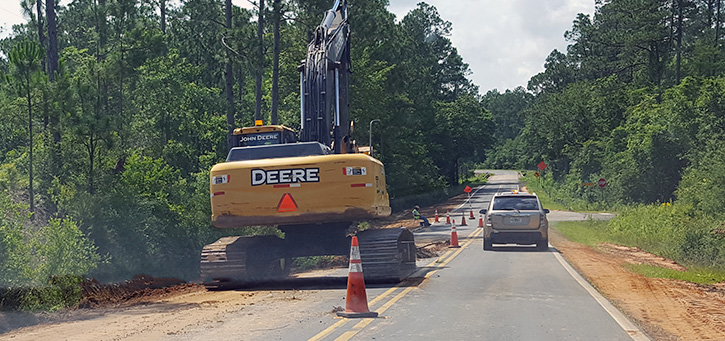
Projects are now 70 to 80 percent complete to widen and resurface several miles of County Road 99 and Barrineau Park Road.
Work is 70 percent complete on a project to widen and resurface seven miles of Highway 99 from Barrineau Park Road north to Highway 97A in Bay Springs, according to Escambia County. Construction on the project began in October 2015, with the contractor currently still working to widen the highway and install driveway pipes by early July. The roadway will be resurfaced by September . Following striping and sign installation, the project should be completed by October.
The Highway 99 project will be submitted to the Federal Highway Administration Agency (FHWA) for reimbursement at an estimated project construction cost of $2.87 million.
The Barrineau Park Road project includes widening the existing travel lanes to 11 feet wide, adding four foot paved shoulders, upgrading guardrails and minor drainage improvements.
Barrineau Park Road is about 80 percent completed. Shoulder widening is currently underway and is scheduled to be completed by the end of July. After the widening, the entire roadway will be resurfaced by the end of September. Following striping and signage, the project should be completed in October.
In addition to the two county projects, the Florida Department of Transportation upgraded the railroad crossing on Highway 99 south Highway 97A.
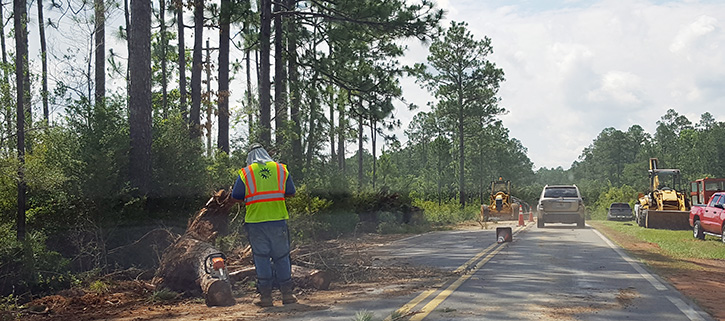
Pictured: Work continues on widening Highway 99 just south of Highway 97A in Bay Springs. NorthEscambia.com photos, click to enlarge.
Column: Is The Local Area Heading For Another Housing Bubble?
June 27, 2016

by Phyllis K. Pooley
Back in 2005, the National Association of Realtors produced the report “Home Price Analysis for Pensacola-Ferry Pass-Brent” in which the author found the local metropolitan housing market to be in “excellent shape” with potential for significant equity gains.
The report analyzed median mortgage servicing costs and median incomes ratio and found that for Escambia and Santa Rosa counties, “This ratio is at a very manageable level. It implies no widespread financial overstretching to purchase a home in the region. Any respectable gains in the local job market could translate into further home price gains.”
Other significant findings in the report included that price declines in the local market were unlikely and the local market would experience a 5 percent decline only under extremely unlikely scenarios of much higher mortgage rates.
Sadly, those words were not prophetic. The quarterly House Price Index generated by the Federal Reserve Bank of St. Louis clearly shows that Pensacola shared in the pain of the housing market collapse.
 The index includes all transactions in an area using both sales prices and appraisals. Between the height of the market in the fourth quarter of 2006 to its lowest point in the second quarter of 2012, house prices fell 29.4 percent in the Pensacola area.
In addition to clearly showing the run-up in prices that began in 2003, the index also shows that the area is just now recovering to 2005 price levels. While prices have rebounded 17.5 percent from their lowest point as of the last quarter of 2015, as illustrated by the trend line, they are still below what might be expected if the bubble had not happened.
Now, just 10 years removed from the height of the housing bubble, there are whispers that another bubble is forming. Housing prices in many areas are once again rising at rates faster than average wage growth, credit conditions are loosening with Fannie Mae and Freddie Mac allowing only 3 percent down payments, and housing supplies are tightening. Are we headed for a repeat of the last disaster?
To answer this question, one first needs a definition of “housing bubble.” It’s typically defined as a deviation of the market price from the fundamental value of the house.
Secondly, one needs to be able to tell if this deviation is occurring. This would seem to be a straightforward task. However, like many things in the economic world, there is more than one way to analyze the question, and experts don’t always agree on what these analyses show.
For example, one researcher might point to home prices increasing at a higher rate than inflation, coupled with a sharp divergence between home prices and rental prices, as an indication that homes are overpriced. Another will examine the ratio between housing price and income and, having noted that it is higher than historical norms, might conclude that there is a price bubble. Still another researcher will look at mortgage-servicing costs as related to income, and argue that if these are within manageable levels, there is no bubble.
The current consensus amongst experts seem to be that while housing prices are climbing, they are doing so because new houses are not being built to increase the supply. Identified as a major indicator of the prior bubble, new homes were being built at a furious pace even as prices continued to climb. Under normal economic conditions, prices tend to fall when supply grows. When that does not occur, it suggests that other forces are in play to support the higher price.
While housing starts are not readily available for metro areas, a proxy for specific new home construction statistics is employment in the construction industry itself. By comparing home prices to the number of construction workers, one can see how these forces might interact.
The data show construction employment at its height during the price bubble and lagging behind prices ever since. This fact suggests that experts may be correct in their view that conditions are still operating in a traditional fashion and a lack of housing supply is supporting home prices at present levels rather than the factors that generate bubbles. Building permit data from the U.S. Census Bureau tends to support this notion as well – at the height of the bubble in 2006 the Pensacola area saw 2,488 permits issued covering 3,126 housing units. By 2012, the number had dropped to 1,466 permits covering only 1,594 units – or half the planned construction.
The most recent data does show housing starts and construction employment on the increase. It will be interesting to watch how these trends play out in the coming months.
Phyllis K. Pooley serves as director of special projects with the University of West Florida Office of Economic Development and Engagement in Pensacola.
Greatest Show On Earth: Circus Train Passes Through Escambia County
June 27, 2016

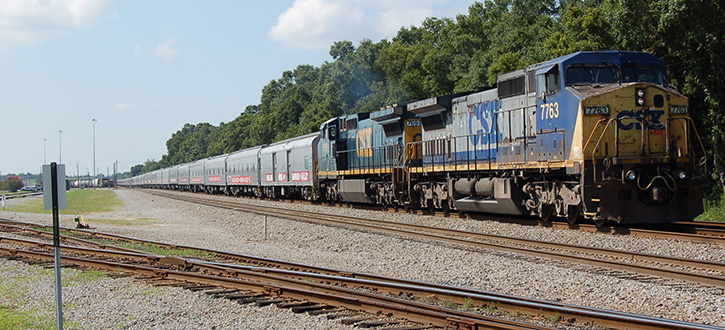
The “Blue Unit” of the Ringling Bros. and Barnum & Bailey circus trains passed through Escambia County Sunday morning, moving from South Florida to California. The circus has two trains, the red and the blue, that criss-cross the county. Photos by Larry Seale for NorthEscambia.com, click to enlarge.



Tennessee Beats Pensacola 3-0
June 27, 2016
The Pensacola Blue Wahoos bats cooled down against the Tennessee Smokies starting pitcher Paul Blackburn.
Blackburn shut down the Pensacola lineup allowing just two hits in six scoreless innings, walking three and striking out five as the Smokies shut out the Blue Wahoos, 3-0, Sunday at Smokies Park.
Blackburn improved to 5-2 with a 2.35 ERA this year.
 The only Pensacola hitters to earn hits in the game were shortstop Alex Blandino (1-4), center fielder Jeff Gelalich (1-3 with walk) and Phillip Ervin (1-3 with walk). They are the top three hitters in the order and Pensacola was 3-28 for the game.
Ervin singled on a bunt back to the pitcher and then stole his 22nd base of the year, which is tied for fifth in the Southern League.
The Blue Wahoos are now 2-2 in the second half and 43-31 overall.
Pensacola starting pitcher Jackson Stephens did work 5.1 innings but gave up three runs on seven hits and five walks, while striking out three. He dropped to 5-6 with a 3.19 earned-run average. James Farris relieved Blackburn and threw two scoreless innings and struck out four. The game was closed by Smokies closer Juan Paniagua, who walked one in one inning and earned his fourth save this season.
In the third inning, Tennessee second baseman Ian Happ doubled in center fielder Jacob Hannemann to put the Smokies up, 1-0.
Tennessee left fielder Trey Martin then laid down a squeeze but that scored right fielder Billy McKinney to put the Smokies ahead, 2-0.
The lead extended to, 3-0, over Pensacola when Tennessee catcher Victor Caratini walked to lead off the sixth inning. Caratini then scored on shortstop Daniel Lockhart’s ground ball single to right field.
Pensacola relievers Jacob Ehret, and Evan Mitchell pitched 2.2 innings of scoreless relief giving up one hit and striking out three. Tennessee pitchers combined to retire 12 Pensacola hitters in a row between the fourth and eighth innings.
Voters Receive New ID Cards
June 27, 2016
Voters in Escambia County were recently mailed a new voter information card from the office of David Stafford, Escambia County Supervisor of Elections.
 Voters are strongly encouraged to review their new cards carefully, particularly their party affiliation and polling location. Voters should contact the elections office immediately with any necessary updates.
The new cards have green text making identification of the most current card simpler. The updated card reflects Escambia County’s State Senate District number change to District 1.
Voter information cards are NOT required when voting; Florida requires approved photo and signature ID when voting in person.
First Baptist Of Bratt Honored For Operation Christmas Child Collections
June 27, 2016
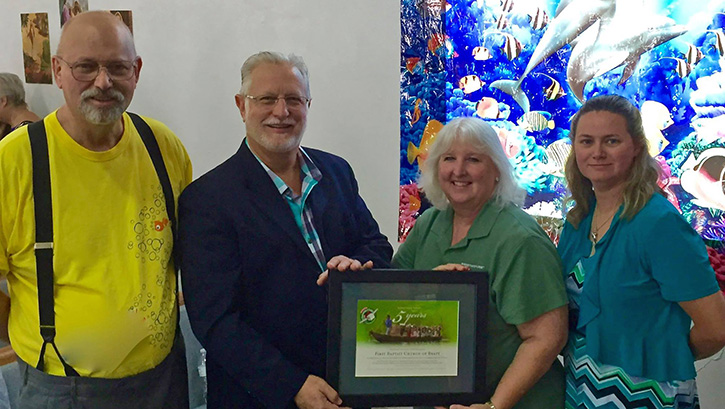
Christmas is still several months away, but Christmas was on the mind of church members Sunday at the First Baptist Church of Bratt.
The church has served for the past five years as a collection point for Operation Christmas Child, which provides simple, gift-filled shoe boxes that bring Christmas joy and evangelistic materials to children in countries across the globe.
Sunday, Bethany Daily, Northwest Florida area coordinator for Operation Christmas Child, gave special recognition to Tim Hawsey and Michelle McKinley at the church. Over 2,300 boxes have been collected by the First Baptist Church of Bratt since 2010.
Submitted photos for NorthEscambia.com, click to enlarge.

Two Molino Residents Injured In Cantonment Crash
June 26, 2016
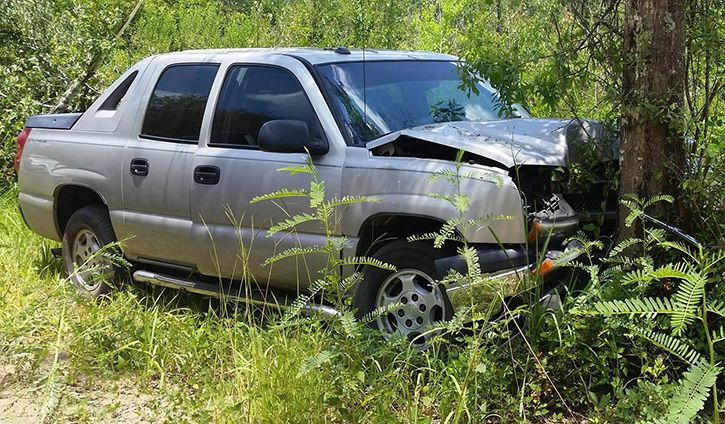
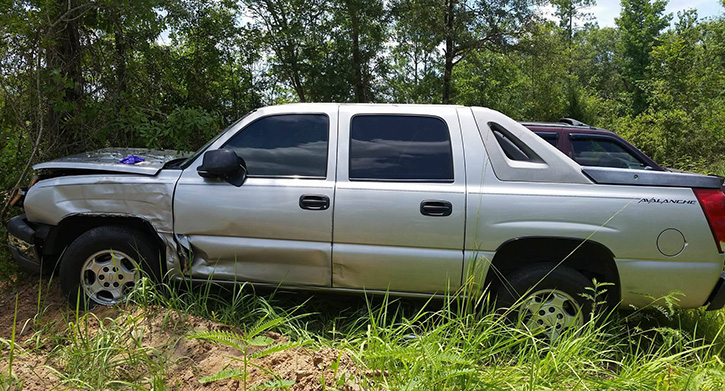
Two people were injured, one seriously, in a single vehicle accident in Cantonment Saturday afternoon.
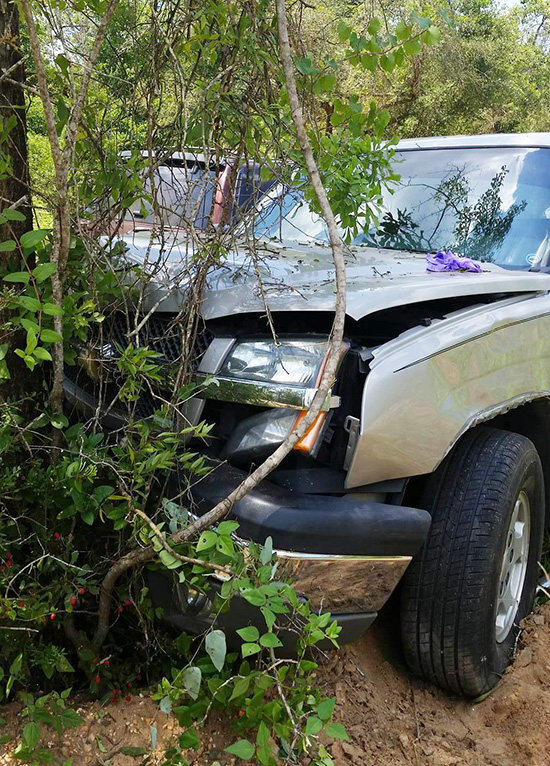 The Florida Highway Patrol said 70-year old John Wall of Molino was southbound on River Annex Road approaching Muscogee Road when he lost control of his 2004 Chevrolet Avalanche, left the roadway and struck a tree.
Wall received minor injuries, while his passenger, 53-year old Laura Montoya of Molino, was seriously injured. Both were transported to Baptist Hospital by Escambia County EMS.
The crash was not alcohol related, and both victims were wearing their seat belts, troopers said.
Any charges against Wall are pending, according to the FHP.
NorthEscambia.com photos by Kristi Barbour, click to enlarge.
Scooter Driver Critical After Beulah Crash
June 26, 2016
The driver of a scooter was critically injured in a wreck Saturday afternoon in Beulah.
 Tommy Mitchell, 50, was westbound on Nine Mile Road near Beulah Road in a 2014 Chevrolet Pickup when he turned into the path of a Yamaha Scooter driver by 51-year old Brian J. Moulyet of Pensacola, according to the Florida Highway Patrol.
Moulyet was airlifted by LifeFlight helicopter to Sacred Heart Hospital in critical condition. Mitchell was not injured.
Mitchell was cited for an improper left turn by the FHP.