

Myrick Named NHS Homecoming Queen (With Photo Gallery)
October 15, 2016

Morgan Myrick was named Northview High School’s homecoming queen for 2016 Friday night.
 Homecoming court members were freshmen Briana White, Payton Jackson, Teriana Redmond; sophomores Ashtyn Carnley, Madison Sherouse, Shelby Bashore, Olivia Seals; juniors Natasha Walker, Celeste North, Madison White; and seniors Peighton Dortch, Autumn Albritton, Brittany McLemore, Mallory Gibson, Morgan Myrick and Zipporah Harris.
Pictured top (L-R) are Sophomore Maid Shelby Bayshore, First Runner Up Autumn Albritton, Homecoming Queen Morgan Myrick, Second Runner Up Peighton Dortch, Junior Main Celeste North and Freshman Main Teriana Redmond. Pictured inset: Myrick reacts to the announcement that she has been name homecoming queen. Pictured below: Myrick is crowned by last year’s queen Savannah Roux as her father, Mike Myrick, looks on. Pictured bottom: Senior court members Albritton, Myrick and Dortch. NorthEscambia.com photos, click to enlarge.

Northview Beats Jay To Clinch Postseason Berth (With Photo Gallery)
October 15, 2016

The Northview Chiefs came out on top against the winless Jay Royals Friday night in Bratt, but it was not as easy of a win as many thought it would be.
 The Royals jumped out to a 6-0 lead in the first quarter, and the Chiefs answered at 6:30 in the second with a quarterback keeper from Luke Ward for a 7-6 advantage that stood at the half. In the third, the Royals rallied for a 19-6 lead in the third quarter.
For a homecoming court gallery, click here.
For a game action gallery, click here.
With 4:55 in the third, Ward found Neikel Robinson on fourth down for a 45-yard touchdown, 19-14. With 8:24 on the clock in the fourth, Ward hit Robinson for crowd-pleasing 85-yard touchdown and a 27-19 Chiefs lead. On Jay’s next down, Ward intercepted and added another touchdown, 37-19. Ward added another touchdown to seal the win for the Chiefs.
“There was nothing pretty about it,” Northview High School Head Coach Dereck Marshman said. “A lot of credit goes to Jay; they played their tails off. There was very little time where I though we outplayed them effort wise, execution wise..It wasn’t pretty, but we’ll take it.”
The win gives the Chiefs (5-3, 1-0) a playoff spot and eliminates Jay (0-8, 0-2) from the postseason. For the Chiefs, it’s their seventh straight playoff berth.
Northview’s game in two weeks at Baker will decide if the Chiefs or the Gators take the district championship, but Marshman said right now he’s more concerned about visiting Walton next week.
“Our full focus right now is on Walton. Senior night, our last home game of the regular season guaranteed to us and a chance to go undefeated at home this season,” he said.
For a homecoming court gallery, click here.
For a game action gallery, click here.
Additional photos (band, cheerleaders, dance team, will be posted by early next week)
NorthEscambia.com photos, click to enlarge.



Over 1,300 Volunteers Participate In United Way’s Day of Caring
October 15, 2016
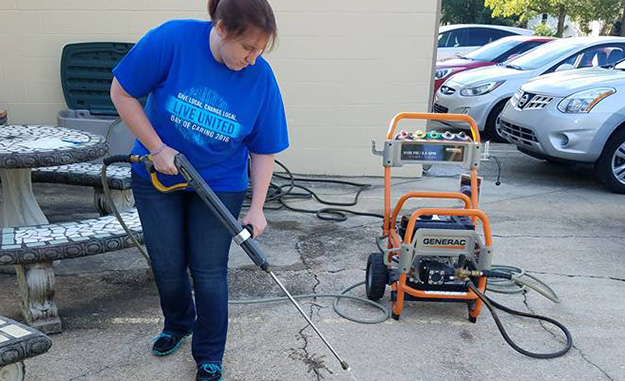
Community volunteers and leaders joined United Way of Escambia County’s to kick off the 24th Annual Day of Caring (DOC) at Woodham Middle School on Friday.
“This is our first year participating in United Way of Escambia’s Day of Caring and we love that we can show off our team and competitive spirit while having some fun before we start our project,” said Maryann Andrews from Escambia Community Clinics (ECC).
ECC employees joined more than 1,300 local volunteers who helped complete 89 projects at 58 agencies and schools in Escambia County. Together, Day of Caring volunteers donated an estimated 8,500 hours that provided local nonprofits and schools an estimated $200,260 in free labor. In effect it would take an individual every hour of the day for almost an entire year to have the same impact that these caring volunteers had in the day. Donations of materials and supplies add thousands more to the effort.
The day of caring is made possible by a committed committee of volunteers led by Day of Caring Chair, Bill Maudlin. Like the dedicated volunteers he leads, Maudlin believes, “What we do today shapes who we are tomorrow. I want our community to grow and improve every day for everyone. Volunteering at United Way Day of Caring affords me the opportunity to enhance the quality of life for all and leave things better than I found them.”

Northview Celebrates Homecoming With Parade (Photo Gallery)
October 15, 2016

The Northview High School Homecoming Parade rolled through Bratt this afternoon.
For a photo gallery, click here.
NorthEscambia.com photos, click to enlarge.




Escambia Tops Tate
October 15, 2016

The Escambia Gators moved into the top spot in District 1-6A with a 37-27 win over the Tate Aggies.
Escambia dominated the scoring in the first half, holding a 14-0 lead into the fourth quarter when the Aggies scored on the ground with touchdowns from Jake Henry and Corey Moorer.
Next week, the Tate Aggies (6-2, 1-1) move on host Choctaw next Friday night before traveling to Pine Forest on October 28.
NorthEscambia.com photos by Kristi Barbour, click to enlarge.


Friday Night Football Finals
October 15, 2016

Here are high school final scores from across the North Escambia area Friday night:
FLORIDA
- Northview 40, Jay 25
- Escambia 37, Tate 27
- Pine Forest 36, Washington 20
- West Florida 44, Bay 9
- Arnold 13, PHS 0
- Taylor County 14, Catholic 7
- Gulf Breeze 55, Pace 28
- Navarre 44, Milton 0
- Baker 49, Chipley 14
ALABAMA
- T.R. Miller 28, Bayside 23
- Escambia Academy 39, Lighthouse Christian (Pcola) 0
- Flomaton 29, Excel 0
- Andalusia 35, W.S. Neal 8
- Carroll 45, Escambia County (Atmore) 0
NorthEscambia.com photo, click to enlarge.
Atmore Prison Escapee Captured
October 14, 2016
Alabama inmate Jerry Lynn Hilburn, 40, was recaptured at 4:00 p.m. on Friday in Lincoln, AL, according to Alabama Department of Corrections officials.
Hilburn escaped from the J.O. Davis Correctional Facility in Atmore on Oct. 10.
 A public tip led U.S. Marshals to an address in Lincoln where Hilburn was hiding in a storage shed located behind a resident’s home. After a brief foot pursuit, Hilburn was apprehended and taken to the Talladega County Jail to await his return to the ADOC.
Hilburn was serving a 20-year sentence on a 2013 drug possession conviction out of Mobile County. Hilburn will be charged for the escape.
Walnut Hill Man Charged With Sexual Battery Of Young Girl
October 14, 2016
A Walnut Hill man has been charged with the sexual battery of a young girl.
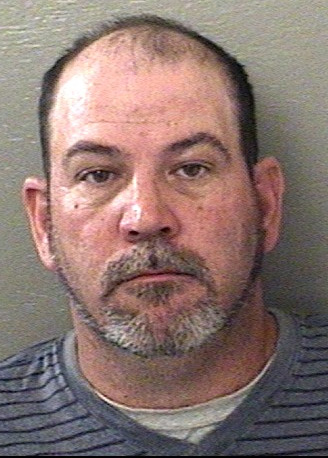 Paul Ernest Coleman, age 44 of 10411 South Pineville Road is charged with sexual battery on a victim under 12. He remains in the Escambia County Jail with bond set at $150,000.
The abuse allegedly occurred between 2006 and 2009, beginning when Coleman was 34-years old and the victim was 5-6 years old. The victim told investigators with the Escambia County Sheriff’s Office and Gulf Coast Kid’s House that Coleman touched her inappropriately almost daily during the three year period during which the family resided in Molino. She also said Coleman forced her to touch him inappropriately during the abuse period.
According to arrest report, the victim first disclosed the abuse in 2012 and came forward with additional information in April 2016.
If convicted on the capital felony charge, Coleman faces a mandatory sentence of life in prison.
Escambia Affordable Housing Community Meeting Scheduled
October 14, 2016
The Escambia County Neighborhood & Human Services Department is hosting a community discussion on the potential development of four affordable housing properties under the Florida Housing Finance Corporation’s State Apartment Incentive Loan, Tax Exempt Bond and Housing Credit Program Monday, Oct. 17 at 5:30 p.m. at the Escambia County Central Office Complex, 3363 West Park Place, Room 104.
The proposed rental developments are:
- Abbington Oaks, 128 units at 625 E. Olive Road
- Delphin Downs, 72 units at 1717 W. Cervantes St.
- Patricia Pointe, 106 units at 9701 Chemstrand Road
- The Place @ P Street, 88 units at 1201 N. P St.
The four developments are requesting a commitment of $37,500 each from the Escambia County Board of County Commissioners if the projects are approved for funding by the Florida Housing Finance Corporation, to be considered by the board at its Wednesday, Oct. 19 special meeting at 9 a.m.
Developers for Delphin Downs, Patricia Pointe and The Place @ P Street will be in attendance. A separate meeting regarding the development of the 110-unit Meadowbrook Commons at 5406 Lillian Highway will be held Tuesday, Oct. 18 at 6 p.m. at Myrtle Grove United Methodist Church, 1030 N. 57th Ave.
For additional information, please contact Meredith Reeves with the Escambia County Neighborhood Enterprise Division at ned@myescambia.com or (850) 595-4968.
Tweak In State Pension Projection Comes With A Cost
October 14, 2016
State analysts agreed Thursday to lower the expected rate of return on Florida’s $144 billion pension fund, while warning that it may be the first in a series of annual downward adjustments.
The shift from a 7.65 percent rate of return to 7.6 percent may seem slight, but it has implications for the $82 billion state budget, which likely will be tight in the coming year.
 A lower expected return on investments means lawmakers will have to increase the state contribution to the pension fund, reducing the overall amount of money the Legislature will have for other needs, ranging from public schools to health-care programs.
Milliman and Aon Hewitt, two financial consulting firms hired to advise the state on the pension fund, had recommended adjusting the long-term rate of return downward to about 7 percent based on economic trends that have resulted in low inflation and interest rates.
The median rate of return for the largest public pension funds in the country is 7.5 percent, according to a Milliman report.
Earlier in the week, analysts meeting as what is known as the Florida Retirement System Actuarial Assumption Conference were deadlocked over whether to lower the rate of return.
Don Langston, staff director of the House Finance & Tax Committee, and Amy Baker, head of the Legislature’s Office of Economic and Demographic Research, had pushed for lowering the rate to 7.5 percent. But they were opposed by representatives of the governor’s office and the state Senate, who wanted to maintain the current 7.65 percent rate.
Christian Weiss, economic policy coordinator for Gov. Rick Scott, said the governor did not support lowering the rate because there was a “wide array of uncertainty” in some of the long-term factors used to recommend a lower rate, including an assumption that interest rates would remain low during the next 20 to 30 years.
When the conference reconvened on Thursday, the members reached a compromise on a 7.6 percent rate, with Langston and Baker warning it is likely to be the first in a series of downward adjustments, although they also agreed that cutting the rate now to 7 percent would be too disruptive.
“It is a move in the right direction. It is a little baby step, not quite as big of a step as I hoped we would take,” Langston said.
But Langston said lawmakers and other state officials involved in the annual budget process need to prepare for a trend of lower returns on investments.
“Unless something radical changes in the world and national economies to turn the long-term outlook around, I think there is going to be continuing pressure on this assumed rate of return in the coming years,” he said.
Baker agreed, calling the move to lower the rate “a signal.”
“I think what we’re setting off is a series of annual changes as the pressure to reduce the rate continues to build,” Baker said. “Instead of giving ourselves any respite at all, we’re going to be looking at every single year for the next number of years revisiting it.”
Lowering the rate means the state will have less money to pay long-term retirement benefits for state and county employees, teachers and other public workers who rely on the fund.
Using the former 7.65 percent rate of return, Milliman had projected the state could pay 85.9 percent of its long-term benefits, representing an unfunded liability of $23.8 billion for the $144 billion fund.
With the new 7.6 percent rate, the report lowers the funded portion to 85.4 percent, representing a $24.9 billion unfunded liability.
As a comparison, lowering the rate of return to 7 percent would have yielded nearly a $38 billion unfunded liability, with the fund only being able to pay 79 percent of its long-term obligations.
In crafting the 2017-18 state budget during the spring legislative session, the Legislature will have to account for the larger unfunded liability in the pension fund using a complicated contribution formula.
Dropping the rate from 7.65 percent to 7.5 percent would have required an estimated $270 million increase in the state’s pension contribution, according to Milliman. A cut to 7.6 percent will still require a projected contribution increase in the range of $90 million based on the formula.
That’s a significant number given that lawmakers are looking at a meager $7.5 million surplus next budget year, followed by a projected $1.3 billion shortfall in the 2018-19 budget year.
The move to lower the rate of return was supported by State Board of Administration officials, who manage the investments in the $144 billion pension fund.
The fund’s investments gained less than 1 percent in the last fiscal year that ended June 30, but have outperformed the 7.6 percent rate over the last 25 years with an 8.39 percent rate of return, according a SBA report. Over the last 15 years, the fund had a 5.93 percent rate of return.
by Lloyd Dunkelberger, The News Service of Florida