
Jim Allen Elementary School Names Students Of The Month
May 18, 2017

Jim Allen Elementary School has named Students of the Month for May. They are Clotee Williamson (left) and Marabelle Hamilton. Courtesy photo for NorthEscambia.com, click to enlarge.
Nokomis and Meadows Stop Sign To Be Relocated
May 18, 2017
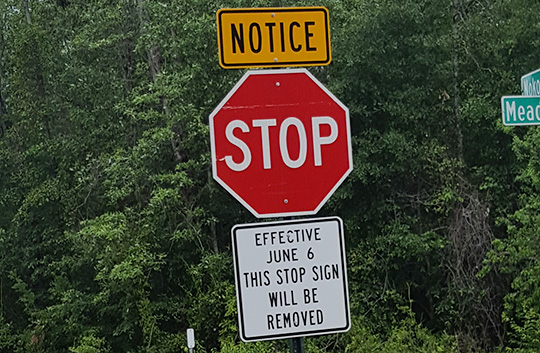
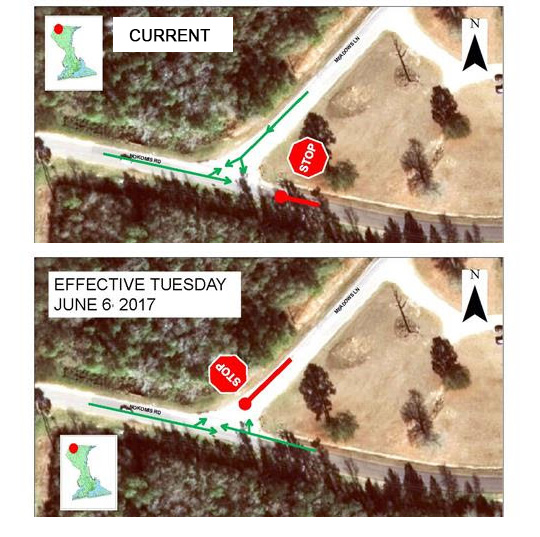
Effective Tuesday, June 6 the stop sign at the intersection of Nokomis Road and Meadows Lane near Davisville will change to improve safety, according to Escambia County.
Currently, there is a single stop sign on the westbound lane of Nokomis Road. On June 6, the stop sign will be moved to the southbound lane of Meadows Lane.
Motorists are advised to use caution when navigating the intersection during the transition period.
Northview Softball’s Jamia Newton Signs With Coastal Alabama
May 18, 2017

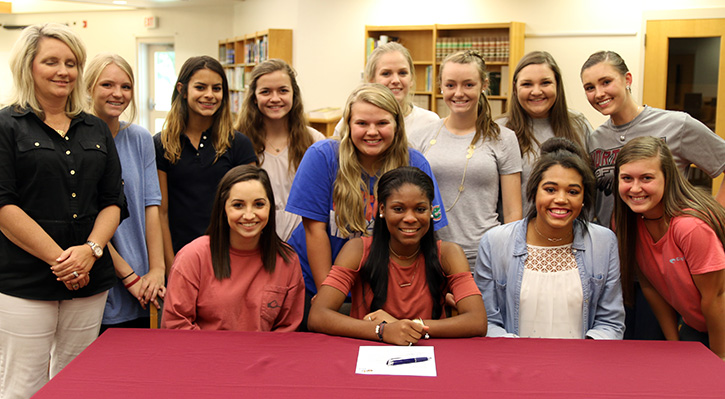
Northview High School senior Jamia Newton has signed to play softball with Coastal Alabama Community College in Monroeville, AL. She is pictured at a signing ceremony Wednesday afternoon at Northview with family, friends and fellow Northview Chiefs players. NorthEscambia.com photos, click to enlarge.
ECFR Installing Free Smoke Detectors Saturday In Harvesters Homes
May 18, 2017
Escambia County Fire Rescue will be installing free smoke detectors Saturday during a neighborhood canvas in the Harvesters Homes subdivision off Muscogee Road in Cantonment. ECFR will be going door to door starting at 8 a.m., walking the neighborhood and offering to install the free smoke detectors.
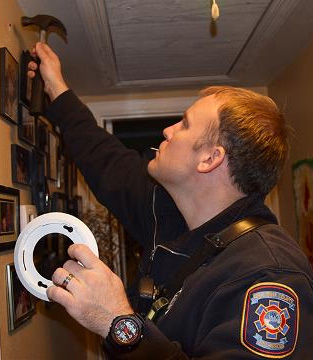 Smoke detectors that are properly installed and maintained play a vital role in reducing fire deaths and injuries. According to the National Fire Protection Association, a working smoke detector cuts the chances of dying in a reported fire in half. The Escambia County Board of County Commissioners and Escambia County Fire Rescue are continuing to work toward their goal of having a working smoke detector in every home in the county.
For more information, contact Escambia County Fire Rescue at (850) 475-5530 or fire@myescambia.com. For information about obtaining a home smoke detector, call 850-595-HERO (4376).
When Will The Molino Road Bridge Reopen?
May 17, 2017
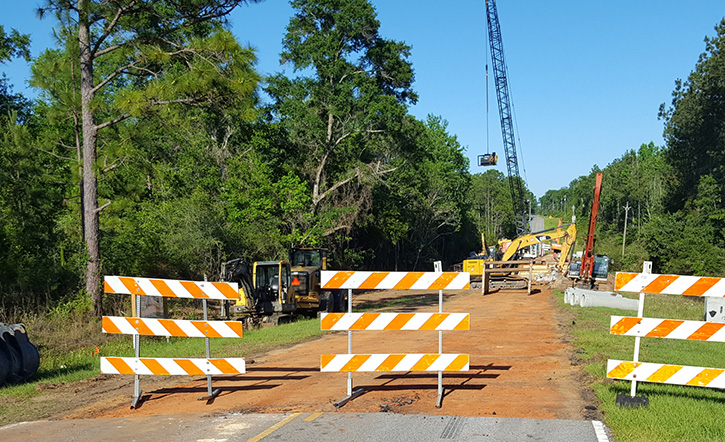
When will the Molino Road bridge reopen? That was the hot question at a community town hall meeting Tuesday night with District 5 Commissioner Steven Barry.
“It’s been about three and a half weeks with any visible work on it,” local resident Bonnie Exner said. “The frustration is the lack of activity.”
The project, Escambia County Public Works Director Wes Moreno said, is funded by the Florida Department of Transportation and is outside direct county control. He said the contractor has until September to complete the bridge replacement under their contract with FDOT.
Numerous residents at the public meeting expressed their displeasure with the lack of signage on Molino Road near Highway 29 warning of the road closure.
“That’s something we can and will take care of,” Barry said, adding that the county will approach FDOT and the contractor for additional signs like a variable message board. If not, he said, the county will place their own message board warning of the closure.
The replacement of the Molino Road bridge over Penasula Creek, just east of Sunshine Hill Road, started in early January.
The project is expected to be completed in approximately 265 calendar days.
The old wood piling supported bridge was constructed in 1958 had reached a level of deterioration to warrant replacement and was next on the list of the FDOT’s Five-Year Work Plan. The project is being funded and the construction work will be performed under contract for the Florida Department of Transportation. After completion of the structure, Escambia County will be responsible for the maintenance of the bridge.
Pictured: Construction on the Molino Road bridge over over Penasula Creek as seen late Tuesday afternoon. NorthEscambia.com photos, click to enlarge.

Century Implements Reservation Fee For Splash Pad Pavilion
May 17, 2017

Due to the popularity of the Century splash pad, the town has implemented a reservation fee for a neighboring pavilion at Showalter Park.
Since the splash pad opened earlier this year, many more people are using the pavilion for birthday parties and other events, Mayor Henry Hawkins said. With no reservation policy in place, there have been conflicts between groups wanting to use the pavilion, the mayor said, including a disagreement that led to the involvement of law enforcement.
Now, the town will reserve the pavilion for $25 per hour, with a two hour minimum. For information on reservations, contact town hall at (850) 256-3208.
“If there is no reservation for a particular time, it is first come first served,” Hawkins said.
The actual splash pad is open to all and cannot be reserved.
NorthEscambia.com file photo, click to enlarge.
Scott Faces Increasing Pressure On School Funding
May 17, 2017
The chorus of voices calling for Gov. Rick Scott to veto a controversial education bill — and perhaps part of the state budget for public schools — grew Tuesday, even as supporters tried to push back.
Two of the state’s major education organizations — the Florida School Boards Association and the Florida Association of District School Superintendents — sent letters to Scott on Tuesday asking him to nix a wide-ranging schools bill (HB 7069) unveiled on the next-to-last business day of the 2017 legislative session.
 The superintendents went a step further and called on Scott to use his line-item veto to strike the Florida Education Finance Program, or FEFP, a move that would essentially force the Legislature to pass a new education budget. The FEFP comprises the majority of state and local funding that flows to public schools.
The letters from the two organizations came on top of calls from the Florida Education Association, the state’s main teachers union, for Scott to take dramatic action on HB 7069, a sweeping measure covering everything from school uniforms and sunscreen to teacher bonuses and recess.
The measure is perhaps best known for its inclusion of a funding program for “schools of hope,” including charter schools in areas with academically struggling traditional schools, and an expansion of the “Best and Brightest” teacher bonus system.
The school boards association was particularly blistering about the way that the bill was put together in budget negotiations between the House and Senate. The legislation emerged as a “conforming bill,” tied to the budget and essentially subject only to an up-or-down vote.
“Legislators took a six-page, single-subject bill, tacked on the content of two very contentious bills, and then added the camouflage of popular provisions from more than a dozen other bills to produce a 274-page behemoth. … We believe that this entire process for developing this conforming bill constitutes an abuse of the legislative process in general and the budget conference process in particular,” wrote Andrea Messina, the school boards association’s executive director, and Tim Harris, its president and a member of the Polk County School Board.
Meanwhile, Miami-Dade County Superintendent Alberto Carvalho appeared at a meeting of the State Board of Education to press the case from school chiefs that the bill and the budget should be vetoed. He said a 1.2 percent increase in the FEFP funding program in the budget year that begins July 1 is particularly paltry.
“That is the lowest increase outside of recessionary conditions,” Carvalho said.
Critics have also pointed out that, while there is a modest per-student increase of 0.34 percent in the FEFP by one measure, the per-student amount under another measure would actually drop. About 20 school districts are expected to see their revenues for each student drop if the current budget is signed by Scott.
Some of the members of the State Board of Education, which is appointed by Scott, suggested Tuesday that they were troubled by aspects of the budget, which defenders say sets aside an all-time high in overall spending on education. Because of enrollment growth and spending outside of the FEFP, the total funding for K-12 education would be at an all-time high even as per-student spending rises only slightly.
“What concerns me (is), if this is a record budget and most of our rural counties are losing money, I’m scared to death of what may happen if we ever have a down year,” said Andy Tuck, vice chairman of the board.
Carvalho suggested that if Scott were to veto both HB 7069 and the FEFP, lawmakers could more broadly spread nearly $419 million that was tucked into the conforming bill. Those funds are now earmarked for a variety of causes including charter schools, persistently failing public schools and teacher bonuses.
But supporters have begun mounting a counterattack. Earlier in the state board’s meeting, House Education Chairman Michael Bileca, R-Miami, defended the conforming legislation, which sprung largely from House ideas on charter schools and teacher bonuses.
“Our approach has been, how do we create this transformative approach to closing the achievement gap, to help really transform these persistently failing schools as well as the areas of the highest poverty in our state,” Bileca said.
Meanwhile, the Florida chapter of PublicSchoolOptions.org, which advocates for public school options like charter and magnet schools, issued a statement calling on Scott to sign the conforming bill.
“HB 7069 is a win for parents because it gives us more options for our children’s education and it entrusts us, not bureaucrats, to make these decisions for our children,” said Carmen Potter, a leader of the group in Florida. “After all, we know them best.”
It is not clear when Scott will have to make a final decision on the bill, which passed before the annual legislative session ended May 8. The governor has 15 days to sign or veto a bill after the Legislature sends it to him, but lawmakers have not done that with the budget or HB 7069.
by Brandon Larrabee, The News Service of Florida
Bratt Elementary Celebrates Reading With Circus Of Fun
May 17, 2017

Students at Bratt Elementary School worked all school year to reach their goals in reading achievement.
 Students read books all year long and were required to pass tests with
Students read books all year long, took tests on their reading level, and were required to pass tests with a grade of at least 85 percent in order to reach their grade level goal. In order to reach the goal, students needed to read beyond their time at school.
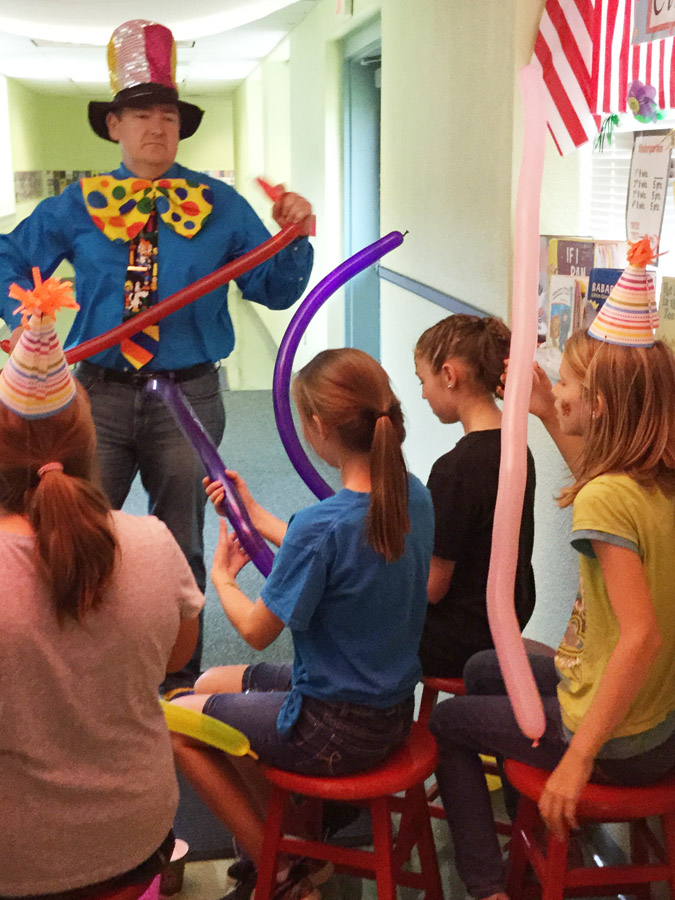
The 96 studetns in gradeds K-5 that reached their goal were treated to a circus of fun recently, complete with face painting, balloon animals, fish pong, a bean bag toss, ladder ball, juggling and a photo booth. Students were able to create their own clown cupcakes at the Circus Concession Stand to enjoy along with nachos and cheese, circus peanuts, animal crackers and fruit punch. Students received prizes at each station, and a special photo from the photo booth.
Submitted photos for NorthEscambia.com, click to enlarge.






FWC Law Enforcement Report
May 17, 2017
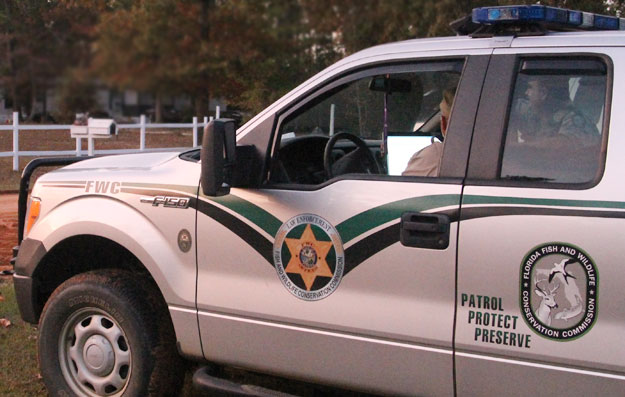
The Florida FWC Division of Law Enforcement reported the following activity during the weekly period ending May 11 in Escambia and Santa Rosa counties.
ESCAMBIA COUNTY
 Officers Allgood and Long found two people illegally camping in Perdido River Wildlife Management Area (WMA). Camping is only allowed in designated camping areas and entry into the area is prohibited one and a half hours after sunset. While speaking to the individuals regarding the violations, they were found to be in possession of marijuana. While addressing the violations, another vehicle drove into the parking area. Officer Long approached that vehicle, spoke to the driver and noticed there was a large pipe used for smoking marijuana on the passenger’s side floorboard. The driver and passenger of this vehicle were also found to be in possession of marijuana. Notice to appear citations were issued for possession of less than 20 grams of cannabis and possession of drug paraphernalia.
Officers concentrated on off-shore fisheries patrols. They issued notice to appear citations for possession of undersized and over the bag limit of red snapper and possession of an undersized amberjack. Two other individuals were cited for possession of red snapper in federal waters. Red snapper season is currently closed in federal waters.
SANTA ROSA COUNTY
Officer Lewis teamed up with FWC biologists to speak to approximately 120 students from Woodlawn Middle School at Blackwater River State Park. Officer Lewis spoke to the students about FWC’s mission, resource protection, boating safety and environmental laws.
Officer Arnette spoke to approximately 150 first-grade students from Baker Elementary School at the FWC Blackwater Fisheries Center in Holt. He talked about the role of an FWC officer and answered numerous questions from the young visitors.
This report represents some events the FWC handled over the past week; however, it does not include all actions taken by the Division of Law Enforcement. Information provided by FWC.
NorthEscambia.com photo.
Barry Holds Town Hall Meeting
May 17, 2017
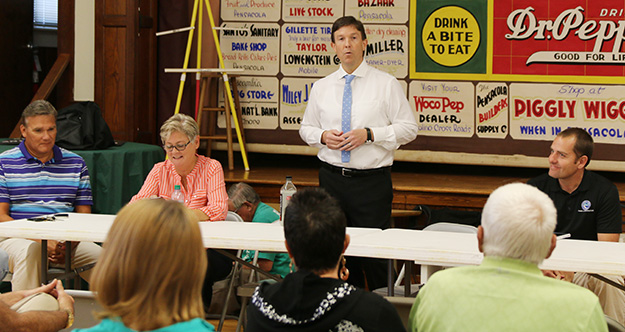
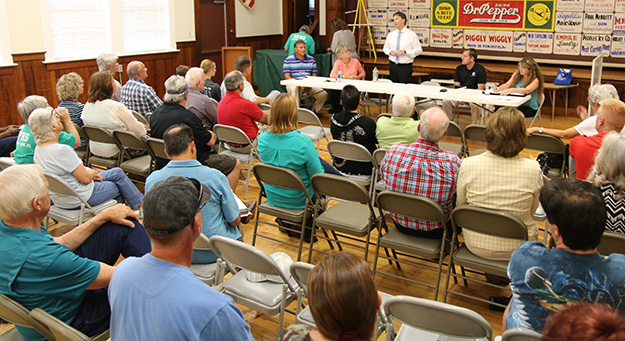
District 5 Escambia County Commissioner Steven Barry held a community town hall meeting Tuesday evening at the Barrineau Park Community Center.
Most questions and comments centered around roads and bridges, including the ongoing closure of Molino Road for a bridge replacement. [Read more: When Will The Molino Road Bridge Reopen?]
Barry said about 20 miles of dirt roads had been paved in District 5 during the last four years, with about 60 miles of dirt road remaining to be surfaced.
Among other issues, residents also expressed concerns about the lack of space for a growing program at the Molino Ballpark and the lack of practice space for the Northwest Escambia football program. Barry said a lighted football practice field will be constructed in Walnut Hill between the walking track at the community center and the nearby Bradberry Park.
NorthEscambia.com photos, click to enlarge.