

March Students Of The Month Named
March 30, 2009
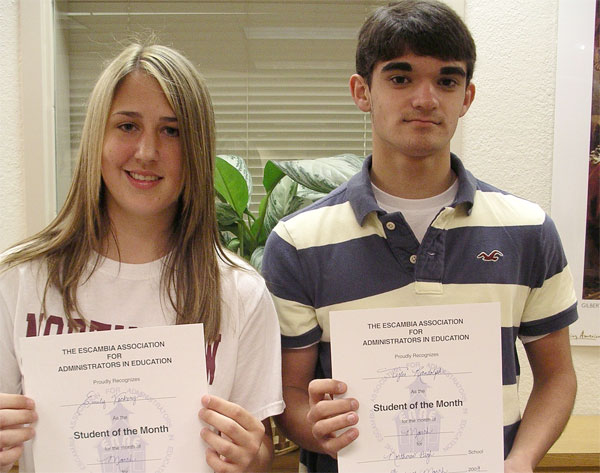
March Students of the Month have been named at North Escambia schools.
The monthly recognition is presented to two students from each participating school by the Escambia Association for Administrators in Education
The following students of the month were named from North Escambia schools:
- Bratt Elementary: Kirsten N. White, third grade; Andrianna C. Cooper, kindergarten.
- Jim Allen: Jordan S. Hamilton, fifth grade; Brianna R. Holmquist, fifth grade.
- Molino Park: Arianna N. Rudd, first grade.
- Northview High: Tyler L. Randolph, ninth grade; Emily F. Vickrey, 10th grade.
Pictured above: Northview High School Students of the Month Emily Vickrey and Tyler Randolph. Submitted photo for NorthEscambia.com.
Bratt Elementary School Librarian’s Home Hit By Possible Tornado
March 28, 2009
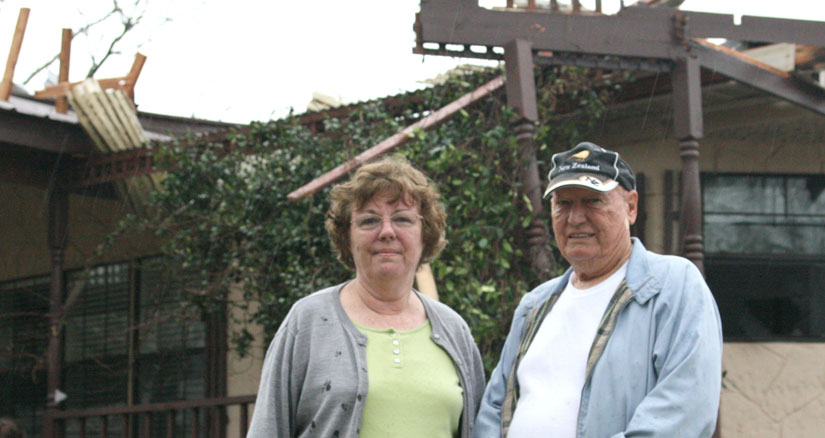
For years, Bratt Elementary School librarian Martha Jeter worried that one day a tornado would hit the school, but she never considered that her home might be destroyed by a storm.
In the pre-dawn hours Friday, her home was heavily damaged by a tornado or powerful straight line winds.
Martha, her husband Gerald and a step-nephew Joe Brown were in the Jeter’s home on Bell Creek Road near Chumuckla in Santa Rosa County when the possible tornado hit just before 5:00 Friday morning.
Gerald was already awake after hearing heavy rains on the small wood frame house’s tin roof, and because of frequent thunder and lightning. Martha was asleep in the back the house. She was oblivious to the weather outside because she was not wearing her hearing aids.
“He got us up and told us to go the hallway,” she said. “I headed toward the kitchen window to look out. Then there was what sounded like an explosion.” That sound was a tree limb crashing through the window of the home.
“The whole house shook,” Gerald said. The family gathered in the hallway, and in seconds it was over.
“We did not really know what had happened,” Martha said. “It was so dark. We knew there was water raining in the house, but it was daylight before we could get a good look at how bad it was.”
The family was uninjured. And what they found was not good.
The carport was gone. The roof on the utility room off the carport was gone. Much of the metal roof on their house was torn away, some hundreds of yards away in the trees. The roof that remained on the home had boards from the carport driven through it.
 A large wooden board was pushed through the wall of their travel trailer, which had been spun around 90 degrees by the winds as it sat just outside their home. The roof on the travel trailer was rolled back.
The damage was so severe that Santa Rosa County condemned their house, declaring it unsafe to live in.
“They tell us that we can’t sleep here tonight,” Martha told NorthEscambia.com late Friday afternoon. The family had gathered at the house trying to salvage clothes and other items before darkness fell. “It’s hard to believe that it is all gone.”
“For years I would pray ‘Lord don’t ever let a tornado hit the school’,” Jeter said. She would say that prayer each time the children at Bratt Elementary huddled in the hallways for tornado drill. “I just never thought one would hit our house, take our house away.”
The Jeters had big plans for their little home next weekend. Their children were to be in town to help Martha and Gerald celebrate their 40th wedding anniversary.
“But we won’t be having them here at this house now,” she said. “But we will still celebrate our anniversary. Forty years.”
The Jeters have lived on Bell Creek Road for almost 22 years. They are not sure if they will rebuild at this point. The family had insurance, but they also had other plans. Martha is just a year away from retirement, and they had thought about moving south to be closer to their kids.
For now, they will be staying with nearby relatives.
“I’m not sure what we will do next,” Martha said. “I am just thankful that we were not hurt, and that no one else was hurt. We were blessed.”
Click here for more NorthEscambia.com photos from the Jeter home in Chumuckla.
Pictured top: Martha and Gerald Jeter outside the remains of their Chumuckla home Friday afternoon. Pictured middle inset: A large piece of wood was driven into the side of a travel trailer just outside the home. Pictured below: The house was heavily damaged by a possible tornado. NorthEscambia.com photos, click to enlarge.

Ballet In Byrneville
March 28, 2009

Ballet Pensacola presented their outreach program “Discover Dance” Friday morning at Byrneville Elementary School. From “choreography” to “point shoes”, students learned words and phrases while getting a taste of modern and traditional ballet. Friday’s Ballet Pensacola presentation at Byrneville Elementary was made possible through the support of Escambia County Bank, Jay Hospital and Century Pharmacy. Photos for NorthEscambia.com, click to enlarge.
Click here for more photos from Ballet Pensacola at Byrneville Elementary School.
Northview, Tate Students Receive Mira Creative Arts Awards
March 27, 2009

Many North Escamba students received Mira Creative Arts Awards Thursday night.
The award honors the 10 brightest creative art stars from each high school in Escambia County.
Northview’s Mira Creative Arts Award winners were:
- Olivia Bryan, theater.
- Patrick Carlson, instrumental music.
- Brandon Coburn, drama.
- Lanie Eubanks, instrumental music.
- Briana Halteman, instrumental music.
- Josh Holder, visual arts.
- Luke Killam, wood working.
- Jackie Lowen, visual arts.
- Jace E. Stone, music.
- Jessica Taylor, visual arts.
Winner from Tate High School were:
- Casen Barnard, Visual Arts.
- Tyler Baxter, Drama.
- Samantha Bruce, Instrumental Music.
- Benjamin Carmichael, Instrumental Music.
- Madeline Chivington, Journalism.
- Stephanie Evans, Visual Arts.
- Candace Hubble, TV Production.
- Alexandria Jarman, Journalism.
- Valorie Lysek, Vocal Music.
- Brittany Nunnelee, Debate.
Pictured above: Olivia Bryan (center) in last November’s Northview High Schoolproduction of “Don’t Say No To The USO”. NorthEscambia.com file photo, click to enlarge.
Facebook Group Seeks To Reunite Century High Grads
March 27, 2009
A few Facebook group is seeking to reunite Century High School graduates.
Felicia McCaw Jones, now living in North Alabama, created the site this week for all Century High School alumni.
“I am a sentimental fool for stuff like this. I would like the group to be proactive in posting pictures from around school times, even just hanging out with friends ‘back in the day’,” Jones said in an email.
 As of Thursday night, there were 43 members on the page. Century graduates still living in the area have joined, along with Blackcat graduates now living in Mobile, Jacksonville, Ohio, West Palm Beach, Atlanta, Virginia and more.
Click here to view the Facebook site for Century High School alumni. In order to view the entire site, you must have a free Facebook membership.
What’s Hot: Ernest Ward Middle School’s Newspaper
March 24, 2009

From what’s hot, to what’s not; to the latest news around campus, students at Ernest Ward Middle School turn to the school’s newspaper Through the Eagles Eye.
“It gives us a chance to express our opinions,” Co-editor Anna Donald said. She likes to write stories about FFA and the Ernest Ward Drama Club, because “they are totally me”.
 Over the years, the paper had evolved into a publication primarily by teachers with little input from students. Ernest Ward Middle School newspaper sponsor Sara McGinnis has worked to change that.
“We have returned over the past couple of years to student input. We have good group,” McGinnis said. “Every article is totally done by them, and they sell the paper during lunch.”
“It is more focused, not as random now,” staff member Dezarae Turner said.
Articles are, like at most schools, proofed by school staff to make sure they are appropriate. But McGinnis’ staff said that they work hard to play by the rules.
“We know that when she gives us ‘the look’, it is time to be good,” Donald said.
Turner said she enjoys writing articles about student life. “I like to hear what the student body has to say,” she said.
The students have also learned that in the newspaper business, the right story sells.
“We sell at least 20 extra copies with anything in it that is Twilight related,” Donald said.
(In case you don’t know: Twilight is the movie of 2008 that would be on the “hot” side of the what’s hot, and what’s not list at Ernest Ward or any middle school.)
Click here for a pdf of the January Ernest Ward Middle School newspaper. (This is 591Kb file that may be too large for readers on a dialup internet connection.)
Members of the newspaper staff at Ernest Ward Middle School are: Jazzlyn Franklin, Cheyenne Godwin, Dezarae Turner, Indigo Rodriguez, Jessica Warner, Isaac Dukes, Hannah Fiellin, Jeremy Stacey, Anna Donald and Angel Mitchell.
Pictured top: Ernest Ward Middle School students (L-R) Dezarae Turner, Jeremy Stacy and Anna Donald proofread the latest issue of the school’s newspaper. NorthEscambia.com photo, click to enlarge.
Panhandle Fresh: Group Markets Local Produce
March 23, 2009

The watermelon and the sweet corn you buy at Wal-Mart late this spring or during the summer may just be from North Escambia. Or the peanuts, or the peppers, or one of the many crops that the marketing cooperative Panhandle Fresh helps local farmers market to the world’s largest retailer.
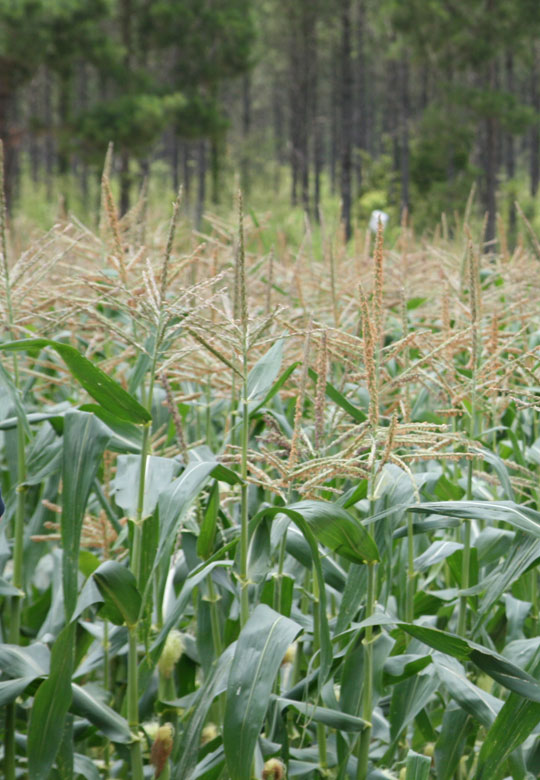 “I never thought I would be selling my sweet corn in Wal-Mart,” Walnut Hill farmer Steve Hiebert told NorthEscambia.com.
Panhandle Fresh handles the marketing, the insurance and logistics of getting produce like Steve’s Sweet Corn from Walnut Hill to Wal-Mart. Panhandle Fresh secures the orders from Wal-Mart and works with local farmers to get coordinate the produce delivery.
“We really just work between the farmers and Wal-Mart to sell what is on the land,” said Andrea Sutrick, marketing coordinator from Panhandle Fresh. Sutrick recently joined Panhandle Fresh after working for Kraft Foods for 10 years to secure shelf space for Kraft products.
“This year we hope to ramp it up a little bit and experiment with more production,” Sutrick said.
No matter the scale, Panhandle Fresh Executive Director Cindy Anderson said selling to a giant retailer is very different for most farmers than selling on their farms or at curbside markets.
“This isn’t for everbody,” Anderson said. “We encourage farmers to commit just 20 percent of their crops to the Panhandle Fresh program. This gives us and the producers a chance to figure out how to best make the program work. I’d rather walk before we run.”
 Panhandle Fresh sits between the farmer and Wal-Mart, providing the $3 million in liability insurance that Wal-Mart requires. The group also provides the marketing, works to secure shelf space for the products, takes care of most paperwork and bills Wal-Mart for the produce. The farmer delivers his goods, bills Panhandle Fresh and receives a check for the fresh goods.
Most farmers are happy with the price that they receive, Anderson said, making it a win-win situation for everyone. Wal-Mart gets the freshest product possible from local farms, and the local farmers that participate get a much needed financial boost.
In addition to Steve’s Sweet Corn from Walnut Hill, Walnut Hill farmer Jerry Davis’ watermelons and Holland Farms peanuts from Jay are among the top Panhandle Fresh products sold in area Wal-Marts in the Florida Panhandle.
Coming up Tuesday, we’ll take a look at one of the big challenges faced by the farmers that participate in Panhandle Fresh, and how the solution may just mean more jobs in North Escambia.
Pictured top and top middle: Steve’s Sweet Corn from Walnut Hill is just one of the products that Panhandle Fresh works to get from area fields in into retail giant Wal-Mart. Pictured bottom middle: Panhandle Fresh greens being sold in an area Wal-Mart. Submitted and NorthEscambia.com file photos, click to enlarge.
Local Church Member Continues To Serve In Iraq
March 23, 2009

A member of a local church that is serving in Iraq is expected to return home in the next two months.
 US Air Force Sgt. John Weaver is currently serving in Iraq. Sgt. Weaver is originally from Jay and currently lives in Pensacola with his wife Lisa and three girls, Krista, Randi, and Starla.
He and his family are very active and faithful members of Ray’s Chapel, and the family makes the drive several times a week to the church. Over the past several months, the church has continued to support Sgt. Weaver in prayer and with care packages from home.
Pictured top: Ray’s Chapel Baptist Church member Sgt. John Weaver poses in a chair in a former Saddam Hussein palace in Iraq. Pictured middle: Weaver is big Alabama Crimson Tide fan. Pictured below: Weaver (middle) poses with his troop. Submitted photos from Iraq for NorthEscambia.com, click to enlarge.

Spring: March Tips For Your Flowers, Shrubs, Lawn And Garden
March 22, 2009

Now that spring is here and the outdoors are turning green again, it is time to begin thinking about working in your outdoor areas in North Escambia and surrounding areas. From flowers, to tree and shrubs to lawns, the Escambia County Extension Service offers some great tips for the late March through April time period:
Flowers
- Begin planting colorful annual flowers such as ageratum, alyssum, amaranthus, asters, baby’s breath, begonia, calendula, celosia, cosmos, dahlia, dusty miller, gaillardia, geranium, hollyhock, impatiens, marigold, nicotiana, ornamental pepper, pentas, phlox, rudbeckia, salvia, sweet Williams, torenia, verbena, vinca and zinnia.
- Caladium bulbs are extremely sensitive to cold soil so there is no advantage to planting early. Purchase caladiums while there is a good selection, but wait until late March or April before planting them in shady beds.
- Begin watching roses for black spot fungus disease (small black spots on the leaves that quickly worsen). Control it by spraying every seven to ten days with a fungicide. Call your local Extension Office for recommended products.
Trees and Shrubs
- Finish pruning summer flowering shrubs such as althea, hibiscus, abelia, oakleaf hydrangea and oleander.
- Delay pruning azaleas, camellias, spiraeas, gardenias and other spring flowering shrubs until after flowering is complete.
- Prune any cold weather-damaged plants only after new growth appears.
- If needed, fertilize shrubs and small trees with a slow release fertilizer. A good general-purpose landscape fertilizer is a 15-0-15.
- Mature palms should receive an application of granular fertilizer. Use a special palm fertilizer that has an 8-2-12 +4Mg (magnesium) with micronutrients formulation. Apply one pound of fertilizer per 100 sq ft of canopy area or landscape area.
- Pick up all fallen camellia blossoms and remove them from your property. This practice helps to prevent petal blight next season.
- Prune ornamental grasses. For more information visit the online publication, “Considerations for Selection and Use of Ornamental Grasses,” at http://edis.ifas.ufl.edu/EP233 or call you local Extension Office for a copy.
- Evergreen and semi-evergreen trees such as live oak and laurel oak shed most of their leaves during March and early April. Make plans to recycle these leaves on your
property by composting or using them as mulch in vegetable, flower and shrub beds.
Vegetable Garden
- In mid-March, plant vegetables such as bush beans, pole beans, lima beans, cantaloupes, sweet corn, cucumbers, eggplant, okra, southern peas, peppers, sweet potatoes, pumpkins, summer squash, winter squash, tomatoes and watermelon.
- Sweet potato plants (slips/draws) can be set out April through June.
Lawns
- Removing excessive accumulation of leaves from the lawn will increase the effectiveness of fertilizer and pesticide applications.
- If a pre-emergence lawn herbicide is needed to control summer weeds, it should be applied in early March or when day temperatures reach 65 to 70 degrees F for 4 to 5 consecutive days. Make certain to choose one that is safe on your type of grass. Call your local Extension Office for a recommendation.
- Wait until early April to fertilize lawns. If fertilized too early, they often respond with yellow spots of iron chlorosis. Use a slow release nitrogen product with a 3-1-3 ratio
(like a 16-2-16) or a 1:0:1 ratio such as a 15-0-15. - Service the lawn mower by sharpening the blade and adjusting the cutting height for your type of grass.
- Anyone considering establishment of centipede grass from seed should hold off until the soil warms up and stabilizes above 70°F.
- Spring dead spots may be present. Before treating these areas, get a diagnosis. Treat, if necessary, and then patch these areas before weeds invade the bare spots. Sodding, plugging or sprigging helps them to fill in quicker.
Birth: Savannah Leigh Gilmore
March 22, 2009

Benjamin and Rachel Gilmore are proud to announce the birth of their daughter, Savannah Leigh Gilmore. Savannah was born on February 8, 2009 at 12:56 pm and weighed 8 lbs and 10 oz. She is the granddaughter of Glen and Jean Wiggins and Elton and Missy Gilmore and the great granddaughter of Pattie Stone and the late George Stone, Ouida Wiggins and the late Billy Wiggins, and Mattie Lou Sheffield.
NorthEscambia.com is now proud to offer free birth and wedding announcements. For more information, email news@northescambia.com. Announcements will ordinarily appear on our Features page.