

Back To School Orientations Next Thursday, Friday
August 11, 2010
New and incoming student orientations will be held next Thursday and Friday at North Escambia schools.
Orientations will be held as follows:
- Bratt Elementary: Thursday, August 19 from 9-10 a.m. for Pre-K; Friday, August 20 from 8-10 a.m. for K-5
- Jim Allen Elementary: Friday, August 20, 9-10:30 a.m. for all grades
- Molino Park Elementary: Thursday, August 19 from 9:30-10:30 Pre-K; Friday, August 20, 9-9:30 a.m. for K-2 and Friday, August 20, 9:30-10 a.m. for 3-5
- Ernest Ward Middle School: August 19, 10 a.m.-11:30 a.m. for new and incoming students
- Ransom Middle School: August 19, 10 a.m.-11:30 a.m. for new and incoming students
- Northview High School: Orientation for ninth grade and new students will be Thursday, August 19 at 8:30 a.m.
- Tate High School: Orientation for ninth grade and new students will be Thursday, August 19 at 8:30 a.m.
Molino Homemakers Club Create ‘Hairy Heads’ Craft
August 8, 2010
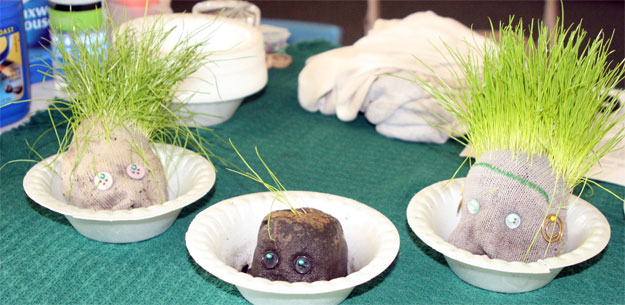
The Molino Homemakers club had a demonstration on making “Hairy Heads” at a recent meeting.
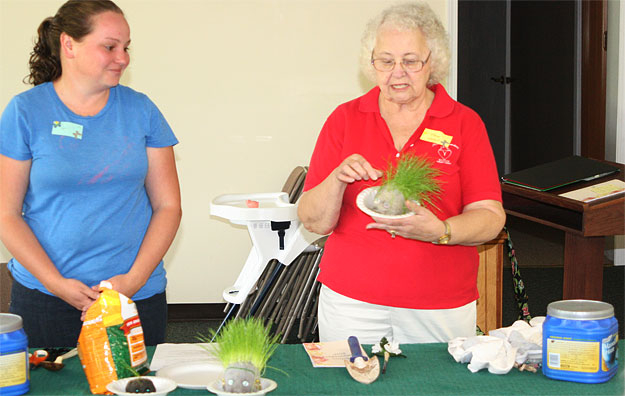
 Nancy Holland gathered up her husband’s old socks, string, rubber bands, Styrofoam bowls, a few grass seeds, potting soil and water. Then she along with April Glass proceeded to demonstrate to the club members how to make a “Hairy Head”.
First you will need to cut off the top of the sock if it has elastic on it which makes it easier to put the soil in. Place a couple of tablespoons of grass seed in toe of the sock. Fill with soil about 6 inches deep. (Depending on the size of the sock) Tie top of sock tightly with string or rubber band. Hold over the bowl and pour water over sock soaking it well. Hold up a few inches and let excess water drip off. Cut off excess sock just above the string or rubber band. Place upside down in the bowl. String will be on the bottom, seeds on top. Shape like a head flattening the bottom sort of like a chin. Put buttons in with pins for eyes, or eyes and nose if you have three buttons. Place in a sunny window. “It is very important to keep the sock moist until it sprouts,” said Holland. Cover with plastic wrap for faster sprouting. Without wrap mist often and cut hair when Hairy needs a haircut. “Why would you want to do this?” asks Holland, “Because you need to be silly once in a while.”
 Barbara Hendrix gave an interesting devotion on cicadas insects like Katydid’s and Honeybees. Saying, “Katydids appear every 17 years or so creating an almost constant noise at an extremely disruptive level, then, they quickly disappear. Honeybees are just the opposite. Their hives exist for years. They make an effort everyday to live in harmony with one another pollinating plants and flowers that furnish fruit and vegetables that provide for our daily nourishment. Without those gifts our loss would be great.” She left us considering whether we are disruptive or doing the work we are called to do.
The Molino Homemakers toured Camp Five Road Prison in Cantonment in place of their regular June meeting.
The Molino Homemakers meet at 10 a.m. on the first Wednesday of each month, excluding July, in the fellowship hall of Molino First Assembly of God Church. Visitors are welcome.
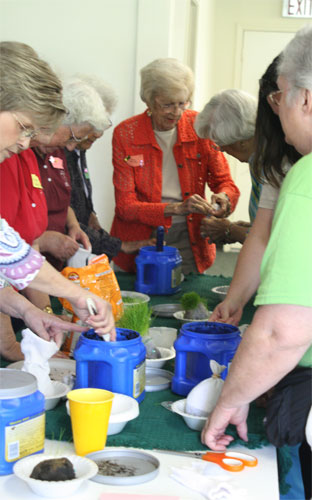
Pictured top: Molino Homemakers Club “Hairy Heads”. Pictured inset: The ladies of the Molino Homemakers Club work on a project. Pictured below: April Glass and Nancy Holland demonstrate the project. Submitted photos by Terri Brown for NorthEscambia.com, click to enlarge.
Century Blackcats 1977-1987 To Hold Reunion
August 8, 2010
The Century High School classes of 1977-1987 will hold a combined reunion on August 20-21.
The event begins with a meet and greet, and registration, at 7:30 Friday night at the Century Community Center (Ag Building) on West Highway 4. The reunion banquet will take place on Saturday, August 21 beginning at 3:30 p.m.
The fee is $25 per person, including food and drinks. For more information, contact Terrie (Anderson) Abernathy at (850) 221-4229, Johnny Findley at (251) 727-0690 or Sharron (Peebles Jones) Bell at (404) 949-6403. Visit the reunion Facebook page at www.facebook.com/CenturyHighSchoolClassReunion.
Featured Recipe: Cumin Grilled Pork Chops
August 8, 2010
This weekend’s featured recipe from Janet Tharpe is Cumin Grilled Pork Chops. A cumin-fueled marinade is the star of this fast and easy dish. Not only does it add a distinctive smokiness to the pork, it also does wonders sealing in the chops’ natural moisture.
To print today’s “Just a Pinch” recipe column, you can click the image below to load a printable pdf with a recipe card.

Now Is Time To Get Ready For That Fall Garden
August 7, 2010
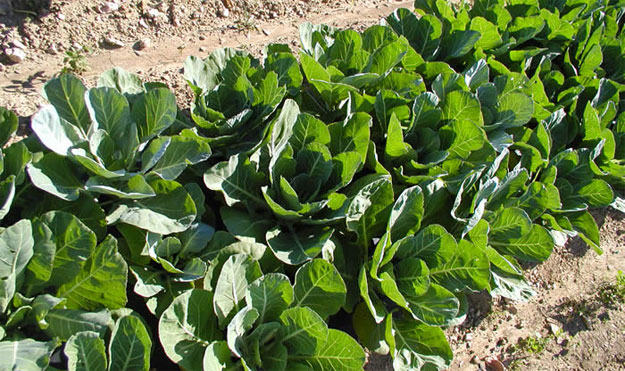
This year, many gardeners celebrated spring by planting a vegetable garden and were rewarded with a bountiful harvest. Others were disappointed with a smaller than expected harvest and too many problems to count. Both groups of gardeners should rejoice! The hot weather may not indicate it, but it’s time to begin a fall vegetable garden.
 But before we enjoy a fall harvest, there’s work to be done preparing the fall vegetable garden. Gardeners must take action now–drastic action. Some of those plants that have been nurtured from “babies” in the spring to monsters now must be pulled out. It is recommended that most plants, but especially weeds, be removed. Leave the okra, cherry tomatoes and beans if the foliage is healthy and they are still producing.
Large-fruited tomatoes may have some small ones still hanging on, but, unless you have at least 10-20 good-sized fruit, pull them out. The largest, best tomatoes you had this spring were the first ones produced. The tomato plant has gotten old, diseased, and damaged by insects; it will never produce an abundance again. Pull the old plants up and discard them.
The next step is to decide if your garden is in the right location. The major consideration for garden placement is sunlight. All vegetables require some sunlight; the most popular vegetables require full sun. “Full” sun means at least eight hours of intense, direct exposure. If such exposure is not received by crops such as tomatoes, peppers and squash (vegetables that contain seed), the plants grow spindly, they have weak stems, drop blooms and are generally nonproductive.
Some leafy vegetables such as broccoli, collards, spinach, and lettuce tolerate shadier conditions than other vegetables, but if your garden does not receive at least six hours of sunlight daily, you will not be successful growing vegetables.
Another key to a successful harvest is proper soil preparation. In Northwest Florida, most soils are less than perfect for vegetable production. So we must improve our soil through the addition of organic amendments.
Adding liberal amounts of organic matter to all types of garden soils is a highly recommended practice. Compost, rotten grass clippings, or leaves applied to the garden surface two to four inches deep and tilled or worked into the soil, greatly improve sands or clays.
 After adding organic amendments, its best to wait several weeks before planting. Extremely fresh organic material, when introduced to the native soil, causes a rapid increase in the numbers of soil microorganisms. These soil microbes reach tremendous numbers as they help to decompose or break down the organic materials to a more usable form. If young plants or seeds are planted while these microbes are highly active, there is a good chance that they will experience nitrogen deficiency, root rot or seedling blights.
A small amount of fertilizer can also be applied during soil preparation. This may be helpful if the organic amendments are too fresh. A little extra nitrogen will help speed up microbial activity.
Some gardeners will also amend the soil with lime during bed preparation. While lime may be necessary in some situations, don’t add it until you’ve had a pH test run by a reliable lab. Too much lime in the soil may be just as bad as too little. A high pH, caused by excessive lime, can cause many problems such as making some nutrients unavailable to plants. So, keep in mind the old adage, “Don’t guess, soil test!”
So, even though the temperatures are unbearable, it’s time to prepare for the fall garden. Stay tuned for future articles on vegetable gardens in Northwest Florida.
Theresa Friday is the Residential Horticulture Extension Agent for Santa Rosa County
Featured Recipe: Wavy Rancheroos
August 1, 2010
This weekend’s featured recipe from Janet Tharpe is Wavy Rancheroos pie. Colorful and flavorful, this pie is a fun take on the classic huevos rancheros Mexican breakfast, but it’s great or lunch or dinner too.
To print today’s “Just a Pinch” recipe column, you can click the image below to load a printable pdf with a recipe card.

Birth: Forester David Bryan
August 1, 2010
 Heath and Shelby Bryan are proud to announce the birth of their son, Forester David Bryan, born July 2, 2010 at Thomas Medical Center.
Forest weighed eight pounds and was 21 inches long. Grandparents are Ricky and Cheryl Golson, and Terry and Sheila Bryan of Bratt. Great-grandparents are Marlene Forester and the late Curtis Forester, the late Walter Lee Golson and Doris Oline Hopkins, Pansy Bryan and the late Preston Bryan, Dillard and Rochelle Bankston, and the late Billy Macks.
Looking For A Bargain? Try The Junior Humane Thrift Store
July 31, 2010
If you are looking for some good, low cost shopping, consider the Junior Humane Society’s Thrift Store in Cantonment.
 Store proceeds benefit JHS activities, such as finding homes for homeless cats and dogs. The store features of clothing for all ages, shoes, office furniture, kitchen supplies, books, toys, pet supplies and other items with new merchandise arriving almost daily.
Initially open just four days a week, hours have been expanded to include everyday except Sunday from 10 a.m. to 4 p.m.
“Some days when we came to open the store, we had customers already lined up and waiting for us,” said Frankie Van Horn Harris, director of the Junior Humane Society. “Hopefully, being open on more days and for longer hours will help our customers and help JHS.”
The store opened for business October 2009 after weeks of planning and hard work by a group of pet-minded and dedicated volunteers. Through the store, JHS volunteers have found a way to help the animals they care about so much and the community at the same time.
The Junior Humane Society’s Thrift Store in Cantonment is located at the corner of Highway 29 and Neal Road in Cantonment.
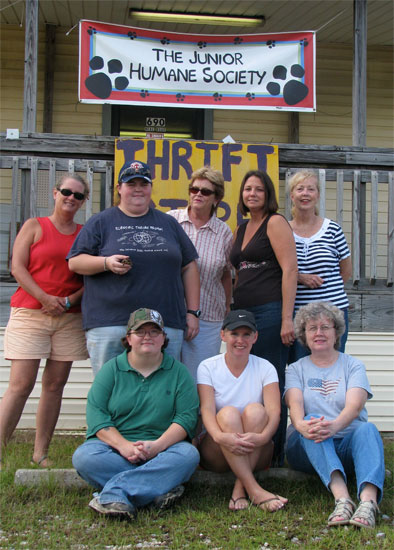
Pictured JHS volunteers Kristi Kirby; Amanda Gifford; Crystal Clanton; Mary Foster; Director Frankie Van Horn Harris; Christa Pettijohn; Elizabeth Irby; and Janet Lewis. Submitted photo for NorthEscambia.com, click to enlarge.
Hydrangeas: Distinctly Southern
July 31, 2010
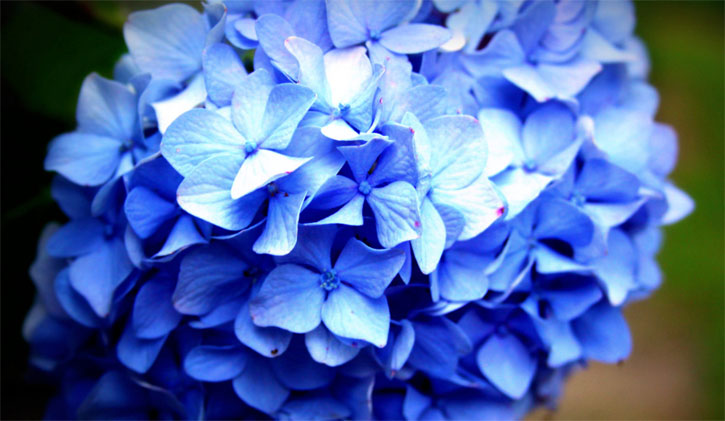
Photo by Mandy Fails of Atmore for NorthEscambia.com, click to enlarge.
Nothing defines a southern landscape more than hydrangeas.
These beautiful, large flowering shrubs fill gardens with their green, leafy foliage and incredible blooms during the warm months.
In order to ensure consistent and reliable blooms, these shrubs must be cared for correctly. In addition to proper site location, fertilizer and moisture conditions, hydrangeas may require pruning. Proper pruning includes correct timing.
Hydrangea aficionados are constantly debating pruning techniques. There are many different types of hydrangeas and pruning differs according to the type. It is a big genus of plants and so it’s important to know what type of hydrangeas you may have and on what type of wood they bloom on.
Blooms on old wood, prune after flowering
The bigleaf hydrangeas, known scientifically as Hydrangea macrophylla, are what most people think of when you mention hydrangeas. Most gardeners will know these as mopheads (also called hortensias) and lacecaps. Many of these blooms will be blue or pink although other colors now are available.
Many large colonies of bigleaf hydrangeas have existed around old homes for decades, surviving and blooming in spite of neglect. This tells us that it is not necessary to prune bigleaf hydrangeas.
However, if you want to keep these shrubs within a defined boundary, control their height or rejuvenate old shrubs, it will be necessary to prune them.
Bigleaf hydrangeas can be reduced in size immediately after flowering. A general rule of thumb is that you may remove up to a third of the shrub’s height. Be sure to complete your pruning before August. This is critical because next year flower blooms start to form in August. Pruning after August will remove next year’s blooms.
There now is a small group of bigleaf hydrangeas that are everblooming or remontant. Endless Summer® is one well-known brand. According to the developers of these reblooming hydrangeas, remove spent flowers to encourage rebloom. They are quite forgiving and will not suffer if left unpruned or pruned at the wrong time because these cultivars bloom on both old and new growth.
Our native oakleaf hydrangea (Hydrangea quercifolia) is a large, deciduous shrub that can grow up to six feet tall. It has deeply lobed, oak-like leaves which turn bronze in the fall. This plant does not usually need pruning. If reshaping or size-reduction is necessary, prune after blooms begin to fade.
Article Continues Below Photo
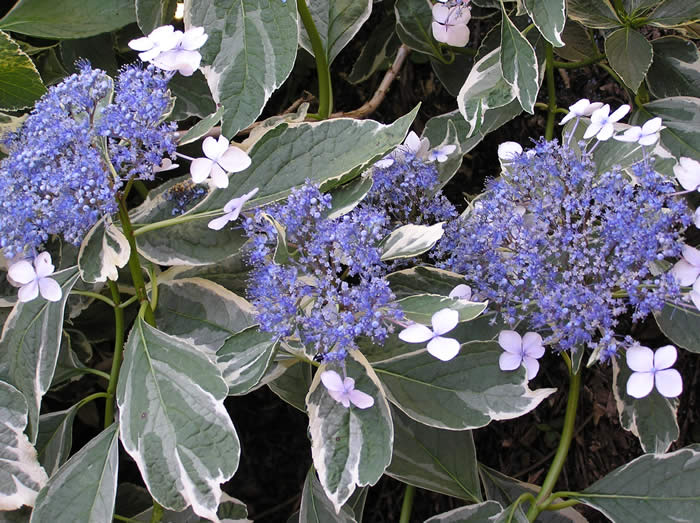
Lacecap hydrangea Photo credit: Theresa Friday
Blooms on new wood, prune in early spring
Smooth hydrangea (H. arborescens) is the other U.S. native. The most common cultivar, ‘Annabelle’, produces rounded inflorescences that may reach up to a foot in diameter.
The panicle hydrangea (H. paniculata) is more of an upright type. It is typically a 10 to 15-foot large shrub or low-branched tree.
Panicle and smooth hydrangeas flower on current year’s growth and can be pruned anytime from late summer until early spring. If pruning these two species in the spring, try to prune before leaves appear.
Winter pruning
Established bigleaf, panicle, oakleaf and smooth hydrangea plants can often benefit from rejuvenation pruning. Remove about one-third of the oldest stems each year. The result is a fuller, healthier plant. This type of pruning is easiest to do in winter, since the absence of leaves makes it easier to see and reach inside plants.
Hydrangeas offer a wide variety of plants which can make the timing of pruning difficult to remember. Just keep in mind, if in doubt, either don’t prune at all or prune after flowering.
Theresa Friday is the Residential Horticulture Extension Agent for Santa Rosa County.

Hospital Honors Dr. Smith For 30 Years Of Service
July 29, 2010

Jay Hospital employees and affiliated physicians recognized C. David Smith, M.D., for 30 years of dedicated service.
“There is no greater example of a caring, loyal, and hard-working physician anywhere,” said Mike Hutchins, administrator of Jay Hospital. “Dr. Smith’s positive impact on our hospital and community over these 30 years is beyond measure.”
Baptist Health Care partnered with Jay Hospital in 1979, to strengthen the then county-owned facility with resources related to technology, personnel and support services. Securing a physician to serve the rural community was critical to the hospital’s survival.
At that time Dr. Smith was in the middle of his residency at the University of South Alabama in Mobile when approached to return to his hometown of Jay, Fla. He agreed to fill the role and began his practice on July 16, 1980. Since then, he has cared for thousands of patients in the North Escambia area.
“We could not ask for a more dedicated physician than C. David Smith,” said Don Salter, Santa Rosa County Commissioner. “His life’s work has been at Jay Hospital for the benefit of his fellow residents.”