
Panhandle Equine Rescue Awarded Petfinder Tractor Supply Grant
July 5, 2013
Panhandle Equine Rescue of Cantonment has been awarded a Tractor Supply Operation grant valued at $1,000 by the Petfinder Association.
This grant is made possible through the Petfinder Foundation’s partnership with Tractor Supply to assist in funding basic operation costs such as hay, veterinary costs or other operating needs for animal welfare organizations who work with barnyard animals.
The non-profit Petfinder Foundation is dedicated to ending the euthanasia of adoptable pets. They help Petfinder member shelters save lives through adoption, help shelters prepare for and recover from disaster and work to ensure animal welfare organizations across the country are more sustainable.
“Due to the economic times and the rising cost of feed and hay, sufficient donations have not been coming in, which makes it difficult to feed the twenty horses we currently have in foster care. We are so grateful to the Petfinder Foundation and for Tractor Supply’s partnership with them. Awarding this grant to our rescue for use towards everyday operations will benefit the horse’s most basic daily needs; feed, hay and vet care” said Diane Lowery, president and co-founder of Panhandle Equine Rescue.
The only horse rescue in Escambia County, Panhandle Equine Rescue was founded by a small group of concerned citizens with a mission to rescue, rehabilitate and provide adoption services for abused, neglected and abandoned equines.
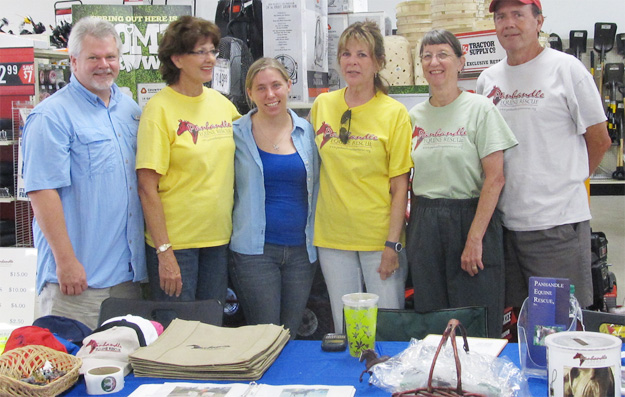
Pictured top: Panhandle Equine Rescue volunteers during a recent fund raiser at Tractor Supply Company on Nine Mile Road. Courtesy photo for NorthEscambia.com, click to enlarge.
Century, Flomaton Celebrate The Fourth With A Bang
July 4, 2013


Fireworks lit up the night Wednesday with an early celebration at Flomaton’s Hurricane Park. The fireworks show was a joint effort of both the Town of Flomaton and the Town of Century. The towns alternate hosting the festivities each year. Photos by Ditto Gorme for NorthEscambia.com, click to enlarge.






Escambia Extension Urges Smart Grilling For Food Safety
July 4, 2013
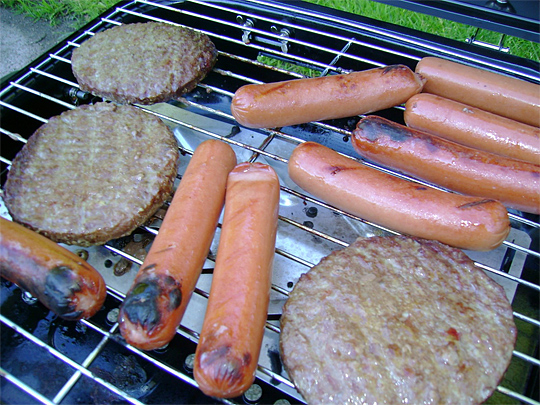
Safety is an important consideration when operating a grill. Improper use can cause a fire or explosion. Keep the area around a lighted grill clear of combustible materials, and never use a grill in an enclosed area such as a sheltered patio or a garage. Avoid wearing loose-fitting clothing that may catch fire. The cooking grids should be cleaned after every cookout. The last thing you want to do is cause someone to become ill due to improper cleaning or unsafe food preparation practices.
Wash your hands with hot soapy water for at least 20 seconds before starting to prepare any foods, and wash your hands again if you do anything else—change a diaper, pet an animal, or blow your nose, for example. Cover any cuts or sores on your hands with a bandage, or use plastic gloves. If you sneeze or cough while preparing foods, cover your mouth and nose with a tissue and turn your face away, or cough into your sleeve. Always wash your hands afterwards.
Bacteria multiply rapidly at room temperature. Most food-borne illness-causing bacteria cannot grow well at temperatures below 40°F or above 140°F. Thaw foods in the refrigerator or in the microwave. Never leave foods out at room temperature.
Keep everything that touches food clean. Bacteria can hitch rides around your kitchen on all sorts of things—plates and cutting boards, dirty utensils, dish rags and sponges, unwashed hands.
Never chop fresh vegetables or salad ingredients on a cutting board that was used for raw meat without properly cleaning it first. If possible, keep a separate cutting board just for the preparation of raw meat, poultry, and fish.
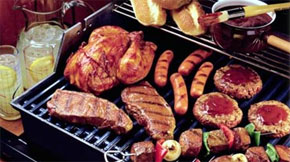 Wash cutting boards thoroughly with hot soapy water, and then sanitize with a solution of household bleach and water.
Keep raw meat, poultry, fish, and their juices from coming into contact with other foods during preparation, especially foods that will not be cooked. Wash all utensils and your hands with hot soapy water after contact with raw meat.
Marinate meat, poultry and seafood in the refrigerator in a covered, non-metal container. Throw away any leftover marinade.
Grill food to a safe internal temperature. Use a meat thermometer to assure correct doneness of the food being grilled.
Safe minimum internal temperatures:
- Poultry (whole, ground, and breasts): 165°F
- Hamburgers, beef: 160°F
- Beef, veal, and lamb (steaks, roasts and chops):
- Medium rare: 145°F
- Medium: 160°F.
- All cuts of pork: 160°F.
Hold meat at 140°F until served. Use a clean platter for transferring cooked meat from grill to serving table.
 Summer is the time for getting together with friends and family and cooking outdoors. Make your outdoor grilling experience safe and enjoyable.
For further information regarding food safety and other related topics, go to the University of Florida’s Solutions for Your Life website: http://www.solutionsforyourlife.com.
Dorothy C. Lee, CFCS, is an Extension Agent II, Family & Consumer Sciences with the Escambia County Extension Service. Reference: Safe Food Handling Fact Sheet, United States Department of Agriculture, Food Safety and Inspection Series.
Fourth Of July Picnic About $6 Per Person This Year
July 4, 2013
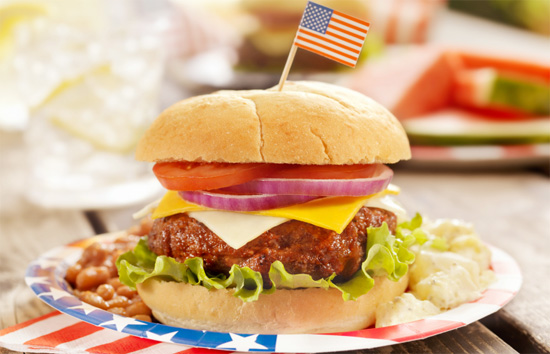
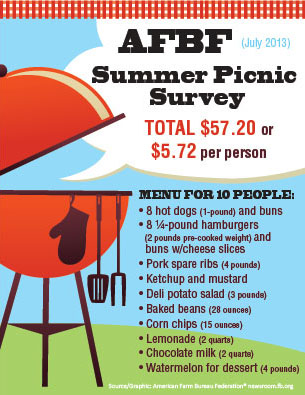
A Fourth of July picnic of Americans’ favorite Fourth foods including hot dogs, cheeseburgers, pork spare ribs, potato salad, baked beans, lemonade and chocolate milk is affordable this summer at less than $6 per person, according to an informal survey conducted by the American Farm Bureau Federation. The average cost for a summer picnic for 10 is $57.20 or $5.72 per person according to AFBF.
 “Although retail food prices have increased modestly over the past year or so, most Americans should be able to find summer picnic foods at close to the average prices found by our volunteer shoppers,” said John Anderson, deputy chief economist at AFBF.
“For many of us, nothing says the Fourth of July more than firing up the grill to prepare a meal,” Anderson said. “We’re fortunate here in America to have a consistent, high-quality supply of meats and poultry that can be grilled or prepared any number of different ways.”
AFBF’s summer picnic menu for 10 consists of hot dogs and buns, cheeseburgers and buns, pork spare ribs, deli potato salad, baked beans, corn chips, lemonade, chocolate milk, watermelon for dessert, and ketchup and mustard.
A total of 60 AFBF volunteer shoppers in 22 states checked retail prices for summer picnic foods for this informal survey.
AFBF’s July Fourth Picnic Survey is part of the organization’s marketbasket series, which also includes an annual Thanksgiving Dinner Cost Survey and two “everyday” marketbasket surveys on common food staples that can be used to prepare a meal.
Featured Recipe: Yankee Doodle Dandy Treats
July 4, 2013
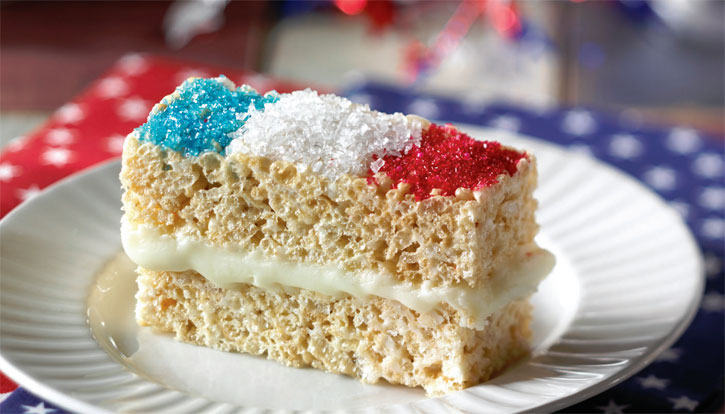
Looking to spend some time with the kids in the kitchen? Yankee Doodle Dandy Treats are a fun, easy and patriotic way to celebrate.
The recipe is not only easy, but it also lots of fun. It’s terrific for a “just-because” snack or as a sweet way to finish off a family picnic. And kids of all ages can help – from pouring and stirring to dipping and decorating, there’s something everyone can do.
Yankee Doodle Dandy Treats
Ingredients
- 3 tablespoons butter or margarine
- 1 package (10 ounces, about 40) regular marshmallows OR 4 cups miniature marshmallows
- 6 cups Kellogg’s® Rice Krispies® cereal OR 6 cups Kellogg’s® Cocoa Krispies® cereal
- 1 1/2 cups white chocolate morsels
- 1 tablespoon vegetable oil
- 3/4 cup powdered sugar
- 2 tablespoons water
- Red-, white- and blue-colored sprinkles
Preparation
- In large saucepan melt butter over low heat. Add marshmallows and stir until completely melted. Remove from heat.
- Add cereal. Stir until well coated.
- Using buttered spatula or wax paper, evenly press mixture into 13 x 9 x 2-inch pan coated with cooking spray. Cool. Crosswise cut in half, forming two 9 x 6 1/2-inch rectangles.
- Meanwhile, in small saucepan melt white chocolate morsels over low heat, stirring frequently. Stir in oil. Add powdered sugar, stirring until combined. Add water. Stir until smooth.
- Spread chocolate mixture over one cereal rectangle. Top with second rectangle. Sprinkle with red, white and blue sprinkles, pressing lightly into cereal mixture. Refrigerate about 30 minutes or until set. Cut into 3 1/4 x 1-inch strips. Best if served the same day.
Serves
Servings 18
Preparation Time:
30 minutes
Total Time:
1 hour
Featured Recipe: Add Flavor To Your 4th With The Marketplace Burger
July 3, 2013
This weekend’s featured recipe is a Marketplace Burger with a Gorgonzola cream cheese spread.

Tax Collector Officers Collecting Food For Manna Food Pantries
July 2, 2013
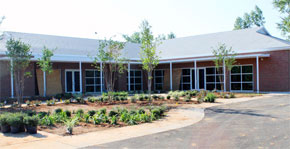 The employees of Janet Holley, Escambia County Tax Collector, are supporting Manna Food Pantries during the month of July by sponsoring a food drive. Their goal is to collect 2,000 pounds of food to help Manna meet the needs of the hungry in our area.
Nonperishable food items can be dropped off at any of the four tax collector locations Monday through Friday between 8:30 a.m. and 4:30 p.m.. Manna Food Pantries welcomes any food donations, but their most needed items are peanut butter, canned fruit, canned tuna and chicken and canned dinners.
Offices are located at:
- Downtown, 213 Palafox Place
- Molino, 6440 Highway 95A, Suite A
- Marcus Pointe, 6451 North W Street
- Warrington, 507 North Navy Boulevard
Health Dept: Drain And Cover Defense Against Mosquitoes
July 1, 2013
The Florida Department of Health in Escambia County is advising the public to “Drain and Cover” to protect against mosquitoes. Drain standing water in and around your home to prevent mosquitoes from laying eggs, and cover your body to protect against bites. Mosquitoes are known carriers of West Nile Virus, and other disease-causing viruses.
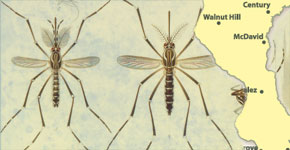 “Given the recent rains we have experienced, mosquitoes may be more prevalent in the upcoming weeks,” says DOH-Escambia Director Dr. John J. Lanza. “Individuals should do all they can to avoid mosquito bites, in order to prevent the spread of infections carried by the insect.”
Adult mosquitoes lay their eggs in standing or slow-moving water. Even one teaspoon of water is adequate for breeding. Mosquitoes are most active during evenings, nighttime and the dawn hours. Being outdoors at these times increases people’s chances of being bitten unless they cover their skin with clothes and/or an effective mosquito repellant.
Drain standing water.
- Drain water from garbage cans, house gutters, buckets, pool covers, coolers, toys, flower pots or any other containers where sprinkler or rain water has collected. Water held in open containers in your house is also a potential breeding location for mosquitoes.
- Discard old tires, bottles, pots, broken appliances and other items that aren’t being used.
- Empty and clean birdbaths and pets’ water bowls at least twice a week.
- When protecting boats and vehicles from rain, ensure that tarps don’t accumulate water.
- Maintain swimming pools in good condition and keep them adequately chlorinated. Empty plastic swimming pools when not in use.
Cover skin with clothing or repellent and cover doors and windows.
- Clothing – Wear shoes, socks, long pants and long sleeves when mosquitoes are most prevalent.
- Use repellents with DEET, picaridin, oil of lemon eucalyptus, or IR3535.
- Always use repellents according to the label. Using too much repellent doesn’t make it work better or last longer.
- Re-apply mosquito repellent as often as needed to prevent mosquito landings and bites.
- When using repellent on children, apply to your hands first and then rub on their arms and legs.
- Instead of repellent, use mosquito netting to protect children younger than 2 months old.
- Place screens on windows, doors, porches, and patios. Always repair broken screens.
For more information contact the Florida Department of Health in Escambia County at (850) -595-6700 or visit www.EscambiaHealth.com.
ECUA Golf Tourney Nets $9K For Sacred Heart Children’s Hospital
June 30, 2013

ECUA Employee’s Golf Tournament organizers recently presented a $9,000 check to the Sacred Heart Foundation. The donation was made possible through proceeds from the 2013 golf tournament held in April. Over the last 15 years, the golf tournament has contributed over $142,000 to the children’s hospital. Pictured: ECUA’s Bobby Rogers, Ron Doolittle, Carol Carlin from the Sacred Heart Hospital Foundation and Bill Ellis. Submitted photo for NorthEscambia.com, click to enlarge.
Healthy Florida Summer Series: Plant A Summer Garden
June 30, 2013
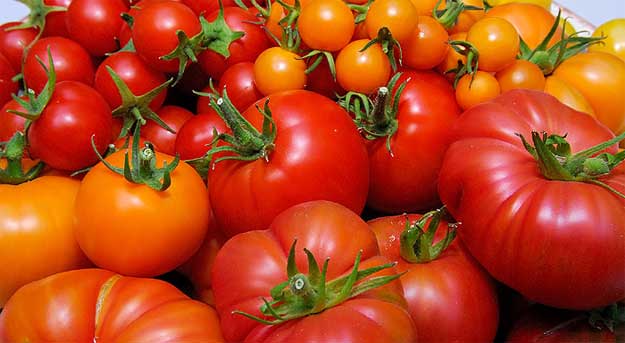
The following article from our “Healthy Summer Series”, in cooperation with the Florida Department of Health, takes a look the healthy benefits of planting your own garden. It’s much easier and more beneficial than you might think. Not only is it a great way to get outside and soak up some vitamin D, it provides you and your family with a wider range of food choices that are just as rich in flavor as they are in health benefits.
Good summer crops in Florida must produce and thrive in muggy, humid and extremely warm weather. When considering a summer garden, it is important to research which fruits and vegetables yield the best results. The following list of fruits and vegetables can be grown during the summer in Florida:
Lima Beans
Recommended varieties: Fordhook 242, Henderson, Jackson Wonder, Dixie (Speckled) Butterpea, Early Thorogreen
When: plant through the summer until September
Eggplant
Recommended varieties: Black Beauty, Dusky, Long, Ichiban, Cloud Nine
When: plant until August
Lima Beans
Recommended varieties: Clemson Spineless, Emerald, Annie Oakley II, Cajun Delight
When: plant until August
Southern Peas (Field Peas, Cow Peas)
Recommended varieties: California Blackeye No. 5, Pinkeye Purple Hull, Texas Cream
When: plant through the summer until September
Peppers
Recommended varieties: Bell: California Wonder, Red Knight; Sweet: Sweet Banana, Mariachi, Cubanelle; Hot: Jalapeño M, Cherry Bomb, Hungarian Hot Wax, Long Cayenne, Habañero
When: Plant starting in July
Sweet Potatoes
Recommended varieties: Centennial, Beauregard, Vardaman
When: plant until July
Watermelon
Recommended varieties: Jubilee (Florida Giant), Crimson Sweet, Sugar Baby, Mickey Lee
When: Plant starting in July
Before planting, do some research on how long it will take your vegetables or fruit to actually grow. It’s best to create a garden plan that includes the name, location, and planting date of each plant. Make a list of supplies and order or purchase your seeds early.
Most Florida soils benefit from the addition of organic matter, such as animal manure, rotted leaves, compost or commercial soil mixes. If you choose not to include organic matter in your soil, adding fertilizer is your best alternative. The amount of fertilizer you should use depends on the type of plant, as well as the soil, so be sure to consult an expert first. Be careful not to add too much fertilizer, as this can result in excess salt accumulation and may damage your plants. Pests ruin perfectly beautiful gardens every day, especially as summer welcomes insects not normally be seen in the fall and spring seasons. These pests include weeds, mites, worms, nematodes and even animals such as raccoons and birds. Though pests, aptly named, are pesky, remember that pesticides aren’t always a smart solution. They can be harmful to people, pets and the natural environment. Some organisms are actually beneficial to your garden, so think twice before you pick up a potentially hazardous pesticide.
The following are several natural alternatives to pesticides:
- Manually pick weeds.
- Monitor each plant carefully twice a week and record observations.
- Plant flowers in your vegetable garden, as they provide nectar and pollen which attracts beneficial insects.
- Learn to identify beneficial insects (praying mantis, spiders, big-eyed bugs/assassin bugs, lady beetles, and all wasps).
- Manually remove larger insects and place them in soapy water to drown.
- Harvest crops such as peppers, squash and beans as soon as they are ripe. Allowing over-ripe fruits to remain on the plants often results in additional insect problems.
In the scorching Florida heat, it is important to always wear sunscreen and stay hydrated while gardening outside for a long period of time.
NorthEscambia.com’s “Healthy Summer Series”, in cooperation with the Florida Department of Health, will take a weekly look at issues aimed at keeping your Florida summer safe and healthy. Information from this article also provided by UF/IFAS Extension.