

Photos: Molino Park Community Helpers Day (With Photo Gallery)
October 10, 2014
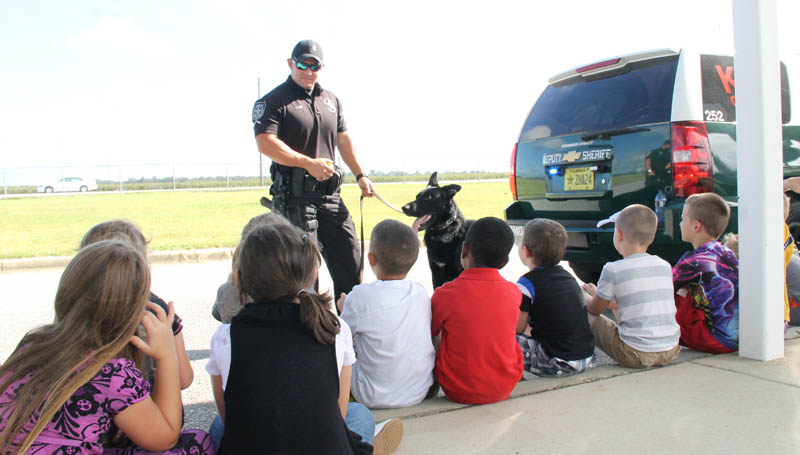
It takes a lot of people, and sometimes a lot of big machines, to keep a community running smoothly.
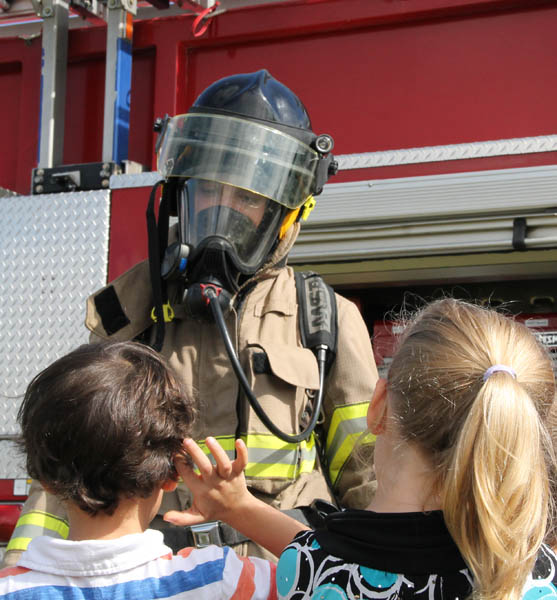 Molino Park Elementary School held a “Community Helpers Day” Thursday for students to learn about some of people that are hard at work, often behind the scenes, in the Molino area.
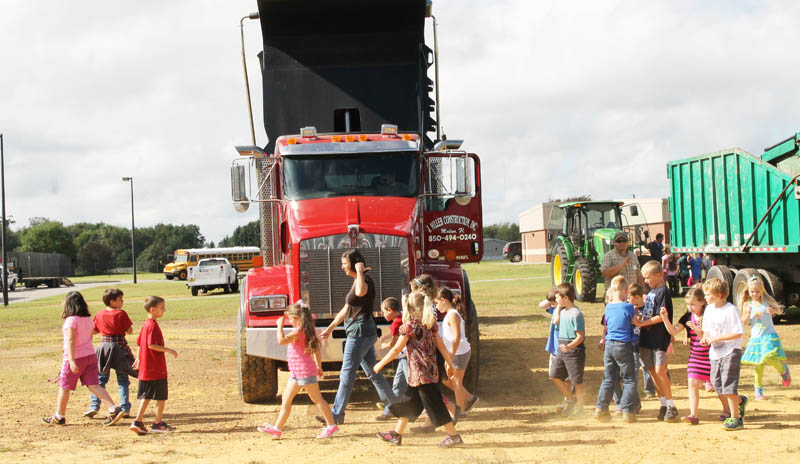
The event includes personnel and equipment from Escambia County EMS, the Escambia County Sheriff’s Office K-9 Unit, the Florida Highway Patrol, the Molino Station of Escambia Fire Rescue, the Florida Division of Forestry, ECUA, J. Miller Construction and Frontier Communications.
Pictured top: Escambia County Deputy Jason Land and his K-9 Edo answer questions Thursday morning during Community Helpers Day at Molino Park Elementary. Pictured: An Escambia Fire Rescue firefighter from Molino’s Station 18 answers questions. Pictured below: Students walk past a dump truck on display from Eli Miller Construction Company. NorthEscambia.com photos, click to enlarge.
Taking A Bite Out Of Hunger: Peanut Butter Drive Underway
October 9, 2014

The Escambia County Extension office, Santa Rosa County Extension office along with the University of Florida Institute of Food & Agricultural Sciences and the Florida Peanut Producer Association are collecting peanut butter now through mid-November to help take a bite out of hunger.
The groups are accepting donations of unopened jars of peanut butter to be donated to local food pantries during Farm-City Week.
Unopened jars of peanut butter of any brand can be dropped off until November 21 at any of the following locations:
Escambia County
- Escambia County Extension Office, 3740 Stefani Road, Cantonment
- Escambia County Farm Bureau, 153 Highway 97, Molino
- Escambia County Public Safety, 6575 North W Street
- Gilmore Services, 31 East Fairfield Drive
Santa Rosa County
- Jay Extension Office at 5259 Booker Lane, Jay
- Santa Rosa County Extension Office at 6263 Dogwood Drive, Milton
- South Santa Rosa Service Center, Master Gardener Help Desk at 5819 Gulf Breeze Parkway
- All Santa Rosa County Library locations
- Lowe’s Stores in Pace and Gulf Breeze
Peanut butter collected in Escambia County last year was donated to food pantries in Molino, Bratt and Century.
Pictured: The Godwins of Godwin Farms in Santa Rosa County, (L-R) Steven, Laryn, Valarie, Kylei, Rachael. Courtesy photo for NorthEscambia.com, click to enlarge.
Local VFW Voices Of Democracy Writing, Speaking Competition Winners Named
October 9, 2014

Northview High School has named winners of their school level VFW Voice of Democracy writing and speaking competition. Winners were (L-R) Alyssa Borelli, second; Mitchell Singleton, first; and Alyssa Bell, third. The three students will now compete for cash prices at the district, state and national levels. Photo for NorthEscambia.com, click to enlarge.
Farmers Learn From Fall Tomato School
October 8, 2014
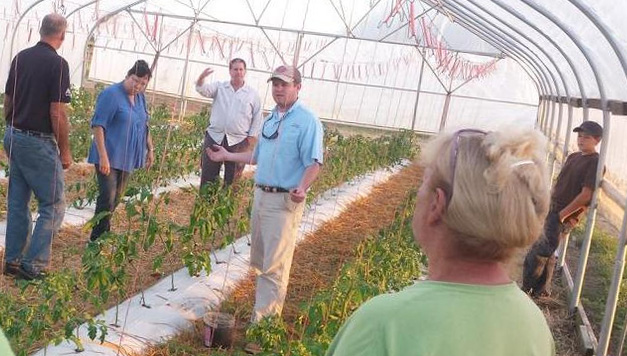
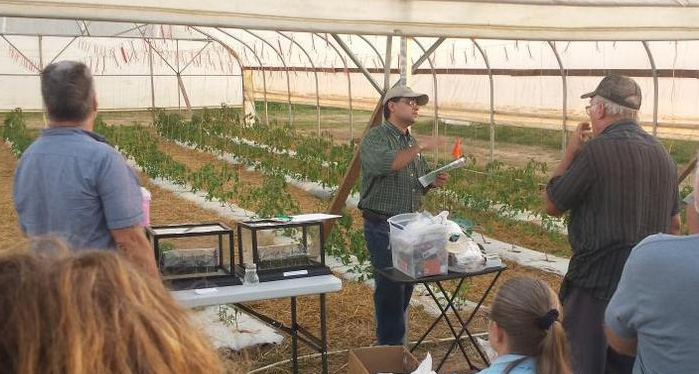
UF/IFAS Extension Gulf Coast Small Farms & Alternative Enterprises held their third installment of “Fall Tomato School” Tuesday in Jay. The workshops were intended for farmers who are interested in learning about small farm tomato production.
The course combined lectures with hands-on activities with a course notebook at the West Florida Research & Education Center in Jay. The school included topics such as transplanting, varieties, nutrition, diseases, staking, insect scouting, harvesting, storage and marketing.
Pictured top: Blake Thaxton, Santa Rosa Extension, explains the importance or trellising in commercial tomato production. Pictured below: Participants learn about pest management. Courtesy photos for NorthEscambia.com, click to enlarge.
Global Corner: Bratt Elementary Students Take Virtual Trip To Kenya
October 6, 2014

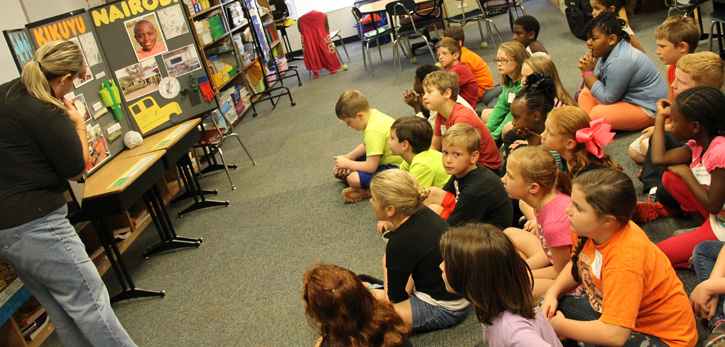
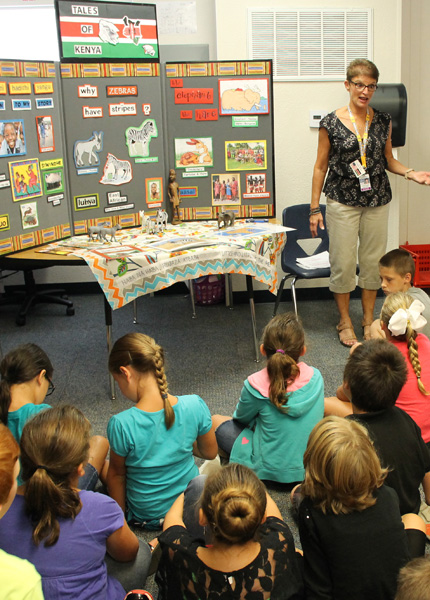 All last week, hundreds of students from Bratt Elementary School took a virtual trip to Kenya, thanks to the Global Corner Learning Center.
The students spent time learning through hands-on activities about the language, arts, culture, geography and more of a unique land half a world away. Each year, The Global Corner teachers take students from their classroom virtually to another country. Through The Global Corner, local students have “visited” Japan, Spain, Egypt, Brazil, Russian, Italy and now Kenya.
The Global Corner “Passport to Kenya” program is scheduled to be at Byrneville Elementary School next week, Molino Park Elementary in November and Jim Allen Elementary in January.
NorthEscambia.com photos, click to enlarge.
Bonus Photos: Northview Homecoming Court
October 5, 2014

Kamryn Brock was name the 2014 Northview High School Homecoming Queen Friday night. Other members of her court were First Runner-up Kendall Cobb, Second Runner-up Jessica McCollough, Freshman Maid Hannah Mascaro, Junior Maid Jadlyn Agerton and Sophomore Maid Morgan Myrick.
For a bonus photo gallery with every court member, click here.
Pictured top: Senior Kamryn Brock reacts to the announcement that she has been name Homecoming Queen. Pictured below: (L-R): Freshman Maid Hannah Mascaro, Junior Maid Jadlyn Agerton, First Runner-up Kendall Cobb, 2014 Queen Kamryn Brock, 2013 Queen Anna Fischer, Second Runner-up Jessica McCollough, and Sophomore Maid Morgan Myrick. NorthEscambia.com photos, click to enlarge.

Chief Spirit: Cheerleaders, Dance Team Photo Gallery
October 5, 2014


For a photo gallery featuring Northview’s cheerleaders and dance team, click here.
NorthEscambia.com photos, click to enlarge.

Weekend Gardening: Time To Plant Those Fall Vegetables
October 5, 2014
by Santa Rosa Extension
The slightest hint of fall is in the air. But this doesn’t mean that the vegetable gardening season is over. Fall is an excellent time to grow cool-season vegetables.
Florida is unique in that we have multiple growing seasons. There is something that can be grown in the vegetable garden all year round. Knowing which vegetables to grow during which season is the key to having a successful harvest.
In the summer, gardeners are somewhat limited in the different types of warm-season vegetables that can be grown and will survive the heat. Now with cooler days approaching, we have a much wider selection of cool-season vegetables to plant.
In September many vegetables can be planted in the garden including beets, broccoli, Brussels sprouts, cabbage, carrots, cauliflower, collards, kale, kohlrabi, leek, lettuce, mustard, onions and radish. In October, you can plant Chinese cabbage, spinach and strawberries.
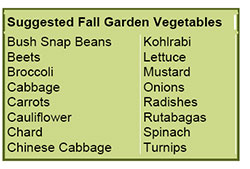 These vegetables are best started from transplants but many can be direct-seeded. If you seed them directly into the soil, keep the ground moist while it’s still warm to give them a good start. Keep them well watered if you transplant, too. The later you start, the smarter it becomes to transplant to cut the time to maturity. Preparing the garden properly is as important as selecting the right plants.
Choose a sunny location. Most vegetables perform poorly in shade. An area that receives at least eight hours of sunlight per day is best. Some vegetables such as broccoli, collards and spinach will tolerate partial shade. Avoid locating your garden near hedges or trees. They not only create too much shade but also compete with the garden for moisture and nutrients.
Locating the garden near the house will make it easier to periodically check the garden for insect pests and disease. And, it is easier to keep an eye on the garden for larger pests such as birds, squirrels and rabbits. Closeness to the house will make it convenient in tending to the garden chores.
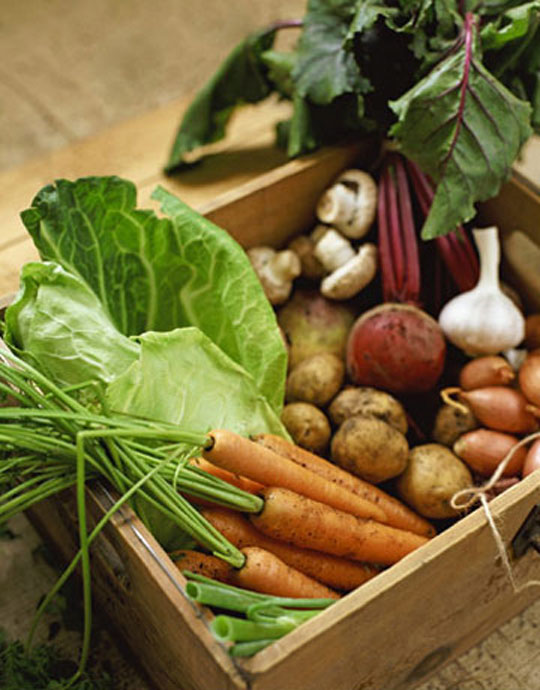 Locate the garden near a water supply so it can be watered as needed. You’ll get only moderate results if you try to grow a garden without supplemental irrigation.
Of course, it’s important to prepare beds properly before planting. To do that, clear the site of all weeds or finished vegetable plants. Turn the soil with a shovel, fork or tiller to a depth of at least 8 inches, and spread a 2-inch to 4-inch layer of organic matter (leaves, grass clippings, aged manure or compost) over the tilled soil. This helps to maintain a high level of organic matter in the soil, which encourages a strong, healthy root system, improves drainage, retains moisture, provides nutrients and promotes vigorous plant growth.
Mix the organic matter thoroughly into the soil. Turn the soil by digging with a shovel, garden fork or a tiller until the materials you’ve added are evenly distributed in the soil. When using fresh organic amendments, it’s best to wait a couple of weeks before planting your transplants or seeds.
By this time of year, insects and diseases have had all summer to build up their populations. Insects such as whiteflies, stink bugs, aphids and caterpillars are commonly seen. Since insect and disease pressure often is greater in the late summer/early fall than in the spring, watch plants carefully for problems and use appropriate control measures promptly when needed. Contact your local Extension Office for control recommendations.
Kamryn Brock Named Northview Homecoming Queen
October 4, 2014

Kamryn Brock was name the 2014 Northview High School Homecoming Queen Friday night. Other members of her court were First Runner-up Kendall Cobb, Second Runner-up Jessica McCollough, Freshman Maid Hannah Mascaro, Junior Maid Jadlyn Agerton and Sophomore Maid Morgan Myrick.
Pictured top: 2013 Homecoming Queen Anna Fischer crowns Kamryn Brock as the 2014 Northview High School Homecoming Queen. Pictured below (L-R): Freshman Maid Hannah Mascaro, Junior Maid Jadlyn Agerton, First Runner-up Kendall Cobb, Queen Kamryn Brock, Second Runner-up Jessica McCollough, and Sophomore Maid Morgan Myrick. NorthEscambia.com photos, click to enlarge.

Jim Allen Pre-K Students Learn About Fire Safety
October 3, 2014
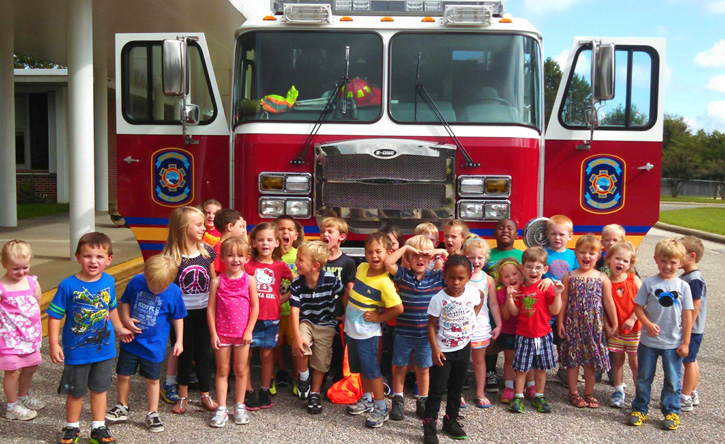
Pre-K students at Jim Allen Elementary School learned about fire safety Thursday morning, thanks to the Cantonment Station of Escambia Fire Rescue. The “B-watch” crew from the station’s Engine 4 — Lt. Chapman, firefighter Diamond and firefighter Schwarz — conducted the safety program. Photo for NorthEscambia.com, click to enlarge.