

Escambia County Back To School Immunization Information
August 3, 2013
The Escambia County School District is reminding parents that students need to be up-to-date on their immunizations before the first day of school.
Before attending school in Florida, students enrolling in kindergarten through 12th grade are required to be current on all their immunizations. In addition, seventh grade students are required to have a Tdap booster vaccine before starting school on August 19.
Students who have medical insurance that will cover vaccinations should see their private provider, according to the school district.
Students who do not have health insurance coverage for immunizations may receive free vaccinations at the Escambia County Health Department at one of the locations listed below. Vaccinations are by appointment only.
- 1295 W. Fairfield Drive, (850) 595-6554
- 8390 North Palafox Street, (850) 484-5151
For additional information or to schedule an appointment, contact the Escambia County Health Department at one of the listed numbers.
Fans Attend America’s Got Talent Going Away Party For Chloe Channell
August 3, 2013

 A going-away party for “America’s Got Talent” contestant Chloe Channell was held Friday night at the Pace Community Center.
The 11-year old will perform live from Radio City Music Hall in the quarterfinals of the NBC series in the coming weeks. She was not listed as one of the acts scheduled to perform next Tuesday, meaning she will appear during the 8 p.m. show on August 13 or August 20.
Friday night, Chloe received going away presents from friends and family. Fish dinners were available to help the family with expenses, and Chloe had the chance to meet with her fans and sign autographs.
Pictured: “Amercia’s Got Talent” contestant Chloe Channell at a party in her honor Friday night in Pace. NorthEscambia.com photos by Kristi Smith, click to enlarge.






Florida Gov’t Weekly Roundup: An Outrageous Summer In Tallahassee
August 3, 2013
Outrage has become the latest trend during the long, hot summer days in Tallahassee.
 Democrats found themselves outraged over the past actions of now-former Education Commissioner Tony Bennett, who was himself outraged at “politically motivated” reports about grading policies in Indiana. The Rev. Jesse Jackson stopped by to express his outrage during protests aimed at overhauling the state’s self-defense laws and other policies.
And Jackson’s comments — where he seemed to compare Florida to Selma and South Africa, and Gov. Rick Scott to George Wallace — drew well over a dozen statements of outrage from Republicans.
By the end of the week, it seemed that many people in the Capitol could use something to help them calm down. And John Morgan was more than happy to help.
UNTIL YESTERDAY
In less than eight months on the job, Bennett had already shown a flair for the ambitious. He continued work to put the national “common core” education standards in place. He began work on a reorganization of the Department of Education. And instead of waiting for poor school grades to be unveiled — a mistake that tripped up his predecessor, Gerard Robinson — Bennett acted to curb the damage when superintendents first raised warnings of a possible public-relations disaster.
 But it was something from Bennett’s past that took less than a week to end his time as the top education official in Florida.
On Monday, an Associated Press report out of Indiana said that Bennett, while the elected superintendent of public instruction in that state, and his employees “frantically overhauled” the Hoosier State’s school-grading system in 2012 in a way that benefited one of Bennett’s political contributors.
The changes came after state officials realized that Christel House, a school founded by Christel DeHaan, might get a grade as low as a “C” in the first edition of state report cards to use the letter-grade system. As a superintendent fighting for strong accountability measures, Bennett had touted Christel House’s success.
“They need to understand that anything less than an A for Christel House compromises all of our accountability work,” Bennett wrote in one email obtained by the AP.
Bennett defended himself Tuesday, saying Christel House’s grade raised legitimate concerns about the grading system in Indiana. While the AP reported that the emails it obtained pointed to algebra results as part of the problem, Bennett said education officials figured out it was largely because Christel House’s high school and 12 others hadn’t yet added an 11th or 12th grade.
The rule governing grades in Indiana, though, required graduation rates to be included in high school grades.
“That calculation unfairly penalized those 13 schools,” Bennett said during the 40-minute conference call. “We found that and we fixed that in order to give a true, transparent grading model for Indiana schools.”
By that point, some Democrats already sensed blood in the water. A trio of lawmakers called Wednesday for Bennett to resign, including a pair of House members who held a conference call to pressure the commissioner.
“I think we deserve to know if he’s brought his pay-to-play tactics to Florida also,” said Rep. Janet Cruz, D-Tampa, even as she conceded that there was no evidence that he had.
The next day, Bennett’s detractors got their wish. Saying he didn’t want to be a distraction, Bennett resigned Thursday even as he continued to defend his actions. He stepped aside despite reported pressure from Scott and State Board of Education Chairman Gary Chartrand to stay.
“The decision to resign is mine and mine only because I believe that when this discussion turns to an adult we lose the discussion about making life better for children,” Bennett said.
Bennett became at least the 11th department head hired during Scott’s term to have resigned; the governor is also on his third chief of staff and is still looking for a replacement for Lt. Gov. Jennifer Carroll. The next education commissioner, who will technically be selected by the State Board of Education, will be the fourth permanent head of the agency to serve under Scott.
The turmoil has fueled calls for the state to go back to electing its schools chief.
“For more than a decade the office has been relegated to a political appointment, and as we have just seen, is subject to the latest political whims,” said Florida Education Association President Andy Ford. “The appointed commissioner is not accountable to parents, not accountable to students, not accountable to educators and not accountable to taxpayers.”
On Friday, the board tapped Pam Stewart to serve as interim education commissioner, a job she held before Bennett was hired in December.
STILL STANDING THEIR GROUND
Meanwhile, a sit-in at Scott’s office aimed at sparking a special session to review the state’s self-defense laws neared the three-week mark with no signs of dissipating. Scott returned to the Capitol on Monday, but largely maintained a busy travel schedule that has kept him out of the office for most of the sit-in.
The governor did not meet with the protesters, but they did get a couple of visitors. One was unlikely; Rep. Halsey Beshears, R-Monticello, stopped by despite disagreeing with the protesters on whether the state should call a special session to review the controversial “stand your ground” law.
Beshears said that any review could wait until the Legislature comes back for its regularly scheduled session in 2014.
“I agree with ’stand your ground,’ it’s a good law,” Beshears said. “I think it has great intention. I disagree with the application in some cases. But like any good law, there is always some bad applications, but they’re very minor.”
Scott has said repeatedly that he will not call a special session to appease the protesters, who also want the state to end zero-tolerance discipline policies in schools and approve initiatives to combat racial profiling.
The protesters began the part-vigil, part-siege protest after George Zimmerman was acquitted of second degree murder in the 2012 shooting death of 17-year-old Trayvon Martin. The law was not used as part of Zimmerman’s defense, but has become associated with the incident.
On Tuesday, the Dream Defenders, a group leading the protest, got a visit from a higher-profile figure and a veteran of the civil-rights movement: the Rev. Jesse Jackson.
Jackson invoked Selma in remarks to reporters, telling them that “massive non-violent resistance” was justified until Florida changed its behavior. And he seemed undaunted by Scott’s repeated insistence that the governor has no intention of calling the special session.
“We hope that the moral appeal and the urgency of the matter will change his mind,” Jackson said. “We’ve seen Southern governors before have to change their minds.”
Jackson listed infamous segregationist George Wallace, a former governor of Alabama, as one of those officials who had to change his mind. Combined with the Selma remark and an earlier reported comment calling Florida an “apartheid state,” Jackson set off a firestorm.
Scott didn’t address the Wallace slam, but demanded Jackson apologize for the Selma and South Africa comparisons. Jackson refused, drawing another statement from Scott.
“It’s disappointing that Jesse Jackson refused to apologize yesterday for his insulting and inflammatory comments about Floridians. Instead, he doubled down on his divisive and reckless remarks,” Scott said.
Other members of the GOP also kept up the pressure, with the Republican Party of Florida sending out daily emails with new lists of lawmakers making sure that the press was aware of their outrage. One of the first to speak out, though, was Pensacola Rep. Mike Hill, the only black Republican in the Legislature.
“When Jackson uses language that describes us as an apartheid state and compares our governor to one of history’s most notorious bigots, he is either hopelessly out of touch or purposefully dishonest,” Hill said.
By the end of the week, the ground seemed to be moving ever so slightly, but not in a way that indicated action. House Minority Leader Perry Thurston, D-Fort Lauderdale, issued a formal request for a special session, though it was exceedingly unlikely that Thurston’s effort would lead to lawmakers being called back to Tallahassee. And House leaders said they would hold a hearing on the law, though the panel’s chairman made it clear he didn’t favor a change.
The protesters weren’t satisfied.
“Ultimately you’re still ignoring the root of the issue, at least in terms of the Zimmerman verdict, and that is the criminalization of our youth, the way that young people are looked at in Florida, black, white and brown, and that’s due to the school-to-prison pipeline and racial profiling that’s perpetuated throughout law enforcement,” Dream Defenders Political Director Ciara Taylor said.
HEMP VOTES
The week was not all about anger. Orlando attorney John Morgan — whose personal-injury firm employs former Gov. Charlie Crist — traveled to Tallahassee on Thursday to pitch his plan to legalize medical marijuana. He told the Capital Tiger Bay Club that he learned about the magic weed’s therapeutic power when his father was dying of esophageal cancer 20 years ago.
“I know it works because I have seen it,” Morgan said. “Are we going to do what’s right, or are we going to get hung up on the word ‘drug?’ ”
The attorney denied his efforts had anything to do with the possible political future of Crist, a Republican-turned-independent-turned-Democrat who could be on the ballot in 2014, when Morgan hopes voters will decide the future of cannabis.
Others weren’t so sure. Susan MacManus, a political science professor at the University of South Florida, said putting hot-button issues on the ballot as constitutional amendments can mobilize potential supporters.
“And that’s why, historically in Florida, both parties have often turned to some of these kinds of issues to get non-traditional voters — and we’re spelling out here, young voters — to the polls,” she said.
STORY OF THE WEEK: Education Commissioner Tony Bennett resigns after reports that he altered the school grading formula in Indiana in a way that benefited a school founded by a political contributor.
QUOTE OF THE WEEK: “I don’t intend to move one damn comma on the ’stand your ground’ law.”–Rep. Matt Gaetz, R-Fort Walton Beach, chairman of the House Criminal Justice Subcommittee, which will review the law.
By Brandon Larrabee, The News Service of Florida
Back To School: Supply Lists
August 3, 2013

School starts Monday, August 19 in Escambia and Santa Rosa counties. Here are the school supply lists from each elementary school and middle school in Escambia County, plus the North Escambia area schools in Santa Rosa County.
(High schools typically do not have a general supply list. Students are advised of their supply needs in each class.)
North Escambia Area Schools:
- Bratt Elementary
- Byrneville Elementary (not yet available)
- Central School
- Chumuckla Elementary
- Ernest Ward Middle
- Jay Elementary
- Jim Allen Elementary
- Lipscomb Elementary
- McArthur Elementary
- Molino Park Elementary
- Pine Meadow Elementary
- Ransom Middle
Complete Escambia County Lists:
ELEMENTARY SCHOOLS
- Bellview Elementary
- Beulah Elementary
- Blue Angels Elementary
- Bratt Elementary
- Brentwood Elementary
- Byrneville Elementary (not yet available)
- Cook Elementary
- Cordova Park Elementary
- Ensley Elementary
- Ferry Pass Elementary
- Global Learning Academy
- Hellen Caro Elementary
- Holm Elementary
- Jim Allen Elementary
- Lincoln Park Elementary
- Lipscomb Elementary
- Longleaf Elementary
- McArthur Elementary
- McMillan Pre-K
- Molino Park Elementary
- Montclair Elementary
- Myrtle Grove Elementary
- Navy Point Elementary
- Oakcrest Elementary
- Pine Meadow Elementary
- Pleasant Grove Elementary
- Scenic Heights Elementary
- Semmes Elementary
- Sherwood Elementary
- Suter Elementary
- Warrington Elementary
- Weis Elementary
- West Pensacola Elementary
MIDDLE SCHOOLS
- Bailey Middle
- Bellview Middle
- Brown Barge Middle
- Ernest Ward Middle
- Ferry Pass Middle
- Ransom Middle
- Warrington Middle
- Woodham Middle
- Workman Middle
Wahoos Pound Barons 16-8
August 3, 2013

The Blue Wahoos bats awakened in the first trip to Regions Field to the tune of a franchise-record 16 runs in a 16-8 win over the Birmingham Barons on Friday night. In addition to setting the franchise record for runs scored, Pensacola also broke the franchise record with 17 hits.
Pensacola fell behind early in the contest on a second-inning homer from Dan Black but responded in a big way in the third inning. Facing Scott Carroll, a minor league rehabber, the Wahoos put up five runs in the third inning. All five runs scored with two outs as Yorman Rodriguez smashed a two-run bases loaded double to right before Donald Lutz launched a three-run homer to right to make it 5-1. For Lutz, it was his first homer since April 21 for Pensacola.
Birmingham responded with a solo homer from former Wahoo Cody Puckett in the last of the third before taking the lead in the fourth with a five-spot of their own to take a 7-5 lead. All five runs were charged to starter Jon Moscot, who in his Double-A debut, gave up seven runs on seven hits in 3+ innings. Chris Manno came on to restore order with three scoreless frames, improving to 3-2 on the year.
Trailing 7-5 heading to the fifth, Pensacola put up 10 runs over the next three frames. In the fifth, Mike Costanzo’s two-run, two-out double tied the game up at seven. An inning later, Devin Lohman brought home another pair of runs with a two-out single that doubled the lead to make it 9-5.
The Wahoos blew the game open in the seventh inning, batting for the cycle as a team. Pensacola scored six runs on seven hits, including four doubles, a triple, and homer. Travis Mattair drove home two with a triple, Brandon Short and Ryan LaMarre brought home a run with doubles and Lohman capped things off with a two-run blast, his seventh of the season.
The teams traded runs in the last of the eighth and top of the ninth to account for the final two runs of the contest.
All nine hitters recorded at least a hit and scored a run in the offensive outburst while seven players recorded an RBI. Lohman (3-for-5, 2 R, 4 RBI) led the charge along with five other players that record multi-hit games: Costanzo (2-for-4, R, 2 RBI), Rodriguez (2-for-6, R, 2 RBI), Lutz (2-for-6, 2 R, 3 RBI), LaMarre (2-for-4, 2 R, RBI), and Chang (3-5, 3 R).
J.R. Ballinger (1-1) took the loss for Birmingham, allowing five runs on four hits with three walks in an inning and a third. Caroll received a no-decision despite allowing five runs on five hits in 3.1 frames.
The Blue Wahoos remain four games back of the Jacksonville Suns, with each of the South Division foes picking up wins on Friday night. Pensacola and Birmingham battle again on Saturday night from Regions Field. Daniel Renken (5-7, 3.37) gets the ball for Pensacola against Birmingham’s Stephen McCray (9-7, 3.49). First pitch is scheduled from 6:30 p.m.
story by Kevin Burke
Florida Names Interim Education Commissioner After Resignation
August 3, 2013
The State Board of Education quickly installed Public Schools Chancellor Pam Stewart as interim education commissioner Friday, returning her to the post she held before Tony Bennett was tapped for the permanent job late last year.
 Bennett resigned Thursday in the wake of reports that, while the elected superintendent of public instruction in Indiana, he tweaked that state’s school grading system to benefit a school founded by one of Bennett’s political contributors.
The board unanimously backed Stewart during a conference call, even as some members lamented the loss of Bennett.
“I can assure you that I did everything possible to convince Tony Bennett to stay on with us,” board Chairman Gary Chartrand told the group.
Another member, Kathleen Shanahan, said the board should begin looking at its accountability system and its commitment to a multi-state consortium developing a new test for students, following Bennett’s decision to step aside.
“It’s a mess, and I think a mess provides an opportunity,” Shanahan said.
Legislative leaders had called for the state to pull out of the exam shortly before Bennett’s resignation. Meanwhile, Democrats and the Florida Education Association called for the state to go back to choosing its education commissioner in statewide elections.
“For more than a decade the office has been relegated to a political appointment, and as we have just seen, is subject to the latest political whims,” FEA President Andy Ford said in a statement backing the proposal. “The appointed commissioner is not accountable to parents, not accountable to students, not accountable to educators and not accountable to taxpayers.”
Jail Transfer Meeting Rescheduled
August 2, 2013
The next meeting concerning the transfer of control of the Escambia County Jail from Sheriff David Morgan to Escambia County will be open to the public.
The joint meeting between Escambia County and the Escambia County Sheriff’s Office that was originally scheduled for Monday, August 5 to continue negations for the transfer of the Jail and Central Booking operations, has been rescheduled to Wednesday, August 7, at 10 a.m. The workshop will be held at 221 Palafox Place in the fourth floor training room within the Escambia County Administration office. This meeting will have limited space and is open to the public.
Teens Arrested For Cantonment Vehicle Burglaries
August 2, 2013
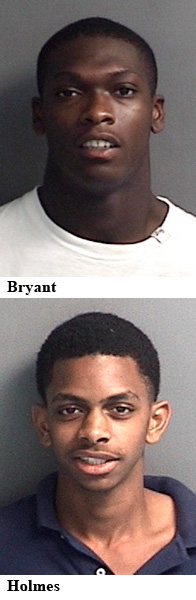 Two juveniles have been arrested in connection with at least four vehicle burglaries in Cantonment.
During the early morning hours Thursday, the Escambia County Sheriff’s Office received a call reporting that a vehicle burglary had just occurred and the victim was chasing the suspects down the road. Deputies arrived in the 1800 block of Wareham Way in Cantonment where a resident advised that the victim had chased the suspects in the direction of Highway 297A.
One of the suspects, 17-year old Marquis Derrell Byrant, was quickly apprehended. Two K-9 units were used to track the second suspect, leading the arrest of 17-year old Lakendrick Jiles Holmes.
An Escambia County Sheriff’s Office revealed the duo was responsible for at least three other vehicle burglaries.
Bryant and Holmes were charged with four counts of burglary of vehicle and larceny. Holmes was also charged with possession of marijuana.
Education Boss Bennett Resigns Amid Grade Changing Scandal
August 2, 2013
Saying he didn’t want to be a distraction, Florida Education Commissioner Tony announced his immediate resignation Thursday amid a rapidly growing controversy stemming from his former job heading the Indiana education system.
Bennett, who during a news conference at the Department of Education called media reports out of the Hoosier State “politically motivated,” said Gov. Rick Scott and Florida Board of Education Chairman Gary Chartrand accepted the resignation.
“The decision to resign is mine and mine only because I believe that when this discussion turns to an adult we lose the discussion about making life better for children,” Bennett said.
Declaring that Bennett’s resignation “created an immediate danger to public welfare,” the Board of Education scheduled an emergency conference call Friday morning to appoint an interim commission.
Both Bennett and Scott recommended that Pam Stewart, chancellor of public schools, be named interim commissioner.
Stewart served as interim commissioner before Bennett was hired in December, a month after he lost a bid to be re-elected as Indiana’s superintendent of public instruction. Voters choose the Indiana superintendent, while Florida’s education commissioner is appointed.
Scott praised Bennett for helping with the governor’s legislative priority this past session of raising pay for teachers.
“He made a difficult decision today with the best interest of his family in mind, and he will no doubt continue to make a great contribution wherever he chooses to serve next,” Scott said in a release.
Bennett was the third education commissioner to serve since Scott was inaugurated in January 2011.
Bennett, who had no immediate plans for the future outside of a weekend with his family, said he made his decision so Scott, taxpayers, teachers and students wouldn’t be distracted by “the malicious, unfounded reports out of Indiana.”
Bennett has been engulfed in recent days in a controversy about whether he improperly changed a school grade to benefit a political contributor while he was Indiana’s education chief.
“Every minute we spend defending the credibility of your commissioner, because of what is said 800 miles away, is a minute we waste that we should have been thinking about educating children in Florida,” Bennett said.
During the news conference, Bennett reiterated his contention that he had done nothing wrong and he would request Indiana’s inspector general to investigate the allegations.
“I am fearless about what they will find,” Bennett said.
While running the Indiana schools, Bennett was noted for following the educational blueprint former Gov. Jeb Bush implemented in Florida, from the A-to-F grading system to expanding charter schools and voucher programs.
Bush on Thursday issued a statement that praised Bennett for his work in Indiana.
“Today, more Hoosier kids are graduating high school ready for college or a career and fewer are dropping out,” Bush said. “Last year, the parents of nearly 10,000 children in low-income homes were able to select the school that best fit their son or daughter. Leadership is doing what is right, knowing the results will follow.”
Patricia Levesque, chief executive officer of Bush’s Foundation for Excellence in Education, in the same release called Bennett “a good man and a good friend. Florida’s students will feel the loss of his leadership the most.”
Bennett’s downfall played out quickly in Florida.
The Associated Press, after obtaining candid emails between Bennett and his Indiana staff, reported Monday that Bennett and his staff “frantically overhauled” the Hoosier State’s grading system last year when it looked like one of his political contributors’ charter schools might get a “C.”
Bennett said Thursday there was a “statistical anomaly that didn’t allow 13 schools . . . to have their grade truly reflect their performance because they were unfairly penalized for kids they didn’t have in their school. That wasn’t rigging anything.”
On Thursday, the Indianapolis Star reported that Indiana wouldn’t have had to take over a pair of Indianapolis public schools if similar changes were offered to local district schools. The charter school alleged to have received favored treatment is called Christel House.
“The issue was similar in both cases,” the Star reported. “Christel House had recently added ninth and 10th grades, and (Indianapolis Public Schools’) Howe and Arlington had added middle school grades. The students who filled those seats posted poor enough scores to drag down the schools’ overall ratings.”
The AP reported that Bennett acted to improve the grade of Christel House, raising the school from a C to an A by removing the ninth- and 10th-grade scores. The Star wrote that the local public-school superintendent asked Bennett to remove the middle school scores, allowing the schools to avoid a state takeover, but “Bennett was unmoved.”
Teachers unions in Indiana have demanded an investigation of the A-to-F rating system, the Star reported.
Last month, in advance of the release of Florida school letter grades, the Florida board of education voted 4-3 to back a recommendation by Bennett to prevent drops of more than one letter grade due to changes to the accountability system.
Without the changes, state officials said, 261 schools would have received failing grades this year.
A trio of Democratic lawmakers on Wednesday, Sen. Dwight Bullard, D-Miami, and Reps. Mark Pafford, D-West Palm Beach, and Janet Cruz, D-Tampa, called on Bennett to resign due to the Indiana reports.
Florida Education Association President Andy Ford wrote Thursday that Bennett’s policies have had no value in advancing education.
“The resignation of Florida’s latest commissioner of education is another symptom of the mistrust parents, teachers and the public have in the state’s incoherent and unsound school reform and accountability policies,” Ford wrote.
by Jim Turner, The News Service of Florida
Investigators Seek Person Of Interest In Monday Homicide
August 2, 2013

The Escambia County Sheriff’s Office is searching for a person of interest in a Monday homicide.
Investigators want to locate 36-year old Larry Huff for questioning in the July 29 homicide of 57-year old Jeffrey Weber, who was found in a room at the Homestay Lodge on Mobile Highway. Weber’s body was discovered by a hotel employee after he did not answer his door.
Anyone with information on the whereabouts of Larry Huff is asked to call he Escambia County Sheriff’s Office at (850) 436-9620 or Crime Stoppers at (850) 433-STOP.
Pictured: Two different looks for LarryHuff, as seen in photos provided by the Escambia County Sheriff’s Office for NorthEscambia.com.