

Free Longleaf Pine Seedlings Wednesday In Walnut Hill And Century
January 13, 2015
Free pine seedlings and a little expert advice will be available today n Walnut Hill and Century.
 The Florida Forest Service will sponsor two Arbor Day events on Wednesday. New Escambia County Forester Cathy Hardin will distribute free longleaf pine seedlings at the Walnut Hill Substation in the morning and at the Century Chamber of Commerce in the afternoon. Information will be available on services provided by the county forester and the Florida Forest Service for private landowners.
From 9:30 to 11:30 a.m., the Hardin will be in Walnut Hill at the UF-IFAS substation located at 7850 Highway 97, just north of Ernest Ward Middle School and in front of the Ruritan Building. Hardin will be at the Century Chamber of Commerce from 1 to 3 p.m. at 7811 North Century Boulevard.
In addition to tree seedlings, there will be brochures on services for both urban and rural land owners including the current Cogongrass grass treatment program.
Man Sentenced In ‘Large Scale’ Local Cocaine Trafficking Ring
January 13, 2015
Another member of what federal prosecutors called a “large scale” local cocaine trafficking organization has been sentenced to federal prison.
 Victor Darnell Rome, age 36 of Escambia County, was sentenced by Chief United State District Judge M. Casey Rodger to 280 months in federal prison and 10 years of supervised probation following his release.
Rome’s indictment was part of a continuing investigation into a large scale distribution network that involved the transportation of cocaine from Texas into the Northern District of Florida. Rome’s co-conspirators Coneil T. Wilkins and Ricky L. Blankenship were sentenced last year. Wilkins was sentenced to 35 years in federal prison for his role in the distribution of approximately $20 million worth of cocaine in Pensacola, and Blankenship was sentenced to life imprisonment for related drug trafficking offenses.
United States Attorney Marsh praised the work of the Drug Enforcement Administration (DEA), the Bureau of Alcohol, Tobacco, Firearms and Explosives, the Escambia County Sheriff’s Office, the Pensacola Police Department, and the State Attorney’s Office for the 1st Judicial Circuit, whose joint investigation led to the indictments.
“I commend our federal, state, and local law enforcement partners for their commitment to public service and community safety,” said United States Attorney Marsh. “This teamwork has resulted in the dismantling of a multi-year criminal conspiracy and demonstrates how the collaboration of all levels of government helps to protect the Northern District of Florida from dangerous drugs.”
ECUA: 97% Of New Santa Rosa Customers Now Have Their Cans
January 13, 2015
After getting off to a rough start, the Emerald Coast Utilities Authority reported Monday that cans have now been delivered to most of their new customers in northern Santa Rosa County.
 Can delivery to new residential sanitation customers in the north end of Santa Rosa County reached the 97% level, following a continued non-stop delivery schedule by ECUA’s contractor, ECUA crews, and the assistance of a second can delivery contractor.
“Today’s deliveries are focused on customers who signed up for service last Thursday, Friday, or Saturday, and as such, curbside collection of bags is now discontinued,” ECUA public information officer, Nathalie Bowers, ECUA public information officer, said. “All customers who signed up before January 9 should have their cans, barring an error in the account set-up or delivery process. If not, we are asking these customers to please call our Customer Service Center at 476-0480 and advise us of their status.”
ECUA took over most residential trash pickup in Santa Rosa county north of the Yellow River on January 1. Residents that have not yet signed up for the service may do so by calling ECUA at (850) 416-0480.
Flu Impacting Blood Donations; Healthy People Urged To Donate Now
January 13, 2015
Officials say the flu is staring to impact the local blood supply.
 The blood center is experiencing fewer donors at various organizations that hold blood drives and are told many of the people who usually donate are out sick with the flu.
Blood donors who are battling the influenza virus are not able to donate until they are well. The blood center is urging all blood donors who are healthy to please donate now while they are feeling well.
While all blood types are needed, there is an increased need for O Negative type blood. Anyone with O Negative blood is encouraged to donate as soon as they can. O Negative is the universal blood type which means it can be given to any patient regardless of the recipients’ blood type. Trauma patient, cancer patients and premature babies are primary recipients of O Negative blood.
Generally healthy people age 16 or older who weigh 110 pounds can donate blood. All blood donors will receive a wellness checkup of blood pressure, pulse, temperature, iron count and a cholesterol screening.
Suspect Arrested After Manhunt North Of Atmore
January 12, 2015
A manhunt north of Atmore Monday morning for a burglary suspect ended with the capture of one suspect.
 Escambia County (AL) Chief Deputy Mike Lambert said someone broke into the Wayside Grocery, just over a mile north of the G.K. Fountain Correctional Facility. Upon arrival the arrival of deputies, the suspect fled on foot.
A manhunt followed, involving officers from the Escambia County (AL) Sheriff’s Office, the Poarch Creek Tribal Police Department and a K-9 team from Fountain Correctional. The man was taken into custody later Monday morning without any additional incident.
Further details, including the name of the suspect, were not available.
Building People: Tate Senior Millet Earns Eagle Scout Rank
January 12, 2015
Tate High School senior Ethan Millet has obtained the rank of Eagle Scout, the highest rank in the Boy Scouts of America, and was honored with a proclamation recently from the Escambia County Commission.
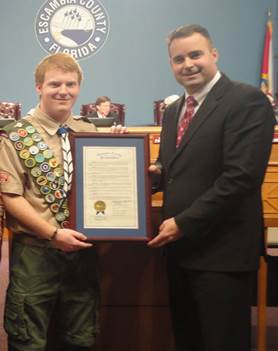 For his Eagle Scout project, Ethan wanted to do something different while giving back to the community. After considering numerous project ideas, he reached back into his experiences at “Joe’s Place”, the Pensacola United Methodist Community Ministries, at his family’s church, St. Luke United Methodist, and decided to distribute personal hygiene kits to needy person in the community.
“We always think about Eagle Scout projects as building something, stepping out and building some tangible thing,” Escambia County Commissioner Doug Underhill said upon presenting the resolution to Ethan. “Ethan’s project was a little unique in that he chose to build people.”
The care kits included a small bag with essential hygiene items, tissue paper, canned foods and water. He set out to make 100 of the kits, but thanks to generous donations was able to distribute just over 200.
“Seeing the joy on their face was probably my favorite part of it,” he said about the care kit distribution. “I remember one man. He grabbed his bag ‘yes, I got it’….he was just so joyous about it; it really made my day to see that.”
Ethan first joined Pack 415 as a Tiger Cub when he was in first grade back in 2003. He earned 32 individual merit badges on his way to becoming an Eagle Scout.
Pictured: Escambia Commissioner Doug Underhill presents a proclamation to Eagle Scout Ethan Millet. Courtesy photo for NorthEscambia.com, click to enlarge.
Six Homeless After Halfway House Destroyed By Fire
January 12, 2015

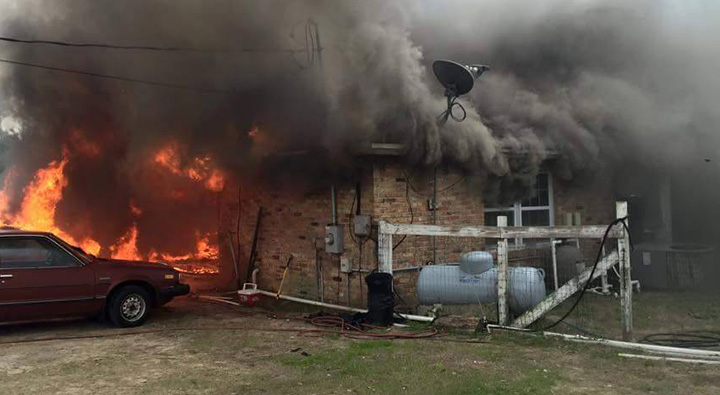
An Escambia County halfway house was heavily damaged by fire Sunday afternoon.
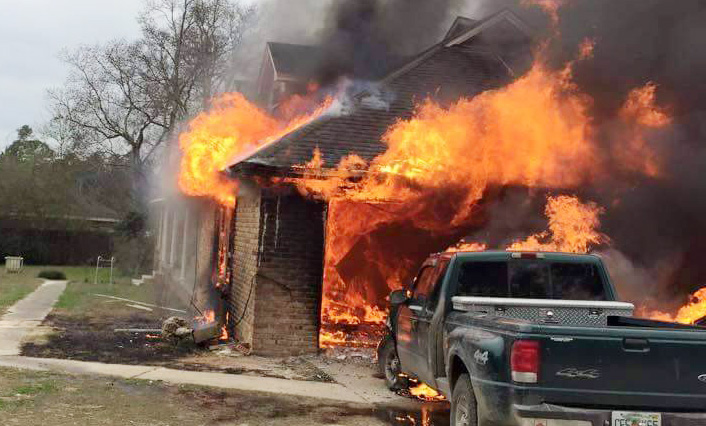 The fire was reported just after noon in the 7300 block of Pine Forest Road, near Five Flags Speedway. Six adults were displaced by the fire, but there were no injuries reported.
A majority of the fire damage was contained to the garage area of the home; two vehicles were also destroyed by the fire.
The cause of the blaze is under investigation by the Florida State Fire Marshal’s Office.
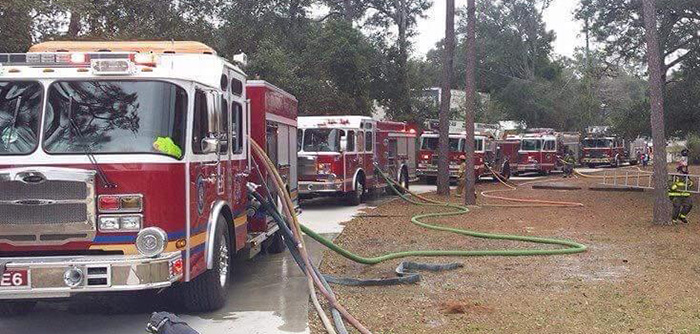
The Ensley, Osceola, Bellview, Brent, Warrington and Beulah stations of the Escambia Fire Rescue battled the blaze, along with the Pensacola Naval Air Station Fire Department.
Photos courtesy Escambia County Professional Firefighters for NorthEscambia.com, click to enlarge.
Lane Closures Planned For I-10 In Escambia County
January 12, 2015
 The right lane of eastbound I-10 near the Scenic Highway overpass at exit 17 in Escambia County will be closed from 7 p.m. to 6:30 a.m. Tuesday, January 13, through Friday, January 16. The nightly closures will allow crews to position large beams for a new Scenic Highway overpass.
In addition, traffic in the left lane of I-10 will be slowed by Florida Highway Patrol escort vehicles between the hours of 12 a.m. and 5 a.m. Drivers should anticipate travel delays during this time.
All planned construction activities are weather dependent and may be re-scheduled in the event of inclement weather.
Four Appointed To Escambia Extension Council
January 12, 2015
Four people have been reappointed to the Escambia County Extension Council.
They are Jean E. Yarter of McDavid, David W. Fitzpatrick of Molino, Tina Lynn Sellers of Pensacola and Genevieve English-Charles of Pensacola. Each will serve through November 30, 2016.
The Extension Council is comprised of members of zones across the county that have an interest or concern in agricultural, family and consumer sciences (home economics), and youth programs of extension; in developing the rural and urban sections; and in developing the county and its resources.
Members may serve a maximum of two consecutive two-year terms before rotating off and must off the council for one two-year term before becoming eligible to serve again.
Man Charged With Murder Following Sunday Night Shooting
January 12, 2015
A Pensacola man was arrested this morning and charged in connection with a fatal shooting that occurred Sunday night.
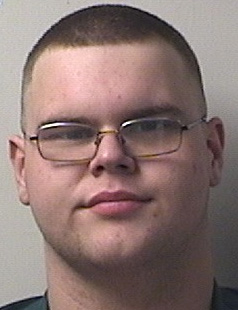 Nicholas A. Nehring, 23, of the 3300 block of Adrian Road is being held without bond in the Escambia County Jail on an open count of murder.
The victim has been identified as Joseph E. Ross, 26, of Pensacola.
Pensacola Police Department Lt. Chuck Mallett said Nehring was taken into custody as he was leaving his house. Several firearms, including what is believed to be the murder weapon were recovered. Mallett said the shooting, which remains under investigation, is believed to be drug related.
The shooting was reported to police at 8 p.m. Sunday and occurred behind the Corner Store, 3818 North Ninth Ave. Upon arrival, officers found Ross lying on the ground. Nehring was developed as a suspect during the investigation.
Anyone with information on the shooting is asked to call the Pensacola Police Department at (850) 435-1900.