
Complete Escambia Primary Election Results
August 31, 2016

With all precincts reporting primary winners from Tuesday in Escambia County are:
US Senate: Marco Rubio
Congress: Matt Gaetz
Senate: Doug Broxson
Sheriff: David Morgan
Tax Collector: Scott Lunsford
BOCC District 1: Jeff Bergosh
BOCC District 5: Steven Barry
ECUA District 1: Vicki Campbell
ECUA District 3: Elbin McCorvey
ECUA District 5: Larry Walker
School Board District 1: Kevin Adams
Century Mayor: Runoff between Freddie McCall and Henry Hawkins
Here are complete, but unofficial vote totals from Escambia County on Tuesday…….
United States Senator (REP)
Marco Rubio 28,128 80.13 %
Carlos Beruff 3,197 9.11 %
Dwight Mark Anthony Young 2,290 6.52 %
Ernie Rivera 1,486 4.23 %
Representative in Congress District 1 (REP)
Matt Gaetz 11,594 33.10 %
Cris Dosev 8,895 25.39 %
Greg Evers 6,541 18.67 %
Rebekah Johansen Bydlak 3,265 9.32 %
James Zumwalt 2,631 7.51 %
Brian Frazier 1,394 3.98 %
Gary Fairchild 441 1.26 %
Mark Wichern 268 0.77 %
State Senator District 1 (REP)
Doug Broxson 19,044 55.50 %
Mike Hill 15,269 44.50 %
Sheriff (REP)
David Morgan 21,487 60.77 %
John Johnson 6,280 17.76 %
Ron McNesby 5,174 14.63 %
Doug Baldwin Sr 2,416 6.83 %
Tax Collector (REP)
Scott Lunsford 21,783 62.95 %
Buck Lee 12,822 37.05 %
Board of County Commissioners District 1 (REP)
Jeff Bergosh 3,346 40.79 %
Jesse Casey 2,442 29.77 %
Karen Sindel 2,415 29.44 %
Board of County Commissioners District 5 (REP)
Steven Barry 8,437 67.63 %
Danny Smillie 4,038 32.37 %
Emerald Coast Utilities Authority District 1 (REP)
Vicki H. Campbell 4,406 55.05 %
Jim Faxlanger 3,598 44.95 %
Emerald Coast Utilities Authority District 5 (REP)
Larry Walker 5,577 60.04 %
Jim A. Taylor 3,712 39.96 %
United States Senator (DEM)
Patrick Murphy 6,099 40.49 %
Pam Keith 5,355 35.55 %
Alan Grayson 2,438 16.18 %
Roque ”Rocky” De La Fuente 655 4.35 %
Reginald Luster 517 3.43 %
Emerald Coast Utilities Authority District 3 (DEM)
Elvin McCorvey 2,079 43.74 %
Clorissti Johnson Mitchell 1,368 28.78 %
Kennie Lyons 693 14.58 %
Charles D. Thornton Sr 613 12.90 %
School Board Member District 1
Kevin Adams 7,235 65.74 %
Willie Kirkland Jr 3,771 34.26 %
Mayor Town of Century
Henry J. Hawkins 128 38.44 %
Freddie W. McCall 112 33.63 %
Ben Boutwell 93 27.93 %
Felic J. Fussner 0 0.00 %
Health Advisory Issued For Escambia After West Nile Case Confirmed
August 31, 2016
The Florida Department of Health in Escambia County (FDOH-Escambia) has issued a mosquito-borne illness advisory after the first human case of West Nile virus (WNV) in 2016 was confirmed in a resident in Escambia County.
 The Escambia County Mosquito Control Division and FDOH-Escambia continue surveillance and prevention efforts. There is heightened concern that other Escambia County residents and visitors may become ill from being bitten by an infected mosquito.
According to CDC, most people (70-80 percent) infected with WNV show no symptoms at all. About one in five people who are infected will develop a fever with other symptoms such as headache, body aches, joint pains, vomiting, diarrhea, or rash. Most people with this type of illness recover completely, but fatigue and weakness can last for weeks or months.
Less than one percent of people who are infected will develop a serious neurologic illness such as encephalitis or meningitis (inflammation of the brain or surrounding tissues). Older adults and persons with weakened immune systems and/or other chronic illnesses are at the greatest risk for severe illness.
“If you suspect you are ill with a West Nile virus infection, please visit your doctor,” says FDOH-Escambia Director, Dr. John J. Lanza. “The most important thing we can do is take precautions to prevent infection.”
Mosquitoes are known carriers of WNV, and other disease-causing viruses. To protect yourself from mosquitoes, you should remember to drain and cover.
Drain standing water.
· Drain water from garbage cans, house gutters, buckets, pool covers, coolers, toys, flower pots or any other containers where sprinkler or rain water has collected.
· Discard old tires, bottles, pots, broken appliances and other items not being used.
· Empty and clean birdbaths and pets’ water bowls at least twice a week.
· Protect boats and vehicles from rain with tarps that do not accumulate water.
· Maintain swimming pools in good condition and chlorinated. Empty plastic swimming pools when not in use.
Cover skin with clothing or repellent;
· Wear shoes, socks, long pants and long sleeves when mosquitoes are most prevalent.
· Apply mosquito repellent to bare skin and clothing.
· Always use repellents according to the label. Environmental Protection Agency (EPA) registered repellents with 10-30 percent DEET, picaridin, IR3535 and some oil of lemon eucalyptus and para-menthane-diol products provide longer-lasting protection.
· Re-apply mosquito repellent as often as needed to prevent mosquito landings and bites.
· Use mosquito netting to protect children younger than 2 months old.
· Adults should apply repellent first to their own hands and then transfer it to the child’s skin and clothing. Avoid applying repellents to the hands of children.
Cover doors and windows.
· Place screens on windows, doors, porches, and patios.
· Repair broken screens.
· Keep unscreened windows and doors closed.
Wahoos Beat Suns
August 31, 2016
His teammates call him, “Mr. Clutch,” and Tuesday Pensacola Blue Wahoos minor league veteran Ray Chang lived up to the nickname.
Locked in a pitcher’s duel between Pensacola right-handed starter Sal Romano and Jacksonville Suns left-hander starter Matt Tomshaw, Chang hit a line drive single with the bases loaded and two outs in the sixth inning to drive in Blue Wahoos right fielder Sebastian Elizalde and center fielder Brandon Dixon to give his team a 2-0 lead.
 Mr. Clutch is now 4-5 with a double and seven RBIs with the bases loaded for Pensacola this season.
Pensacola won its fifth in a row, beating Jacksonville, 5-2, Tuesday in front of 3,192 at Blue Wahoos Stadium. Pensacola is just 1,937 fans short of reaching 300,000 fans in each of its first five seasons with one more home game to play Wednesday.
No one was happier to have the 12-year-minor league veteran Chang back in the lineup than Pensacola manager Pat Kelly.
“How about that? He comes back and gets that big clutch hit,” Kelly said. “And then gets a double after that. He didn’t miss a beat. He comes with experience. He knows all the pressure is on the pitcher and not the hitter.”
Chang was playing in his second game Tuesday with the Blue Wahoos after getting transferred from Triple-A Louisville, where he had just gone 3-3. He was a defensive substitution Monday. Chang went 2-4 with a run scored and two RBIs and is hitting .274 for Pensacola.
“It was weird,” the 33-year-old Chang said. “I wasn’t 100 percent locked in the first two at bats. That situation automatically locks you in. I was just trying to get a pitch to hit.”
Romano was grateful for Chang coming through. Romano improved to 6-11 with a 3.42 ERA this season. In the second half of the season, the Cincinnati Reds No. 16 prospect has been dominant, going 5-4 with a 2.39 ERA.
He had a perfect game through 4.2 innings with four strikeouts when Jacksonville shortstop Peter Mooney hit a line drive to left field for the first Suns hit.
Romano has a career high 140 strike outs and now is tied for the Pensacola single-season franchise record. Three more strikeouts and, Romano, who boasts a 95 mph fastball, will reach 500 career strikeouts in five minor league seasons. Romano, who is second in the Southern League in strikeouts, previously had a high of 128 strikeouts in 2014 for the Low-A Dayton Dragons.
His final line in Tuesday’s game read: eight innings pitched, two hits, no runs, no walks and six strikeouts on 94 total pitches.
“I pitched off my fastball, which made all my other pitches look better,” Romano said. “I trust all my pitches. It’s been a fun half.”
Kelly liked that Romano wanted to go out and finish the game in the ninth inning after only giving up the singles to Mooney and second baseman Garrett Weber.
“That was fun to see,” Kelly said of Romano’s two hitter. “Boy, how far he has come since the start of the year. He wanted to go out for the ninth. We’ve raised all these five or six-inning pitchers who look to come out of the game. Here’s a guy who wants to end the game. That’s nice to see.”
After Chang’s single, Pensacola added two more runs to put the Blue Wahoos up, 4-0, when Blue Wahoos catcher Joe Hudson followed with a double into the left field corner. Both third baseman Taylor Sparks and Chang scored.
The Blue Wahoos, who have won four straight series, are 14-5 with six games left before the playoffs. Pensacola, which won the first half South Division title, are battling Mississippi Braves for the second half crown, too. The Blue Wahoos are a half game behind Mississippi, which is 35-28 and 69-63 overall. Pensacola is 35-29 in the second half and has its best overall record in franchise history at 76-58.
Romano is looking forward to the playoff run.
“This is a special team and a special run for us,” he said. “We go out there and try to win every single ball game and play hard. We’re going to be a hard team to beat. I’m really excited for it.”
Kelly added: “The next five days will be very interesting,” Kelly said.
Firefighters Save Cantonment Home
August 30, 2016
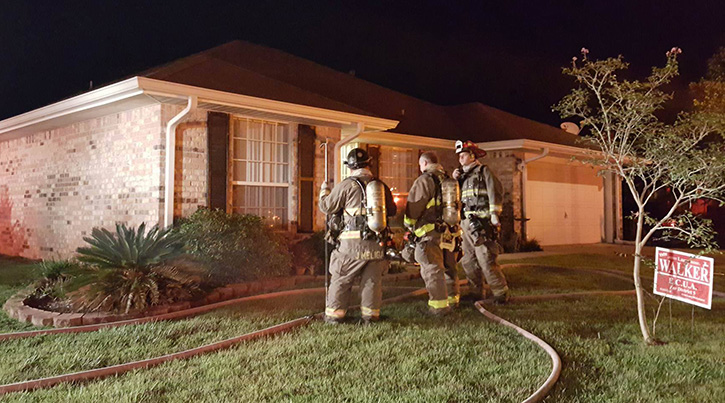
Quick work by firefighters saved a Cantonment home early Tuesday morning. They were able to quickly extinguish an apparent stove fire about 2 a.m. in the 9900 block of Bristol Park Road. The Cantonment, Ensley and Bellview stations of Escambia Fire Rescue responded to the blaze. Photo by Kristi Barbour for NorthEscambia.com, click to enlarge.
One Injured When Semi Hits Two Vehicles In Jay
August 30, 2016
One person was injured when the driver of a semi plowed into a couple of other vehicles in Jay Monday morning.
 According to the Florida Highway Patrol, semi truck driver Winston Terry Spencer, age 45 of Chipley, said his vision was obstructed by a glare on his windshield as he rear-ended a 2002 GMC Sierra driven by 22-year old Gerald Casey Kilpatrick of Jay.
The accident happened about 11 a.m. on Highway 4 at Commerce Street as Kilpatrick slowed for traffic. After hitting Kilpatrick’s Sierra, the semi also hit a parked Kia Sorrento and a sign belonging to Tri-City Home Medical Supply.
Spencer and Kilpatrick were not injured. Kilpatrick’s passenger, 29-year old Rachel Jackson of Jay, was transported to Jay Hospital with minor injuries.
Spencer was cited for careless driving by the FHP.
FWC Law Enforcement Report
August 30, 2016
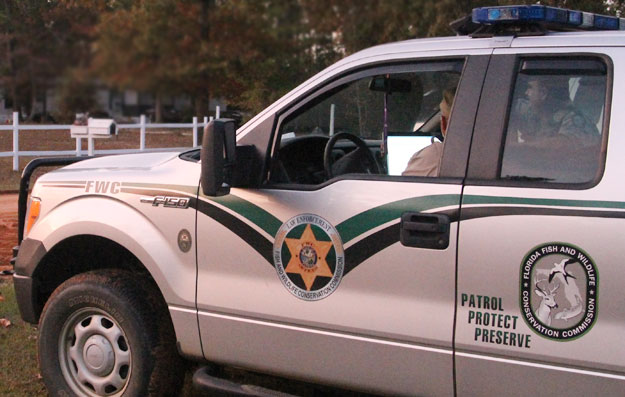
The Florida FWC Division of Law Enforcement reported the following activity during the weekly period ending August 25 in Escambia and Santa Rosa counties.
ESCAMBIA COUNTY
 Officers Allgood, Cushing, Roberson, Manning, Miller and the U.S. Coast Guard (USCG) Pensacola worked commercial shrimp boats in Pensacola Bay for several nights. Multiple net and safety violations were documented with warnings and citations. A total of four oversized shrimp nets were seized. One of the nets measured more than 900 square feet, almost twice the legal size.
Officers Allgood, Cushing and McHenry worked offshore onboard the FinCat. During an inspection of a commercial reef fish vessel, Officer Allgood discovered a grossly undersized greater amberjack in an ice box. One of the crew members stated that he was going to use it for bait. A federal citation was issued for the violation. While approaching a different vessel during the patrol, the FWC crew noticed a red snapper floating in the water behind it. During the inspection, Officer Allgood located several undersized Spanish mackerel. While alongside, the FWC crew members observed several large red snapper scales on the transom of the vessel. After speaking with the subjects on board, Officer Allgood was directed to a bag of red snapper fillets. Federal citations were issued for the violations.
While approaching a recreational vessel, the FinCat crew observed one subject on board move to the rear of the vessel and throw something out of the vessel. The FWC crew observed a one-gallon bag full of fish fillets floating on the water. During the subsequent vessel inspection, Officers Allgood and McHenry discovered several more bags of fillets including gray triggerfish, greater amberjack, red snapper and another 50‑pound greater amberjack in whole condition. Federal citations were issued for the violations.
Lieutenant Hahr was patrolling in the Perdido River Wildlife Management Area (WMA) when he observed a car pull into an area where nighttime access is prohibited. He made contact with the driver and observed signs of impairment. After field alcohol tasks were performed, he arrested the driver for driving under the influence (DUI). She was transported to the Escambia County Sheriff’s Office where she provided a breath sample of .099 almost 2 ½ hours after the stop. She was booked for driving with a breath alcohol level of .08 or above.
SANTA ROSA COUNTY
Officers Jones, Roberson, Barnard, Rockwell and Trueblood and the USCG responded to a missing boater in the Intracoastal Waterway near the Navarre Causeway. It was reported by fire rescue that two people were on board a small sailing boat when one of them fell overboard. Rescue units worked through the night searching for the missing person. The following morning the missing person was found alive and well at a family member’s residence. The investigation is ongoing.
Officers Ramos and Lewis taught the laws portion of the Hunter Safety Course at Avalon Middle School and Jay High School. As hunting season nears, FWC reminds hunters that anyone over the age of 16 and born on or after June 1, 1975, is required to complete the Hunter Safety Course unless using the Hunter Safety mentoring exemption and hunting under the supervision of a qualified hunter.
This report represents some events the FWC handled over the past week; however, it does not include all actions taken by the Division of Law Enforcement. Information provided by FWC.
Both Sides Urge Justices To Resolve Credit Card Law
August 30, 2016

A group of Florida businesses agrees the U.S. Supreme Court should resolve questions about the constitutionality of a state law that has barred merchants from imposing surcharges on customers who pay with credit cards — but the answer might ultimately come in a case from New York.
Attorney General Pam Bondi in June asked the Supreme Court to take up the dispute, after a federal appeals court ruled that the law violated the First Amendment. The 11th U.S. Circuit Court of Appeals said the law allows businesses to offer discounts to customers who pay with cash but does not allow surcharges for credit-card purchases — a situation the ruling likened to “distinctions in search of a difference.”
Lawyers for four Florida businesses that challenged the law filed a document this month agreeing that the case is worthy of a Supreme Court decision. But they urged justices to resolve the issues through a New York case, which involves a similar law and was filed earlier.
The 2nd U.S. Circuit Court of Appeals upheld a New York law blocking businesses from imposing surcharges for credit-card purchases. That conflicts with the ruling by the 11th U.S. Circuit Court of Appeals in the Florida case — a conflict that could serve as potential grounds for the Supreme Court to decide to take up the case.
“None of this is to say that this (Florida) case would be a poor vehicle. It would not be,” said the document filed this month in the Florida case. “But there is nothing to suggest that it would be a better vehicle than (the New York case). If anything, the robust record of enforcement in (the New York case) makes that case a superior vehicle. That record includes a criminal prosecution and numerous detailed and uncontested declarations from merchants targeted by the New York attorney general in recent years for violating the law.”
A petition filed in May at the Supreme Court in the New York case said 10 states have laws regulating how businesses can communicate price differences when customers pay with credit cards or cash.
Florida has allowed businesses to offer discounts to customers who pay with cash but has not allowed price differences to be construed as surcharges for credit-card users.
The challenge to the Florida law was filed in 2014 by businesses that had received “cease-and-desist” letters from the state related to alleged violations of the credit-card surcharge law, according to court documents. The businesses were Dana’s Railroad Supply in Spring Hill, TM Jewelry LLC in Key West, Tallahassee Discount Furniture in Tallahassee and Cook’s Sportland in Venice. The law says violators can face second-degree misdemeanor charges.
The businesses argued, and a majority of the 11th U.S. Circuit Court of Appeals agreed, that the law violates free-speech rights. In the document filed this month at the Supreme Court, for example, the businesses’ lawyers wrote that Dana’s Railroad Supply wanted to “disclose the true cost of accepting credit cards” to customers of the model-railroad hobby shop.
“They want to put their sign back up without fearing criminal prosecution,” the document, posted on the website SCOTUSblog said. “They would like to truthfully tell their customers — ‘both at the entrance to (the) store and at the register so that there will be no surprise’ — that the store ‘will add a small fee onto the sale if they choose to pay by credit card, and that there will be no fee if they choose to pay with cash or debit.’ The other respondents (businesses) want to say the same.”
But in the June petition to the Supreme Court, Bondi’s office argued that the law deals with a “pricing practice” and is not a free-speech issue.
“This (Supreme) Court’s intervention is necessary to correct the 11th Circuit’s contravention of a well-established axiom of First Amendment law: Regulations of economic conduct do not implicate the First Amendment,” the petition said. “The surcharge statute, by prohibiting a particular pricing practice, is just such a regulation. If allowed to remain, the 11th Circuit’s holding to the contrary will obscure the bright line that this (Supreme) Court has drawn between speech and economic conduct and … will cast a First Amendment cloud over a variety of economic regulations.”
by Jim Saunders, The News Service of Florida
Volleyball: PHS Downs Northview
August 30, 2016

The Northview High School varsity and junior varsity volleyball teams fell to Pensacola High School on Monday in Bratt.
The Northview Lady Chiefs will travel to Central on Tuesday for junior varsity at 5:00 and varsity at 6:00. The Chiefs will host Laurel Hill on Thursday, JV at 4:00, varsity at 5:00.
NorthEscambia.com file photo, click to enlarge.
Wahoos Beat Jacksonville
August 30, 2016
Pensacola Blue Wahoos Barrett Astin threw in relief and as a starter in college with the Arkansas Razorbacks and in his four seasons in professional baseball.
The 24-year-old freely admits he prefers the bullpen but you wouldn’t know it from his 11 starts with Pensacola this season.
 Astin started his third straight game for Pensacola and threw a season-high seven scoreless innings to lead the Blue Wahoos to its fourth consecutive win, 4-0, Monday over the Jacksonville Suns at Blue Wahoos Stadium.
The victory clinched the Blue Wahoos fourth straight series win and they are 13-5 heading down the stretch. It puts them just a half game behind the Mississippi Braves who are on a 3-10 slide, including a seven game losing streak, since the Atlanta Braves called up Mississippi shortstop Dansby Swanson on Aug. 17.
Pensacola, the first half Southern League South Division champion, is 34-29 in the second half and has its best overall record in franchise history at 75-58, while Mississippi is 34-28 and 68-63.
Astin said he feels comfortable in either role. Last year, he started all 14 games he pitched for Pensacola and 11 of the 16 games he played at High-A Daytona Tortugas to start the 2015 season. He was 8-9 overall with a 3.98 ERA.
“Really I’ve been starting and relieving my whole career,” said Astin, who reached the College World Series in 2012 as the Arkansas closer. “I prefer being a reliever. But right now this is what the (Cincinnati) Reds want.”
They may want more of right-handed starter Astin who ended up tossing seven innings, allowing five hits, no walks and striking out seven. He is the second Pensacola pitcher after Rookie Davis, who got called up to the Triple-A Louisville Bats, to win nine games (9-3) and Astin now has a 2.29 ERA and a WHIP under 1.00.
Pensacola manager Pat Kelly said he believes Astin has benefitted from returning to the Blue Wahoos this season. Astin was 1-4 in his last seven starts last year in Double-A for the first time with Pensacola and saw his ERA balloon from 3.48 to 5.63.
“He has shown confidence and been aggressive, coming right after the hitters,” Kelly said. “Repeating this league has been good for him.”
Astin agrees that a second year of seasoning has helped him develop as a pitcher. He throws a fastball, slider, curveball, changeup and cutter. Last night, he threw all of them over the plate throwing 59 of 84 pitches for strikes.
“I had five (Monday) tonight and threw them all for strikes, which helps a lot,” he said. “It gives me a lot of confidence getting ready for the playoffs. You want to go in clicking on all cylinders.”
Kelly said that Mississippi misses Swanson, who even though he was hitting .261, provided the leadership and defense the Braves needed.
“That’s a huge part of it,” said Kelly about Swanson’s promotion to Atlanta. “At this level one player, one batter can improve your lineup or really hurt it. He was only hitting in the .260s but he played solid steady defense for them.”
Jacksonville Suns pitcher Luis Castillo quickly showed his 99-mph fastball, striking out Pensacola second baseman and leadoff hitter Alex Blandino, in the first inning. Still, both Blandino and left fielder Phillip Ervin hit his main pitch out of the park just foul down the left field line.
Despite Castillo’s velocity in only his second start for Jacksonville, center fielder Brandon Dixon crushed a pitch into left-center over Suns left fielder Austin Dean’s head that drove in Ervin, who drew a walk, for a 1-0 Blue Wahoos lead.
Castillo was replaced after 3.2 innings giving up three runs on two hits and four walks, while striking out five. He earned the loss and now 0-1 with a 1.86 ERA. He had an impressive Double-A debut last week against the Chattanooga Lookouts, allowing one earned run in six innings.
Dixon led Pensacola at the plate, going 2-4, with his 22nd double of the season and driving in his 63rd RBI. He now has hit in nine straight games and is batting .462 (18-39) with one homer and nine RBIs.
Meanwhile, Pensacola right fielder Sebastian Elizalde had his hit streak end at 13 games, going 0-4 and striking out twice. He fell one game short of his career-high 14 game hitting streak for High-A Daytona last year.
One Killed During Major Explosion At Cantonment Airgas Plant
August 29, 2016

One person was killed as a major explosion ripped through the Airgas facility next to the Ascend Performance Materials plant on Old Chemstrand Road in Cantonment just after noon Sunday. There were no other injuries or fatalities.
About 12:15 p.m., multiple agencies from across Escambia County responded to the Airgas facility. First responders reported a major explosion with an area of significant structural collapse. The area was described a “mini-war zone”.
The gas that exploded was nitrous oxide, some of which was released into the atmosphere but did not pose any threat to the public. There were no gasses or chemicals released outside the industrial facility. There were no evacuations or shelter in place orders issued for residents living near the plant.
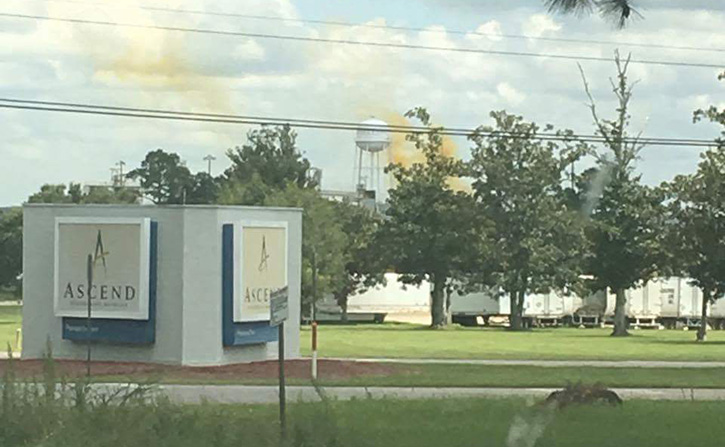 The Ascend plant supplies a mixture of gases to the Airgas plant, which Airgas uses to make nitrous oxide.
“Ascend personnel and contractors are all safe and accounted for at this time. Ascend’s site operations continue to operate safety,” Ascend said in a written statement. “Ascend is currently working with local authorities and first responders…Ascend’s facilities located near the event may have sustained some damage, which Ascend will assess after the completion of all necessary emergency response procedures.”
As emergency workers, assisted by an Ascend response team, secured the area made sure there was no risk of an additional explosions, it was determined that one Airgas employee was missing. After an extensive search, his body was recovered after 6 p.m. His name has not yet been released.
Residents across the area reported feeling the blast, including Amy Hayes.
“My property borders the plant, the closest one to it. I was outside when I felt the blast… it was like a movie, feeling the heat blast/wave that literally pushes into your body. It blew the wooden frames off our windows. The plume was immediate and after not knowing what the smell was … confirming that it was nitrous of some sort and could be dangerous,” Hayes said, adding that she evacuated with her children and dogs. “It was a major explosion and I never want to feel that again.”
The investigation is under the lead of the Florida State Marshal’s Office. Other agencies that responded to the scene included Escambia County Fire Rescue, Escambia County Emergency Management, Escambia County EMS, Escambia County Sheriff’s Office, Escambia Search and Rescue, the ATF, Florida Highway Patrol, the Trauma Intervention Program on Northwest Florida, and K-9 teams from the Century Correctional Institution.
For breaking news, like our Facebook page and/or follow @northscambia on Twitter.
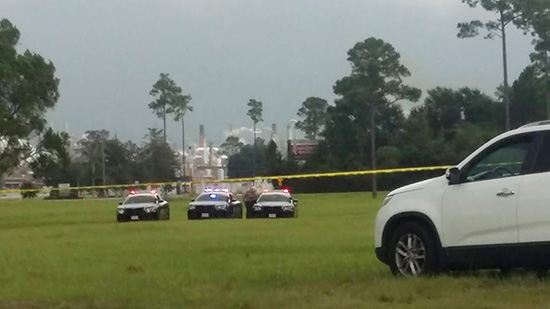
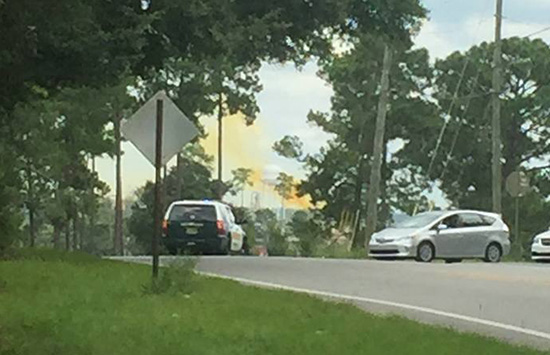
Reader photos for NorthEscambia.com, click to enlarge.