Better grab the umbrella — we are in for a wet Tuesday as showers stream across the area throughout the day.
Here is your official North Escambia area forecast:
- Tuesday: Showers and thunderstorms likely. Mostly cloudy, with a high near 90. Southeast wind between 5 and 10 mph. Chance of precipitation is 60%.
- Tuesday Night: A 20 percent chance of showers and thunderstorms before 1am. Partly cloudy, with a low around 71. Southeast wind around 5 mph.
- Wednesday: A 40 percent chance of showers and thunderstorms. Partly cloudy, with a high near 95. East wind around 5 mph becoming south.
- Wednesday Night: A 20 percent chance of showers and thunderstorms before 10pm. Partly cloudy, with a low around 72. South southwest wind around 5 mph becoming calm.
- Thursday: A 30 percent chance of showers and thunderstorms. Partly cloudy, with a high near 93. North northwest wind around 5 mph becoming calm.
- Thursday Night: A 20 percent chance of showers and thunderstorms. Partly cloudy, with a low around 73. Calm wind.
- Friday: A 30 percent chance of showers and thunderstorms. Partly cloudy, with a high near 96. Calm wind becoming northeast around 5 mph.
- Friday Night: A 20 percent chance of showers and thunderstorms. Partly cloudy, with a low around 73. South southeast wind around 5 mph becoming calm.
- Saturday: A 30 percent chance of showers and thunderstorms. Mostly cloudy, with a high near 95.
- Saturday Night: A 20 percent chance of showers and thunderstorms. Partly cloudy, with a low around 74.
- Sunday: A 40 percent chance of showers and thunderstorms. Mostly cloudy, with a high near 93.
- Sunday Night: A 20 percent chance of showers and thunderstorms. Partly cloudy, with a low around 73.
- Monday: A 40 percent chance of showers and thunderstorms. Partly cloudy, with a high near 94.
Written by William Reynolds · Filed Under Archive
Here’s the latest BP oil spill information specific to Escambia County for Tuesday, June 22, with updates in yellow:
- Report tar or oiled debris on the beach 1-877-389-8932 or #DEP from a cell phone.
- DO NOT TOUCH oiled or injured wildlife. Report your finding to 1-866-557-1401.
|
- Five skimmers were contracted by the state of Florida for this area with one skimmer designated for Escambia County.
- Afternoon aerial information identified one patch of sheen off of Big Lagoon with no oil observed within 10 miles of Pensacola.
- Cleaning stations have been placed next to the crossovers (between the crossovers and the roadways) to aid in the removal of tar and oil.
- Winds will shift from a southeasterly direction this afternoon as the sea breeze moves inland, but a general east to southeast wind flow between 5 and 15 knots is forecast to continue across the north-central Gulf operations area through much of this week.
- A tropical wave moving westward is producing a large area of disorganized storm activity. There is a low (20%) chance of this becoming a tropical cyclone within the next 48 hours.
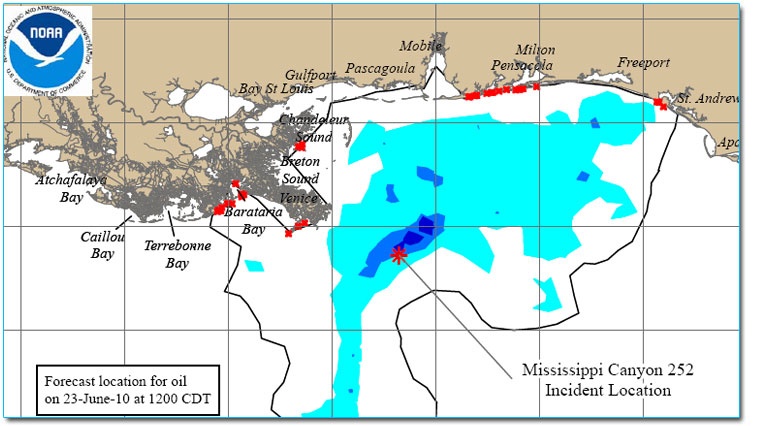
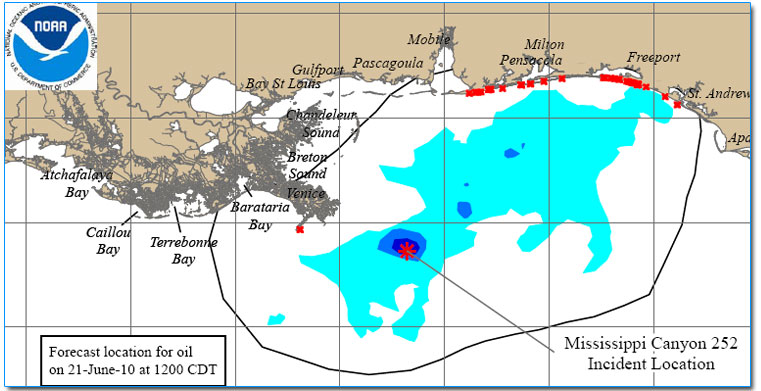
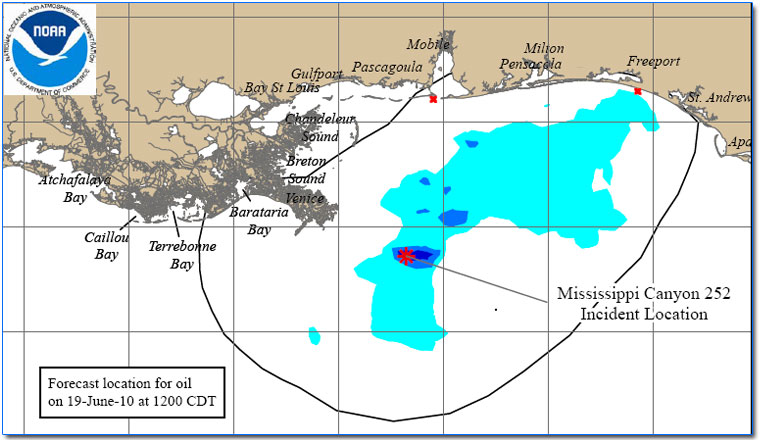
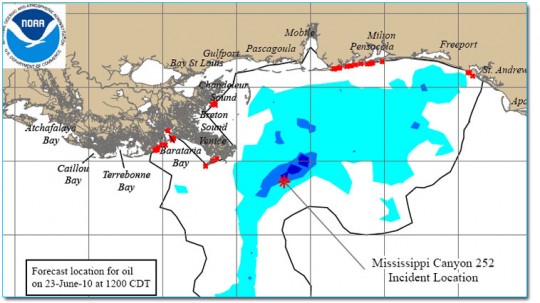
- The NOAA trajectories indicate an almost stationary movement of the oil slick through Tuesday before a slow retreat to the west-northwest by Wednesday. The Florida Panhandle will continue to be threatened by shoreline impacts as far east as Panama City through Wednesday as tidal influences and southeast winds could continue to push sections of oil towards the coast.
|
|
| BP |
- BP claims in Florida total 17,083 with approximately $15,221,896.03 paid.
|
- Do not sign any documents in return from money from BP or anyone else until you know the extent of your loss. BP officials carry proper identification badges or business cards.
- There are reports of a scam involving individuals falsely representing themselves as BP employees and offering applicants training and job placement for a fee. BP does not charge to train applicants. If you or someone you know has been charged for training, please contact law enforcement.
- BP’s Florida Gulf Response web site: www.floridagulfresponse.com.
- File claims with BP online: http://www.bp.com/claims.
- BP’s claims office is located at 3960 W. Navy Boulevard, Suite 16 & 17. The office is currently open 8 a.m. to 7 p.m., seven days a week, until further notice. BP claims categories. Call 1-800-440-0858 to help expedite the process. If you are not satisfied with BP’s resolution, call 1-800-280-7118.
- The BP community outreach office is located at 435 East Government Street for questions on volunteering, vessels of opportunity program, or any other questions. Phone: 850-912-8640.
- To register as a consultant, contractor, vendor or submit information on alternative response technology, services products or suggestions, call BP at 281-366-5511.
- BP Vessels of Opportunity – see the master vessel charter agreement and vessel requirements checklist online www.deepwaterhorizonresponse.com. To pick up or deliver completed Vessels of Opportunity packets, visit 435 East Government Street. For information, call 281-366-5511.
- The Fish and Wildlife Service is working with Tri-State Bird Rescue & Research, contracted by BP to provide assistance to oiled wildlife. Specific safety and other requirements must be met before anyone will be allowed on-site for any participation. If you have wildlife training, call 1-866-557-1401.
- Boaters are requested to report sightings of broken, disconnected or adrift boom and are asked to keep their distance from boom especially at night or in conditions of restricted visibility. Please report damaged, vandalized, adrift or stolen boom to: 1-866-448-5816. See details.
|
|
| Federal |
- Latest information from NOAA Fisheries Service, including federal fisheries closure, regulation changes and quota increases: http://sero.nmfs.noaa.gov.
|
|
| State of Florida |
- The Small Business Administration issued an economic injury Disaster Loan Declaration for the state of Florida. Pensacola office: 401 E. Chase St., Ste. 100. For more information on Economic Injury Disaster Loans visit the SBA website.
- For information on the Florida Small Business Development Center’s Mobile Area Command units, visit www.floridasbdc.org/Special Programs/bcrm.asp.
- Additional guidance to help small businesses survive a disaster can be found at www.MyFloridaCFO.com or by calling 850-413-3089 or toll-free 1-877-MY-FL-CFO (1-877-693-5236).
- Submit innovative technology ideas, suggestions or products by completing this form. Send the form and supporting documentation to Innovative.Technology@dep.state.fl.us.
- Video and audio public service announcements are available for download to educate the public on response, safety, coast watch and beach cleanup. See details.
- Report boom vandalism to the 1-800-320-0519 or #DEP from your cell phone.
|
|
| Escambia County Board of County Commissioners and Staff |
- Citizen/Public Meetings this week:
- NOTE LOCATION CHANGE: Commissioner Grover Robinson will hold a District 4 town hall beach meeting on Tuesday, June 22 from 6 p.m. to 8 p.m. at the Pensacola Beach Community Church, 920 Via De Luna Drive.
- Escambia County Extension Office and University of Florida IFAS will host “SOS: The Science of the Spill” Public Forum meeting on Wednesday, June 23 from 6 p.m. to 8 p.m. at Sanders Beach Community Center, 913 South “I” Street
- Commissioner Gene Valentino will host a ribbon cutting for the new kayak launch at Civitan Park on Thursday, June 24 at 5 p.m. at Civitan Park, 404 2nd Street
|
- Clean-up crews continue to work both beaches at night when temperatures are cooler.
- “Hot shot” teams will respond to specific requests during the day as needed.
- We are continuing to monitor clean-up efforts and skimming operations.
- The Escambia County Health Department has rescinded the current health advisory related to swimming in the Perdido Key area. More details.
- A federal website is live providing real time information about the Deepwater Horizon BP Oil spill into one customizable, interactive map.
- A Recreational Vessel Decontamination Facility for local boaters is being established.
- Reports vary widely throughout the day as heat from the sun brings subsurface oil to the top, and cooler temperatures at night tend to cause it to sink below the surface.
- Anyone caught destroying, disturbing or stealing boom will be prosecuted. If you spot any illegal activity related to the booms, please call 1-800-320-0519.
- See Escambia Inland Waterways Deployed Boom List.
- Skimmer vessels continue to respond as reports are received. Skimmers are working nightly.
- Perdido Pass, Pensacola Pass and Bayou Texar are navigationally restricted during flood (incoming) tide and reopen during ebb (outgoing) tide as water flows out to the gulf. They are manned to allow access to necessary vessel traffic. (See NOAA tide predictions.)
- Boaters are asked to be mindful of the boom and skimming operations, to use slow speeds so as not to produce a wake that may disrupt the boom, and to be aware of restricted areas.
- A flashing light has been attached to all boom to increase visibility to boaters.
- The Intracoastal Waterway remains open.
- The beaches at Pensacola Beach and Perdido Key remain open.
- The Florida Fish and Wildlife Conservation Commission (FWC), in coordination with Florida’s Department of Environmental Protection, the Department of Agriculture and Consumer Services and the Department of Health, issued an executive order to temporarily close a portion of coastal state waters offshore of Escambia County to the harvest of saltwater fish, crabs and shrimp. Details.
- The closure includes state waters from the beaches out nine nautical miles into the Gulf from the Alabama line east to the Pensacola Beach water tower. Interior bays and estuaries remain open to fishing. This area covers approximately 23 miles of Florida’s coastline in Escambia County. Map.
- Recreational catch-and-release fishing is still allowed.
- The Pensacola Beach Fishing Pier and the Pensacola Bay Fishing Bridge are open for sightseers and fishing, however fishing off the Pensacola Beach Fishing Pier is catch and release only.
- Reconnaissance flights and ATV beach patrols are being conducted daily, weather permitting, to monitor Florida’s shoreline for impact.
- Unified command continues to check, verify the condition and make repairs as needed to currently placed booms.
- If citizens see anything unusual on the beaches, Escambia County has opened field offices on Pensacola Beach and Perdido Key to assist in answering questions from the public and to also act as staging areas for the county monitoring teams.
- The Pensacola Beach field office is located at 5 Via Deluna, Suite 8; phone: 934-6500.
- The Perdido Key field office is located at 13578 Perdido Key Drive; phone: 791-6905
- Staff continue to monitor and maintain boom. See Booming Locations and Booming Maps.
- SRIA lifeguards continue patrolling beaches for oil from 7 a.m. to 7 p.m.
- Hurricane season began June 1. See the Hurricanes and Oil Spill Fact Sheet (PDF)
- Escambia County, in conjunction with the University of West Florida, is collecting gulf water samples from Santa Rosa Island and Perdido Key routinely to indicate any changes in water quality. The latest testing came back negative for aliphatic hydrocarbons, meaning no dissolved or dispersed hydrocarbons were found. Tar balls represent a different and less toxic form of the oil.
- On inland waters (bays, bayous, estuaries, rivers), private property owners may install oil absorbent material, booms or fences on private property above the mean high waterline (MHWL) only. No material may be installed or sprayed below the MHWL.
- On gulf-front property, the use of silt fences, obstructions, hay bales, peat, surfactants or other material is not approved. DEP is the permitting agency for beaches and coastal systems. No obstructions to sea turtle nesting behavior is allowed.
|
|
| City of Pensacola |
- Boom has been added by city at the Escambia Bay entrance to Gaborone Swamp off Scenic Highway.
- As requested by the city, additional boom has been placed at the mouth of Bayou Texar by the county to provide additional protection.
- Boom has been added by city to protect aquatic vegetation just south of 17th Avenue boat ramp at Bayou Texar on west side.
- DEP has boomed Project Greenshores Phase II from Muscogee Wharf to Hawkshaw Lagoon.
- Boom has been added by the city across entrance to Pitt Slip Marina in the very near future, as warranted.
- Boom has been added by the city to entrance of new Maritime Park bulkhead mitigation site immediately west of Crab Trap restaurant.
- City is currently requesting/seeking approximately 1100′ of boom to secure and protect the rip-rap surrounding the Bruce Beach wetland mitigation site maintained by the Port of Pensacola.
- Boom has been added by city to protect shoreline of Sanders Beach-Corrine Jones community center and waterfront park facility immediately east of Bayou Chico.
|
|
| Volunteer Opportunities |
- The Occupational Health and Safety Administration (OSHA) has determined volunteers cannot be used in any situation where they may come in contact with oiled shorelines or oiled wildlife.
- To volunteer, visit www.volunteerfloridadisaster.org.
|
|
| Safety Information |
|
Wildlife
- Do not attempt to rescue oiled or injured birds or wildlife as this may cause additional injuries.
- If oiled, injured or dead wildlife are found, call 1-866-557-1401. Provide location where the wildlife was sighted.
Boats
- Boats should keep a safe distance from the booms. Do not drive boats over booms.
- Do not drive boats through slicks or sheens.
Beaches and Waterways
- Citizens should take precautions around waterways to avoid contact with oil substances.
- Officials are closely monitoring potential public health and environmental concerns.
Personal Safety
- Gulf coast residents may detect an odor because of the oil spill. Some are more sensitive to these odors and may experience nasal irritation and feelings of nausea. In combination with seasonal allergies or pre-existing respiratory conditions, some may experience more severe symptoms. For Air Quality Reports, see http://www.epa.gov/bpspill/air.html.
- Individuals who have pre-existing medical conditions, such as asthma or other respiratory illness should contact their health care provider if feeling symptomatic.
- If you see or smell oil, leave immediately. Avoid skin contact with oil or oil-contaminated water. Do not swim or ski in areas affected by oil, and if you travel through the area by boat, take care when hoisting the anchor. Restrict pets from entering oil-contaminated areas. If you get oil on your skin, wash it off with soap and water. Young children, pregnant women, people with compromised immune systems, and individuals with underlying respiratory conditions should avoid the area.
- Do not fish in the oil spill-affected waters. Do not harvest and eat dead fish, fish with oily residue or fish that have a petroleum odor.
|
|
| Business Information |
- More information about what types of damages are eligible for compensation under the Oil Pollution Act as well as guidance to seek compensation can be found at www.uscg.mil/npfc.
- Florida emergency management and economic development staff are gathering information from businesses impacted by the Deepwater Horizon oil spill. Please complete their survey and help shape Florida’s response to this event. The survey will be updated periodically.
- Take detailed records of cancelled reservations. When cancellations occur, ask the party if the cancellation is related the oil spill. Keep the person’s name and contact information, and the revenues lost as a result of the cancellation.
- Businesses negatively impacted due to the oil spill, are asked to keep detailed profit and loss records should a claim need to be presented. Calculate estimated losses for a six-week period and have records, receipts and documentation to support your claim. Compare business to a five-year average of revenues between May and June, which can offer insight as to the damages incurred.
- Make a detailed list of assets, including non-structural, and include supportive records. If your hotel or restaurant is within walking distance to the beach, the business’s assets could be damaged even though there is no physical damage to the structure. Please record this depreciation.
|
|
Important Phone Numbers For Citizens
-
- Report oil on the beach or shoreline: 1-877-389-8932 or #DEP from a cell phone
- To report oiled wildlife: 1-866-557-1401
- BP Claims: 1-800-440-0858
- To report damaged, vandalized, adrift or stolen boom: 1-866-448-5816 or 1-800-320-0519
- Escambia County Citizen’s Information Line: 471-6600
- Florida Oil Spill Information Line: 1-888-337-3569
|
Written by William Reynolds · Filed Under Archive
Registration for the second session of swimming lessons at the newly renovated city pool at Tom Byrne Park in Atmore will be this afternoon.
Registration will take place from 5-6 p.m., and will continue until each class is filled. The session will be July 28-July 15. Swimming and tennis lessons are $35 for a three week session.
Admission to the pool is just $1 for ages 17 and under and $1.50 for 18 and over.
For complete swimming and tennis lesson information and pool hours, click here.
Written by William Reynolds · Filed Under Archive
The Bratt-Davisville Water System has issued a precautionary boil water notice for the residents of Highway 4, Bratt Road and Pine Barren Road following a water main break.
The Bratt-Davisville Water System advises as a precaution that all water used for drinking, cooking, making ice, brushing teeth, or washing dishes be boiled. A rolling boil of one minute is sufficient. As an alternative bottled water may be used.
The precautionary boil water notice will remain in effect until the problem has been corrected and a bacteriological survey shows that the water is safe to drink.
What to do during precautionary boil water notice (PBWN):
- When a PBWN is issued, a rolling boil for a period of one minute is sufficient to render water used for drinking, cooking, making ice, brushing teeth, or washing dishes microbiologically safe, free of bacteria, viruses, and protozoa.
- Tap water can be disinfected by adding 8 drops of unscented household bleach (4-6% active ingredients) to each gallon of water, then mixing the water and allowing it to stand for a minimum period of 30 minutes.
- Note: Cloudy water requires 16 drops of bleach and a 30 minute contact time. Also, other approved chemical disinfectants are available at stores that sell camping and hiking supplies.
Written by William Reynolds · Filed Under Archive
Most of the area had some thunder Saturday evening. Some of us will once again see afternoon storms on Sunday, but the rain will be much more widespread.
Before the storms, expect hot, muggy weather, with temps well into the 90’s.
Here is your official North Escambia area forecast:
- Sunday: A 20 percent chance of showers and thunderstorms. Partly cloudy, with a high near 96. North northwest wind around 5 mph.
- Sunday Night: A 20 percent chance of showers and thunderstorms before 10pm. Mostly cloudy, with a low around 74. West southwest wind around 5 mph becoming calm.
- Monday: A 30 percent chance of showers and thunderstorms after 11am. Partly sunny and hot, with a high near 97. Northeast wind around 5 mph becoming southeast.
- Monday Night: A 20 percent chance of showers and thunderstorms after 1am. Partly cloudy, with a low around 72. East southeast wind around 5 mph.
- Tuesday: A 40 percent chance of showers and thunderstorms. Mostly cloudy, with a high near 91. Southeast wind between 5 and 10 mph.
- Tuesday Night: A 20 percent chance of showers and thunderstorms. Partly cloudy, with a low around 72. Southeast wind around 5 mph.
- Wednesday: A 20 percent chance of showers and thunderstorms. Partly cloudy, with a high near 94. Northeast wind 5 to 10 mph becoming southeast.
- Wednesday Night: Partly cloudy, with a low around 73. South wind around 5 mph becoming calm.
- Thursday: A 20 percent chance of showers and thunderstorms. Partly cloudy, with a high near 96.
- Thursday Night: Partly cloudy, with a low around 73.
- Friday: A 30 percent chance of showers and thunderstorms. Partly cloudy, with a high near 95.
- Friday Night: A 20 percent chance of showers and thunderstorms. Mostly cloudy, with a low around 74.
- Saturday: A 30 percent chance of showers and thunderstorms. Mostly cloudy, with a high near 93.
Written by William Reynolds · Filed Under Archive
Tomorrow is Father’s Day, and NorthEscambia.com is giving you the chance to tell the world what is special about your father.
Tell us a little bit about your dad and why he is special to you in 200 words or less, and we may select your story to appear in a special feature this tomorrow (Father’s Day).
Please include your name (and the names of your siblings, if you would like), your father’s name and the community where he lives. Please take the time to proofread your story just a little bit.
To submit a story:
Post the story and a photo to our Facebook book wall at www.facebook.com/NorthEscambia
Or…Email the story and photo to news@northescambia.com
Written by William Reynolds · Filed Under Archive
Temperatures will be back in the middle 90’s on this Saturday, but some will get relief from afternoon thunderstorms. The hot weather will continue on Sunday for Father’s Day, with another chance of afternoon thunder.
Here is your official North Escambia area forecast:
- Saturday: A 40 percent chance of showers and thunderstorms after 10am. Partly cloudy, with a high near 95. West northwest wind around 5 mph.
- Saturday Night: A 20 percent chance of showers and thunderstorms before 10pm. Partly cloudy, with a low around 73. West southwest wind around 5 mph.
- Sunday: A 30 percent chance of showers and thunderstorms after 1pm. Mostly cloudy, with a high near 96. West northwest wind around 5 mph becoming calm.
- Sunday Night: Partly cloudy, with a low around 74. Calm wind becoming south around 5 mph.
- Monday: A 40 percent chance of showers and thunderstorms. Partly cloudy, with a high near 94. Calm wind becoming east southeast between 5 and 10 mph.
- Monday Night: A 20 percent chance of showers and thunderstorms. Partly cloudy, with a low around 73. East southeast wind between 5 and 10 mph becoming calm.
- Tuesday: A 30 percent chance of showers and thunderstorms. Partly cloudy, with a high near 93. Southeast wind between 5 and 10 mph.
- Tuesday Night: Partly cloudy, with a low around 73. South wind between 5 and 10 mph becoming calm.
- Wednesday: A 20 percent chance of showers and thunderstorms. Partly cloudy, with a high near 95.
- Wednesday Night: Partly cloudy, with a low around 73.
- Thursday: A 20 percent chance of showers and thunderstorms. Partly cloudy, with a high near 95.
- Thursday Night: Partly cloudy, with a low around 72.
- Friday: Scattered showers and thunderstorms. Mostly cloudy, with a high near 93. Chance of precipitation is 30%.
Written by William Reynolds · Filed Under Archive
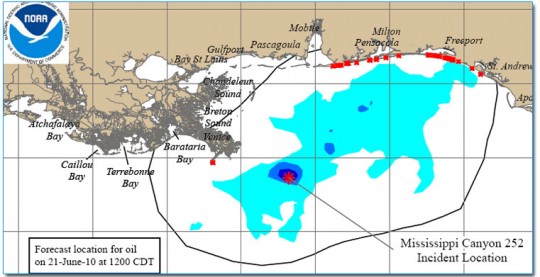
Here is the latest BP oil spill information specific to Escambia County for Saturday, June 19:
- Report tar or oiled debris on the beach 1-877-389-8932 or #DEP from a cell phone.
- DO NOT TOUCH oiled or injured wildlife. Report your finding to 1-866-557-1401.
|
- The Escambia County Health Department has rescinded the current health advisory related to swimming in the Perdido Key area. More details
- Local booming is still being deployed on the incoming tide. Boaters needing access in or out locally boomed waters are asked to call 850-736-2261 and wait for assistance.
- Afternoon aerial observations report good conditions in the Escambia County waterways, Perdido Pass and Pensacola Pass.
- Relatively weak winds (up to 10 knots), low seas (below 2 feet) and low rain chances are expected to continue through the next 3 days, which will be favorable for surface oil recovery operations.
- Winds are light and variable but are expected to turn west-southwesterly in the afternoons.
- No tropical development is expected in the Atlantic Basin through the next 48 hours.
- Forecast shows that a lot of the oil is moving to the east of us which means less of an impact over the weekend.
- The sand rake is being considered for use on Perdido Key. Plans are to have them staged this evening.
- Pensacola Beach saw very light and very sporadic tar balls.
- On Perdido Key, tar balls have been reported scattered along the length of the beach with up to five percent coverage in some areas.
- Clean-up crews continue to work both beaches at night when temperatures are cooler.
- “Hot shot” teams will respond to specific requests during the day as needed.
- We are continuing to monitor clean-up efforts and skimming operations.
|
- Anyone caught destroying, disturbing or stealing boom will be prosecuted. If you spot any illegal activity related to the booms, please call 1-800-320-0519.
- See Escambia Inland Waterways Deployed Boom List.
- Skimmer vessels continue to respond as reports are received. Skimmers are working nightly.
- Perdido Pass, Pensacola Pass and Bayou Texar are navigationally restricted during flood (incoming) tide and reopen during ebb (outgoing) tide as water flows out to the gulf. They are manned to allow access to necessary vessel traffic. (See NOAA tide predictions.)
- Boaters are asked to be mindful of the boom and skimming operations, to use slow speeds so as not to produce a wake that may disrupt the boom, and to be aware of restricted areas.
- A flashing light has been attached to all boom to increase visibility to boaters.
- The Intracoastal Waterway remains open.
- The beaches at Pensacola Beach and Perdido Key remain open.
- The Florida Fish and Wildlife Conservation Commission (FWC), in coordination with Florida’s Department of Environmental Protection, the Department of Agriculture and Consumer Services and the Department of Health, issued an executive order to temporarily close a portion of coastal state waters offshore of Escambia County to the harvest of saltwater fish, crabs and shrimp. Details.
- The closure includes state waters from the beaches out nine nautical miles into the Gulf from the Alabama line east to the Pensacola Beach water tower. Interior bays and estuaries remain open to fishing. This area covers approximately 23 miles of Florida’s coastline in Escambia County. Map.
- Recreational catch-and-release fishing is still allowed.
- The Pensacola Beach Fishing Pier and the Pensacola Bay Fishing Bridge are open for sightseers and fishing, however fishing off the Pensacola Beach Fishing Pier is catch and release only.
- Based on the volume of tar balls washing ashore on Perdido Key and the difficulty in avoiding contact with the tar in the surf, the state health department issued a health advisory June 8 from the Florida/Alabama line east to the entrance of Johnson Beach/Gulf Islands National Seashore. The Health Department posted signs at the affected area. – Lifted – More Information
- This is an advisory, not a ban. People may safely participate in activities that are above the high tide line and can still swim at their own risk. If you experience respiratory problems, leave the area and contact a physician if you deem necessary. Please see the Health Department web site for more information on health safety: www.escambiahealth.com.
- The health department will continue to monitor the levels of tar balls and will lift the advisory as conditions improve.
- Reconnaissance flights and ATV beach patrols are being conducted daily, weather permitting, to monitor Florida’s shoreline for impact.
- Unified command continues to check, verify the condition and make repairs as needed to currently placed booms. The county will work with Unified Command on any placement of boom within navigable waterways.
|
|
| BP |
- BP claims in Escambia County total 2,510 with approximately $2,400,000 paid.
|
- Do not sign any documents in return from money from BP or anyone else until you know the extent of your loss. BP officials carry proper identification badges or business cards.
- There are reports of a scam involving individuals falsely representing themselves as BP employees and offering applicants training and job placement for a fee. BP does not charge to train applicants. If you or someone you know has been charged for training, please contact law enforcement.
- BP’s Florida Gulf Response web site: www.floridagulfresponse.com.
- File claims with BP online: http://www.bp.com/claims.
- BP’s claims office is located at 3960 W. Navy Boulevard, Suite 16 & 17. The office is currently open 8 a.m. to 7 p.m., seven days a week, until further notice. BP claims categories. Call 1-800-440-0858 to help expedite the process. If you are not satisfied with BP’s resolution, call 1-800-280-7118.
- The BP community outreach office is located at 435 East Government Street for questions on volunteering, vessels of opportunity program, or any other questions. Phone: 850-912-8640.
- To register as a consultant, contractor, vendor or submit information on alternative response technology, services products or suggestions, call BP at 281-366-5511.
- BP Vessels of Opportunity – see the master vessel charter agreement and vessel requirements checklist online www.deepwaterhorizonresponse.com. To pick up or deliver completed Vessels of Opportunity packets, visit 435 East Government Street. For information, call 281-366-5511.
- The Fish and Wildlife Service is working with Tri-State Bird Rescue & Research, contracted by BP to provide assistance to oiled wildlife. Specific safety and other requirements must be met before anyone will be allowed on-site for any participation. If you have wildlife training, call 1-866-557-1401.
- Boaters are requested to report sightings of broken, disconnected or adrift boom and are asked to keep their distance from boom especially at night or in conditions of restricted visibility. Please report damaged, vandalized, adrift or stolen boom to: 1-866-448-5816. See details.
|
|
| Federal |
- Latest information from NOAA Fisheries Service, including federal fisheries closure, regulation changes and quota increases: http://sero.nmfs.noaa.gov.
|
|
| State of Florida |
- The Small Business Administration issued an economic injury Disaster Loan Declaration for the state of Florida. Pensacola office: 401 E. Chase St., Ste. 100. For more information on Economic Injury Disaster Loans visit the SBA website.
- For information on the Florida Small Business Development Center’s Mobile Area Command units, visit www.floridasbdc.org/Special Programs/bcrm.asp.
- Additional guidance to help small businesses survive a disaster can be found at www.MyFloridaCFO.com or by calling 850-413-3089 or toll-free 1-877-MY-FL-CFO (1-877-693-5236).
- Submit innovative technology ideas, suggestions or products by completing this form. Send the form and supporting documentation to Innovative.Technology@dep.state.fl.us.
- Video and audio public service announcements are available for download to educate the public on response, safety, coast watch and beach cleanup. See details.
- Report boom vandalism to the 1-800-320-0519 or #DEP from your cell phone.
|
|
| Escambia County Board of County Commissioners and Staff |
- Schedule change for the weekend
- 9 a.m. EOC briefing only
- No news conferences
- Return to twice daily briefings and news conference schedule on Monday
- Citizen/Public Meetings next week
- Commissioner Grover Robinson will hold a District 4 town hall beach meeting on Tuesday, June 22 from 6 p.m. to 8 p.m. at the SRIA Conference Room, 1 Via de Luna, Pensacola Beach
- Escambia County Extension Office and University of Florida IFAS will host “SOS: The Science of the Spill” Public Forum meeting on Wednesday, June 23 from 6 p.m. to 8 p.m. at Sanders Beach Community Center, 913 South “I” Street
- Commissioner Gene Valentino will host a ribbon cutting for the new kayak launch at Civitan Park on Thursday, June 24 at 5 p.m. at Civitan Park, 404 2nd Street
- The Declaration of State of Local Emergency has been extended through June 25.
|
- If citizens see anything unusual on the beaches, Escambia County has opened field offices on Pensacola Beach and Perdido Key to assist in answering questions from the public and to also act as staging areas for the county monitoring teams.
- The Pensacola Beach field office is located at 5 Via Deluna, Suite 8; phone: 934-6500.
- The Perdido Key field office is located at 13578 Perdido Key Drive; phone: 791-6905
- County contractors continue to monitor passes for indications of oil during the evening hours.
- Contractors and staff continue to monitor clean up crews and skimming operations.
- Staff continue to monitor and maintain boom. See Booming Locations and Booming Maps.
- SRIA lifeguards continue patrolling beaches for oil from 7 a.m. to 7 p.m.
- Hurricane season began June 1. See the Hurricanes and Oil Spill Fact Sheet (PDF)
- Escambia County, in conjunction with the University of West Florida, is collecting gulf water samples from Santa Rosa Island and Perdido Key routinely to indicate any changes in water quality. The latest testing came back negative for aliphatic hydrocarbons, meaning no dissolved or dispersed hydrocarbons were found. Tar balls represent a different and less toxic form of the oil.
- On inland waters (bays, bayous, estuaries, rivers), private property owners may install oil absorbent material, booms or fences on private property above the mean high waterline (MHWL) only. No material may be installed or sprayed below the MHWL.
- On gulf-front property, the use of silt fences, obstructions, hay bales, peat, surfactants or other material is not approved. DEP is the permitting agency for beaches and coastal systems. No obstructions to sea turtle nesting behavior is allowed.
|
|
| City of Pensacola |
- Boom has been added by city at the Escambia Bay entrance to Gaborone Swamp off Scenic Highway.
- As requested by the city, additional boom has been placed at the mouth of Bayou Texar by the county to provide additional protection.
- Boom has been added by city to protect aquatic vegetation just south of 17th Avenue boat ramp at Bayou Texar on west side.
- DEP has boomed Project Greenshores Phase II from Muscogee Wharf to Hawkshaw Lagoon.
- Boom has been added by the city across entrance to Pitt Slip Marina in the very near future, as warranted.
- Boom has been added by the city to entrance of new Maritime Park bulkhead mitigation site immediately west of Crab Trap restaurant.
- City is currently requesting/seeking approximately 1100′ of boom to secure and protect the rip-rap surrounding the Bruce Beach wetland mitigation site maintained by the Port of Pensacola.
- Boom has been added by city to protect shoreline of Sanders Beach-Corrine Jones community center and waterfront park facility immediately east of Bayou Chico.
|
|
| Volunteer Opportunities |
- The Occupational Health and Safety Administration (OSHA) has determined volunteers cannot be used in any situation where they may come in contact with oiled shorelines or oiled wildlife.
- To volunteer, visit www.volunteerfloridadisaster.org.
|
|
| Safety Information |
|
Wildlife
- Do not attempt to rescue oiled or injured birds or wildlife as this may cause additional injuries.
- If oiled, injured or dead wildlife are found, call 1-866-557-1401. Provide location where the wildlife was sighted.
Boats
- Boats should keep a safe distance from the booms. Do not drive boats over booms.
- Do not drive boats through slicks or sheens.
Beaches and Waterways
- Citizens should take precautions around waterways to avoid contact with oil substances.
- Officials are closely monitoring potential public health and environmental concerns.
Personal Safety
- Gulf coast residents may detect an odor because of the oil spill. Some are more sensitive to these odors and may experience nasal irritation and feelings of nausea. In combination with seasonal allergies or pre-existing respiratory conditions, some may experience more severe symptoms. For Air Quality Reports, see http://www.epa.gov/bpspill/air.html.
- Individuals who have pre-existing medical conditions, such as asthma or other respiratory illness should contact their health care provider if feeling symptomatic.
- If you see or smell oil, leave immediately. Avoid skin contact with oil or oil-contaminated water. Do not swim or ski in areas affected by oil, and if you travel through the area by boat, take care when hoisting the anchor. Restrict pets from entering oil-contaminated areas. If you get oil on your skin, wash it off with soap and water. Young children, pregnant women, people with compromised immune systems, and individuals with underlying respiratory conditions should avoid the area.
- Do not fish in the oil spill-affected waters. Do not harvest and eat dead fish, fish with oily residue or fish that have a petroleum odor.
|
|
| Business Information |
- More information about what types of damages are eligible for compensation under the Oil Pollution Act as well as guidance to seek compensation can be found at www.uscg.mil/npfc.
- Florida emergency management and economic development staff are gathering information from businesses impacted by the Deepwater Horizon oil spill. Please complete their survey and help shape Florida’s response to this event. The survey will be updated periodically.
- Take detailed records of cancelled reservations. When cancellations occur, ask the party if the cancellation is related the oil spill. Keep the person’s name and contact information, and the revenues lost as a result of the cancellation.
- Businesses negatively impacted due to the oil spill, are asked to keep detailed profit and loss records should a claim need to be presented. Calculate estimated losses for a six-week period and have records, receipts and documentation to support your claim. Compare business to a five-year average of revenues between May and June, which can offer insight as to the damages incurred.
- Make a detailed list of assets, including non-structural, and include supportive records. If your hotel or restaurant is within walking distance to the beach, the business’s assets could be damaged even though there is no physical damage to the structure. Please record this depreciation.
|
|
Important Phone Numbers For Citizens
-
- Report oil on the beach or shoreline: 1-877-389-8932 or #DEP from a cell phone
- To report oiled wildlife: 1-866-557-1401
- BP Claims: 1-800-440-0858
- To report damaged, vandalized, adrift or stolen boom: 1-866-448-5816 or 1-800-320-0519
- Escambia County Citizen’s Information Line: 471-6600
- Florida Oil Spill Information Line: 1-888-337-3569
|
Written by William Reynolds · Filed Under Archive
Do you want to say thanks to your dad for Father’s Day? NorthEscambia.com wants you to tell us what is special about your father.
We may select your story to appear in a special feature this Sunday (Father’s Day). Tell us a little bit about your dad and why he is special to you in 300 words or less.
Please include your name (and the names of your siblings, if you would like), your father’s name and the community where he lives. Please include your phone number, which will not be published.
Please take the time to proofread your story just a little and make sure you use spell check.
To submit a story with a photo:
Email the story in the body of an email and attach a photo. Please tell us the names of everyone that appears in your photograph. Send to news@northescambia.com with the subject line “Father’s Day”.
To submit a story without a photo:
You can simply leave a comment on this story (your comment will not be “approved” or appear to the public until Sunday). Or you can email your story to news@northescambia.com with the subject line “Father’s Day”.
Written by William Reynolds · Filed Under Archive
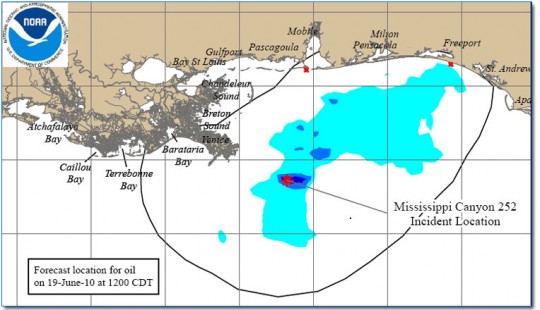
Here is the last information on the BP Oil Spill specific to Escambia County for Friday, June 18 — day 60 of the crisis.
- Report tar or oiled debris on the beach 1-877-389-8932 or #DEP from a cell phone.
- DO NOT TOUCH oiled or injured wildlife. Report your finding to 1-866-557-1401.
|
- Relatively weak winds (up to 10 knots), low seas (below 2 feet) and low rain chances are expected to continue through the next 3 days, which will be favorable for surface oil recovery operations.
- Winds are light and variable but are expected to turn west-southwesterly in the afternoons.
- No tropical development is expected in the Atlantic Basin through the next 48 hours.
- Forecast shows that a lot of the oil is moving to the east of us which means less of an impact over the weekend.
- The sand rake is being tested on Perdido Key. Plans are to put them in operation tomorrow night.
- Pensacola Beach saw very light and very sporadic tar balls, some tar covered debris. Odors reported by two locals at Sabine Bay and one oiled bird, possibly a cormorant.
- On Perdido Key, the state park has sporadic tarballs ranging from dime to dollar size.
- Beginning this evening clean-up crews will be working both beaches at night when temperatures cooler.
- “Hot shot” teams will respond to specific requests during the day as needed.
- We are continuing to monitor clean-up efforts and skimming operations.
|
- Reports vary widely throughout the day as heat from the sun brings subsurface oil to the top, and cooler temperatures at night tend to cause it to sink below the surface.
- Anyone caught destroying, disturbing or stealing boom will be prosecuted. If you spot any illegal activity related to the booms, please call 1-800-320-0519.
- Boaters needing access in or out of locally boomed waters are asked to call 850-736-2261 and wait for assistance.
- See Escambia Inland Waterways Deployed Boom List.
- Skimmer vessels continue to respond as reports are received. Skimmers are working nightly.
- Tar balls of various sizes continue to come in with nightly high tides over widely scattered areas of the beaches. Cleanup crews are responding daily.
- Perdido Pass, Pensacola Pass and Bayou Texar are navigationally restricted during flood (incoming) tide and reopen during ebb (outgoing) tide as water flows out to the gulf. They are manned to allow access to necessary vessel traffic. (See NOAA tide predictions.)
- Boaters are asked to be mindful of the boom and skimming operations, to use slow speeds so as not to produce a wake that may disrupt the boom, and to be aware of restricted areas.
- A flashing light has been attached to all boom to increase visibility to boaters.
- The Intracoastal Waterway remains open.
- The beaches at Pensacola Beach and Perdido Key remain open.
- The Florida Fish and Wildlife Conservation Commission (FWC), in coordination with Florida’s Department of Environmental Protection, the Department of Agriculture and Consumer Services and the Department of Health, issued an executive order to temporarily close a portion of coastal state waters offshore of Escambia County to the harvest of saltwater fish, crabs and shrimp. Details.
- The closure includes state waters from the beaches out nine nautical miles into the Gulf from the Alabama line east to the Pensacola Beach water tower. Interior bays and estuaries remain open to fishing. This area covers approximately 23 miles of Florida’s coastline in Escambia County. Map.
- Recreational catch-and-release fishing is still allowed.
- The Pensacola Beach Fishing Pier and the Pensacola Bay Fishing Bridge are open for sightseers and fishing, however fishing off the Pensacola Beach Fishing Pier is catch and release only.
- Based on the volume of tar balls washing ashore on Perdido Key and the difficulty in avoiding contact with the tar in the surf, the state health department issued a health advisory June 8 from the Florida/Alabama line east to the entrance of Johnson Beach/Gulf Islands National Seashore. The Health Department posted signs at the affected area.
- This is an advisory, not a ban. People may safely participate in activities that are above the high tide line and can still swim at their own risk. If you experience respiratory problems, leave the area and contact a physician if you deem necessary. Please see the Health Department web site for more information on health safety: www.escambiahealth.com.
- The health department will continue to monitor the levels of tar balls and will lift the advisory as conditions improve.
- Reconnaissance flights and ATV beach patrols are being conducted daily, weather permitting, to monitor Florida’s shoreline for impact.
- Unified command continues to check, verify the condition and make repairs as needed to currently placed booms. The county will work with Unified Command on any placement of boom within navigable waterways.
|
|
| BP |
- BP claims in Escambia County total 2,510 with approximately $2,400,000 paid.
|
- BP has 365 vessels activated in the Vessels of Opportunity program in Florida.
- 341 Qualified Community Responders are actively working the cleanup efforts in the Florida Panhandle.
- Do not sign any documents in return from money from BP or anyone else until you know the extent of your loss. BP officials carry proper identification badges or business cards.
- There are reports of a scam involving individuals falsely representing themselves as BP employees and offering applicants training and job placement for a fee. BP does not charge to train applicants. If you or someone you know has been charged for training, please contact law enforcement.
- BP’s Florida Gulf Response web site: www.floridagulfresponse.com.
- File claims with BP online: http://www.bp.com/claims.
- BP’s claims office is located at 3960 W. Navy Boulevard, Suite 16 & 17. The office is currently open 8 a.m. to 7 p.m., seven days a week, until further notice. BP claims categories. Call 1-800-440-0858 to help expedite the process. If you are not satisfied with BP’s resolution, call 1-800-280-7118.
- The BP community outreach office is located at 435 East Government Street for questions on volunteering, vessels of opportunity program, or any other questions. Phone: 850-912-8640.
- To register as a consultant, contractor, vendor or submit information on alternative response technology, services products or suggestions, call BP at 281-366-5511.
- BP Vessels of Opportunity – see the master vessel charter agreement and vessel requirements checklist online www.deepwaterhorizonresponse.com. To pick up or deliver completed Vessels of Opportunity packets, visit 435 East Government Street. For information, call 281-366-5511.
- The Fish and Wildlife Service is working with Tri-State Bird Rescue & Research, contracted by BP to provide assistance to oiled wildlife. Specific safety and other requirements must be met before anyone will be allowed on-site for any participation. If you have wildlife training, call 1-866-557-1401.
- Boaters are requested to report sightings of broken, disconnected or adrift boom and are asked to keep their distance from boom especially at night or in conditions of restricted visibility. Please report damaged, vandalized, adrift or stolen boom to: 1-866-448-5816. See details.
|
|
| Federal |
- Latest information from NOAA Fisheries Service, including federal fisheries closure, regulation changes and quota increases: http://sero.nmfs.noaa.gov.
|
|
| State of Florida |
- The Small Business Administration issued an economic injury Disaster Loan Declaration for the state of Florida. Pensacola office: 401 E. Chase St., Ste. 100. For more information on Economic Injury Disaster Loans visit the SBA website.
- For information on the Florida Small Business Development Center’s Mobile Area Command units, visit www.floridasbdc.org/Special Programs/bcrm.asp.
- Additional guidance to help small businesses survive a disaster can be found at www.MyFloridaCFO.com or by calling 850-413-3089 or toll-free 1-877-MY-FL-CFO (1-877-693-5236).
- Submit innovative technology ideas, suggestions or products by completing this form. Send the form and supporting documentation to Innovative.Technology@dep.state.fl.us.
- Video and audio public service announcements are available for download to educate the public on response, safety, coast watch and beach cleanup. See details.
- Report boom vandalism to the 1-800-320-0519 or #DEP from your cell phone.
|
|
| Escambia County Board of County Commissioners and Staff |
- If citizens see anything unusual on the beaches, Escambia County has opened field offices on Pensacola Beach and Perdido Key to assist in answering questions from the public and to also act as staging areas for the county monitoring teams.
- The Pensacola Beach field office is located at 5 Via Deluna, Suite 8; phone: 934-6500.
- The Perdido Key field office is located at 13578 Perdido Key Drive; phone: 791-6905.
- EOC briefings continue 9 a.m. and 4 p.m., with news conferences at 9:30 a.m. and 4:30 p.m.
- County contractors continue to monitor passes for indications of oil during the evening hours.
- Contractors and staff continue to monitor clean up crews and skimming operations.
- Staff continue to monitor and maintain boom. See Booming Locations and Booming Maps.
- SRIA lifeguards continue patrolling beaches for oil from 7 a.m. to 7 p.m.
- Hurricane season began June 1. See the Hurricanes and Oil Spill Fact Sheet (PDF)
- Escambia County, in conjunction with the University of West Florida, is collecting gulf water samples from Santa Rosa Island and Perdido Key routinely to indicate any changes in water quality. The latest testing came back negative for aliphatic hydrocarbons, meaning no dissolved or dispersed hydrocarbons were found. Tar balls represent a different and less toxic form of the oil.
- On inland waters (bays, bayous, estuaries, rivers), private property owners may install oil absorbent material, booms or fences on private property above the mean high waterline (MHWL) only. No material may be installed or sprayed below the MHWL.
- On gulf-front property, the use of silt fences, obstructions, hay bales, peat, surfactants or other material is not approved. DEP is the permitting agency for beaches and coastal systems. No obstructions to sea turtle nesting behavior is allowed.
|
|
| City of Pensacola |
- Boom has been added by city at the Escambia Bay entrance to Gaborone Swamp off Scenic Highway.
- As requested by the city, additional boom has been placed at the mouth of Bayou Texar by the county to provide additional protection.
- Boom will be added by city to protect aquatic vegetation just south of 17th Avenue boat ramp at Bayou Texar on west side.
- DEP currently booming Project Greenshores Phase II from Muscogee Wharf to Hawkshaw Lagoon.
- Boom will be added by the city across entrance to Pitt Slip Marina in the very near future, as warranted.
- Boom has been added by the city to entrance of new Maritime Park bulkhead mitigation site immediately west of Crab Trap restaurant.
- City is currently requesting/seeking approximately 1100′ of boom to secure and protect the rip-rap surrounding the Bruce Beach wetland mitigation site maintained by the Port of Pensacola.
- Boom has been added by city to protect shoreline of Sanders Beach-Corrine Jones community center and waterfront park facility immediately east of Bayou Chico.
|
|
| Volunteer Opportunities |
- The Occupational Health and Safety Administration (OSHA) has determined volunteers cannot be used in any situation where they may come in contact with oiled shorelines or oiled wildlife.
- To volunteer, visit www.volunteerfloridadisaster.org.
|
|
| Safety Information |
|
Wildlife
- Do not attempt to rescue oiled or injured birds or wildlife as this may cause additional injuries.
- If oiled, injured or dead wildlife are found, call 1-866-557-1401. Provide location where the wildlife was sighted.
Boats
- Boats should keep a safe distance from the booms. Do not drive boats over booms.
- Do not drive boats through slicks or sheens.
Beaches and Waterways
- Citizens should take precautions around waterways to avoid contact with oil substances.
- Officials are closely monitoring potential public health and environmental concerns.
Personal Safety
- Gulf coast residents may detect an odor because of the oil spill. Some are more sensitive to these odors and may experience nasal irritation and feelings of nausea. In combination with seasonal allergies or pre-existing respiratory conditions, some may experience more severe symptoms. For Air Quality Reports, see http://www.epa.gov/bpspill/air.html.
- Individuals who have pre-existing medical conditions, such as asthma or other respiratory illness should contact their health care provider if feeling symptomatic.
- If you see or smell oil, leave immediately. Avoid skin contact with oil or oil-contaminated water. Do not swim or ski in areas affected by oil, and if you travel through the area by boat, take care when hoisting the anchor. Restrict pets from entering oil-contaminated areas. If you get oil on your skin, wash it off with soap and water. Young children, pregnant women, people with compromised immune systems, and individuals with underlying respiratory conditions should avoid the area.
- Do not fish in the oil spill-affected waters. Do not harvest and eat dead fish, fish with oily residue or fish that have a petroleum odor.
|
|
| Business Information |
- More information about what types of damages are eligible for compensation under the Oil Pollution Act as well as guidance to seek compensation can be found at www.uscg.mil/npfc.
- Florida emergency management and economic development staff are gathering information from businesses impacted by the Deepwater Horizon oil spill. Please complete their survey and help shape Florida’s response to this event. The survey will be updated periodically.
- Take detailed records of cancelled reservations. When cancellations occur, ask the party if the cancellation is related the oil spill. Keep the person’s name and contact information, and the revenues lost as a result of the cancellation.
- Businesses negatively impacted due to the oil spill, are asked to keep detailed profit and loss records should a claim need to be presented. Calculate estimated losses for a six-week period and have records, receipts and documentation to support your claim. Compare business to a five-year average of revenues between May and June, which can offer insight as to the damages incurred.
- Make a detailed list of assets, including non-structural, and include supportive records. If your hotel or restaurant is within walking distance to the beach, the business’s assets could be damaged even though there is no physical damage to the structure. Please record this depreciation.
|
|
Important Phone Numbers For Citizens
-
- Report oil on the beach or shoreline: 1-877-389-8932 or #DEP from a cell phone
- To report oiled wildlife: 1-866-557-1401
- BP Claims: 1-800-440-0858
- To report damaged, vandalized, adrift or stolen boom: 1-866-448-5816 or 1-800-320-0519
- Escambia County Citizen’s Information Line: 471-6600
- Florida Oil Spill Information Line: 1-888-337-3569
|
Written by William Reynolds · Filed Under Archive
« Previous Page — Next Page »