
Local Students, Schools Place In FFA Competition
December 8, 2011
Eleven middle and high school FFA chapters from Escambia, Santa Rosa, and Okaloosa counties took part in the Sub-District I FFA Competition this week in Jay.
To take part in the Career Development Events (CDE), students spend many hours training for the competition and receive assistance from their advisor, industry partners, alumni and community stakeholders.
“The key to achievement lies in the ability to think critically, communicate clearly, and perform effectively in a competitive world. These skills are enhanced through participation in CDEs,” according to the Escambia County FFA.
Results from the competition were:
High School
Prepared Public Speaking
- Ashley Mcleod – Laurel Hill
- Austin Pfeiffer – Tate
- Courtney Solari – Northview
Extemporaneous Speaking
- Ashley Mcleod – Laurel Hill
- Justin Hall – West Florida
- Megan Gibbs – Tate
Creed Speaking
- Savannah Maddox – Tate
- Patra Miller – Ransom
- Karli Butcher – Milton
Tractor Operation and Maintenance
- Jake Scott – West Florida
- Brandon Chambless – Northview
- Forrest Gibbs – Tate
Parliamentary Procedure
- Tate
- Northview
- Milton
Middle School
Prepared Public Speaking
- Harley Tagert – Jay
- Andrew Bosinger – Beulah
Extemporaneous Speaking
- Madison Lockman – Ransom
- Emalie Sharpe – Beulah
- Hannah Garrett – Bellview
Opening and Closing Ceremony
- Beulah
- Ernest Ward
- Ransom
Parliamentary Procedure
- Ernest Ward
- Bellview
Northview Girls Get District Win Over Freeport
December 8, 2011
The Northview Varsity girls won their first district basketball game against Freeport by one — 47-46.
Shaquana Jones led the Lady Chiefs with 28 points, while Elaza Bates added nine. Danielle Steadham contributed four points. Taylor Byrd, Talia Syria and Jazzlyn Franklin each added two points for the Chiefs.
Molino Man Pleads No Contest To Ripping Off Vacationing Couple
December 8, 2011
An 18-year that allegedly ripped off a vacationing Molino couple while watching their home has entered a no contest plea to the grand theft charges against him.
 Nicholas Allen Jones of Molino entered the plea before Judge Terry Terrell. He will be back in court December 27 for a sentencing hearing and the results of a pre-sentencing investigation. Meanwhile, Jones remains free on $18,500 bond.
A Molino couple told Escambia County Sheriff’s deputies that Jones was watching their property and collecting their mail while they were on a two-week vacation this summer. When the couple returned home, the wife noticed her iPod was gone. After checking the house, she found the couple was missing $7,080 worth of jewelry.
According to the Sheriff’s Office, there was no sign of forced entry, and the wife said Jones was the only person with a key to the house.
Deputies were able to determine that many of the items were pawned at The Gold Xchange, Elite Jewelers and Kernel Enterprises in Pensacola. When asked why he took the items and pawned them, Jones told deputies “I don’t know”, according to the arrest report.
Jailers Collect 166 Coats For Needy Kids
December 8, 2011

The Detention Division of the Santa Rosa County Sheriff’s Office collection 166 coats to keep children warm in the Jay area during the long cold days of winter. The coats were collected as part of the “Coats for Kids Drive”. The nearly 14 dozen coats will be distributed by the Jay Chamber of Commerce.
C-Shift was tops in the coat drive, collecting 65 coats. They received a certificate and a pizza party for their efforts.
Submitted photo for NorthEscambia.com, click to enlarge.
Ransom Middle Takes First Place In Chess Tournament
December 8, 2011
Twenty-four students from Ransom Middle School’s Chess Club competed against students from various private schools in Pensacola in the Junior Chess Club in a four- round tournament. Each game was played for 60 minutes.
Gary Moore, Ransom Middle School, won first place. The competition was very skilled and evidenced by the fact that the opposing chess club had a player that had a 960 rating. Ransom Middle School’s highest rating player is Ryan Reyes, Ransom’s Club president, who has a 630 rating. Second place was won by Anish Gupta of the Creative Learning Academy and Tristan Carr of Ransom Middle School won third place.
This is also the first year that the Ransom Knights have won first place. Also, this is the first year that Ransom Middle School had female competitors (Randa Shaw and Sydney Roberson), while the opposing chess club had none.
The following Ransom Middle School students played in the tournament.
- Paul Ashton
- Tristan Carr
- Dallas Ditto
- Zach Donaldson
- Eric Esselburn
- Nicholas Gulsby
- Isaiah Hansen
- Johnathan Hendren
- Brett Henry
- Warren Hetherington
- Marcus Hurston
- Gavin Kelley
- Travis King
- Wayne Lawley
- Gary Moore
- Leandro Perez
- Ryan Reyes
- Sydney Roberson
- Devin Searcy
- Caleb Schaffer
- Randa Shaw
- Devonte Simmons
- Justis Walker
- Patrick Wellborn
Walnut Hill Man Arrested On Four Year Old Warrant
December 8, 2011
 A Walnut Hill man wanted by authorities for over four years was arrested Wednesday.
Alton Wade Broxson, age 45 of Corley Road, was booked into the Escambia County Jail without bond on an outstanding probation violation warrant.
According to court records, Broxson placed on probation after being convicted in October 2006 on a misdemeanor battery case from 2005. A violation of probation warrant was issued for his arrest in May 2007.
No Texting And Driving Bill Passes Transportation Committee
December 8, 2011
A bill aimed at curbing the temptation to text while on the road in Florida was approved by the Senate Transportation Committee Wednesday by a 10-0 vote.
The measure prohibits driving “while manually typing or entering multiple letters, numbers, symbols, or other text in a wireless communication device”. The bill also prohibits drivers from reading messages while driving.
The bill makes an exception to emergency responders and those with hands-free devices.
First time offenders get fined $30, court costs and six points on their driving record. The bill is sponsored by Sen. Nancy Detert, R-Venice.
By The News Service of Florida
Photos: Flomaton High Group Brings Cheer To Century Care Center
December 8, 2011
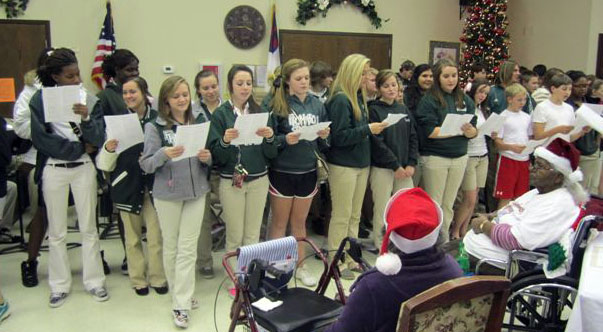
Members of the Flomaton High School Beta Club visited Century Care Center this week. The group sang Christmas carols and brought a gift for every resident at the facility.
For more photos, click here.
Pictured: Members of the Flomaton High School Beta Club sang carols and provided gifts for the residents of the Century Care Center. Submitted photos for NorthEscambia.com, click to enlarge.

Rick Scott: Slash Hospitals, Boost School Funding
December 8, 2011
Gov. Rick Scott unveiled a budget plan Wednesday partially paying for a boost in education spending with deep cuts to hospital payments, drawing scoffs from the state’s main teachers union and howls of protest from hospital groups.
Scott’s plans would also trim business taxes, shutter some prisons and shrink the state workforce by about 4,500 positions.
But what drew the most attention was Scott’s proposal to plow $1 billion into public education, in marked contrast to his reputation last year as a skinflint governor who balanced the budget with across-the-board spending reductions. Scott and his supporters touted it as a reaction to his meetings with Floridians during his summer travels; Democrats saw it as a crass political maneuver by an unpopular governor ahead of an election year.
Whatever the motivation, Scott said he would not bend.
“I will not sign a budget from the Legislature that does not significantly increase state funding for education,” he vowed.
The increase would be offset by several factors. About $444 million would replace one-time state funding or the loss of local tax income, and another $190 million would pay for enrollment growth. The per-student increase would be about $142, or 2.3 percent. Scott also didn’t replace hundreds of millions of dollars in federal education funding meant to fill some shortfalls.
Andy Ford, president of the Florida Education Association, downplayed Scott’s education spending as an attempt to distract from the cuts of recent years. The state would still spend about $210 million less on education under Scott’s plan than it did five years ago, with overall education funding down about $1.6 billion.
“Today’s budget proposal seeks to put a smiley face on the massive budget cuts of the past few years and ignores the realities that our children aren’t getting the education they need,” Ford said. “The governor says he wants to create high-paying jobs for Florida by investing in public education, but this budget proposal puts little more than a Band-Aid on the massive cuts of the past few years.”
Scott’s plan would also slash Medicaid reimbursement rates for hospitals, part of a plan to reduce by $2.1 billion the expected spending for the program next year. The governor said he would accomplish that largely by paying the same rates for similar hospitals, which would be placed into 10 groups to determine payment rates according to the type of facility.
“Our current system of reimbursing Medicaid hospital providers is unfair, illogical and incredibly expensive for Florida families and businesses,” Scott said at a press conference that was at one point crashed by a Daily Show reporter asking the governor for a urine sample.
But hospitals said that cut would wreak havoc on the state’s health-care system and could trigger higher charges to private citizens and insurance plans to offset the losses.
“It amounts to a giant tax on the sick,” said Bruce Rueben, president of the Florida Hospital Association.
Tony Carvalho, president of the Safety Net Hospital Alliance of Florida, said some hospitals’ financial viability would be threatened if the cuts were approved. The average rate reduction for hospitals would be about 35 percent, he said.
“These are staggering cuts for some hospitals,” Carvalho said.
Democrats also laid into the plan, saying it was an effort by the governor to bolster his approval ratings ahead of legislative and presidential elections next year.
“Leave it to the Madoff of Medicare to gut money from education only to return partial funding the following election year in a transparent effort to buoy the sagging poll numbers of the state’s Republicans,” Florida Democratic Party Executive Director Scott Arceneaux said in a blistering statement following the budget’s release.
Legislative Democrats were only slightly more measured in their criticism. Senate Minority Leader Nan Rich, D-Weston, said lawmakers should look at tax increases instead of further cuts as a source of new education funding.
“Pitting one critical priority against another is not the solution Floridians expect from the leader of the fourth largest state in the nation,” she said. “School books versus seniors or teachers versus public safety should not be among the options.”
Other portions of Scott’s budget plan include:
–A reduction of 4,500 positions in state government, including 2,800 filled positions. Officials with the governor’s office said they expected about 600 workers to ultimately lose their jobs when turnover and attrition were accounted for;
–The closing of some Department of Corrections facilities in an effort to save around $65 million, though Scott’s administration said the exact number wasn’t clear yet. The budget plan also counts on the state prevailing in a lawsuit challenging a policy privatizing prisons over the southern third of the state;
–Trust fund sweeps of around $147 million, though the Department of Transportation account would be untouched;
–About $23 million in tax cuts for businesses, which Scott said would be targeted mostly at small businesses, along with a constitutional amendment that could reduce tax bills further; and
–$15 million in new funding to restore the Florida Forever land-conservation program.
Republican legislative leaders, meanwhile, seemed to be unable to agree on exactly how quickly they would act on Scott’s recommendations. Senate President Mike Haridopolos, R-Merritt Island, has pushed to delay a final vote on the budget until a new set of revenue estimates becomes available, likely in March. That could extend the session, slated to begin in January, or lead to a special meeting later in the year.
“I just want to deal with numbers that I feel comfortable with and not be off by hundreds and hundreds of millions of dollars. … At the very minimum, we want to see where this economy is going before we make some final decisions,” Haridopolos said in an interview Wednesday.
But House Speaker Dean Cannon, R-Winter Park, issued a statement seeming to rule out extra meetings for the spending plan.
“I am confident that [Scott's] blueprint will be a valuable tool as the House develops its own priorities and works with the Senate to pass a balanced budget by the end of the regular session,” Cannon said.
By The News Service of Florida
Atmore Man Charged In Century Shotgun Shooting Road Rage Incident
December 7, 2011
An Atmore man has been charged with shooting a man in Century Tuesday and firing a shotgun across busy Highway 29 in a road rage incident.
 Deririck Medlock Hoover, Ala., told deputies he was traveling north on North Century Boulevard (Hwy. 29) about 3:50 p.m. when a white four-door vehicle swerved in front of him, cutting him off. Medlock said he pulled into the Century Quick Stop at 8130 North Century Boulevard to calm down after the near-accident.
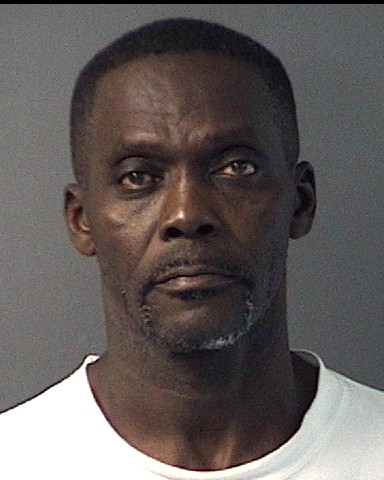
The driver of that vehicle, 55-year old Willie Floyd, was charged with aggravated battery, discharging a firearm in a public place and criminal mischief.
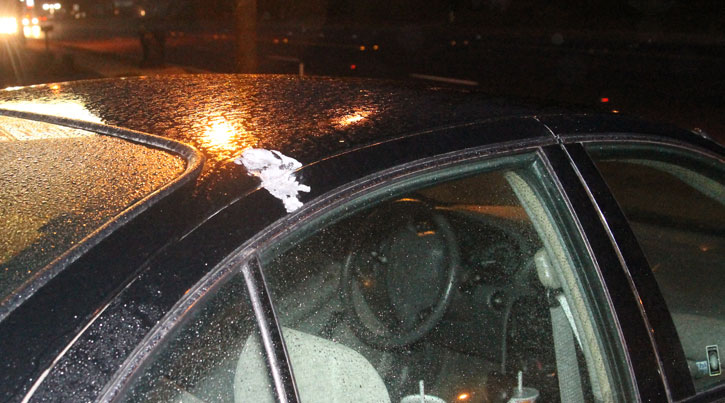
Medlock said he was outside his vehicle talking on his cellphone when Floyd then pulled into the parking lot and confronted the him, according to an arrest report. Floyd then retrieved a shotgun from his car and fired into the Medlock’s car, striking it with birdshot at the roof line above the rear passenger door (pictured below left).
Medlock then ran across North Century Boulevard when Floyd fired again, striking the victim in the leg with birdshot. Birdshot was also lodged in his wallet in his back pants pocket. Medlock hid behind a tree across North Century Boulevard from the store, where he watched Floyd drive away. Medlock then drove to the Southern Panhandle Restaurant just north of the store and called 911. He was evaluated there by Escambia County EMS, and he refused transport to the hospital.
 A witness inside the store at the time of the shooting gave chase, following Floyd’s vehicle to Williams Street, just off West Highway 4 in Century. Deputies were not able to locate the vehicle on Williams Street once they arrived. Other witnesses confirmed the details given by the victim, and at the shooting was captured on the store’s surveillance video.
A 19-year old passenger in Floyd’s vehicle ran inside the convenience store during the incident. He was identified on the store’s surveillance video and questioned by deputies. He was not charged.
When deputies questioned Floyd, he refused to give them any statement and contacted his attorney. Floyd was positively identified as the shooter by the victim, according to the Sheriff’s Office.
For more photos from the scene, click here.
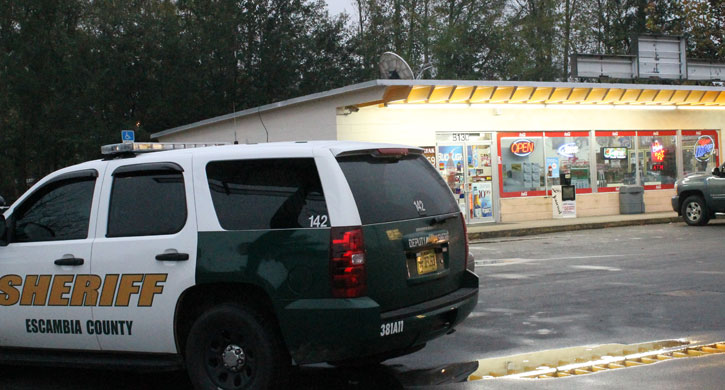
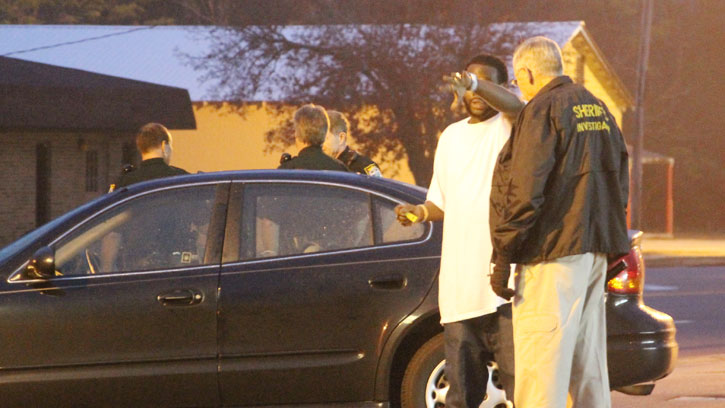
Pictured top: A Hoover, Ala., man explains how an Atmore man shot him with shotgun Monday in Century as Escambia County Sheriff’s Office Investigator Frank Way listens. Pictured inset: Damage to the victim’s car. Pictured below: A Monday afternoon shooting outside a Century convenience store is under investigation. NorthEscambia.com photos, click to enlarge.