

Photos: Hundreds Attend Molino Park Fall Carnival
October 13, 2012


Hundreds attended the annual Molino Park Elementary School Fall Carnival Friday evening at the school. The event featured games, food, entertainment and lots of great family fun.
NorthEscambia.com photos, click to enlarge.

Homecoming Win: ECHS Beats Monroe County
October 13, 2012


The Escambia County Blue Devils defeated Monroe County 36-18 Friday night in Atmore.
Coming up Monday morning on NorthEscambia.com, we will have a photo gallery from the Escambia County High School homecoming court, plus Friday afternoon’s parade.
Pictured: The Escambia County Blue Devils beat Monroe County Friday night in Atmore. NorthEscambia.com photos by Marcella Wilson, click to enlarge.

Navy Celebrates 237th Birthday Aboard Pensacola NAS With Bell Ringing
October 13, 2012

To honor the U.S. Navy’s 237th birthday, a global commemoration ceremony was held Friday with a Navy-wide bell ringing ceremony at 9 a.m., including a ceremony at Pensacola NAS.
The tradition of bell ringing to mark time in the Navy dates before the advent of the chronometer, when time at sea was measured by the trickle of sand through a half-hour glass.
One of the ship’s boys had the duty of watching the glass and turning it when the sand had run out. He struck the bell as a signal that he had performed this vital function. From this ringing of the bell evolved the tradition of striking the bell once at the end of the first half hour of a four hour watch, twice after the first hour, etc., until eight bells marked the end of the four hour watch. The process was repeated for the succeeding watches.
This age-old practice of sounding the bell on the hour and half hour has its place in the nuclear and missile oriented United States Navy at the dawn of the 21st century, regulating daily routine, just as it did on historic vessels under sail in the late 18th century.
Friday’s ceremony at Pensacola NAS consisted of the ringing of eight bells signifying the end of the 237th watch and one bell to signify the start of the watch of the 238th year.
Pictured: Sailors and guests listen as Commanding Officer Capt. Chris Plummer explains the ringing of the bells Friday at Pensacola NAS to signify the end of the 237th year of the Navy and the beginning of the 238th. Courtesy photo for NorthEscambia.com, click to enlarge.
Molino Woman Injured In Barrineau Park Road Crash
October 12, 2012
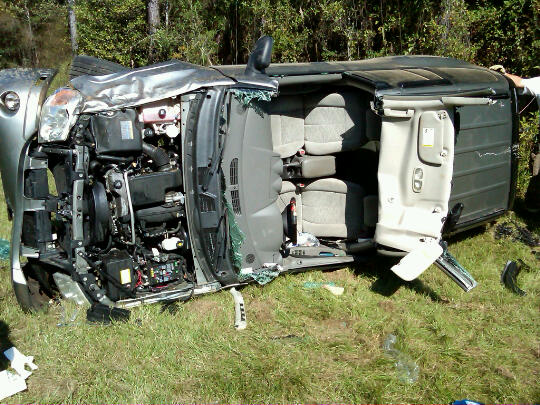
One person was injured in a single vehicle wreck on Barrineau Park Road Friday morning.
The Florida Highway Patrol said 59-year old Enola Money of Molino was transported to Sacred Heart Hospital by ambulance following the 9:45 a.m. crash just east of Jacks Branch Road.
Money apparently lost control and ran into a ditch, with her 2007 GMC Envoy coming to rest on its side. She was trapped inside the vehicle for a brief period as first responders used the Jaws of Life to free her.
The accident is under investigation by the Florida Highway Patrol. Escambia County EMS and the Molino and Cantonment stations of Escambia Fire Rescue also responded to the crash.
NorthEscambia.com photo, click to enlarge.
Human Remains Discovered In Cantonment Woods
October 12, 2012

An investigation is underway after human remains were discovered in a wooded area in Cantonment Thursday afternoon.
The remains were discovered about 4 p.m. in a wooded area off Well Line Road and Santa Rosa Road by a person that was clearing land.
“It appears that the remains have been there for some time,” Rawson said Thursday evening as the investigators remained on the scene, an area they were reaching with four-wheelers. “It’s too early to tell if the remains or male or female, or exactly how long they have been there.”
The remains will be turned over to the medical examiner’s office for an autopsy and identification.
Library War Continues Between ‘Dysfunctional’ City And ‘Extortionist’ County
October 12, 2012
“Dysfunctional”, “horse crap” and “extortionist” — the war of words between Escambia County and the City of Pensacola over library funding escalated Thursday, with members of the Escambia County Commission firing the latest verbal salvos over not just the library but also public transit.
The county commission cut their contribution to the library by 5-percent with the new budget year that began October 1, and the West Florida Library System responded by cutting hours at at all branches but most drastically at the Century and soon to be open Molino Branch. Just over two-thirds of the library system’s budget is from the county, while the city funds less than a third under an interlocal agreement.
 In a letter last week to the city, County Administrator Randy Oliver said the county will withhold a portion of their funding for the library system in order to hire the city’s library employees to fully staff libraries in the county, reducing the appropriation by the amount necessary to provided staffing to all library branches in the unincorporated areas at the same level as the branch in the city with the greatest operating hours.
After NorthEscambia.com published Oliver’s plan on Monday, City Administrator Bill Reynolds responded to Oliver Tuesday with a letter defending the reduced hours and claiming the county has actually failed to pay $1,229,663 for library services since 2008.
Reynolds said that Oliver’s plan to adjust library funding to maintain service hours at the rural branches “can only be taken as contemplation by the County to somehow further disrupt the system”. And he called the county’s threatened cutbacks “extortion”.
Thursday morning, commissioner fired back during a Committee of the Whole meeting.
“I call horse crap on that,” Escambia County Commissioner White said Thursday morning. White represents District 5, home of the Century and Molino Branch libraries. “They are the extortionists.”
 Commissioner Grover Robinson suggested that the city and county sit down to discuss the library and funding. But White said that would be a “waste of time” because “they’re so dysfunctional”.
The county has been “villainized” by the city, Commissioner Wilson Robertson said, mentioning how the city quit funding mass transit and leaving the county to foot the entire bill for ECAT, including routes in the city. He suggested that county add up the mass transit money not paid by the city, about $6.5 million, subtract $1.2 million for library funding and bill the city for the difference. If not, he suggested that the county limit mass transit service inside the city.
“It we are going to be accused of extortion, let’s get this right,” Robertson said.
Commissioner Gene Valentino suggested that the county could “seize control” of the library system since the commission represents the entire county, including Pensacola residents.
Robinson asked County Attorney Alison Rogers to draft a motion to be considered by the commission on October 18 that would get the county out of their interlocal library agreement with the city.
Prep Football Finals
October 12, 2012

Here are final football scores from around the area Friday night
Florida
Pensacola 32, Tate 14
Jay 36, Cottondale 20
Pine Forest 63, Washington 0
Escambia 29, Pace 28
Gulf Breeze 23, Milton 20
Catholic 26, Walton 0
Open: West Florida, Northview
Alabama
Southern Choctaw 26, Flomaton 21
Escambia County 36, Monroe County 18
Clarke Prep, 27, Escambia Academy 26
T.R. Miller 48, Southside 18
W.S. Neal 44, Bayside 42
Pictured above and below: The Jay Royals picked up a homecoming win against Cottondale Friday night. Photos by Michelle Gibbs for NorthEscambia.com, click to enlarge.

JV Football: West Florida Over Northview (With Gallery)
October 12, 2012

 The JV West Florida Jaguars got past Northview 22-20 Thursday evening in Bratt.
The JV Chiefs will end their season next Monday evening at 6:30 against Escambia County High School of Atmore.
For a photo gallery, click here.
NorthEscambia.com photos, click to enlarge.

Commission To Review, Possibly Terminate Administrator Next Week
October 12, 2012

The Escambia County Commission could vote to terminate the contract of of County Administrator at their next meeting on October 18.
 Calling it a “housekeeping” measure, District 5 Commissioner Kevin White introduced a motion during a Thursday morning meeting to reserve the right to take a termination vote October 18 after a public evaluation of Oliver’s performance. The motion passed 3-2, with commissioners Grover Robinson and Marie Young against.
Each commissioner has already submitted their own personal written evaluation of Oliver’s job performance. He was given a generally good reviews by Young and Robinson, but numerous issues and shortcomings were raised by commissioners White, Wilson Robertson and Gene Valentino.
“The policies he promotes are his, not the commissioners,” Valentino wrote in his review of Oliver. “Initiatives of commissioners were killed through his approach. He would not champion a commissioner cause unless he agreed.”
Valentino also scored Oliver poorly in his leadership abilities, community relations, administrative duties and economic development. “Feedback from the public and other county agencies found him to be arrogant and rude,” Valentino wrote. He also said Oliver had a “I know better than the commissioner” attitude.
 “This is a tough job. Randy is not perfect but who can be with five bosses,” Robinson wrote in his evaluation, generally rating Oliver at or above satisfactory in all aspects.
“He does not seem to be open minded to other ideas,” White wrote, giving Oliver less than satisfactory ratings in supervision, community relations, administrative duties, economic development and intergovernmental relations.
White said that over time he has “developed less faith” in Oliver’s supervision as county administrator.
“You’ve shown great leadership and has helped the county in many ways,” Young wrote on her evaluation form. “It is my desire that your tenure will for many opportunities to help grow Escambia County and improve the quality of life for our citizens.” Young gave Oliver straight “outstanding” marks in all evaluation categories.
Robertson expressed concerns with Oliver’s performance in the areas economic development, county council relations, planning and administrative duties.
Oliver was hired as county administrator in September 2010.
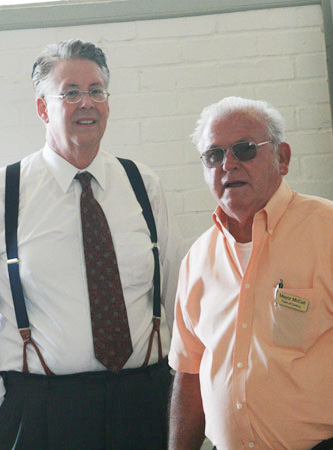
Pictured top: (L-R) Pensacola Chamber President Jim Hizer, Escambia County Administrator Randy Oliver, Century Mayor Freddie McCall and Escambia County District 5 Commissioner Kevin White discuss economic development during a tour of Century in 2011. NorthEscambia.com file photo, click to enlarge.
Undefeated: Ernest Ward Beats Summerdale (With Photo Gallery)
October 12, 2012


The Ernest Ward Middle School Eagles continued their perfect season with a 30-0 win over Summerdale (Ala.) Thursday night in Walnut Hill. The Eagles (6-0) will wrap up their season next Thursday night at 6:00 at Elberta, Ala.
For a photo gallery, click here.
Pictured: The Ernest Ward Middle School Eagles defeated Summerdale Thursday night at home. NorthEscambia.com photos, click to enlarge.