

Cantonment Woman Accused Of Elderly Abuse Sentenced On Lesser Charges
February 5, 2015
A Cantonment woman charged last year with abusing her elderly roommate has been sentenced on lesser charges.
 Kelly Colleen Lister was sentenced to 11 months and 15 days in the county jail, with credit for time served, for battery and resisting arrest without violence. A charge of abuse of a disabled elderly person was dropped.
The roommate victim told Escambia County Sheriff’s deputies that Kelly Colleen Lister has been drinking all day and broke several things inside their house before hitting her in the face. The victim told deputies she is mentally disabled and cannot move without the aid of a walker or wheelchair. She said Lister had knocked her off a couch.
An independent witness at the home confirmed the alleged abuse to deputies, according to an arrest report, and the victim had obvious physical injuries.
When deputies ordered Lister to stand up from a couch, she instead grabbed a bottle of liquor and began to drink it, and she pulled away from deputies trying to place her under arrest, the ECSO report states.
Century Business Challenge Now Open
February 5, 2015
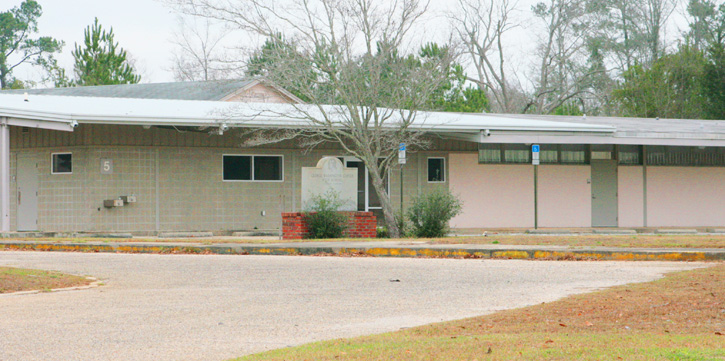
The Century Business Challenge is now open, with the winner set to receive startup money and an almost free business location for a year.
The challenge is effort of Quint and Rishy Studer and the University of West Florida Haas Center for Business Research and Economic Development and the UWF Small Business Development Center.
The Century Business Challenge will be open to any applicant wishing to start a new business in the Town of Century. Business relocations and expansions will be considered, but only for compelling need-based reasons. The winner of the Century Business Challenge will receive a package of incentives to assist with the planning, location, and operational hurdles that often keep entrepreneurial plans from ever being realized.
The package will include:
- A one year lease in the Century Business Center (the former “Habitat for Opportunity Building” in a former school on Pond Street) for $1. The lease may be extended with a rate dependent on the financial condition of the business.
- Up to $25,000 in build-out and startup capital funds to be used for equipment, building upgrades, or furniture from the Studers; and
- Ongoing business mentorship from successful business leaders.
Applicants will first need to submit an application, followed by a business plan that is based on the Challenge timeline and resources. Participants will receive business plan software valued at $90 to assist them with their plan. Following the submission of the business plans, a Challenge panel of business experts will judge each business plan, and the top-scoring business plans will proceed to Round Two, which is a more intensive, elevator-pitch style interview with the Challenge panel.
The Challenge panel will determine the winning business plan, and the winning company will immediately begin the process of working to start, relocate, or expand a business in Century.
Applications are available at CenturyBusinessChallenge.com and are due by March 31. Business plans will be due by May 29.
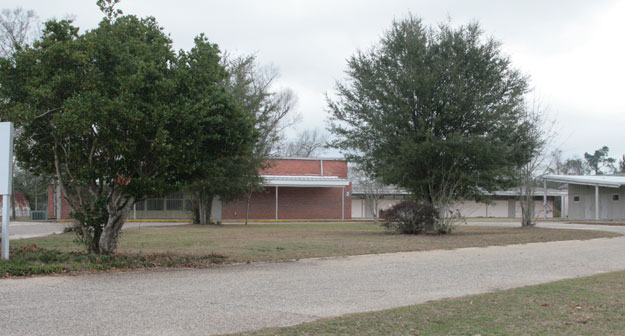
Pictured: The now-empty Century Business Center. NorthEscambia.com file photos.
Sheriff’s Office Seeks Two Possible Shooting Witnesses
February 5, 2015
Escambia Sheriff’s investigators are seeking two possible witnesses in connection with the January 19 afternoon shooting that occurred on Erress Boulevard. The victim later passed away from injuries sustained during the shooting.
Investigators believe Courtney Tywan Beasley, 23, and Leila Lucille Gilliams, 23, may have information concerning the incident during which 23-year old Jessie James Bryant, Jr. was shot and killed. The Sheriff’s Office said that neither Beasley nor Gilliams are considered suspects at this time.
Anyone with any information on the whereabouts of Courtney Tywan Beasley or Leila Lucille Gilliams should contact Gulf Coast Crime Stoppers at (850) 433-7867. Calls are anonymous and if information helps to solve a crime, the caller could earn a cash reward.
Five Questions For Florida DOC Secretary Julie Jones
February 5, 2015
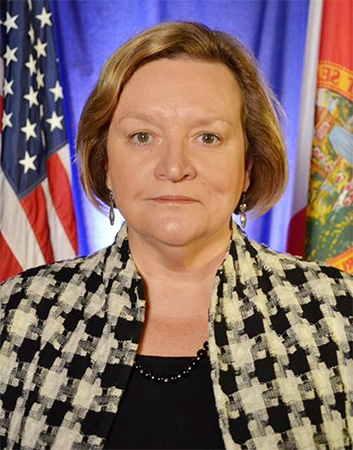
Florida Department of Corrections Secretary Julie Jones came out of retirement to take over a troubled agency dealing with reports of cover-ups involving inmate deaths, whistleblower lawsuits and state and federal investigations into prison activities.
Tapped in December by Gov. Rick Scott, Jones is the first woman to lead the agency overseeing more than 100,000 inmates. She retired last spring after a five-year stint as chief of the Department of Highway Safety and Motor Vehicles. Prior to that, Jones served more than two decades at the Florida Fish and Wildlife Conservation Commission, where she worked her way up to director of law enforcement before taking the highway-safety position in 2009.
Five questions for Julie Jones:
Q: You’ve taken over an agency that is the subject of lawsuits from workers who say they’ve been retaliated against for exposing wrongdoing. The department is under state and federal investigation at different prisons for corruption and abuse and is the object of almost daily critical news reports. Do you think you’ll be able to turn the agency around and instill public confidence and particularly assure families of inmates that when their loved ones enter institutions they will come out alive?
 JONES: I am absolutely confident that we are going to be able to right this ship. I say that based on my confidence in the people that work for this department and the solid reputation that many of our people have in their communities. We’re doing a series of surveys right now. We did an online survey. We’re also going into every institution. I have a team that’s going there for me. The teams that are entering into these institutions are finding people that care. They understand their role. They want to be involved in reentry. They want to be involved in getting that inmate in and out. They are standing up saying that they are not going to let a few people ruin their reputation. That’s what’s happened. There’s been a small number of people that have tarnished the entire system, the entire corrections system. It pains me that it’s been so effective. You heard me say in testimony last night (in a Senate committee) that it’s a perception. I truly believe, yes, we have pockets of resistance and people that probably should not be corrections officers but they are few and far between. It’s my confidence in the existing staff that leads me to believe that we can fix it and that I’m going to be able to be accountable to those families and friends of inmates, and for them to know that they will be safe in our institutions.
Q: Your predecessor, former Secretary Michael Crews, said that there were problems with flooding, leaking roofs, supply shortages and a list of other troubles that went way beyond perception.
JONES: We definitely have an infrastructure problem. Mr. Crews talked about it. I have talked about it. We have approximately $116 million in infrastructure needs. But because that number is so large, it’s better for me to break it up in chunks. I asked staff, what can you do this year? And the answer was $15 million for fixed capital outlay, and the governor’s put it in the budget. This solves another problem. Because we’ve been underfunded in that category, to keep the roofs fixed we’ve been keeping vacancies in our officer positions to fix the roof. That creates an officer safety issue. It creates issues inside the institutions that create tension. If we fix the funding issues associated with this agency, I think it goes a long way to stabilizing the environment. Fully staffed institutions means we now can deliver all those services to those inmates, and get them into the system and get them out of the system, preferably in a better way.
Q: The department is estimated to spend $33 million on overtime this year, largely because of staffing shortages. You asked for $16.5 million to fill vacant positions. That would only fill about 300 more than 2,000 jobs that were cut over the past several years. Can you fill critical staff positions at prisons with the amount of money you requested?
JONES: The staffing level on the books is not the issue. Stopping the use of salary dollars for roofs, for bed linens, for medicine, for all the stuff that we’re using it for and using it to staff the institutions is the goal here. I have a list of every institution, and that list gives me current required positions, total facility positions and then staffing. My suggestion was 96 percent. You’re never going to have every position filled, just because of churn — people retiring, quitting, going off to another job. That number, for staffing goal, is 16,283 positions. We have 16,851 authorized positions. That looks like we’re overstaffed. In reality we’re not. Because there’s another issue that’s key to staffing a prison and it’s relief factor. We want the issue of relief factor to always be considered in a staffing matrix. So you can ask me how many bodies I need. Then I’m going to tell you when someone goes on leave — they’re sick, military leave, maternity leave — you always need a little fudge factor in there for extra staffing to keep everything filled. That number is a couple of hundred more. So we’re very close to being fully staffed. That’s why when the governor looked at me and said, “How much money do you need?” we did an analysis of the entire system but also went beyond just the security section, the institutions part. That $16.5 million is for every critical position in reentry, in the institution units and the correction probation, our community corrections people. Because all three have to work seamlessly and integrate with one another in order to help that inmate out of the system. You’re going to hear me talk more and more about taking that individual when they enter into a reception center, do every evaluation that we can and then tell that inmate, here is your reentry plan. You may have a two-year sentence. You may have a 10-year sentence. But we’re going to immediately begin the process to get you the resources that you need to be safe. You’re not going to be happy in a prison. No one’s happy in a prison. But to keep you occupied. To get you educational classes, vocational, drug and alcohol rehabilitation — anything that we have available for you to get into the correct correctional environment to have that corrections piece be real. Right now, because of the staffing and because of some gaps in our budget, I believe we warehouse people. We need to start to be a correctional institution now.
Q: There’s been some criticism, including from senators, about your interpretation of the use-of-force statistics. There was an increase of 1,017 incidents of use of force, an 18 percent rise. But you explained that numbers weren’t really going up because the number of incidents that could have resulted in use of force but did not went up by more than 2,000. Can you explain your interpretation of the use-of-force data?
JONES: It’s very important when you talk about use of force to understand it’s a negative term but it’s not necessarily a negative act. I was trying to say that use of force is anything from holding someone’s arm and escorting them into a room all the way to doing a cell extraction. Those cell extractions, by the way, are planned. They’re safe. And they’re always videotaped. That goes to some of the questions on how do you know when force is used. We know because we try to video any encounters, if not at the beginning of the encounter, at the end of the encounter. The three biggest areas of increase last year were in self-defense, use of force to quell a disturbance or use of force for physical resistance to a lawful act. I also said yesterday that the number of times we had to react to those issues were up 894 but the precipitating act associated with that 800-plus increase were actually 2,812. What I was trying to say was yes, we had an increase of laying hands on an inmate for a legitimate purpose and it was because we had almost double an increase of times where those officers had to react. So yes, it went up, but so did the precipitating acts. The point that I think was lost in the discussion was use of force is 99 percent of the time legitimate. It’s necessary. We use use of force to quell riots, disturbances between inmates, when we have inmates with weapons, when we have possession of stimulants. We dispense a lot of pills in our corrections institutes. Sometimes it’s hard to tell whether they swallow the pill or not. They go back in and it becomes contraband. Someone else is taking medication that they shouldn’t. Aggravated battery on an inmate or on an officer. We have assaults not only on inmates but on officers. And we have unauthorized possession of contraband, which is usually cell phones. And then gang-related activity. We actually had an increase from 187 incidents to 244 with gang-related activity. These are the kinds of things our officers are encountering. So it sounds terrible. It’s increased by almost 900 incidents of use of force when in actuality, because we’re training officers with critical incident techniques to lower the temperature when they encounter many of these situations, the number of misuse where you violated policy in your use of force and were subsequently disciplined — remember an increase of almost 900 incidents — the misuse, the illegal use of force by a corrections officer went down from 40 to 27 incidents. So these numbers are big. But you have to understand what the numbers represent. And the key number for me is violations of policy are down. I believe it’s down because we’ve done a lot of training in the last six months and it’s proving to be very, very valuable. In 2010, when we closed 23 institutions, we put almost 12,000 inmates into already-occupied dorm space. So we put more people together. Close confinement of 12,000 more people into the same or similar institution I think has created tension. We have these chronic vacancies. So just the fact that we don’t have fully staffed institutions where we can keep an eye on every inmate at every corner means that sometimes we have an inmate that walks up to the control room with an injury that we didn’t observe. Someone else did that to them. Staff assaults have gone up 12 percent. That’s the other piece that I think is missed in this. The correlation between staffing and use of force indicates that the officers are doing something wrong. The number’s going up so they must be at fault. And they’re not. The question that very few people ask me is, is there a correlation with staffing and assaults on officers and injuries to officers, and indeed there is. Officers are quelling more disturbances and doing it correctly and getting injured more often. That’s the story. That last piece is very rarely spoken about.
Q: One of the first things you did after taking over was to look at the health-care contracts and say they needed to be reworked. Senate Criminal Justice Chairman Greg Evers ordered you this week to renegotiate the contracts immediately. Has the time come for the state to rethink the privatization of health care for inmates?
JONES: Let me talk about the accountability measures. We need liquidated damages. We need penalties. And we need to totally rethink the behavioral sciences piece that’s associated with mental-health care in these contracts. These contracts were done under a request-for-proposal standard. I think they need to be rebid under an invitation to negotiate so we can really sit down with vendors and talk about where their skills are, what they have to offer and set mutually agreed-upon goals about what is success and what is staffing. I intend to look at this very hard in the next two weeks. I know Sen. Evers said rebid today. But frankly I have to take a seamless approach to how we do these contracts because I need a continuum of service. These two companies that have these contracts can give me 120-day notice and walk away. I don’t want that to happen. I want us to come to an agreement where we mutually agree that we need to redo how we’re operating under these contracts and then rebid. I do not believe that privatization of health care was a failure. I believe that if we had done it correctly with the right procurement instrument we would have been much more successful. But I want the ability to look at all angles. I believe that if we went back to state employees it would be much more expensive than the current contract. But rebidding the contracts as they exist today would be more expensive. So we’re going to have to look at it from all angles. Do we continue with privatization or do we partially privatize? All of these options will be on the table. Going back to fully-staffed (full-time employees) with state employees I do not believe is an option.
by Dara Kam, The News Service of Florida
National Signing Day Highlights
February 5, 2015

Wednesday was National Signing Day. Scroll down the page for highlights and photos from signings across the area.
Northview OL Jaylen Parker signed with LaGrange College in LaGrange, GA, choosing the school over Huntingdon College in Montgomery ( pictured above).

Northview OL Tydre Bradley signed with Rochester Community and Technical College in Rochester, MN (above).
Tate High School’s DE Chris Terrell signed with Central Arkansas, rather than Southern Mississippi.
Escambia’s Gerold Bright signed with Utah State.
Catholic High’s Duke Acromite signed with Jacksonville University, Antione Barker signed with Troy, and Daniel Byrd signed with Jacksonville State.
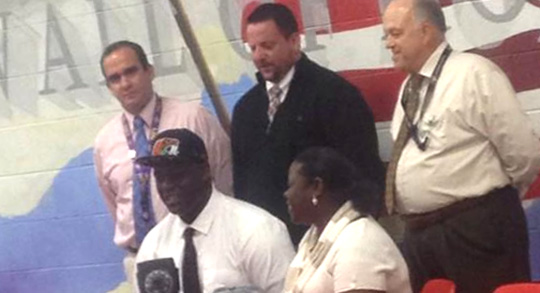
DL Albert Moore from West Florida High School signed with FAMU (above).
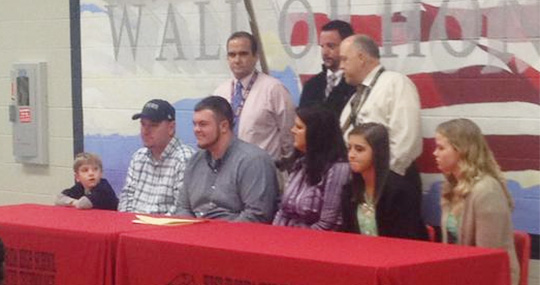
OL Devin Gibson from West Florida High School signed with the new Argo football program at the University of West Florida (above).
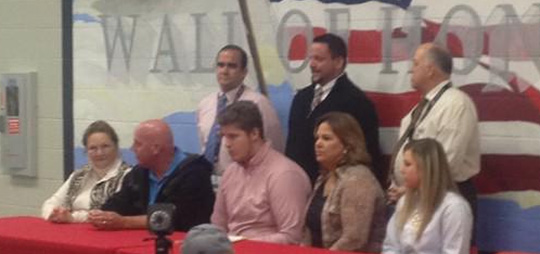
OL Noah Banks from West Florida High School signed with Murray State (above).
NorthEscambia.com and West Florida Football photos, click to enlarge.
Tate High Drama’s ‘The Addams Family: A Musical Comedy’ Opens Tonight
February 5, 2015

The Tate High School Drama Department will present “The Addams Family: A Musical Comedy” on the school cafetorium stage Friday and Saturday at 7:00 each evening.
The creepy, kooky, mysterious, spooky and altogether “ooky” Addams Family story brings the characters of Gomez Addams, Morticia Addams, Uncle Fester, Wednesday Addams, Pugsley Addams, Grandma, Lurch and others onto the stage in an original story with Wednesday falling in love with a sweet, smart young man from a respectable family – a man her parents have never met. And if that weren’t upsetting enough, Wednesday confides in her father and begs him not to tell her mother. Now, Gomez Addams must do something he’s never done before – keep a secret from his beloved wife, Morticia. Everything will change for the whole family on the fateful night they host a dinner for Wednesday’s ‘normal’ boyfriend and his parents.
The Tate Drama Department will also be conducting a silent auction to help raise funds for the state competition. Tickets are $10 for the reserved section and $7 for general admission.
Pictured: The Tate Drama Department’s “The Addams Family: A Musical Comedy”. Photos for NorthEscambia.com, click to enlarge.

Media, Open Government Groups Seek Answers On Bailey FDLE Ouster
February 5, 2015
Media organizations and open-government advocates are upping the pressure on Gov. Rick Scott and the Florida Cabinet, filing a lawsuit that alleges the handling of the forced resignation of the state’s top law-enforcement officer violated the Sunshine Law and calling for an independent investigation.
The two separate moves came ahead of a Thursday meeting in Tampa, where Scott, Agriculture Commissioner Adam Putnam, Chief Financial Officer Jeff Atwater and Attorney General Pam Bondi are set to discuss new steps for hiring and reviewing agency heads.
Filed by the Associated Press, the Florida Society of Newspaper Editors, Citizens for Sunshine and St. Petersburg attorney Matthew Weidner, the lawsuit focuses on conversations between Scott’s staff and aides for other Cabinet members concerning the ouster in December of former Florida Department of Law Enforcement Commissioner Gerald Bailey. The staff discussions were a way for Scott to work around the state’s open-meetings laws, the suit contends.
“The governor violated the Sunshine Law by using conduits to engage in polling, discussions, communications and other exchanges with other members of the Cabinet regarding his unilateral decision to force the resignation of the FDLE commissioner and appoint a replacement without any notice to the public, without any opportunity for the public to attend, and without any minutes being taken,” says the lawsuit, filed late Tuesday.
In a “frequently asked questions” document sent to the news media and a series of follow-ups, the Scott administration has outlined some of the discussions between the governor’s staff and the offices of the other Cabinet members. Scott’s office has denied that the discussions about Bailey violated state law.
“It has been a longstanding convention for governor’s staff to provide information to Cabinet staff,” said one answer. “This was the same process the Cabinet staff followed in respect to Gerald Bailey.”
The groups suing Scott and the Cabinet say those kinds of statements show the need for the courts to also issue an injunction barring similar conversations in the future.
“Plaintiffs would suffer irreparable injury if defendants continue the longstanding practice of violating the Sunshine Law by allowing Cabinet aides to engage in polling, discussions and communications about appointments required to be made by the Cabinet and relaying the results of those exchanges back to Cabinet members prior to a Cabinet meeting,” the lawsuit says.
Meanwhile, the Tallahassee-based First Amendment Foundation wrote a letter to Bondi asking for a special prosecutor to look into whether the Sunshine Law was violated. (The News Service of Florida is a member of the foundation.)
“Only a prosecutor with the authority to subpoena witnesses and documents can adequately investigate this matter,” wrote Barbara Petersen, the foundation’s president, in a letter dated Wednesday. “However, that prosecutor must be perceived as entirely objective. A prosecutor outside of Leon County — one who does not reside and work in the same town as those under investigation — should be appointed. Otherwise, public confidence in the investigation itself will be compromised.”
The decision to push out Bailey has sparked perhaps the most serious crisis Scott has faced in his four years as governor. He and the Republican Cabinet members have clashed about what the Cabinet members were led to believe about Bailey’s departure.
Scott initially said the commissioner resigned from the post. But Bailey, who has only publicly commented to the Miami Herald/Tampa Bay Times Tallahassee bureau, has said, “I did not voluntarily do anything.”
The governor has signaled that he would like to make other changes at agencies under Cabinet control, perhaps starting as soon as Thursday. Scott is calling for the Cabinet to begin the process of possibly removing at least three agency heads: Insurance Commissioner Kevin McCarty, Office of Financial Regulation Commissioner Drew Breakspear and Department of Revenue executive director Marshall Stranburg.
Putnam and Atwater have said that they will not discuss additional leadership changes until the hiring process is revamped.
by Brandon Larrabee, The News Service of Florida
6,000 Gallon Sewage Spill On Quintette Road Cleaned Up
February 4, 2015
About 6,100 gallons of sewage leaked on Quintette Road Tuesday afternoon when a sewage line was ruptured by a contractor working in the area.
The 8-inch force main was damaged at 561 West Quintette Road. About 6,000 gallons was contained, collected and transported by vacuum truck to the Central Water Reclamation Facility for proper disposal and treatment. ECUA crews repaired the break, and the overflow area was then cleaned and disinfected with a biocide agent that abated any contamination concerns, per state protocol, according to an Emerald Coast Utilities Authorities press release.
The Escambia County Health Department and the Florida Department of Environmental Protection were notified.
Reports Of Shooter At Saufley Field Were False
February 4, 2015
 Authorities responded to a report of an active shooter at the Navy’s Saufley Field Wednesday morning, but that report turned out to be false.
The 911 was call was reportedly received at a dispatch center in Alabama, with the caller reporting a possible shooter at Saufley Field. The military and local authorities were able to verify that the report was false after a search of the area.
The incident remains under investigation.
Driver Injured In Three Vehicle Crash
February 4, 2015

One person was injured in a three-vehicle crash Wednesday morning on Highway 95A at Tate School Road. The driver was transported by ambulance to West Florida Hospital with injuries that were not believed to be serious. The other drivers were not injured. NorthEscambia.com photos by Kristi Price, click to enlarge.