

Blue Angels To Fly Over 2016 Super Bowl
January 30, 2016

The Blue Angels are slated to perform a flyover of the 2016 Super Bowl at Levi’s Stadium in Santa Clara, California, Feb. 7.
The Blue Angels will open the football game with their signature six-jet Delta formation, immediately following the national anthem.
The football game is set to pit the National Football League’s Denver Broncos against the Carolina Panthers. More than 70,000 spectators are expected to attend the football game, which draws more than 114 million viewers worldwide.
The Blue Angels are currently training in California for the 2016 air show season and are scheduled to fly 65 demonstrations at 33 locations throughout North America in 2016, which is the Blue Angels 70th anniversary year.
The mission of the Blue Angels is to showcase the pride and professionalism of the United States Navy and Marine Corps by inspiring a culture of excellence and service to country through flight demonstrations and community outreach.
NorthEscambia.com file photo, click to enlarge.
Science And Engineering Fair Results
January 30, 2016
The results of the 2016 West Panhandle Science and Engineering Fair were announced his week an awards ceremony held at University of West Florida. The annual Science and Engineering Fair is a partnership of the College of Science and Engineering and the Escambia and Santa Rosa County School Districts.
Students who qualified to compete at the Florida State Science Fair will have an asterisk by their name. Grand winners (two senior winners) are eligible to compete at the International Science and Engineering Fair, May 8-13 in Phoenix, AZ, and won $6000 scholarships from the University of West Florida. Junior Grand winners are eligible to compete at State.
Winners of specific events in the high school and middle school categories were:
Animal Sciences
1st place – Skyler Flynn & Chase Creech – WFHS *
2nd place – Serena Green, Grace Menzies & Kayla Lycus – BTWHS
Behavioral & Social Studies
GRAND – 1st Place – Patricia McAuley, Holley Meany & Lauren Beall – PHS *
2nd Place – Lillian Wiggins & Virginia Beall – PHS *
3rd Place – Delaney McCall & Carly Fraser – PHS
Biomedical & Health Sciences
1st Place – Eva DeSoi – PHS *
2nd Place – Wesley Delware – EHS
3rd Place – Ariana Evans – BTWHS
Cellular/Molecular Biology & Biochemistry
1st Place – Sohail Mirza – PHS *
2nd Place – Kinan Alsheikh & Carla Dias – PHS *
HM – MacKenzie Sutt & Elizabeth Teets – BTWHS
Chemistry
1st Place – John Dixon & Justin Liu – PHS *
2nd Place – Daniel Duong – BTWHS (* Senior Alternate)
3rd Place – April Mendez – BTWHS
HM – Raymond Brown – EHS
HM – Rebecca Weatherspoon – BTWHS
Earth & Environmental Sciences
1st Place – Kelly Wu – PHS *
2nd Place – Jonathan Billingslea – PHS *
3rd Place – Reid Harwell – PHS
HM – Alexis Evans & Miya May – BTWHS
Engineering
GRAND 1st Place – Alexander Pope – PHS *
2nd Place – Matthew Arellano, Teri Laird & Sarah Quinlan – EHS
3rd Place – Dakota Davison & Bailey Wilson – EHS
Environmental Engineering
1st Place – Elleon Forty & Jeffrey Sutherland – PHS *
Intelligent Machines, Robotics & System Software
1st Place – Geneva Anderson – WFHS *
2nd Place Dina Razek, Drew Jimenez & Kareem Bataineh – PHS *
HM – Olivia Stanhope – WFHS
Mathematics & Computational Sciences
1st Place – Omari Harris – BTWHS
HM – Henry Kimberi – WFHS
Microbiology
1st Place – Greer Coffey & Emily Dawson– BTWHS
2nd Place – Jennifer Dean & Heidi Neumann – PHS
Physics & Astronomy
1st Place – Xuan Ho & Joseph McCormack – PHS *
2nd Place – Jacob Ferris – PHS (* Senior alternate)
3rd Place – Rachael Chase & Samantha Cherry – EHS (* Senior Alternative)
HM – Amy Peterson – BTWHS
Plant Sciences
2nd Place – Ashlyn Whittington – BTWHS
3rd Place – Kyndall Rideau – BTWHS
Animal Sciences
1st Place – Dana Amin – Saint Paul *
2nd Place – Sarah Hamilton – Saint Paul (*Junior Alternate)
3rd Place – Mariah Mack – Bellview Middle
3rd Place – Cody Thomas – Ernest Ward Middle
HM – Kyla Brewer – Holley Navarre
Behavioral & Social Sciences
1st Place – Hannah Meyers – Saint Paul *
2nd Place – Emily Wentzel, Hope Fell & Lauren Lacour – Saint John’s *
3rd Place – Gisel Martinez – Holley Navarre
HM – Seth Menzer – Holley Navarre
Biomedical & Health Sciences
1st Place – Kaylee McDonald – Holley Navarre
2nd Place – Madeline Mauzy – Holley Navarre
3rd Place – Olivia Coleman – Holley Navarre
HM – Zhikembria Williams – Bellview Middle
HM – Mya Clegg – Bellview Middle
HM – Darah Schumpert – Holley navarre
Cellular/Molecular Biology & Biochemistry
1st Place – Brooke Rayborn – Holley Navarre *
2nd Place – Zachary Oestmann – Holley Navarre *
HM – Logan Wallace – Holley Navarre
HM – Lauren Miller – Holley Navarre
Chemistry
1st Place – Mary Beloat – Holley Navarre *
2nd Place – John Middleton – Saint Paul
3rd Place – Emily White – Saint John’s
HM – Jessica Olson – Holley Navarre
HM – Jasmine Galvez – Saint Paul
Earth & Environmental Sciences
1st Place – Chase Turner – Holley Navarre *
2nd Place – Darcy Sullivan – Saint Paul *
3rd Place – Meghan McGilley – Saint Paul
HM – Peter Mougey – Saint Paul
Engineering
1st Place – Quin Baker, Jr. – Saint Paul *
2nd Place – Katherine Fey – Holley Navarre (* Junior Aternate)
3rd Place – Cameron Lange – Holley Navarre
HM – Mya Hamilton – Holley Navarre
Environmental Engineering
1st Place – Claire Han – Brown Barge Middle *
2nd Place – Kaleb Barrett – Holley Navarre
3rd Place – Nathaniel Merrill –Gulf Breeze
Intelligent Machines, Robotics & System Software
GRAND 1st Place – Regan Rudzki – Holley Navarre *
GRAND 1st Place – Ravi Raj – Brown Barge Middle *
3rd Place – Maddox DeMars – Holley Navarre
HM – D.Connor Vickery – Holley Navarre
Mathematics & Computational Sciences
1st Place – Chance Cunningham – Holley Navarre *
HM – Mikael Patriarca – Bellview Middle
Microbiology
1st Place – Payden Mouritsen – Brown Barge Middle *
2nd Place – Mary Galloway – Saint Paul *
3rd Place – Angelia Morris – Holley Navarre
HM – Olivia West – Saint Paul
HM – Callista Salazar – Holley Navarre
Physics & Astronomy
1st Place – Kori Vertz – Warrington Middle *
2nd Place – Timmy Hodges – Saint Paul *
3rd Place – Julianna Cannon – Holley Navarre
HM – Meredith McGhee – Ernest Ward Middle
Plant Sciences
1st Place – Isaiah Gurule-Rat – Saint John’s *
2nd Place – Lillian Sylvia – Holley Navarre (* Junior Alternate)
3rd Place – Austin Anderson – Holley Navarre
HM – Noah Buenaflor – Holley Navarre
Additional Special Awards were also announced to include:
American Chemical Society–$100 to Sr. and $50 to Jr. Chemistry & Biochemistry for outstanding achievement in chemistry. The winners for chemistry are Senior: team project of John Dixon & Justin Liu (PHS); junior, Mary Beloat (Holley Navarre). The winners for Biochemistry are senior, Sohail Mirza (PHS) and junior, Brooke Rayborn (Holley Navarre)
American Meteorological Society–A certificate of outstanding achievement in the field Meteorology is awarded to Jasiana Edwards (Holley Navarre), Miya May (BTWHS) and Alexis Evans (BTWHS).
American Psychological Association — The world’s largest association of psychologists, works to advance the creation, communication, and application of psychological knowledge to benefit society and improve people’s lives. A certificate for outstanding research in psychology is awarded to Patricia McAuley, Holley Meaney, and Lauren Beall (all PHS).
American Society of Civil Engineers/Pensacola Branch — Supporting this science fair for the first time this year, presented with the following awards:
1st place Sr. Division: Alexander Pope- $50 gift card and medal (PHS)
2nd place Sr. Division: Jeffrey Sutherland & Elleon Forty – medals (PHS)
3rd place Sr. Division: Bailey Wilson & Dakota Davison – medals (EHS)
1st place Jr. Division: Claire Han-$50 gift card and medal (BBMS)
2nd place Jr. Division: Quin Baker – medal (St. Paul)
3rd place Jr. Dividsion: Ezra McKenna – medal (Holley Navarre)
ASM Materials Education Foundation—Provided an award for the most outstanding exhibit in materials science. A certificate & a medallion for the best materials engineering project is awarded to Alexander Pope (PHS).
ASU Walton Sustainability Solutions Initiatives: Recognized two Sr. projects for striving to find innovative solutions to humanity’s most challenging problems. Geneva Anderson (WFHS) and Kelly Wu (PHS)will receive a certificate and will be nominated to enter for the Grand Prize, a trip to Arizona for the 2016 Sustainability Solutions Festival.
Association for Women Geoscientists: Awarded a Certificate of Achievement to recognize a female student whose project exemplifies high standards of innovativeness and scientific excellence in the geosciences was presented to Darcy Sullivan (St. Paul).
Association for Unmanned Vehicle Systems International: Awarded projects for their excellence in the categories of EAEV, ENMS, IMRS, and PHYS. Each of the top three projects will receive $15 iTunes Cards. Top 3 will compete for a $500 award for the best project from the Three Rivers, East Panhandle and West Panhandle regional fairs. The top projects: Alexander Pope (PHS), Geneva Anderson (WFHS), Jonathan Billingslea (PHS). Additionally, five more projects earned certificates of merit. Certificates were presented to: Kareem Bataineh (PHS), Drew Jiminez (PHS), Dina Razek (PHS), Ezra McKenna (Holley Navarre), Regan Rudzki (Holley Navarre), Samantha Cherry (EHS), Rachael Chase (EHS), Maddox DeMars (Holley Navarre) .
Judge Issues Split Decision In Horse Track Regulatory Fight
January 30, 2016
Gambling regulators overstepped their authority with a proposed rule that would require jockeys to wear white pants and protective garb such as helmets and boots specifically designed for horse racing, an administrative law judge decided Friday.
But regulators’ proposed rule requiring horse races to begin from a box or gate and establishing minimum lengths and widths for horse tracks should stand, Administrative Law Judge E. Gary Early ruled in a 33-page order.
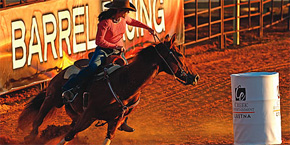 The order came in a case involving Gretna Racing, a tiny Northwest Florida track operated by the Poarch Creek Indians of Atmore that received the nation’s first pari-mutuel permit for rodeo-style “barrel racing.”
The state Division of Pari-mutuel Wagering spent two years crafting the rules aimed at reining in barrel races, which were stopped by a different administrative law judge in 2013.
Regulators in 2011 granted a pari-mutuel license to Gretna Racing for the rodeo-style barrel racing, which, in turn, allowed the facility to open a more-lucrative card room. An appeals court later ruled that the state erred in granting the barrel-racing license. After the ruling, the state and Gretna Racing entered an agreement authorizing “flag drop” races in which two riders compete against each other but without any obstacles in the arena.
The proposed rules, published last summer, set up standards for track shapes and sizes and established new requirements for jockeys, aimed at barrel racers — mostly women — affiliated with the Gretna track.
The North Florida Horsemen’s Association — which represents about 200 owners, trainers and riders in the barrel racing industry linked with the Gadsden County facility — challenged the rules, resulting in Friday’s order.
The association’s lawyer, Donna Blanton, had questioned a proposal that would require all races to begin from a starting box or gate, which would put an end to “flag drop” races. The rule would impose a “significant adverse economic impact” on the riders, owners and breeders, Blanton wrote in the 44-page complaint filed last year.
The rule is designed to “appease industry participants who seek to have quarter horse racing defined in such a way that supports their form of quarter horse racing to the exclusion of all others,” Blanton argued. “The satisfaction of special interests cannot serve as a logical basis for the track rule.”
The proposed rule also established that each race must have at least five entrants with a minimum of two contestants.
Quarter horse breeders, owners and trainers affiliated with other tracks have complained about the barrel-racing and flag-drop races, which have also set the stage for the Gadsden County to potentially begin operating slot machines.
Early ruled that state law gave the agency authority “specifically tailored to the adoption of standards for racetracks, race meets, and races.”
“Without the ability to set track and race standards, the legislative authority in (the statute) would have little purpose or meaning,” he wrote.
In contrast, state law does not give the agency — a division of the Department of Business and Professional Regulation — the power to craft rules pertaining to jockeys, Early wrote.
The proposed rule required that jockeys demonstrate riding ability, including switching the riding crop from one hand to another while maintaining control of the horse in a stretch drive.
The proposed rule also required jockeys to wear white pants, “unique racing colors,” and protective vests, helmets and boots “which have been specifically designed for horse racing when riding in races or when exercising horses.”
But nothing in state law gives the agency the authority for that rule, Early wrote. Instead, the statute regarding occupational licenses only deals with information necessary to establish “the identity and good moral character of an applicant for an occupational license,” he wrote.
Representatives of the North Florida Horsemen’s Association could not immediately be reached for comment Friday.
Friday’s order is the latest in a series of rulings about state gambling regulations.
Last month, Administrative Law Judge Robert E. Meale ruled that the Division of Pari-mutuel Wagering overstepped its authority with rules that would have placed additional requirements on jai alai operators.
David Romanik, a lawyer who is a part-owner of the Gretna track, questioned Early’s decision upholding the track rule.
Romanik said that “everybody will be able to comply” with the track regulation, but he didn’t rule out an appeal.
“It’s not really the end-of-the-world type stuff. It was really more a matter of principle that, for the first time ever, the division is now starting to dictate policy to management as to how to run a private business, which is what these tracks are,” he said.
Regulators are entitled to establish rules regarding wagering, drugging of animals and the integrity of jockeys, Romanik said.
“But how big your track is and how many horses should be in the race? What does the Division of Pari-mutuel Wagering know about that? They know nothing. That’s why they’ve never regulated it before,” he said. “To me, that’s the biggest error in this ruling — now allowing the division to start regulating into an area of someone else’s private business.”
The Florida Supreme Court, meanwhile, is poised to decide whether slot machines should be allowed at the Gretna track in a case that could have wide-reaching implications.
The Supreme Court accepted jurisdiction in the Gretna Racing case after a split appellate court ruled in October that Gretna Racing cannot have slot machines without the authorization of the Legislature, even though voters in the county approved slots in a referendum.
The Supreme Court’s decision also will likely affect gambling operations in at least five other counties — Brevard, Hamilton, Lee, Palm Beach and Washington — where voters have approved authorizing slots at local pari-mutuels.
Man Charged With Online Solicitation
January 30, 2016
Agents with the Florida Department of Law Enforcement, along with investigators from the Escambia and Okaloosa County sheriff’s offices today arrested William Burton Allen, 42, of 6774 Murphy Cassidy Road, Milton, on one count of computer pornography online solicitation of a parent, one count of transmitting harmful material to a minor and one count of unlawful use of a two way communications device.
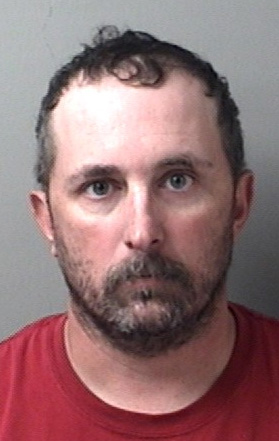 Allen was arrested after soliciting an undercover FDLE agent, who he believed was the mother of a 14-year old female juvenile, for sex. Allen had been communicating with the undercover agent by email and text messages since October 2015.
Anyone with information concerning this investigation is urged to contact the FDLE Pensacola Regional Operations Center at (800) 226-8574.
Allen is being held in the Escambia County Jail with bond. The case will be prosecuted by the Office of the State Attorney, 1st Judicial Circuit.
Cantonment Man Charged With Multiple Burglaries
January 29, 2016
A Cantonment man has been charged in connection with burglaries from Cantonment to Beulah.
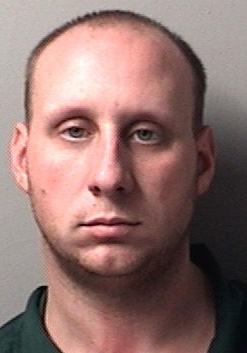 Jon Edward Berry, 29, remained in the Escambia County Jail with bond set at $15,000.
Berry was charged with grand theft and dealing in stolen property for allegedly stealing aluminum machinery components and industrial steel paper components from a business on Stone Boulevard in Cantonment. He then allegedly sold thousands of pounds of the components as scrap, receiving over $2,500 from two recycling businesses.
A search warrant was executed last week at Berry’s residence on Cottage Hill Road in reference to multiple burglaries that occurred on Huntington Creek Circle in Beulah. A boat and trailer stolen from Vantage Road was located the property, according to the Escambia County Sheriff’s Office. Barry was charged with grand theft for the boat and trailer valued at $20,000.
Berry was also charged with an additional count of grand theft after the search warrant turned up a whirlpool bathtub valued at $3,000 and light fixtures worth $2,500. The items were allegedly stolen from a home under construction on Huntington Creek Circle in Beulah.
Hecker Road Railroad Crossing Opens, Numerous Crossings To Close In February
January 29, 2016
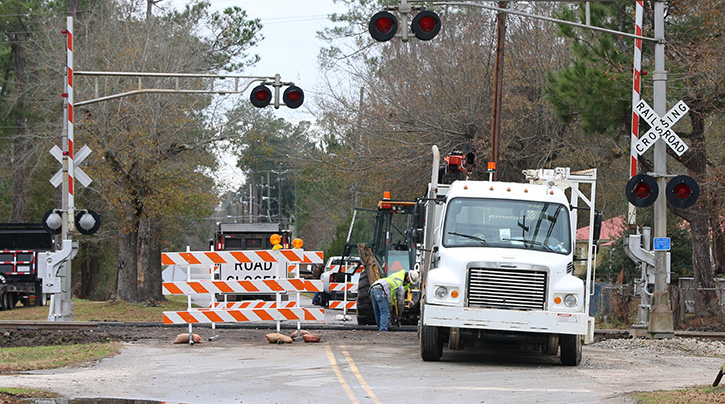
The Hecker Road railroad crossing in Century reopened Wednesday afternoon after a two-day closure for maintenance.
CSX will close numerous other North Escambia a crossing as part of its network-wide crossing maintenance program beginning February 9. Work is expected to be completed in one week.
CSX engineering crews will be laying new rail ties, resurfacing crossings and repaving them with asphalt. CSX has worked closely with local officials to coordinate the crossing closures to minimize disruption to the community and is communicating directly with residents where there are dead-end roads or no-outlet situations.
Traffic will experience temporary closures to the following road crossings during the operations period:
- Cottage Street
- McCurdy Road
- State Road 4
- Hecker Road
- Front Street
- East Pond Street
- Jefferson Avenue
- Salters Lake Road
- Bluff Springs Road
- Courtney Road
- Mystic Springs Road
- East Bogia Road
- Cotton Lake Road
The roads listed above will be temporarily closed at different times throughout the week of February 9 depending on the maintenance schedule, according to CSX.
All activities are weather dependent and may be delayed or rescheduled in the event of inclement weather. Motorists are reminded to travel with care through the work zone and to watch for construction equipment and workers entering and exiting the roadway.
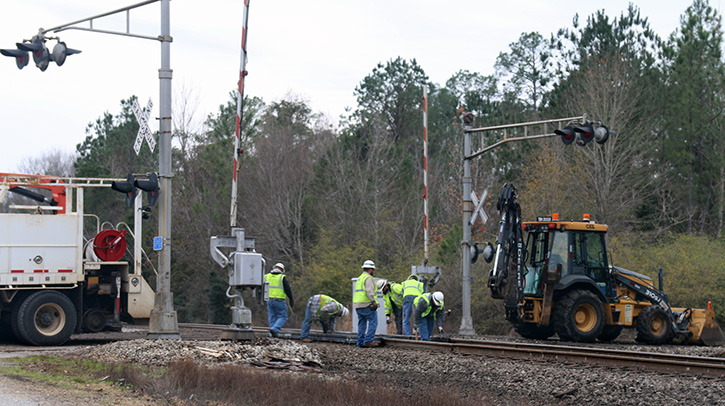
Pictured: Workers wrapped up a railroad crossing replacement on Hecker Road in Century on Thursday. NorthEscambia.com photos, click to enlarge.
FDOT Palm Trees Welcome Drivers To Florida And Century
January 29, 2016
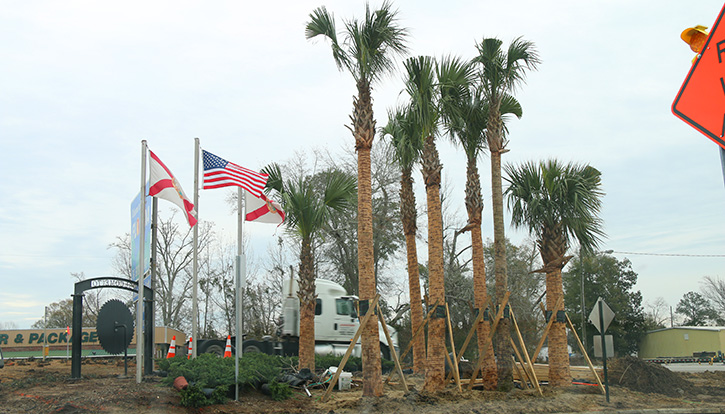
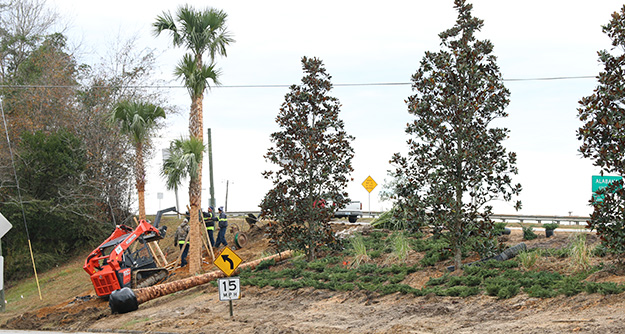
A Florida Department of Transportation Gateway Beautification project is underway in Century on Highway 29 at the Alabama/Florida state line. The project includes numerous palm trees and other plants. We’ll show you the final results when the project is complete. NorthEscambia.com photos, click to enlarge.
Graham Will Get Say On Poarch Creek Slots At Gretna
January 29, 2016
The Florida Supreme Court on Thursday said former Gov. and U.S. Sen. Bob Graham can file a friend-of-the-court brief to oppose the possibility of slot machines at a Gadsden County pari-mutuel facility operated by the Poarch Creek Indians of Atmore.
Graham, represented by former state lawmaker Dan Gelber, sought permission Wednesday to file a brief in a case in which Gretna Racing argues it should be allowed to offer slot machines.
The 1st District Court of Appeal in October sided with Gov. Rick Scott’s administration, which contends that slot machines would require legislative approval. Gadsden County voters in 2012 approved a referendum aimed at allowing slots, and Gretna Racing argues it should be allowed to offer the lucrative machines.
The filing Wednesday said Gretna Racing opposed Graham’s request to file a brief. The Wednesday document said Graham will argue, in part, that Gretna Racing’s interpretation of state law “contradicts the Florida Constitution’s prohibition against lotteries.”
The Supreme Court’s Gretna decision could have wide-ranging implications because voters in Brevard, Hamilton, Lee, Palm Beach and Washington counties also have approved referendums seeking to allow slot machines.
by The News Service of Florida
Senate Panel, Headed By Evers, Looks For Death Penalty Fixes
January 29, 2016
A Florida Senate panel chaired by Greg Evers heard Wednesday from prosecutors, judges, public defenders and experts about how to fix the death-penalty process after the U.S. Supreme Court struck down the state’s capital sentencing structure this month.
The Senate Criminal Justice Committee workshop focused on the impact of the decision, known as Hurst v. Florida, which found the state’s system of allowing judges — not juries — to impose the death penalty is unconstitutional.
Much of the testimony from defense lawyers, judges and prosecutors also dealt with issues related to but not explicitly addressed in the Jan. 12 ruling.
The 8-1 decision was centered on what are known as “aggravating” circumstances that must be found before defendants can be sentenced to death. A 2002 U.S. Supreme Court ruling, in a case known as Ring v. Arizona, requires that determination of such aggravating circumstances be made by juries, not judges.
Under Florida law, juries make recommendations regarding the death penalty, based on a review of aggravating and mitigating circumstances, but judges ultimately decide whether defendants should be put to death or sentenced to life in prison.
Florida law also does not require that the jury recommendations to impose death sentences be unanimous, making the state an “outlier” compared to others with capital punishment, Bob Dunham of the Washington, D.C.-based Death Penalty Information Center, told the committee.
While Florida only requires a simple majority recommendation from juries, Alabama and Delaware — the only other states that do not require unanimity — both require at least nine jurors to vote in favor of capital punishment.
Being so outside of the mainstream puts Florida at risk in a future Supreme Court ruling, Dunham said.
Nearly all of the speakers Wednesday recommended that the Legislature require unanimous verdicts in death penalty sentences, as is required for all other verdicts under state law.
Capital Collateral Counsel for the Southern Region Neal Dupree said the lack of unanimity is “disconcerting” in death sentences.
“We require a jury to be unanimous in every other aspect of law, why shouldn’t a unanimous jury be required in this instance?” said Dupree, whose state-backed agency represents Death Row inmates.
O.H. “Bill” Eaton, a retired Florida judge and death penalty expert, told the panel that requiring unanimous verdicts in death penalty sentences would require jurors to be more deliberative.
“When you have a unanimous verdict, everybody’s got to work and they’ve got to come to grips with a decision,” Eaton said.
But Brad King, the state attorney for the 5th Judicial Circuit, which includes Ocala, said unanimous verdicts should be required for decisions regarding aggravating circumstances but not for whether the death penalty should be imposed. King suggested that 9-3 decisions for sentencing would suffice.
Allowing one juror “with no qualifications” related to the death penalty to prevent a death sentence would “give them absolute control over what that sentence is,” King said.
“You allow them to control the entire process,” he said.
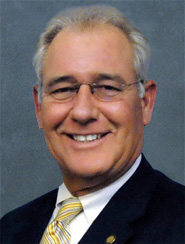 Evers, who represents the North Escambia area, assembled the speakers and asked them to make specific recommendations to the Legislature about how to fix the problem with the sentencing process.
Florida Solicitor General Allen Winsor, who works for Attorney General Pam Bondi and who argued the Hurst case before the U.S. Supreme Court last fall, told the committee that his office did not have any suggestions about how the state should respond.
“You’re really not going to give us any recommendations?” Evers said.
Under questioning from Senate Minority Leader Arthenia Joyner, Winsor remained reticent.
“What he’s going to do is he wants us to come up with the decision and then they’re going to work with us on it,” Evers, R-Baker, said.
Lawmakers are also grappling with whether the Hurst ruling should apply retroactively to already-sentenced Death Row inmates, something the U.S. Supreme Court did not address in its ruling.
Dupree is representing Cary Michael Lambrix, a Death Row inmate scheduled to be executed on Feb. 11. The Florida Supreme Court will hear oral arguments in the case, including the impact of the Hurst decision, on Tuesday.
Dupree said Florida lawmakers should follow their own example in a 1972 law passed in anticipation of a U.S. Supreme Court decision in a case known as Furman v. Georgia that resulted in a nationwide moratorium on the death penalty. The law, still on the books, required that all death sentences be reduced to life imprisonment if a U.S. Supreme Court decision finds that the state’s death penalty statute is unconstitutional.
Sen. David Simmons asked the panel whether the 1972 law would have to be applied in the wake of the Hurst ruling, but received mixed responses from the experts.
Evers said the Senate will pass “some type of death penalty reform” during the legislative session. After the meeting, he said he intends to propose a measure that will require juries to impose death sentences and that it will also address how many jurors must decide on the sentence.
“I can’t guarantee it will be unanimous, but the numbers will change,” Evers said. “We’re going to look at it to where we don’t have to come back here and we can put Florida’s death penalty to rest.”
by The News Service of Florida
Open Carry, Stand Your Ground Measures Headed To House Floor
January 29, 2016
Three gun-related measures — including an open-carry proposal and another that would change the burden of proof in the state’s “stand your ground” law — are headed to the House floor for a full vote.
A proposal that would let the nearly 1.5 million people in Florida with concealed-weapons licenses openly display firearms in public received a thumbs-up at its final committee stop on Thursday. Later in the day, the Senate passed two other gun measures, including the “stand your ground” proposal (SB 344).
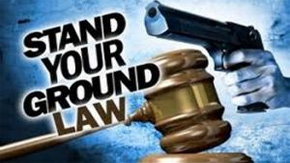 The House will take up the self-defense measure after it receives the bill from the Senate, House Speaker Steve Crisafulli’s spokesman Michael Williams said in an email Thursday. A House version failed on a tie committee vote in November.
The House Judiciary Committee approved the open-carry bill (HB 163) after rejecting an amendment with alternatives suggested by the Florida Sheriffs Association. Gun rights advocates argued the amendment wouldn’t stop people with concealed-carry licenses from being arrested for accidentally exposing a sidearm.
“To every extent that our citizens can take more responsibility for their own safety, we enhance the public safety of the collective society,” Rep. Matt Gaetz, a Fort Walton Beach Republican who sponsored the bill, told reporters after the meeting. “Of course, there are circumstances where people use firearms in a bad way, just like there are circumstances where people use other weapons in a bad way. I don’t think that’s the function of the law. I think that’s the function of the individual.”
Rep. Michelle Rehwinkel Vasilinda, a Tallahassee Democrat, joined Republicans on the committee in a 12-4 vote in favor of the proposal.
The committee tacked on an amendment that would require an openly carried gun to be in a holster, case or bag. The amended bill would also acknowledge that private employers can display written notices stating that possession of a firearm is prohibited.
The open-carry measure drew concerns from several lawmakers over its potential impact to tourism. Law enforcement officials are split on the proposal — the Florida Police Chiefs Association and some county sheriffs support it, while the Florida Sheriffs Association is opposed.
Lake Worth Democrat Rep. David Kerner argued that, with or without open-carry, concealed-weapon license holders can defend themselves now.
“Nobody wants this policy except a very small group of Floridians,” Rep. Dave Kerner, D-Lake Worth, said. “I don’t think we should jeopardize the image and safety of our state and law enforcement officers to appease a theory of constitutional law that is not accurate.”
Kerner, a former police officer, attempted to include language proposed by the Florida Sheriffs Association that would define measures for law enforcement when a concealed-weapons license holder inadvertently displays a sidearm.
But influential National Rifle Association lobbyist Marion Hammer dismissed concerns about the bill as “creative hyperbole.”
“Most license holders will never carry openly,” Hammer said. “But if they do they won’t cause a problem. And how do I know that? Because if they cause problems, they will lose their license and then they can’t carry concealed or openly.”
A Senate companion (SB 300) is awaiting a hearing by the Senate Judiciary Committee, where amendments similar to Kerner’s are expected.
The Senate, meanwhile, on Thursday sent a pair of gun-related bills to the House.
By a 24-12 vote, the Senate signed off on a measure (SB 344) that would alter the burden of proof in “stand your ground” self-defense cases.
Democrats contend the proposal will put an end to cases before all of the facts are fully revealed.
“It potentially stops an investigation cold after the last man standing tells his side of the story,” said Senate Minority Leader Arthenia Joyner of Tampa. “The dead do not have the opportunity to rebut the tale told by the survivor. In cases where there are no witnesses, this bill stacks the deck against the justice for the dead.”
The bill stems from a Supreme Court ruling last year that said defendants have the burden of proof of showing they should be shielded from prosecution under the “stand your ground” law. In “stand your ground” cases, pre-trial evidentiary hearings are held to determine whether defendants should be immune from prosecution. The measure, sponsored by Sen. Rob Bradley, would place the burden of proof on prosecutors in the evidentiary hearings.
Bradley, a former prosecutor, said the “fundamental tenet” of the criminal-justice system is that the state has the burden of proof in criminal proceedings.
“I think it’s simply incorrect to suggest that this bill will result in an otherwise guilty individual going free,” Bradley, R-Fleming Island, said. “If the state has sufficient evidence to successfully prosecute a defendant in a jury trial, the state will prevail in the immunity hearing before a judge and the judge will permit the case to go to trial.”
But Democrats argued that the measure would increase the likelihood of a repeat of the 2012 death of Trayvon Martin, a black 17-year-old who was shot by neighborhood-watch volunteer George Zimmerman in Sanford.
Zimmerman, who claimed he shot the teen in self defense, was not immediately charged. A jury later acquitted him of second-degree murder charges.
“We talk about the shifting of burden from the defendant on to the state. All I can do is think about how that (Zimmerman) trial played out and what I felt like when that jury verdict came down,” said Sen. Dwight Bullard, a Miami Democrat who is black.
Although the House version of the proposal (HB 169) failed on a tie vote in its only committee vetting last year, Williams said “the House will take up the (Senate) bill for consideration” when it receives the bill.
The Senate unanimously passed a second measure (SB 130) — dubbed the “backyard range” bill — intended to restrict the recreational discharge of a firearm in certain residential areas.
The measure prohibits the recreational discharge of a firearm outdoors, including for target shooting or celebratory shooting, in primarily residential areas with a density of one or more dwelling units per acre. A violation would be a first-degree misdemeanor punishable by up to a year in jail and a $1,000 fine.
A staff analysis of the bill pointed to reports about people constructing gun ranges in their backyards, with neighbors being concerned for safety. Law enforcement officials complained that they were hamstrung because their lawyers found the state statute barring “recklessly or negligently” discharging a firearm to be “subjective and vague.”
by Jim Turner, The News Service of Florida