

Hayward Elected Pensacola Mayor; Complete City Council Results
November 3, 2010
Ashton Hayward has been elected as Pensacola’s first strong Mayor.
Mike Wiggins has conceded the race as unofficial results show him behind by just a few hundred votes in a very close race.
Unofficial results:
MAYOR PENSACOLA
Ashton Hayward 10,508 51.94 %
Mike Wiggins 9,723 48.06 %
CITY COUNCIL DISTRICT 1
P.C. Wu 2,358 75.89 %
Steve Fulford 749 24.11 %
CITY COUNCIL DISTRICT 2
Sherri Myers 1,110 51.58 %
Courtney B. Peterson 1,042 48.42 %
CITY COUNCIL DISTRICT 6
Brian Spencer 1,248 53.63 %
Jewel Cannada-Wynn 1,079 46.37 %
Evers Takes Senate District 2, Defeats Tea Party Candidate
November 3, 2010
Republican Greg Evers is celebrating victory tonight in the race for Senate District 23.
Evers, R-Baker, had 80 percent of the vote to 20 percent for Tea Party candidate Christopher Crawford in early returns.
“I am humbled and honored that the voters of Senate District 2 have chosen me to represent them in the Florida Senate,” said Evers, who celebrated his victory with a small group of family and friends. “I am a pro-life, conservative farmer and small businessman who has been endorsed by the NRA; and I ran for Senate District 2 because, like many voters in Northwest Florida, I’m concerned with the direction our country and state are headed.”
“Now that I have been elected, I will take the issues I campaigned on straight to the state’s Capitol and ensure Northwest Florida has a strong voice in the Florida Senate,” said Evers. “I am committed to fulfilling the promises I made while on the campaign trail – from fighting to take back our state from out-of-control Washington insiders, to focusing on building strong families, to getting our neighbors back to work and our economy back on track, to implementing Arizona-style immigration reform and fighting to defeat Obamacare.”
“I could not have achieved this victory tonight without the support of voters across Northwest Florida, and I look forward to serving them proudly in the Florida Legislature,” concluded Evers.
Senate District 2 consists of Holmes and Washington, and parts of Escambia, Santa Rosa, Bay, Okaloosa, and Walton Counties. The seat was previously held by Senator Durrell Peaden, Jr., MD, who was term-limited out.
Evers had served Florida House District 1 since 2001.
Charlie Crist Sees Career Halted On GOP’s Night
November 3, 2010
Gov. Charlie Crist picked the wrong election year to leave the Republican Party.
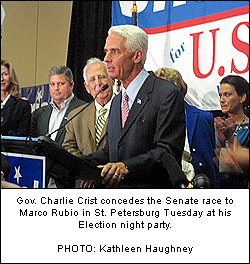 Crist walked into a ballroom Tuesday night at the Vinoy Renaissance, a swanky hotel in his hometown of St. Petersburg, and conceded defeat in the U.S. Senate race to Republican Marco Rubio, doing what seemed unthinkable just a couple of years ago -putting a stop, at least for now, to what seemed to be a meteoric political rise.
Of course, few thought Crist wouldn’t be a Republican either.
Crist thanked his wife Carole, his parents and his sisters. And he thanked his supporters.
“I also want you to know from the bottom of my heart it has been the greatest honor of my public life to serve as your governor,” he told backers.
It was far different from the scene four years ago, when Crist, buoyed by cheering crowds and adoring supporters throughout the state, won the governor’s office over Democrat Jim Davis. The term political rock star was thrown around and Crist was talked of as a future presidential contender. He was also vetted as a possible running mate for Republican presidential candidate John McCain.
Tuesday night, he was the odd man out, watching from outside the Republican Party he once headed as it celebrated its biggest election night in more than a decade. And he watched Rubio win a Senate seat that early on seemed Crist’s to take.
“More than anything, Crist proves the axiom that timing and opportunity are the most important variables,” said Democratic strategist Steve Schale, who ran President Barack Obama’s Florida operation in 2008. “Virtually any other cycle, Crist would be punching his ticket to the Senate. He just ran into a buzz saw in 2010.”
Crist started as the easy favorite. When he jumped in, Republican leaders tried to clear the field for him.
But Rubio persisted, catching the attention of the Tea Party movement and county Republican parties. He went to all the small grassroots events and slowly his numbers began to rise. By the spring, Crist saw his campaign struggling to reach Republican voters. His popularity seemed to lie more with Democrats and moderates.
When it looked like he could lose the GOP primary to Rubio, he left the Republican Party to run as an independent and his cross party popularity showed as his poll numbers catapulted him past Rubio and Democratic candidate Kendrick Meek. Early in the summer, it looked like Crist would triumph over his former party. Then it fell apart.
As Crist moved away from his Republican roots, and enthusiasm grew among conservatives, Rubio rode a growing national star. And Crist’s numbers tumbled.
Crist – always thought of as having an incredibly keen sense of political timing – either missed what was developing, or suddenly became less interested in winning after a lifetime of having a knack for it. In what clearly was stacking up as a Republican year, Crist was courting Democrats and moderates. His strategy – and at least for now his career – came to a halt Tuesday night.
“This was the wrong year,” for a “raging moderate” like Crist said former Sen. Dave Aronberg, a Democrat who also lost this year in the primary for attorney general.
“I thought he had the highest political skill of anyone I ever met,” Aronberg said. “His major miscalculation was he underestimated the rise of the right wing of the Republican Party and the tea party.”
The question now is whether Crist’s quixotic independent Senate run was his swan song or whether he’ll reinvent himself. He could turn to the private sector and run a foundation like his predecessor Gov. Jeb Bush. He’d likely be a welcome visiting professor at university political science departments.
Or, he could sit back and wait for an opportune moment to jump back in the political arena. In 1998, former Gov. Bob Graham trounced Crist in the U.S. Senate race. Afterward, Bush appointed him to be a deputy secretary at the Department of Business and Professional Regulation. Crist bided his time and in 2000 won a special election for Education Commissioner’s race, then an elected position. He followed it up with a win in the 2004 attorney general’s race and then the governor’s race in 2006. Some have suggested he may be interested in the Tampa Bay area U.S. House seat now held by U.S. Rep. Bill Young.
“For Crist, with his universal name ID, the question isn’t if he can make a comeback, but when his ambition and political opportunity line up,” Schale said.
Crist was brief in his public remarks Tuesday night and left no hint as to what he might do in the future. He exited the stage, shaking hands and hugging friends. Crist, who has rarely been unwilling to go before the press, didn’t take any questions.
By Kathleen Haughney
The News Service Florida
Broxson Easily Wins House District 1 Race
November 3, 2010
In the District 1 Florida House race to succeed Greg Evers, Republican Doug Broxson easily defeated Mathias Venditto with more than 85 percent of the vote.
The district covers portions of Escambia, Santa Rosa and Okaloosa counties, including the northern two-thirds of Escambia and Santa Rosa.
Venditto, 30, ran with no party affiliation.
Escambia, Alabama Election Results: Wins For Smith, White, Quarker, Jackson, Digmon
November 3, 2010
Here are complete but unofficial results from Escambia County, Alabama:
SHERIFF
Grover Smith 6531
Heath Jackson 4203
Read more about the sheriff’s race…click here.
COUNTY COMMISSION DISTRICT 3
Larry White 1533
Buster Crapps 824
COUNTY COMMISSION DISTRICT 5
David Allen Quarker Sr. 1186
Don “Viking” Ellestad 304
SCHOOL BOARD, DISTRICT 4
Cindy Jackson 1025
Stephanie Agerton 965
SCHOOL BOARD, DISTRICT 6
Sherry Digmon 850
Cereal Daniel 807
Flomaton Mayor Declines Plan To Rename Hwy 113 In His Honor
November 3, 2010
Flomaton’s mayor has declined an Alabama plan to name a portion of Highway 113 in his honor.
A ceremony was planned for next Tuesday to name Highway 113 from Flomaton to I-65 the “Dewey J. Bondurant, Jr. Highway”. The Alabama Legislature approved the name in Bondurant’s honor earlier this year with the passage of a bill sponsored by Sen. Marc M. Keahey.
But the ceremony has been canceled, according to Rebecca White, public information specialist for the Alabama Department of Transportation.
“The mayor felt like there were a lot of people in that area that were responsible for getting the highway widened,” said White. “The mayor felt like it was not right to name it just after him.”
The four-laning of the 13.5 mile stretch of Highway 113 was a joint project between several agencies in Alabama as well as Escambia County, Florida, which provided $4 million toward the $22.7 million project. Representatives from Alabama and Florida, including Bondurant, worked more than four decades on the project.
 “I’ve never met anyone any better than Dewey,” Alabama Gov. Bob Riley said at the November 2008 ribbon cutting for the widened highway. “He came in and not only put together a plan that would work, then…he went out and secured the funds that made this a reality. This would not have happened without the mayor. The mayor’s leadership on this was just exemplary.”
Florida and Alabama agreed back in 1967 to four-lane roads on both side of the state line for an evacuation route. Florida finished their part along Highway 29 by 1990, but Alabama did nothing more after acquiring right-of-way back in the 1970’s.
“Mayor Dewey J. Bondurant, Jr., of Flomaton worked tirelessly to see this project come to fruition; the project would not have been possible without his hard work and dedication; he is to be commended for seeing this effort through to conclusion,” stated the bill passed by the Alabama Legislature.
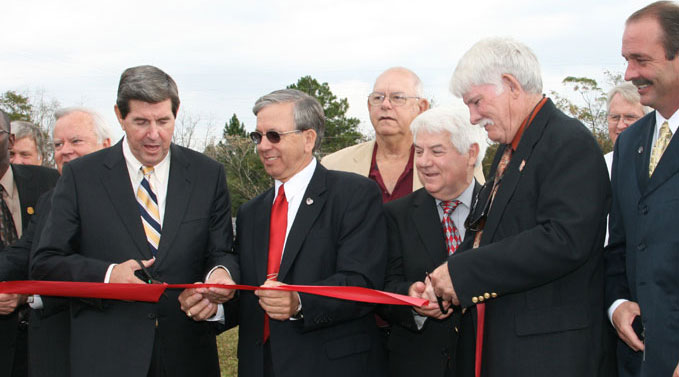
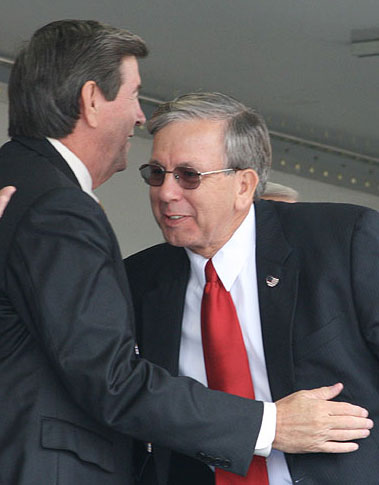
Pictured top: Alabama Gov. Bob Riley (left) and Flomaton Mayor Dewey Bondurant (second from left) cut the ribbon on the newly widened Highway 113 in November, 2008 as dignitaries from Alabama and Florida look on. Pictured inset: Gov. Riley thanks Bondurant for his work on the Highway 113 project. NorthEscambia.com file photos, click to enlarge.
Amendments 5 And 6 Poised To Pass
November 3, 2010
A pair of constitutional amendments meant by backers to take some of the politics out of drawing legislative and congressional districts appeared headed for approval early Wednesday morning.
The proposals – aimed at keeping parties from drawing districts to favor themselves or particular legislators – looked likely to be one of the few dark spots for Republicans on an otherwise GOP night across the nation. Republicans are in power and set to draw the districts for the Legislature and Congress in 2012, and fought hard against the two proposals, Amendment 5 and Amendment 6.
The amendments were the culmination of efforts to limit the influence of politics on the drawing of the boundaries by a group called Fair Districts Florida. The measures survived constitutional challenges and a competing legislative proposal that was struck down by the courts.
Amendments 5 and 6, which early Wednesday morning were on course to reach the 60 percent. With more than 92 percent of precincts reporting, Amendment 5 had the support of 62.5 percent of voters. Amendment 6 was supported by 62.8 percent of voters, according to the Division of Elections figures.
The measures – one covering legislative districts and the other congressional – would require that voting districts be compact, contiguous and respect city and county boundaries when possible. The proposals’ thorniest provisions would prohibit line drawers from favoring incumbent politicians or political parties, a perk the majority party has enjoyed for generations.
Fair Districts spent nearly $9 million to promote the amendments. The measure’s major contributors were Democratic-allied groups, including the Florida Education Association, the National Education Association, and the Service Employees International Union. Supporters also include AARP, the Florida League of Women Voters and the state NAACP.
Opponents were led by state Republican lawmakers who called the plan unworkable and said it would dilute minority access to state and federal office by prohibiting districts from being drawn to ensure minority representation.
Such access districts were created during redistricting in 1992 and 2002 to create voting districts with as many black Democrats as possible. The changes helped clear the way for Florida to elect its first minority representatives in Congress since shortly after the Civil War, while also increasing the small number then serving in the Legislature.
But such minority-packed districts also reduced the Democratic population in surrounding areas. That allowed Florida Republicans to flourish and in 1996 win control of the Legislature for the first time in 122 years. Redistricting in 2002 only solidified the GOP’s grip on legislative power.
The Florida NAACP and most black Democratic lawmakers have rejected Republican claims that the changes would hurt minorities, saying federal protections are unaffected.
By Michael Peltier
The News Service Florida
Putnam Wins Ag Commissioner
November 3, 2010
Congressman Adam Putnam’s win in the agriculture commissioner’s race Tuesday gave Republicans a sweep of the three Cabinet seats, though they awaited a razor-thin governor’s race to know whether the governor would also be on their side.
Putnam defeated Democrat Scott Maddox. With most precincts in the state reporting, Putnam had a comfortable lead with 2.7 million votes, 58 percent, to Maddox’ 1.7 million votes, or 37 percent.
Joining Putnam on the all-GOP Cabinet will be Attorney General Pam Bondi, who defeated Democrat Dan Gelber, and Chief Financial Officer Jeff Atwater, who beat Democrat Loranne Ausley. The Cabinet meets with the governor, who isn’t technically part of the body.
“Agriculture is more than a traditional base of our economy, it is a vital and dynamic part of Florida’s bright future,” Putnam said in a statement. “Fostering these new employment opportunities, stewarding our state’s resources and protecting Floridians from those who would prey on them will by my daily focus.”
Putnam, of Bartow, served five two-year terms in Congress representing most of Polk County and part of Hillsborough. While serving in the U.S. House of Representatives, he became chairman of the Republican Conference, the chamber’s third highest Republican post.
Putnam was elected to the House in 2000 following a four-year stint in the Florida House, to which he was elected in 1996 at the age of 22.
A fifth generation Floridian, Putnam’s family runs citrus and cattle operations in Polk County.
He replaces Charlie Bronson, a Republican, who is retiring.
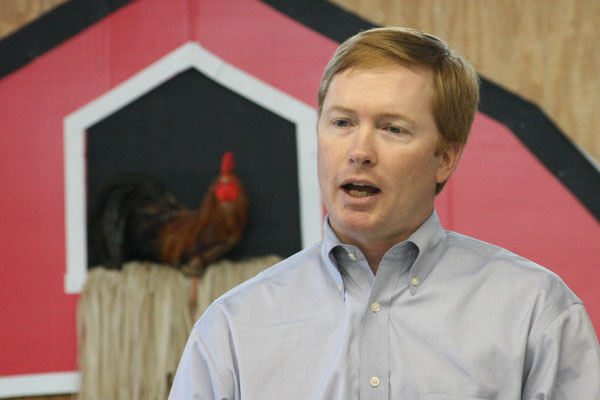
Pictured: Adam Putnam campaigns for Florida’s agriculture commissioner in April, 2009 at Fran’s Country Grill in Molino. NorthEscambia.com file photo, click to enlarge.
Republicans Pick Up Seats In Fla. House, Senate
November 3, 2010
he national Republican wave filtered down Tuesday to the Florida Legislature, where Republicans ousted at least five incumbent Democrats in the House picked up two more seats in the Senate to give them their largest modern majority in that chamber.
Republicans were poised to have 81 of the 120 House seats and in the Senate won two open seats that had been held by Democrats, one in the Tampa Bay area and one in South Florida, giving them a 28-12 majority in the upper chamber.
The gains give the Republicans a veto-proof majority in both chambers, should there be a bright spot for Democrats. In the governor’s race, Democrat Alex Sink could still win – with several votes yet to be counted the race remained too close to call late into the night.
The Senate’s Republican majority is shaping up as the largest by either party since Democrats held a 30-10 advantage over the GOP in 1986. In the House, Republicans held 85 seats in 2006, before Democrats made gains that fall and in 2008.
Two returning members led the way, as former Sen. Jack Latvala retook for Republicans the Tampa Bay area seat held by Democrat Charlie Justice, who was leaving to run for Congress. Latvala defeated Nina Hayden to put the Pinellas County seat back in GOP hands.
Former Rep. Gayle Harrell ousted freshman Adam Fetterman, D-Port St. Lucie, to lead a wave of GOP challengers into the House. Other Democratic House incumbents who were ousted were Rep. Debbie Boyd, D-Newberry, Rep. Janet Long, D-Seminole, Rep. Bill Heller, D-St. Petersburg, and Rep. Keith Fitzgerald, D-Sarasota.
The other Senate seat flipped by Democrats was the South Florida seat left open by Dave Aronberg, who quit for an unsuccessful bid for attorney general. Republican Lizbeth Benacquisto won the seat, defeating Democrat Kevin Rader.
As Republican legislative leaders looked at their broadening majority, they were already discussing a veto override session in mid-November to undo some of Gov. Charlie Crist’s vetoes from earlier in the year.
“Tonight’s successes demonstrate the strength of our slate of Republican members and candidates and highlight the fact that Republican values of lower taxes, less spending and limited government continue to resonate with voters across the Sunshine State,” House Speaker-Designate Dean Cannon said Tuesday night. “I look forward to joining our returning members as well as our more than 30 new Republican members as we work to cultivate a fertile economic environment by shrinking the size and scope of government, empowering the individual, and promoting the family.”
Boyd was defeated in House District 11 by Elizabeth Porter in a rematch of a close race in 2008. Long was defeated in House District 51 by Larry Ahern. Jeff Brandes defeated Heller in House District 52, while Ray Pilon beat Fitzgerald in House District 69.
Democrats also failed to win in seats where they had pinned some hopes of bucking what they knew would be a Republican trending night. The party had talked up Katie Edwards as a strong candidate to flip House District 119, which had been held by Republican Juan Zapata. But Edwards was defeated by Republican Frank Artiles.
Democrats had also hoped to unseat Rep. Chris Dorworth, R-Lake Mary, in a race in which a Tea Party candidate was also on the ballot. But Dorworth was easily on his way to defeating Democrat Steve Barnes and John DeVries, the tea party candidate.
In the Senate, Republicans held on to two targeted seats, with Sen. Steve Oelrich, D-Alachua, turning back a challenge from Democrat Perry McGriff, and Republican Party Chairman John Thrasher winning his northeast Florida Senate seat against a challenge by Democrat Deborah Gianoulis. Republicans also appeared set to keep control of the South Florida seat being vacated by Senate President Jeff Atwater, with Rep. Ellyn Bogdanoff appearing headed for victory.
By David Royse
The News Service Florida
Pam Bondi Wins AG Spot
November 3, 2010
Former Tampa-area prosecutor Pam Bondi is Florida’s new attorney general, defeating Democratic state Sen. Dan Gelber Tuesday in the race to be the state’s top lawyer.
Bondi, who stepped down as a Hillsborough county prosecutor after nearly 18 years, swept past Gelber in the general election, touting her opponent as the ultimate insider, a death knell in an anti-incumbent and anti-Democrat year.
She also got a boost from outgoing Attorney General Bill McCollum, who led the lawsuit against President Obama’s health care overhaul. Bondi fervently supported the lawsuit and talked it up at every campaign stop, earning her the immediate support of Republican-friendly groups including the Florida Chamber of Commerce and the Associated Industries of Florida.
“As your attorney general, I pledge to make you and your family safer, our neighborhoods more secure, and I will be a vigilant watchdog for our taxpayers,” said Bondi, in a speech to supporters who watched results with her at the Pepin Hospitality Center in Tampa. “And I vow to stand up to a federal government health care takeover.”
The big Republican embrace of Bondi pumped cash into the candidate’s campaign account, allowing her to mount an aggressive television campaign. In TV commercials, she pushed hard against Gelber’s votes as a House and Senate member, particularly a vote for a now repealed measure, called the “Scarlet Letter” law, which required women to publish their sexual histories if they put a child up for adoption and did not identify the child’s father.
For weeks, polls had been giving Bondi the edge over Gelber in the race to replace Attorney General Bill McCollum, though there was still a rather large contingent of undecided voters because the race received less attention than some other races in the state, such as senate or governor. She ultimately claimed victory by a margin of 56 percent to 40 percent.
Bondi’s victory was immediately praised by Republican supporters who campaigned on her behalf.
“We need a strong Republican in this position to continue the federal health care lawsuit and ensure our Constitutional rights are upheld,” said incoming Senate President Mike Haridopolos.
Gelber, a state senator and former House minority leader, called Bondi to congratulate her and in a two minute speech to supporters in Miami, recounted the last few days of the campaign, comparing it to a “dysfunctional family vacation.” The political winds were not in his favor he admitted, but said he believes Bondi will do “just fine” in her new job.
“I want her to do well,” he said. “Because frankly, if she does well, Florida does well. And that’s something we should all understand very deeply.”
By Kathleen Haughney
The News Service Florida