WILD BILL McCOY
Return to the Interesting Facts Page
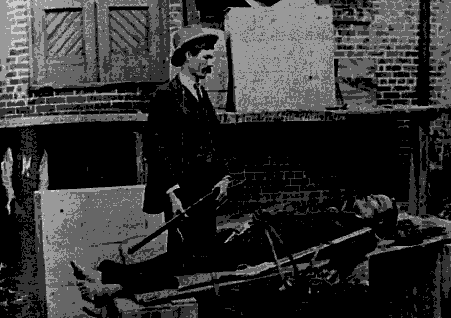
Above: This is a picture of Wild Bill McCoy dead after being killed for shooting and killing Sheriff McMillan
"Bill McCoy is one of the most colorful and enigmatic characters of our area's history. Sometime we'd like to do a whole book about him, but that would take more research. We have newspaper clippings telling his story. Some are written by people who fought against him or by people who worked with him. Some rely on hearsay. These date from the 1890's, the 1920's, 1930's, and on to 1980. Nobody knows Bill McCoy's true identity" (Pictorial History Book by Collier and Fischer).
Bill lived peaceably in Teaspoon, which was later known as Century. He picked up the nickname "Railroad" because he claimed to have once worked for the railroad. He also claimed to have worked in the circus for seven years and performed magic tricks and acrobatics as proof. At the time he first gained notice, he was employed in the turpentine business at Bluff Springs. The particular characteristic that got him noticed by the law was that he always carried a Winchester rifle, frequently stuffed down his pants leg, giving him a slight limp. Moving from tree to tree, chipping bark and dipping pine sap, he always had that rifle.
There was a state law in Florida that required anyone who carried a rifle to have a permit. Deputy Allen Brewton pointed this out to Bill. Bill replied that he didn't think it was necessary and walked away. This sort of behavior, "uppity", as they used to say, was very shocking and the Deputy let him walk away. Another day came and Deputy Brewton set about to sell a license or collect that rifle. As Bill once again simply walked away, the Deputy and his companions opened fire on Bill and missed. Bill turned and shot the ear off one man and made his escape into the woods. That day in 1892 was the beginning of a career of crime for Railroad Bill.
Bill earned his living robbing trains, mostly. Sometimes he would rob a store or hold up an individual. It is likely many thefts were arbitrarily assigned to him. Booty would be sold at bargain prices or given to poor blacks and whites in his area of operation. Sometimes goods were just thrown off of moving trains for anyone to take. He allowed and encouraged superstitious notions to be added to his reputation. He never trusted anyone. To some degree he was respected by the poor folks. Respect was tempered by fear of physical or spiritual retribution. Nobody messed with Bill.
The railroad had tried. From Mobile to Brewton, Pine Barren to Castleberry, L&N detectives tracked him and laid traps for him. On the few occasions he was caught, he always produced one more gun and made his escape. The newspapers had a field day. You have to understand that the railroad was held in low esteem in those days. Then one day in 1895, he shot Sheriff E. S. McMillan.
Following a lead, McMillan and his deputies headed toward Bluff Springs. They failed to heed a warning from their informant , and Bill was ready for them. After Bill's second shot pierced the Sheriff's heart, the deputies answered with a hail of lead, felling Bill. As it was dark and Sheriff McMillan needed attention, Bill's body was left for the morning. When the new day came, there was no body. Brewton canceled its Fourth of July festivities to mourn the death of the popular sheriff.
Killing the sheriff diminished Bill's popularity with the common folk. He still got his way, though, because of the fear. Bill continued to rob trains and stores. It was not until March 7, 1897 that Bill's career would end.
Private detectives, rail detectives, lawmen, and citizens were after Bill, or at least the $1250 reward on his head. A posse was taking a break in the store of Tidmore and Eard in Atmore when a lone, black man with a slight limp walked through to the counter. Nobody paid him much attention except the storekeeper who recognized him as Railroad Bill. After Bill's last visit, the storekeeper placed a double barrel shotgun within reach so that he might win that reward. He was so afraid of Bill that he didn't go for the gun. Bill sat himself on a barrel and proceeded to snack on crackers and cheese, the posse continuing their conversations just across the room.
Leonard McGowin had recognized Bill going into the store. Again, Bill's reputation, the legend that he could only be killed by a silver bullet, his known ability with a gun, caused McGowin to hesitate. McGowin went around to a side door and fired his rifle from outside, issuing a fatal wound. On the way down, Bill went for his gun, but was hit again by a shotgun blast from the storekeeper. It took the startled posse a moment to figure out what was going on and then they opened fire on the corpse.
Railroad Bill's body was strapped to a board. His guns were placed on his person and he was placed on public display. In every "colored waiting room", in every major depot, from Atmore and Brewton to Montgomery, citizens were given the chance to pay 25 or 50 cents to view the remains or have their pictures taken with the notorious outlaw. The photo here of Leonard McGowin standing over the body, was widely sold for 50 cents by a company in Brewton. The body was buried in an unmarked grave in Pensacola. (A Pictorial History)